
Once called Turkey Hills, a hilltop farm town that gave up Fitchburg in 1764, sent its families north to settle New Hampshire, printed Bibles in the 1830s and spent its summers at Whalom Park.
Lunenburg, Massachusetts on the map
Click the map to look closer.
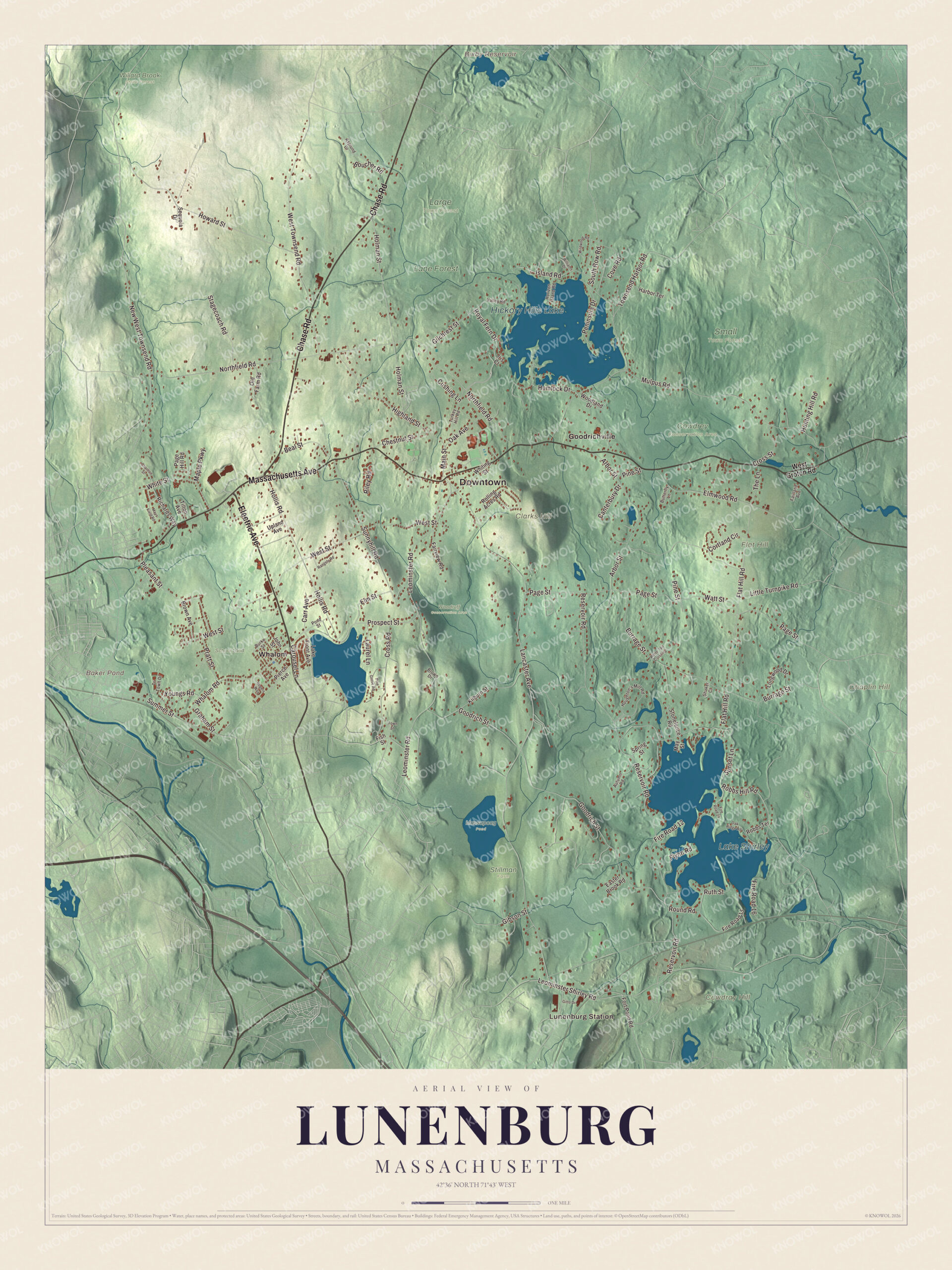
Lunenburg today
By KNOWOL
Shaded hills with Clarks Hill, Chaplin Hill and Cowdray Hill, Lake Shirley, Hickory Hills Lake and Baker Pond, and Massachusetts Avenue, Electric Avenue, Chase Road and Main Street crossing town.5
The history of Lunenburg, Massachusetts
Turkey Hills and the first families
Before it was Lunenburg, this upland was Turkey Hills, named, an 1883 book says, for the wild turkeys on its hills. Samuel Page of Groton was already clearing a farm here when the General Court's committee came in 1719, and the 1889 county history calls him the Selkirk of the wilderness. In May 1725 the settlers wrote the lieutenant governor that nine families were posted in five garrisons, all willing to stand their ground. By the next March, 26 houses were raised and ten were lived in. Widow Jane Boynton came about then with fourteen living children. Lunenburg was incorporated in 1728, and its families kept moving north. The same history says two-thirds of early Rindge, New Hampshire, descended from them.6783
Bibles, books and palm-leaf hats
Little water flows through Lunenburg, and its streams are small, but in the 1830s its village was busy with books. George Boutwell, a store boy here from 1830 to 1834, remembered Col. Edmund Cushing printing Bibles, spelling-books and dictionaries on hand presses and sending them to Boston by team. William Greenough and Sons set up stereotyping on the Lancaster road, and Alvah Crocker, who later championed the Fitchburg Railroad, came over with a one-horse wagon to cart off the bindery's paper shavings. The 1879 county history counts 16,000 volumes printed and bound in 1837, and 90,000 straw hats. Women had long braided straw for hats and bonnets, and by Boutwell's day palm leaf had taken its place. He earned pocket money stripping the leaves at ten cents a hundred.9102
Summer at Whalom
The lake at Whalom once carried a mouthful of a name. A record of 1713 spells it Unkachewalwick, later writers tried Unkechewalom and Chualoom, and by 1889 the county history noted that people spoke only the last two syllables. George Boutwell, who grew up on a hillside farm near it in the 1820s, remembered a body of clear, deep spring water. In 1893 the Fitchburg and Leominster Street Railway opened Whalom Park on the shore. By 1912 it had a hotel, a dance hall, a deer park, a bear cage, a roller coaster and a steamer on the lake, plus an open-air theatre that began in 1898 with folding chairs on a slope and grew to seat close to 3,000. The park closed in 2000, and apartments on Carousel Lane stand there now.1112135
Lunenburg, Massachusetts through the years
25 moments from 1718 to today.
- 1718Samuel Page of Groton is clearing a farm at Turkey Hills, the first settler.7
- 1719The General Court grants South Town, the land of today's Lunenburg, Fitchburg and part of Ashby.8
- 1725Nine families are living in five garrison houses at Turkey Hills.8
- 1726Settlers report 26 houses raised and ten of them lived in.8
- 1728Lunenburg is incorporated on August 1, named for a title of King George II.8
- 1729Philip Goodridge dies, and his gravestone calls him the first man buried here.7
- 1731Worcester County is formed, with Lunenburg its thirteenth and youngest town.14
- 1733A road is cut 42 miles through the woods from Lunenburg to Northfield.15
- 1752After 43 recorded votes in three years, the town meets in its second meetinghouse.16
- 1764Fitchburg, more than half the old township, becomes a town of its own.17
- 1772John Hancock gives the church a Bible.18
- 1775Sixty men march from Lunenburg on April 20 under Capt. George Kimball.19
- 1776The militia company plants a buttonwood tree on the Common on July 4.20
- 1830The First Parish dedicates a new meetinghouse on Christmas Day.21
- 1833Stars fall all night in November, and the town butcher stays home, sure it's Judgment Day.22
- 1837Lunenburg prints and binds 16,000 books and makes 90,000 straw hats.2
- 1848The Farmers' Club is formed, the only one in the state, says the 1879 county history.23
- 1861On April 22 a bald eagle circles the new flag in front of the town house.24
- 1867The town buys the 1830 meetinghouse, moves it about 70 yards north and makes it the town hall.21
- 1875Luther Burbank sells the rights to the potato he bred here and heads for California.5
- 1876Fitchburg's mayor asks Lunenburg to join the city as its 7th ward.25
- 1893The street railway opens Whalom Park on Lake Whalom.5
- 1898Whalom's open-air theatre opens, with folding chairs on a slope.13
- 1926Water fills the new Dickinson Reservoir, today's Hickory Hills Lake.5
- 2000Whalom Park closes after 107 seasons.5
Places to see in Lunenburg, Massachusetts
Places worth a visit in Lunenburg today.
- Main StreetTown center. Heart of the Lunenburg Historic District.
- Massachusetts AvenueShirley line to Fitchburg line. Route 2A through the town center.
- Clarks HillSouth of the center. Also called Turkey Hill in 1879.
- Lake WhalomLeominster line. The Unkechewalom of the old records.
- Whalom ParkCarousel Lane, by Lake Whalom. Trolley park site, 1893 to 2000.
- Lake ShirleyShirley line. Once Catacunemaug pond, then Shirley reservoir.
- Hickory Hills LakeOn Mulpus Brook. Private lake flooded in 1926.
- GoodrichvilleVillage. Site of an early garrison house.
- Lunenburg StationVillage. Village named for its rail stop.
Lunenburg on the National Register of Historic Places
All 1 places in Lunenburg on the National Register of Historic Places that still stand today, oldest first, and why each one matters.4
-
Lunenburg Historic District
The historic center of town, laid out on high ground known as Turkey Hill, with 77 historic buildings on 102 acres. They include the Cushing House of about 1724, the Stillman Stone House of about 1730, an 1835 brick schoolhouse and a town hall that began as a Unitarian church.26
Lunenburg in their words
“His hearers knew he was not cursing, but only trying to tell them where he caught a string of fish.”
History of Worcester County, 1889, on early settlers trying to say the old name of Lake Whalom11
“It is impossible to find a town within an extended radius or to name a State in the Union that does not contain many who trace their ancestry through the records of Lunenburg.”
History of Worcester County, 1889, on Lunenburg as the mother of towns27
“A charming summer resort on the shores of Whalom Lake, about two and a half miles from Fitchburg center, and one of the best summer theaters in New England.”
Andrew Whitney, Ashfield, Springfield and Fitchburg, Massachusetts, 1912, on Whalom28
Towns near Lunenburg, Massachusetts
Sources for the history of Lunenburg
- Lunenburg, Massachusetts, Wikipedia
- History of Worcester County, Massachusetts (1879), on Lunenburg's early trades, Internet Archive
- History of Worcester County, Massachusetts (1889), on Lunenburg as the mother of towns, Internet Archive
- National Register of Historic Places listings in northern Worcester County, Massachusetts, Wikipedia
- Map of Lunenburg, Massachusetts in 2026, KNOWOL (USGS elevation, Census Bureau roads)
- Origin of the names of the towns in Worcester County (1883), on Turkey Hill, Internet Archive
- History of Worcester County, Massachusetts (1889), on Lunenburg's first settlers, Internet Archive
- History of Worcester County, Massachusetts (1889), on the grant and first years of Lunenburg, Internet Archive
- Reminiscences of sixty years in public affairs, George S. Boutwell (1902), on printing in Lunenburg, Internet Archive
- Reminiscences of sixty years in public affairs, George S. Boutwell (1902), on palm-leaf hats, Internet Archive
- History of Worcester County, Massachusetts (1889), on Lunenburg's ponds, Internet Archive
- Reminiscences of sixty years in public affairs, George S. Boutwell (1902), on his father's farm by Whalom pond, Internet Archive
- Fitchburg: a quality city, a manufacturing and mercantile review (1912), on Whalom Park, Internet Archive
- History of Worcester County, Massachusetts (1889), on Lunenburg and the new county, Internet Archive
- History of Worcester County, Massachusetts (1889), on the Northfield road, Internet Archive
- History of Worcester County, Massachusetts (1889), on Lunenburg's second meetinghouse, Internet Archive
- History of Worcester County, Massachusetts (1889), on the division of the town, Internet Archive
- History of Worcester County, Massachusetts (1879), on Lunenburg's churches, Internet Archive
- History of Worcester County, Massachusetts (1889), on Lunenburg in April 1775, Internet Archive
- History of Worcester County, Massachusetts (1879), on Lunenburg in the Revolution, Internet Archive
- History of Worcester County, Massachusetts (1889), on the 1830 meetinghouse and the town hall, Internet Archive
- Reminiscences of sixty years in public affairs, George S. Boutwell (1902), on the falling stars of 1833, Internet Archive
- History of Worcester County, Massachusetts (1879), on the Farmers' Club, Internet Archive
- History of Worcester County, Massachusetts (1879), on Lunenburg in April 1861, Internet Archive
- History of Worcester County, Massachusetts (1879), on Fitchburg's offer to annex Lunenburg, Internet Archive
- Lunenburg Historic District, Wikipedia
- History of Worcester County, Massachusetts (1889), on Lunenburg as the mother of towns (second copy), Internet Archive
- Andrew Whitney, Ashfield, Springfield and Fitchburg, Massachusetts (1912), on Whalom, Internet Archive