
A hill town on the Ware River where Timothy Ruggles started a fair in 1762, an iron furnace on Moose Brook cast kettles and cannon ball, and the Gilbert woolen mills built the village of Gilbertville.
Hardwick, Massachusetts on the map
Click the map to look closer.
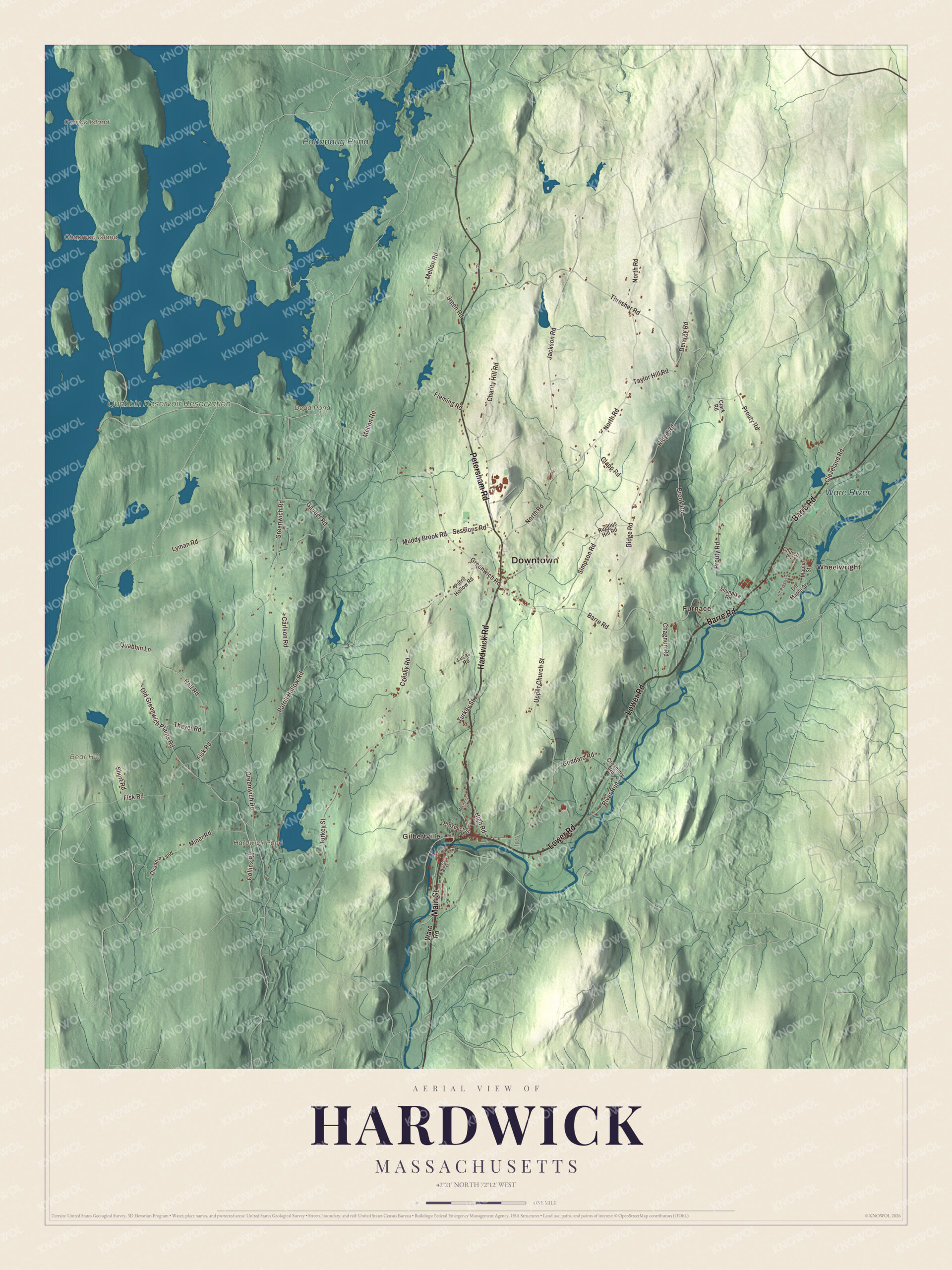
Hardwick today
By KNOWOL
Hardwick in 2026, with Petersham, Barre and Greenwich roads, Hardwick Pond, Pottapaug Pond, Bear Hill and the Quabbin Reservoir Reservation along the northwest edge.5
The history of Hardwick, Massachusetts
Fair days on the Common
Hardwick got its fair in 1762, when the province passed an act letting the town hold one on the third Wednesday and Thursday of May and of October. Timothy Ruggles was behind it. Twice a year crowds came to buy and sell cattle and goods, and there was wrestling and other contests of strength and skill. The county court licensed ten Hardwick men as innholders to put up the visitors. Ruggles, who wouldn't take up arms against the king, left Hardwick in 1774 and ended his days in Nova Scotia, and the town voted the fair down in 1775. Petitions to bring it back failed in 1785 and 1791. The tradition lives on today in the Hardwick Community Fair.2678
Iron kettles to flannel
About the middle of the 1700s an iron furnace went up on Moose Brook at what's still called Furnace Village. Its ore came from West Brookfield, and for sixty or seventy years it turned out hollow-ware, from big potash kettles to tea kettles, pans and skillets. In 1776 its owners were casting cannon ball for the state, with thirty men keeping the fire going day and night through a blast of five or six months. Early in the 1800s another furnace went up on the Ware River, and that neighborhood was called New Furnace. In 1860 George H. Gilbert's firm built a brick mill there on the site of an old paper mill, and the village took his name. By 1883 about a thousand people worked in its mills.91011123
The road to Bennington
Captain Samuel Robinson of Hardwick served five campaigns in the French War. Coming home from one of them, he lost his way and passed through the wild country that became Bennington, Vermont. He liked what he saw and talked others into going with him. The first party reached Bennington on June 18, 1761, and Hardwick families were at its heart: Robinsons, Fassetts, Harwoods and Pratts, and a few years later Stephen Fay, who kept the Catamount Tavern. Robinson's son Moses became governor of Vermont. The Separate Church that Hardwick dissenters had formed about 1750 went north with them, and the town's 1883 history calls it the first Congregational church in Vermont.1314
Hardwick, Massachusetts through the years
25 moments from 1686 to today.
- 1686Nipmuc people transfer the rights to Wombemessock to eight settlers from Roxbury for twenty pounds.1
- 1732The General Court recognizes the settlement, by then called Lambstown.1
- 1736The first church goes up, with the Reverend David White as minister.1
- 1739Lambstown is incorporated as Hardwick, named for the first Earl of Hardwicke.1
- 1750About this year dissenters in Hardwick form a Separate Church.14
- 1754Timothy Ruggles tells the General Court the town has no more than eighty families.1
- 1761Hardwick families are among the first settlers to reach Bennington, Vermont, on June 18.13
- 1762An act of June 12 lets Hardwick hold a fair each May and October.2
- 1775The town votes to end the fair as the Revolution comes on.2
- 1776The furnace at Furnace Village is casting cannon ball for the state.10
- 1778Ruggles of Hardwick is named beside the former governors in the act barring Loyalists from returning.15
- 1815A new furnace on the Ware River, where Gilbertville is now, is in blast.12
- 1833A gore of about two hundred acres is annexed, the land most of Gilbertville stands on.16
- 1836The Town House is built, paid for from the federal surplus revenue.17
- 1838Hardwick celebrates its centennial on November 15 in a pouring rain.18
- 1845William C. Wesson starts a daily two-horse mail coach from West Brookfield.19
- 1860The first Gilbert mill, five stories of brick, goes up on the site of the old paper mill.3
- 1870Trains on the Ware River Railroad start running from Palmer to Gilbertville.19
- 1874Gilbertville's Trinitarian Congregational church dedicates its new house of worship on September 10.20
- 1883The Gilbert mills employ about a thousand people, most of them in Hardwick.3
- 1886The covered bridge between Gilbertville and Ware is built.21
- 1938A flood destroys much of Gilbertville.22
- 1967Eagle Hill School opens in Hardwick.1
- 1991The Hardwick Village and Gilbertville historic districts join the National Register.8
- 2010The Ware-Hardwick Covered Bridge reopens in October after its restoration.21
Places to see in Hardwick, Massachusetts
Places worth a visit in Hardwick today.
- Hardwick Village Historic DistrictThe old town center. Petersham, Barre and Greenwich roads, listed 1991.
- GilbertvilleSouth end of town. The Gilbert company's mill village.
- Ware-Hardwick Covered BridgeGilbertville, on the Ware River. Lattice truss of 1886, reopened 2010.
- WheelwrightOn the Ware River near Barre. Named for paper mill owner George Wheelwright.
- FurnaceMoose Brook. Where the old iron furnace stood.
- Ware RiverEastern edge of town. The water that ran Gilbertville's mills.
- Muddy BrookWestern Hardwick. Drains the town's western side.
- Quabbin Reservoir ReservationNorthwest corner. Land of the old Swift River Valley.Visit their website
- Pottapaug PondNorthwest corner. Now part of the Quabbin's waters.
- Eagle Hill SchoolOld Petersham Road. Boarding school opened in 1967.Visit their website
Hardwick on the National Register of Historic Places
All 3 places in Hardwick on the National Register of Historic Places that still stand today, oldest first, and why each one matters.4
-
Hardwick Village Historic District
The old town center along Petersham, Barre, Greenwich, Ruggles Hill and Gilbertville roads, in a town incorporated in 1739. General Timothy Ruggles started a market fair here in 1762, a tradition that carries on in the Hardwick Community Fair, and nearby streams powered saw and grist mills.8
-
Gilbertville Historic District
The mill village that grew around George H. Gilbert's woolen mill on the Ware River from the 1860s. His company built a Congregational church and a library for its workers, and St. Aloysius Church was founded for the Catholic immigrants who came to work in the mills. A flood in 1938 destroyed much of the village.22
-
Ware-Hardwick Covered Bridge
A single-span Town lattice truss about 137 feet long, built in 1886 over the Ware River between Gilbertville and Ware. It survived the 1930s flood that destroyed the Gilbertville mills, and it reopened in October 2010 after a $1.9 million restoration.21
Hardwick in their words
“what is probably the prettiest strictly manufacturing village in Massachusetts”
The Boston Daily Advertiser, 1880, on Gilbertville, quoted in the History of Hardwick, 18833
“Hardwick Fair had as conspicuous a notice as General Election, or Commencement at Cambridge.”
History of Hardwick, 1883, on how the almanacs announced the colonial fair2
“The climate of Hardwick is eminently favorable to health and long life.”
Lucius R. Paige, History of Hardwick, 188323
Towns near Hardwick, Massachusetts
Sources for the history of Hardwick
- Hardwick, Massachusetts, Wikipedia
- History of Hardwick, Massachusetts (1883), on the Hardwick Fair, Internet Archive
- History of Hardwick, Massachusetts (1883), on the George H. Gilbert Manufacturing Company, Internet Archive
- National Register of Historic Places listings in Worcester County, Massachusetts, Wikipedia
- Map of Hardwick, Massachusetts in 2026, KNOWOL
- History of Hardwick, Massachusetts (1883), on the fair's innholders, Internet Archive
- History of Hardwick, Massachusetts (1883), on Brigadier Ruggles, Internet Archive
- Hardwick Village Historic District, Wikipedia
- History of Hardwick, Massachusetts (1883), on the Furnace Village iron furnace, Internet Archive
- History of Hardwick, Massachusetts (1883), on cannon ball in the Revolution, Internet Archive
- History of Hardwick, Massachusetts (1883), on the furnace blasts, Internet Archive
- History of Hardwick, Massachusetts (1883), on the New Furnace, Internet Archive
- History of Hardwick, Massachusetts (1883), on the emigration to Bennington, Internet Archive
- History of Hardwick, Massachusetts (1883), on the Separate Church, Internet Archive
- History of Hardwick, Massachusetts (1883), on the act of 1778, Internet Archive
- History of Worcester County, Massachusetts (1889), on the Hardwick gore, Internet Archive
- History of Hardwick, Massachusetts (1883), on the Town House, Internet Archive
- History of Hardwick, Massachusetts (1883), on the centennial of 1838, Internet Archive
- History of Hardwick, Massachusetts (1883), on the mail coach and the railroad, Internet Archive
- History of Hardwick, Massachusetts (1883), on the Trinitarian Congregational Church of Gilbertville, Internet Archive
- Ware-Hardwick Covered Bridge, Wikipedia
- Gilbertville Historic District, Wikipedia
- History of Hardwick, Massachusetts (1883), on the climate, Internet Archive