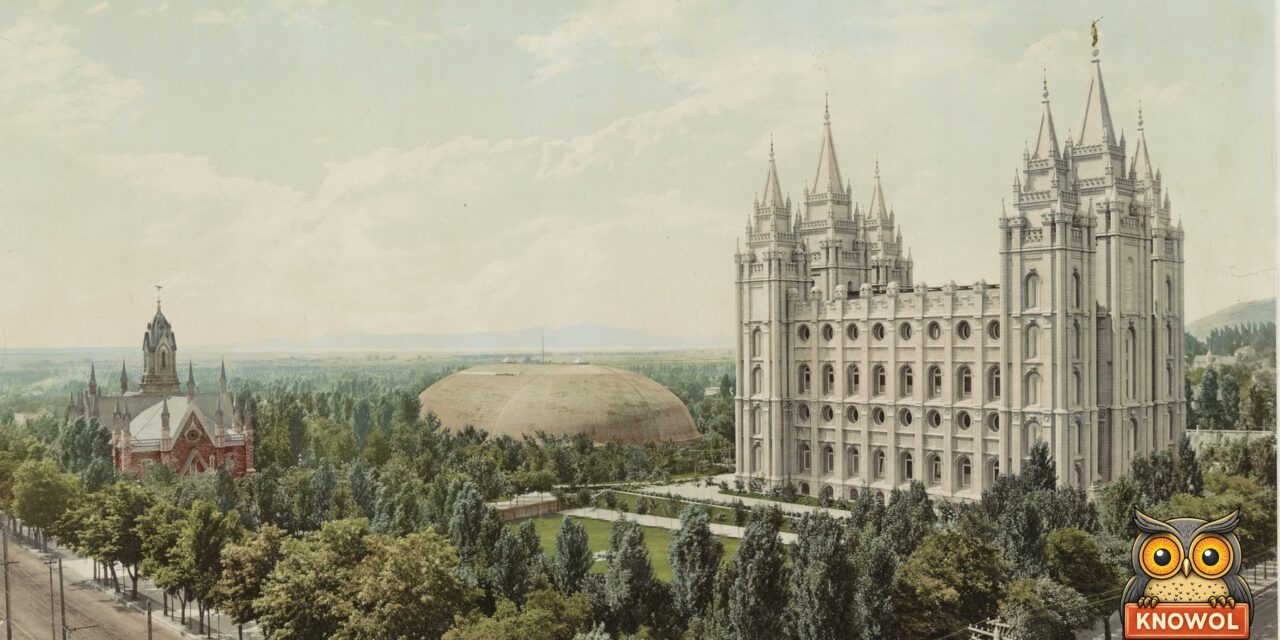
On the morning of Saturday, January 4, 1896, the telegraph at the Western Union office in Salt Lake City clicked out the news that Utah was finally a state. President Grover Cleveland had signed the proclamation in Washington at 10:03, which was 8:03 by Utah’s clocks. Bells rang, whistles blew and a national salute was fired. In all that noise, The Salt Lake Herald came up with a contest, and the next morning’s paper announced it under the headline “Utah’s First Born.”
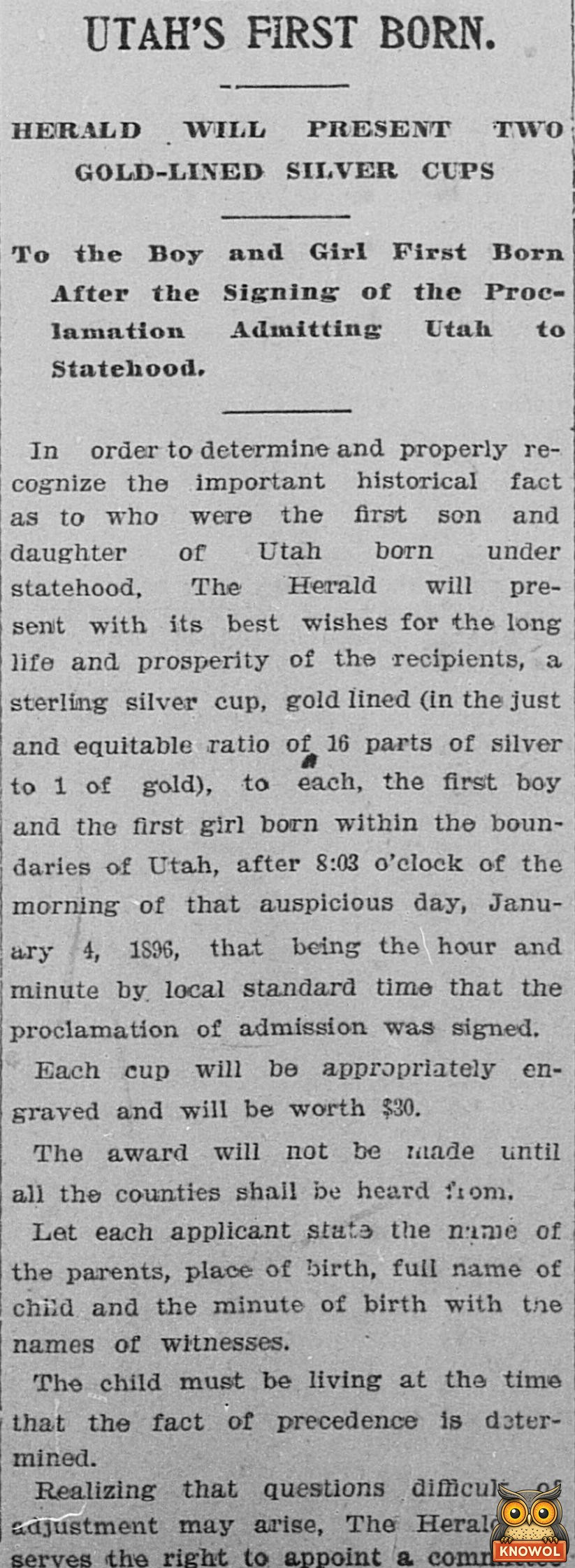
“Utah’s First Born,” The Salt Lake Herald, Salt Lake City, Utah, January 5, 1896, page 1. Library of Congress, Chronicling America. Click the clipping to read it full size.
A silver cup for each
The Herald promised “a sterling silver cup, gold lined (in the just and equitable ratio of 16 parts of silver to 1 of gold),” to the first boy and the first girl born in Utah “after 8:03 o’clock of the morning of that auspicious day.” Each cup would be engraved and “worth $30.” Parents had to send “the minute of birth with the names of witnesses.”
That ratio was a joke every reader got. “16 to 1” was the slogan of the free silver movement, which wanted the government to coin silver and gold at that ratio, and silver-mining Utah loved it. The Denver News passed the joke along: the cups, it said, “will contain 16 parts of silver to 1 part of gold.”
Sixteen “new women” and seven boys
By January 20 the Herald counted “sixteen ‘new women’ and only seven boys,” using the 1890s nickname for the modern, independent young woman. Mrs. E. A. Shepherd of Salina wrote that her son was born at a quarter to six that evening, far too late to win, “but like all other good Democrats, I feel like trying.” She was naming him for Joseph L. Rawlins, Utah’s delegate in Congress from 1893 to 1895, and she had a question: “Please let us know what the L. in his name stands for.” It stood for Lafayette.
Joseph K. Purcell wrote from Kamas to claim the cup for his baby daughter: “We have named her Deseret and she is making quite a noise about the premium you have been offering.”
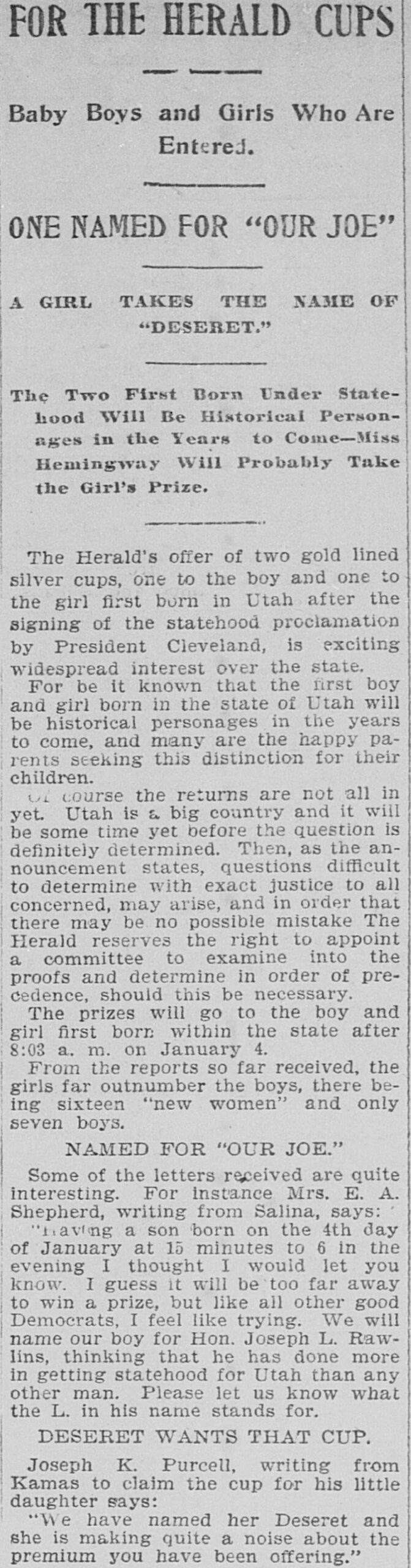
“For the Herald Cups,” The Salt Lake Herald, Salt Lake City, Utah, January 20, 1896, page 5. Library of Congress, Chronicling America. Click the clipping to read it full size.
One minute after the proclamation
The entries came from Plain City to Teasdale, each with its minute, and two stood out. A baby girl was born to Thomas and Vilate Hemingway in Salt Lake City at 8:04 a.m. Her father worked for the Rapid Transit company, and the certificate signed by her doctor and midwife showed she arrived “just one minute after President Cleveland signed the proclamation by local standard time.” Six minutes after her, at 8:10, a boy was born to Anton and Hannah E. Jensen at Gunnison, Utah, a town in Sanpete County. They named him Grover Cleveland James Jensen.
Gunnison had plenty to celebrate that week. On Monday, January 6, when the new state government took office, the town “turned out en masse to celebrate Inaugural day,” its correspondent wired the Herald, with “firing of anvils, parading by brass band,” and “three grand balls tonight free.”
The cups were engraved
The Herald held the contest open into February for anyone who could beat 8:04 and 8:10, and no one did. “Candidates for these cups sprang up all over the territory, from Logan to St. George,” the paper said on May 17, but the certificates of the doctors and midwives settled it: the winners were “little Sarah Vilate Hemingway of this city, and Master Grover James Jensen of Gunnison.” The Herald printed drawings of both cups. The girl’s was covered with flowers. The boy’s, with a cherub on its side, read “Presented with best wishes by the Salt Lake Herald to the first boy born in the state of Utah, Grover James Jensen.”

“Herald Prize Cups,” with drawings of the girl’s cup (top) and the boy’s cup, The Salt Lake Herald, Salt Lake City, Utah, May 17, 1896, page 9. Library of Congress, Chronicling America. Click the clipping to read it full size.
Shirt waists for 40 cents
The same Sunday page that showed the cups carried a big “Removal Sale” ad for Cohn Dry Goods on Main Street. A ladies’ shirt waist of fine percale “with high collar and Bishop sleeves” was 40 cents, a corset was 45 cents, and men’s bicycle gloves were $1.25. Fifty ladies’ suits “worth from $6 to $12” were marked down to $2.99 and $4.98. The $30 that each cup was worth would have bought six of the better suits, with change left over.
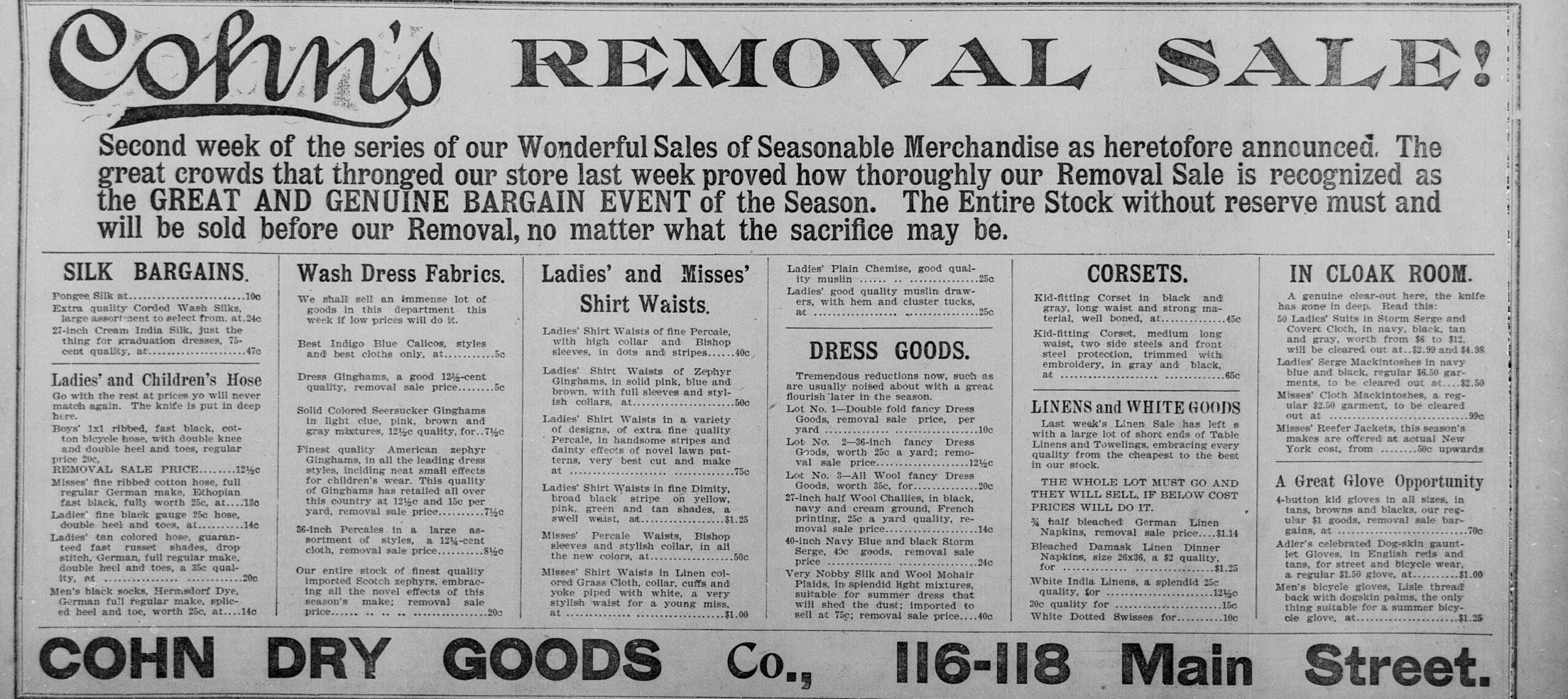
Cohn Dry Goods Co. “Removal Sale” advertisement, on the same page as the prize cups, The Salt Lake Herald, Salt Lake City, Utah, May 17, 1896, page 9. Library of Congress, Chronicling America. Click the picture to see it full size.
On show at the Co-op store
On May 24 the Herald’s man in Gunnison reported that the boy’s cup had arrived. The Jensens lived about two miles outside town, so they agreed “to place the cup on exhibition at the Co.-op. store,” where anyone could see it all week. “This being an event which will never occur again, the whole community is interested,” he wrote. A photograph of the boy would be sent to the Herald soon, and he added one more line: “Apparently the happiest person concerned just now is Grandma Hanson.”
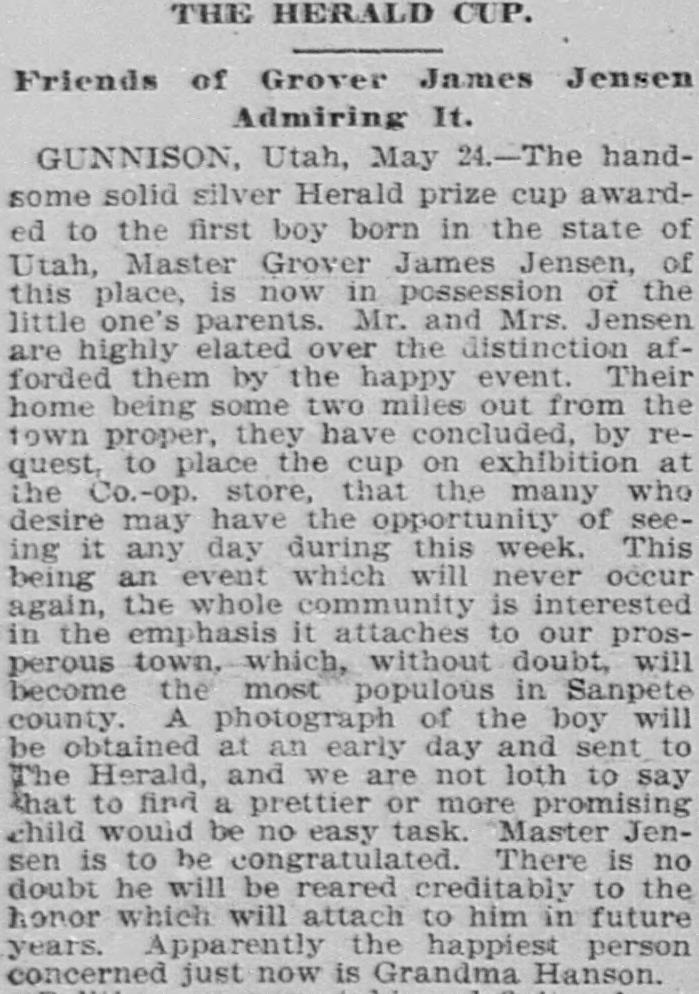
“The Herald Cup,” from Gunnison, The Salt Lake Herald, Salt Lake City, Utah, May 26, 1896, page 11. Library of Congress, Chronicling America. Click the clipping to read it full size.
The Herald had said the two winners would grow up to be “important personages in the great commonwealth of Utah.” In Gunnison that week, with his cup on show at the Co-op store, one of them already was.
Sources
- The Salt Lake Herald (Salt Lake City, Utah), January 5, 1896, page 1 (“Utah’s Star Is Now Shining,” “Utah’s First Born”), January 7, 1896, page 7 (“Great Joy at Gunnison”), January 15, 1896, page 4 (quoting the Denver News), January 20, 1896, page 5 (“For the Herald Cups”), January 27, 1896, page 8 (“The Cup Winners”), February 4, 1896, page 8 (“The Gold Lined Cups”), May 17, 1896, page 9 (“Herald Prize Cups” and the Cohn Dry Goods advertisement) and May 26, 1896, page 11 (“The Herald Cup,” from Gunnison).
- Joseph Lafayette Rawlins: Biographical Directory of the United States Congress, U.S. House of Representatives.
- All newspaper images: Library of Congress, Chronicling America. Published 1896, public domain.
- Cover: “Temple Square, Salt Lake City,” photochrom print, copyright 1899 by the Detroit Photographic Co. (cropped). Library of Congress Prints and Photographs Division, 2016802673. No known restrictions on publication.