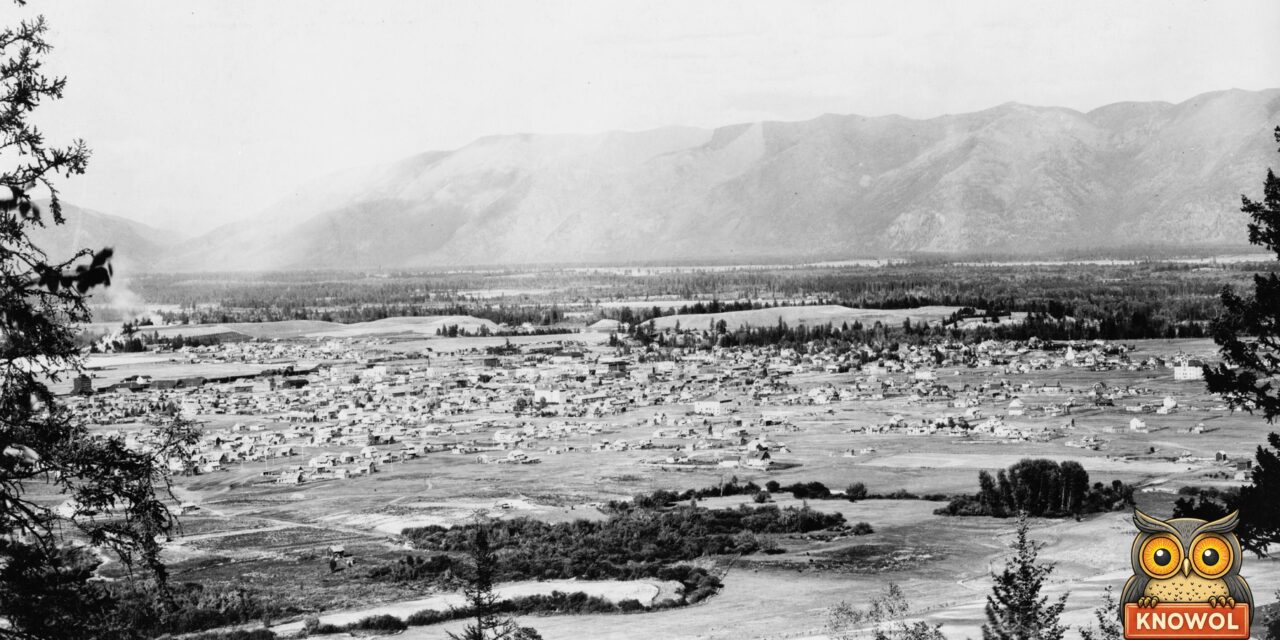
One winter day early in 1897, a sleigh pulled up to D. J. Plume’s place near Kalispell, Montana. J. T. Robbins and his wife had come to stay, and they meant to be fed. Robbins was collecting on an election bet, and his man had lost.
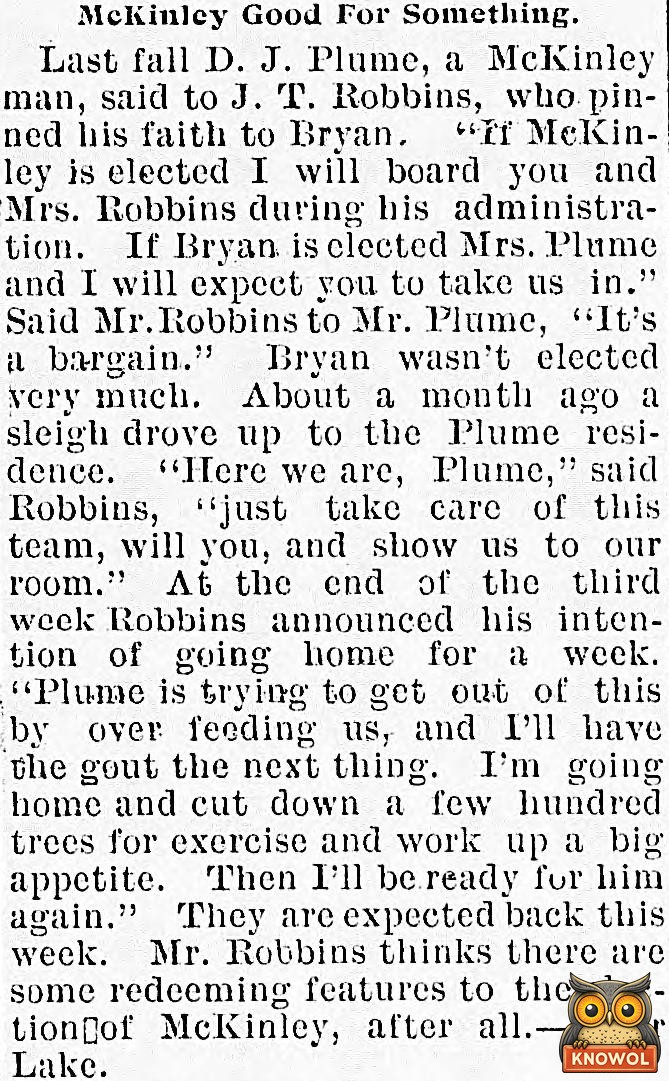
“McKinley Good For Something,” from the Kalispell Inter Lake, reprinted in The Ravalli Republican, Stevensville, Montana, March 17, 1897, page 3. Library of Congress, Chronicling America. Click the clipping to read it full size.
A bet that ran backward
The bet went back to the fall of 1896, when William McKinley ran for president against William Jennings Bryan. Bryan wanted the government to coin silver freely, and silver-mining Montana loved him for it. Plume was a McKinley man. Robbins, as the paper put it, “pinned his faith to Bryan.”
Plenty of election bets made the loser wheel the winner down the street in a wheelbarrow. Plume’s ran the other way: whoever backed the winner would feed the other fellow. Here is the whole story, as the Kalispell Inter Lake told it and The Ravalli Republican of Stevensville reprinted it on March 17, 1897:
Last fall D. J. Plume, a McKinley man, said to J. T. Robbins, who pinned his faith to Bryan. “If McKinley is elected I will board you and Mrs. Robbins during his administration. If Bryan is elected Mrs. Plume and I will expect you to take us in.” Said Mr. Robbins to Mr. Plume, “It’s a bargain.” Bryan wasn’t elected very much. About a month ago a sleigh drove up to the Plume residence. “Here we are, Plume,” said Robbins, “just take care of this team, will you, and show us to our room.” At the end of the third week Robbins announced his intention of going home for a week. “Plume is trying to get out of this by over feeding us, and I’ll have the gout the next thing. I’m going home and cut down a few hundred trees for exercise and work up a big appetite. Then I’ll be ready for him again.” They are expected back this week. Mr. Robbins thinks there are some redeeming features to the election of McKinley, after all.
“Bryan wasn’t elected very much” was the editor having fun. McKinley won 271 electoral votes to Bryan’s 176. Montana went for Bryan by a wide margin, so Robbins had lots of company in his disappointment, but only he had a free room waiting.
Four years of board
McKinley’s term started on March 4, 1897, and ran four years. If the paper’s “about a month ago” was right, the Robbinses moved in before he had even taken the oath. The story traveled, too. On April 1, the Dupuyer Acantha, on the far side of the Rocky Mountains, called it “the latest election bet to drift to the surface” and spelled the town “Kallispell.”
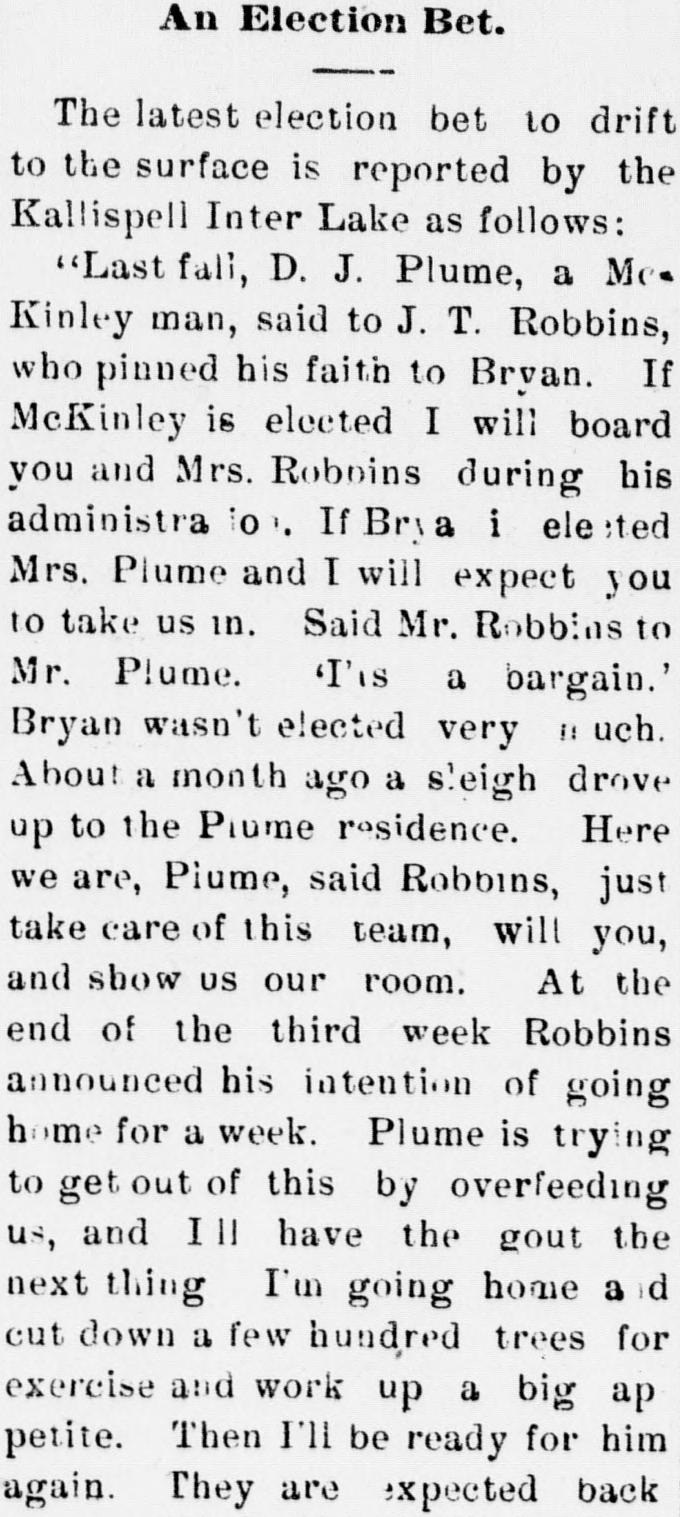
“An Election Bet,” The Dupuyer Acantha, Dupuyer, Montana, April 1, 1897, page 1. Library of Congress, Chronicling America. Click the clipping to read it full size.
The man with the orchard
The Kalispell Bee shows what kind of host Plume was. He lived at Ashley, on the edge of Kalispell, and grew apples and cherries. In May 1901 the Bee reported a hard frost had ruined his orchard. The report came from the man renting his farm, and Plume wrote in to set things straight. “Not wishing to be classed as the Flathead liar, ordered before a commission for lunacy, tapped for the simples,” he began, he had never said any such thing. If he had claimed the ice was two inches thick, “I would be like the man that said his horse was 16 feet high. I would stick to it.”
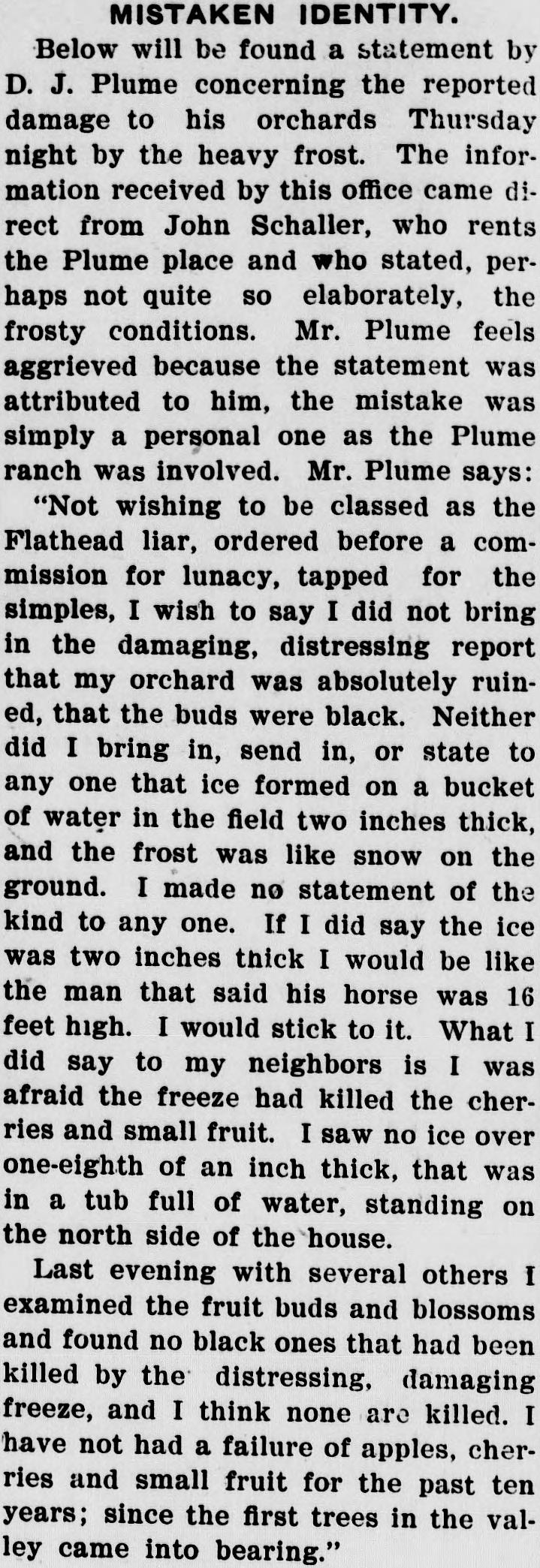
“Mistaken Identity,” D. J. Plume’s letter about the frost, The Kalispell Bee, Kalispell, Montana, May 11, 1901, page 3. Library of Congress, Chronicling America. Click the clipping to read it full size.
“I have not had a failure of apples, cherries and small fruit for the past ten years,” he wrote, “since the first trees in the valley came into bearing.” At the county fair in October 1902, the Bee praised “the fine plates of Alexander apples exhibited, especially those of D. J. Plume.”
Beans and hardtack
Plume still liked a full table. On a Sunday in February 1903, he and Mrs. Plume hosted “a good old fashioned ‘coffee cooling'” for Civil War veterans and their wives. Each man was asked to bring “some article that he had carried through the war of rebellion,” and almost a hundred guests came. The orders of the day began “D. J. Plume’s quarters captured,” and the company marched to the commissary, “capturing with a vicious charge the beans and hardtack.”
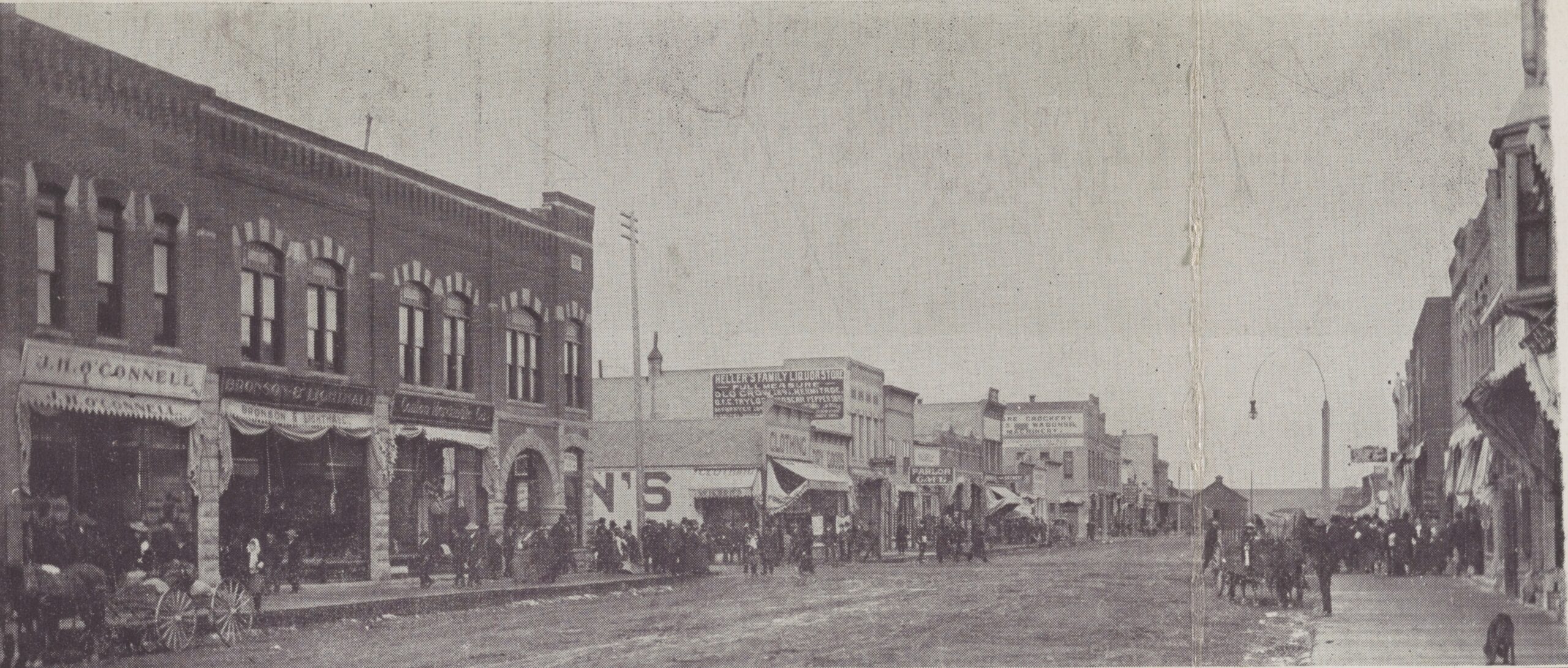
Main Street, Kalispell, Montana, on a postcard copyrighted in 1905 by J. R. White. Library of Congress Prints and Photographs Division. Click the picture to see it full size.
A month later he had houses to rent, in a Bee column where classified ads cost “one cent a word.” His came to about a quarter: “Two houses, with three or four acres of ground at Ashley; also house and 15 acres of land, two miles from Kalispell.”
Nobody wrote down whether the Robbinses came back for all four years, or whether Plume’s cooking finally won. The Inter Lake left them in the middle of the deal, with Robbins chopping trees to get his appetite back and deciding McKinley wasn’t so bad after all.
Sources
- The Ravalli Republican (Stevensville, Montana), March 17, 1897, page 3 (“McKinley Good For Something,” from the Kalispell Inter Lake).
- The Dupuyer Acantha (Dupuyer, Montana), April 1, 1897, page 1 (“An Election Bet”).
- The Kalispell Bee (Kalispell, Montana), March 12, 1901, page 3, May 11, 1901, page 3 (“Mistaken Identity”), October 14, 1902, page 5 (fair exhibits), February 13, 1903, page 5 (“Old Soldiers’ Gathering”) and March 10, 1903, page 5 (classified ads).
- All newspaper images: Library of Congress, Chronicling America. Published 1897 to 1903, public domain.
- “Main Street, Kalispell, Montana,” postcard, copyright 1905 by J. R. White, Library of Congress Prints and Photographs, no known restrictions on publication.
- Cover: “Kalispell, Mont.,” photograph by J. R. White, copyright 1906 (cropped). Library of Congress Prints and Photographs Division, 91719682. Published 1906, public domain.