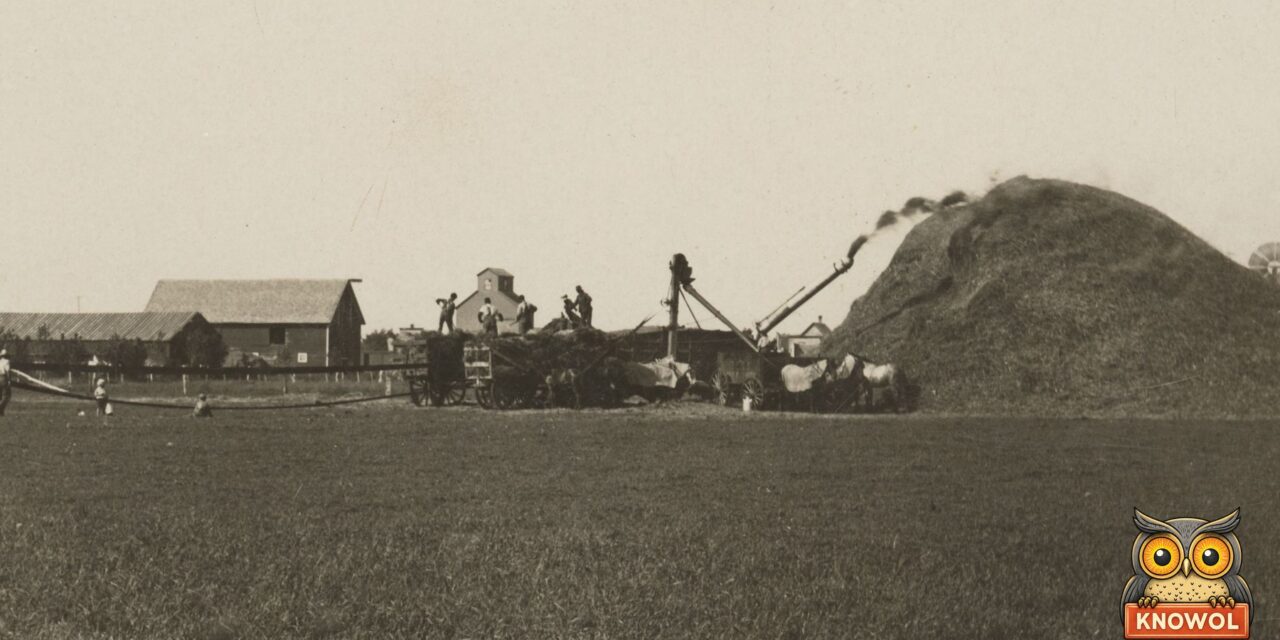
In the fall of 1905 the threshing crews were working their way from farm to farm around Lake Andrew, a farm town near New London, Minnesota. The young men on the crews had a habit the households didn’t care for. They sat up “the greater part of the night playing games,” while everyone else had gone to bed and wanted “rest and peace.” On October 30 the Willmar Tribune’s Lake Andrew correspondent reported that one woman, never named, had found the cure.
“Women are cunning,” the item began. “She gave the boys just enough kerosene in their lamp to keep up the light while they got ready for bed, and the young roosters were sure to go to roost without any serious trouble except an occasional slip of the tongue.” It ended with an offer to every other household: “No patent right remedy; it is free to all.”
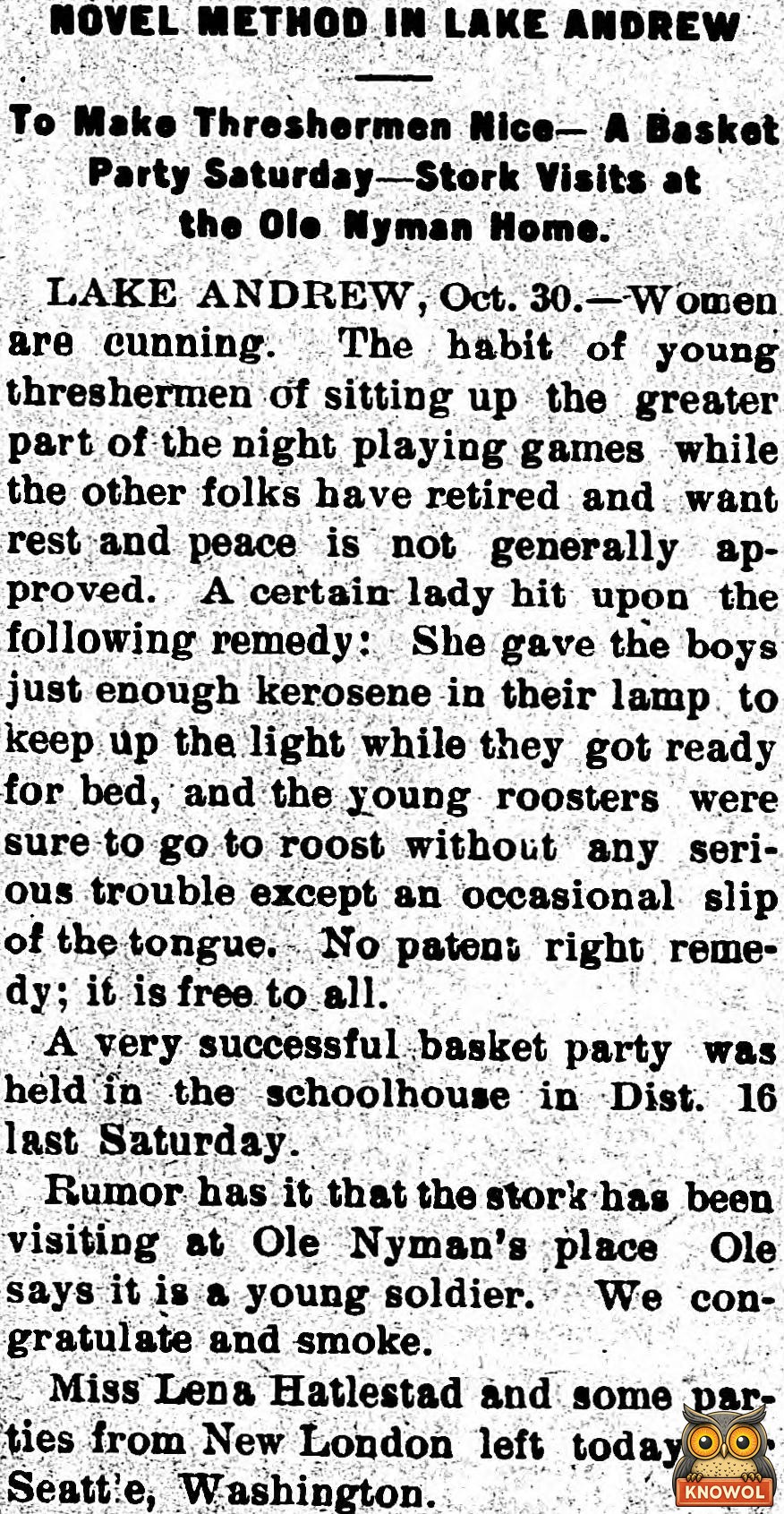
“Novel Method in Lake Andrew,” Willmar Tribune, Willmar, Minnesota, November 1, 1905, page 1. Library of Congress, Chronicling America. Click the clipping to read it full size.
Twelve hundred acres in shock
Threshing came after harvest. The grain was cut and set up in shocks or stacks in the fields, and then a threshing rig, an engine and a separator with its crew, went from farm to farm to knock the grain loose. In August the Lake Andrew column reported that John Nelson planned to take his rig to Murdock, “where he is engaged to thresh out the crop on twelve hundred acres in shock.” By early September he was home for a Sunday and went back with “some of the Lake Andrew boys, as threshing help was scarce in that locality.”
It was state fair week, but the correspondent said the farmers “have all the exhibitions at home that they can attend at present.” In Sunburg, another Kandiyohi County town, young women went to help in other households for the busy days: “Miss Eva Tollefson assisted Mrs. Johnson last week thru threshing.”
Snow on the summer leaves
Then the weather turned. In late October rain and snow laid up the machines for a few days, and the Sunburg writer said the threshers “get stuck in the mud everywhere.” At Lake Andrew the joists of the Jericho flat house, a grain warehouse, gave way under the load, and the manager “found his wheat stored away in the cellar.”
On Sunday, October 29, it snowed. In Willmar sleigh bells were heard on the streets in October for the first time, and the Tribune said “October weather records were smashed to smithereens.” The Lake Andrew correspondent, in the same column as the kerosene trick, wrote: “Eight to ten inches of snow while the trees are still dressed in their summer gowns is a very unusual sight.” The column went on, “Hope this snow will not last long, as there is quite a bit of threshing left yet.” J. J. Week of Norway Lake told the paper that in his neighborhood “not more than half the threshing is done.”
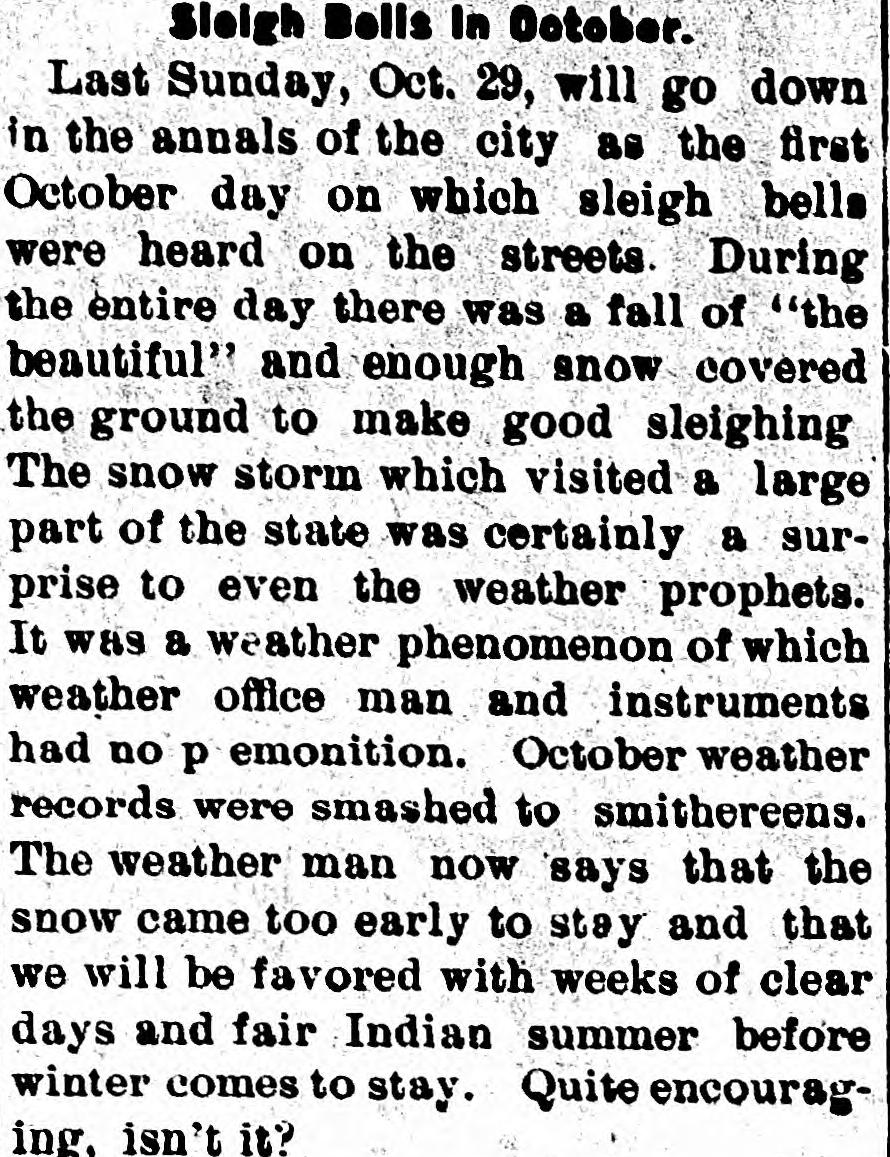
“Sleigh Bells in October,” Willmar Tribune, Willmar, Minnesota, November 1, 1905, page 1. Library of Congress, Chronicling America. Click the clipping to read it full size.
“Not throw aspersions on all”
One thresherman wanted the record set straight. In the next week’s Tribune, John Nelson had his say:
Your Lake Andrew correspondent tells of boys accompanying a threshing crew who sat up nights playing cards. As I have been threshing in the neighborhood, I wish you would correct any impression that may have been made that the boys with my machine did anything of the kind. As there were three rigs in the vicinity your correspondent might have specified which one it was and not throw aspersions on all.
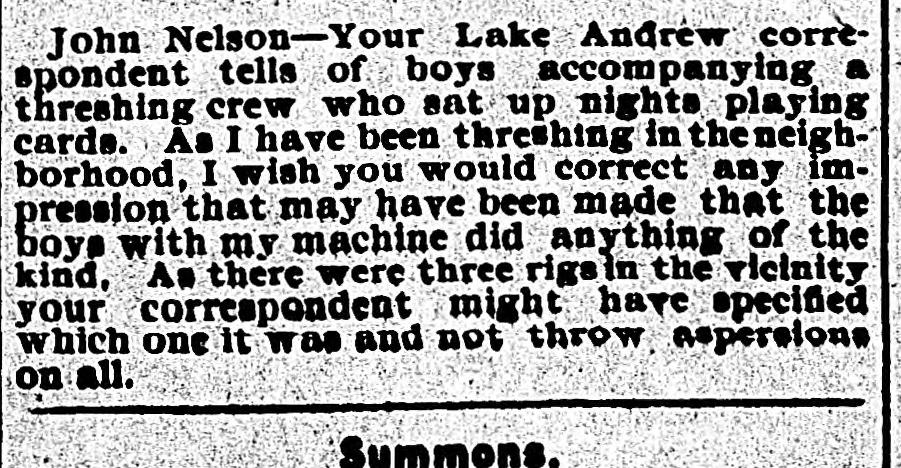
John Nelson’s answer, Willmar Tribune, Willmar, Minnesota, November 8, 1905, page 8. Library of Congress, Chronicling America. Click the clipping to read it full size.
Baskets, a baby and 76 cents
Life went on around the threshing. The same October 30 column reported “a very successful basket party” at the District 16 schoolhouse, where Miss Hilda Rasmusson of Whitefield had been hired in September to teach a six months’ term. For a basket social, a Willmar church society explained that same week, “Every lady is requested to bring a basket containing lunch for two. These will be auctioned off to the highest bidder.” The stork had visited Ole Nyman’s place, too: “Ole says it is a young soldier. We congratulate and smoke.” The baby was a son, born October 22 at his grandmother’s house in Willmar.
The Willmar markets on November 1 paid farmers 76½ cents a bushel for No. 1 wheat, 22 cents for oats and 85 cents for flax. Eggs brought 19 cents. And for 15 cents in stamps, the Tribune Printing Company would mail a thresher a pocket account book, “a little less than 4×6 inches in size.”
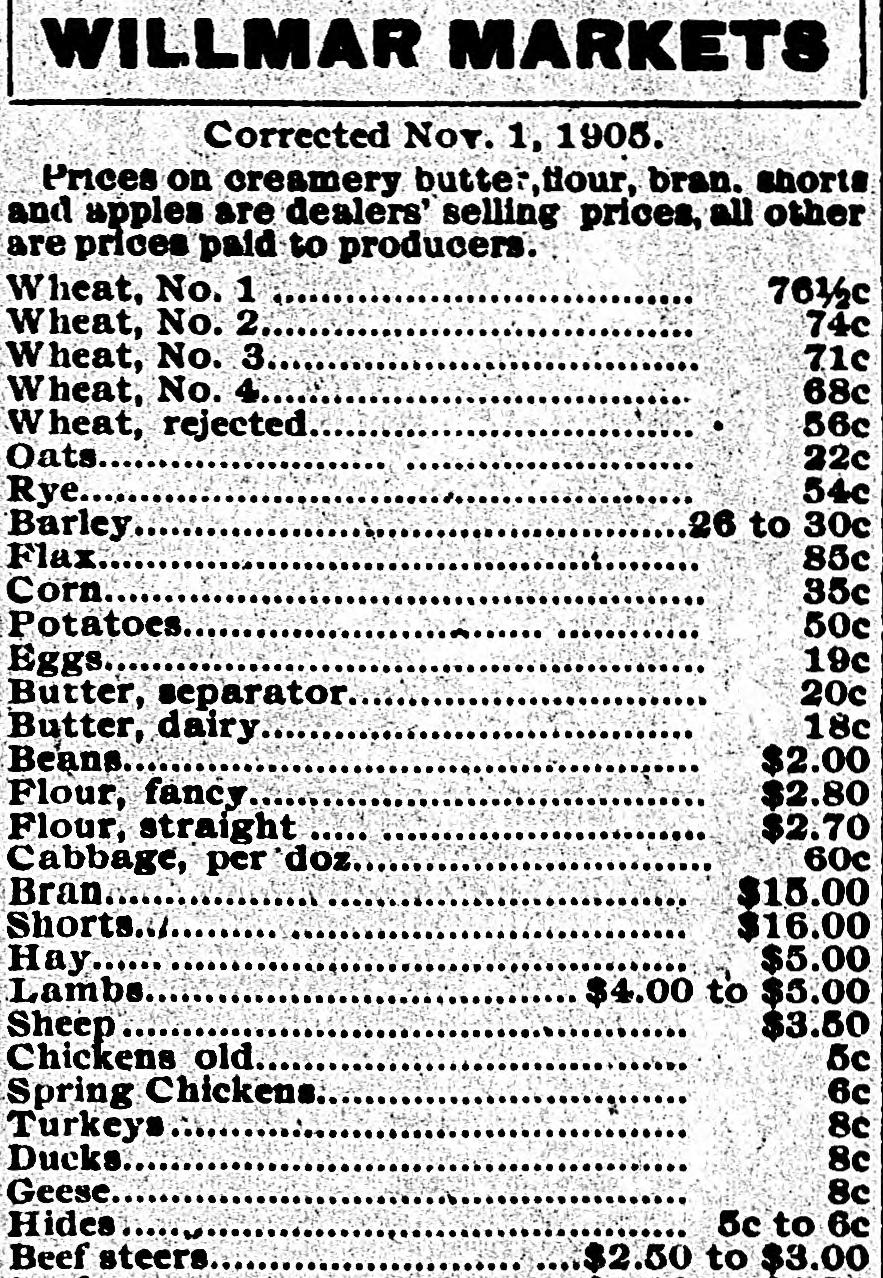
“Willmar Markets, Corrected Nov. 1, 1905,” Willmar Tribune, Willmar, Minnesota, November 1, 1905, page 8. Library of Congress, Chronicling America. Click the clipping to read it full size.
Laid up for the winter
Some crews kept going. On November 6 the correspondent reported, “Gunder Swenson doesn’t mind rain or snow; he is banging away with his threshing machine as though nothing had happened.” A week later Swenson “laid up his threshing rig after a long and successful run,” ready to start shredding corn. The woman who rationed the lamp oil was never named in the paper. Her remedy, as the column promised, was free to all.
Sources
- Willmar Tribune (Willmar, Minn.), August 9, 1905, page 8 (Lake Andrew, Aug. 7: John Nelson’s rig to Murdock), September 13, 1905, page 1 (District 16 teacher) and page 8 (Lake Andrew, Sept. 4), October 25, 1905, page 1 (Lake Andrew and Sunburg columns) and page 8 (Nyman birth), November 1, 1905, page 1 (“Novel Method in Lake Andrew,” “Sleigh Bells in October,” “Basket Social”), page 5 (“What People Say”) and page 8 (markets, threshers’ account books), November 8, 1905, page 1 (“Doings at Lake Andrew”) and page 8 (John Nelson), and November 22, 1905, page 1 (Lake Andrew, Nov. 13).
- All newspaper images: Library of Congress, Chronicling America. Published 1905, public domain.
- Cover: Photograph: “Threshing at Wolverton, Minn.,” Haakon Bjornaas, between 1905 and 1920, Minnesota State University Moorhead through the Minnesota Digital Library, Wikimedia Commons, No Copyright, United States. Wolverton is in western Minnesota, not Kandiyohi County; it shows the kind of threshing rig the Lake Andrew crews ran.