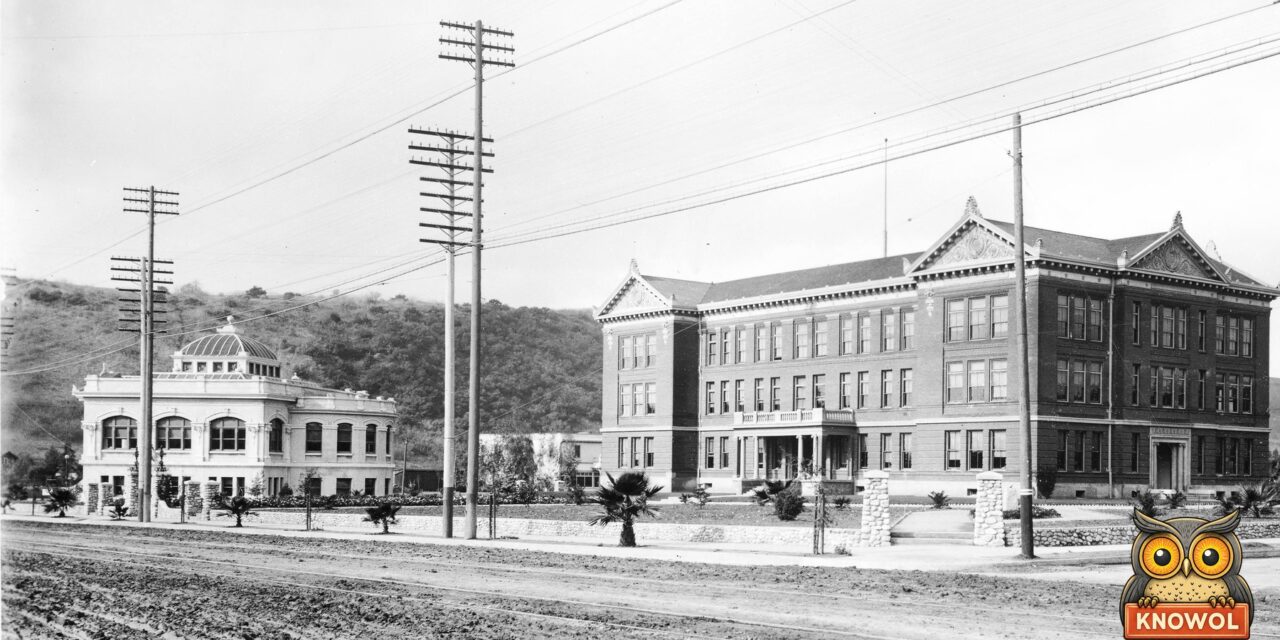
On the afternoon of Tuesday, March 28, 1905, the young women of Occidental College in Los Angeles, California, held a track meet that no man was allowed to see. The faculty had ruled that no man “should be allowed to penetrate that sacred precinct,” and a high board fence closed in the field on all four sides. At 4:29, one minute ahead of schedule, the starter fired a pistol, and “four young women clad in bloomer costumes were off” over the hurdles. The next morning the Los Angeles Herald told the whole story of the co-eds’ meet, and near the top it added one more line: “But knot holes were at a premium.”
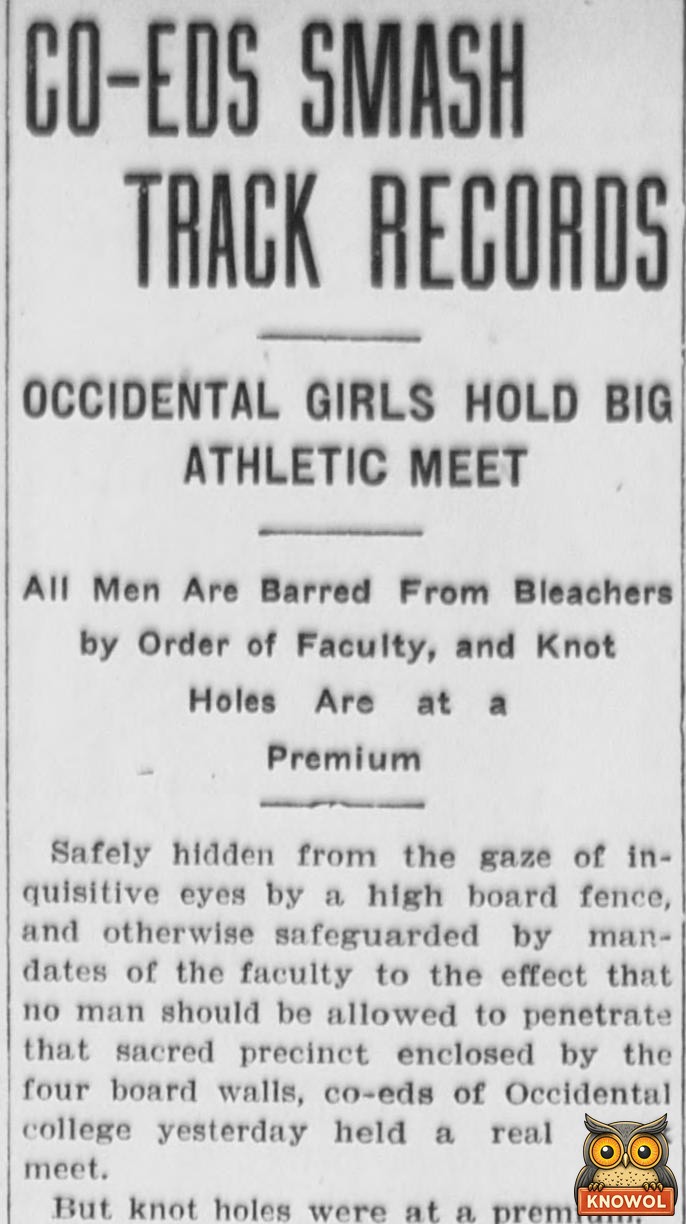
“Co-Eds Smash Track Records,” Los Angeles Herald, Los Angeles, California, March 29, 1905, page 7. Library of Congress, Chronicling America. Click the clipping to read it full size.
A small college in Highland Park
In 1905 Occidental stood in Highland Park, in the hills on the northeast side of Los Angeles. By the college’s own history, three large buildings, a few smaller ones and an athletic field were squeezed onto about ten acres there, and the Southern Pacific railroad ran right through the campus. It was a small school. That June, Occidental graduated eleven seniors, and six of them were women. One of the five men, J. R. Jeffers, became the poet Robinson Jeffers.
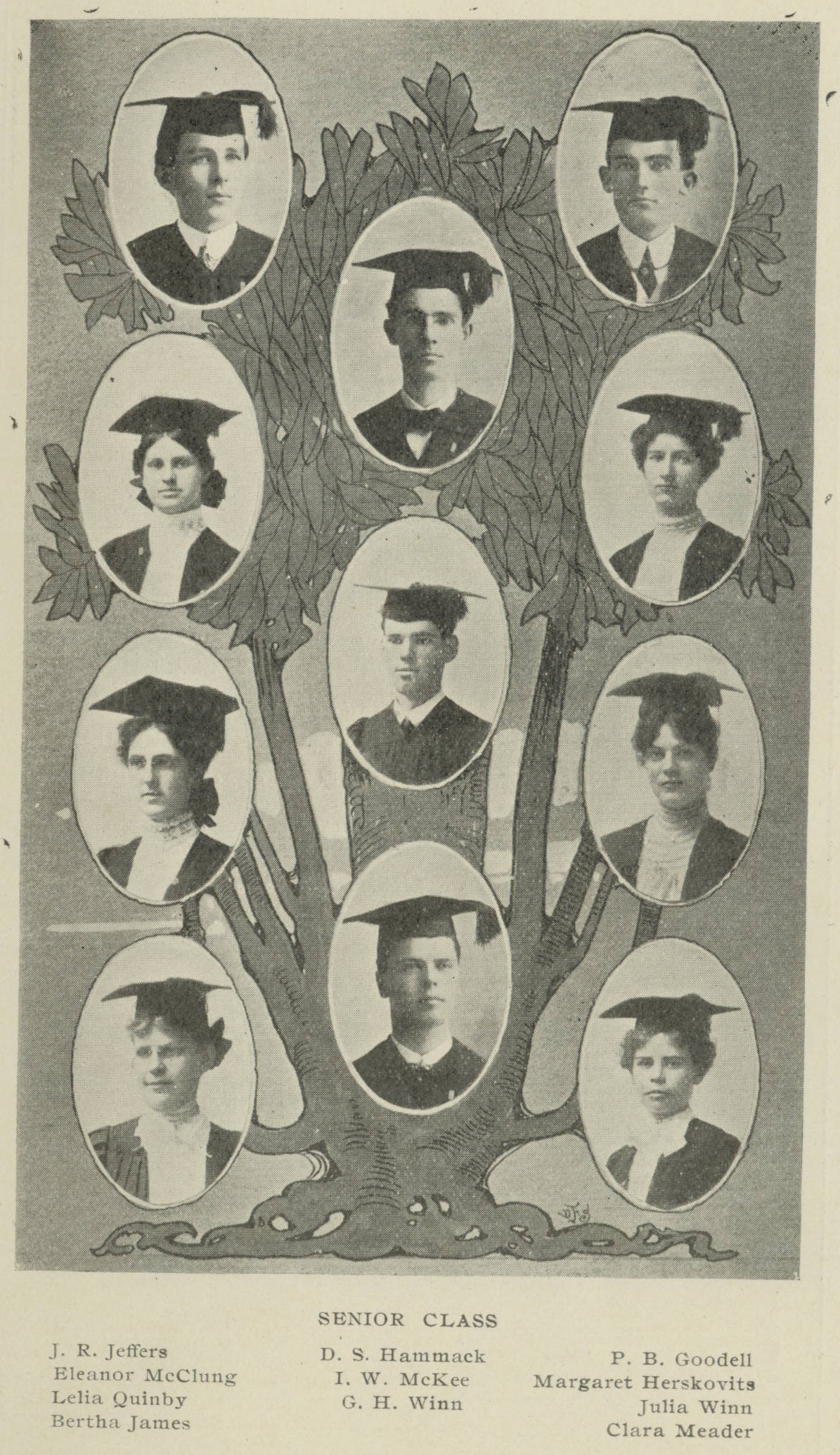
The senior class of 1905, from “The Occidental,” the college’s commencement annual for that year. USC Digital Library, via Wikimedia Commons. Public domain. Click the clipping to read it full size.
The men’s track team trained under Coach Merrill on the college grounds, and the Herald followed it all season. Its star was Hagerman, a broad jumper and hurdler the paper ranked above any rival “now upon the Southern California athletic horizon.”
Two teams and a pistol
The women split into two teams: the freshmen against the sophomores and the “preps,” as the paper called the younger students of the college’s prep school. Bertha Boal captained the freshmen and Vera Brooke led the other side, and just before the first race the two captains gathered their “men” for final instructions. Girls from every class filled the seats along the track, which on other days was a basketball court, and cheered them on.
The captains raced each other in the high hurdles. Bertha Boal won, Vera Brooke came second and Fern Gordon third, while May Darling “landed with the first hurdle on the ground.” Bertha also won the thirty-yard dash in 4 seconds. Vera won the high jump at 3 feet 7 inches and put the shot 22 and a half feet, which the crowd thought remarkable. As one onlooker pointed out, the ball “weighed seven whole pounds.” Abba McCready and Katherine Darling won the three-legged race, and the 440-yard dash was thrown out after an argument over a mistake by the starter.
A relay race closed the program, and the freshmen won the meet 38 to 21. The winners got paper medals. Lillian Merrill handed the relay cup to the freshmen and gave a speech praising the contestants for “their bravery in action and wonderful powers of endurance.” One event never happened. “Darkness prevented the try out for the broad jump,” the Herald reported, “and Hagerman’s record was saved.”
Twenty yards of silk
The same page of the Herald shows what a young woman of 1905 wore the rest of the time. Coulter Dry Goods Co. advertised spring suits and costumes with full, flowing skirts at $37.50, $55 and $62.50, and a new double-width silk crepe de chine at $1.50 a yard. The store did the math for its readers: “Where twenty yards of narrow material is necessary for a gown of the present modes, ten yards of this double-width silk will be needed.” Behind the fence, the co-eds ran in bloomers.
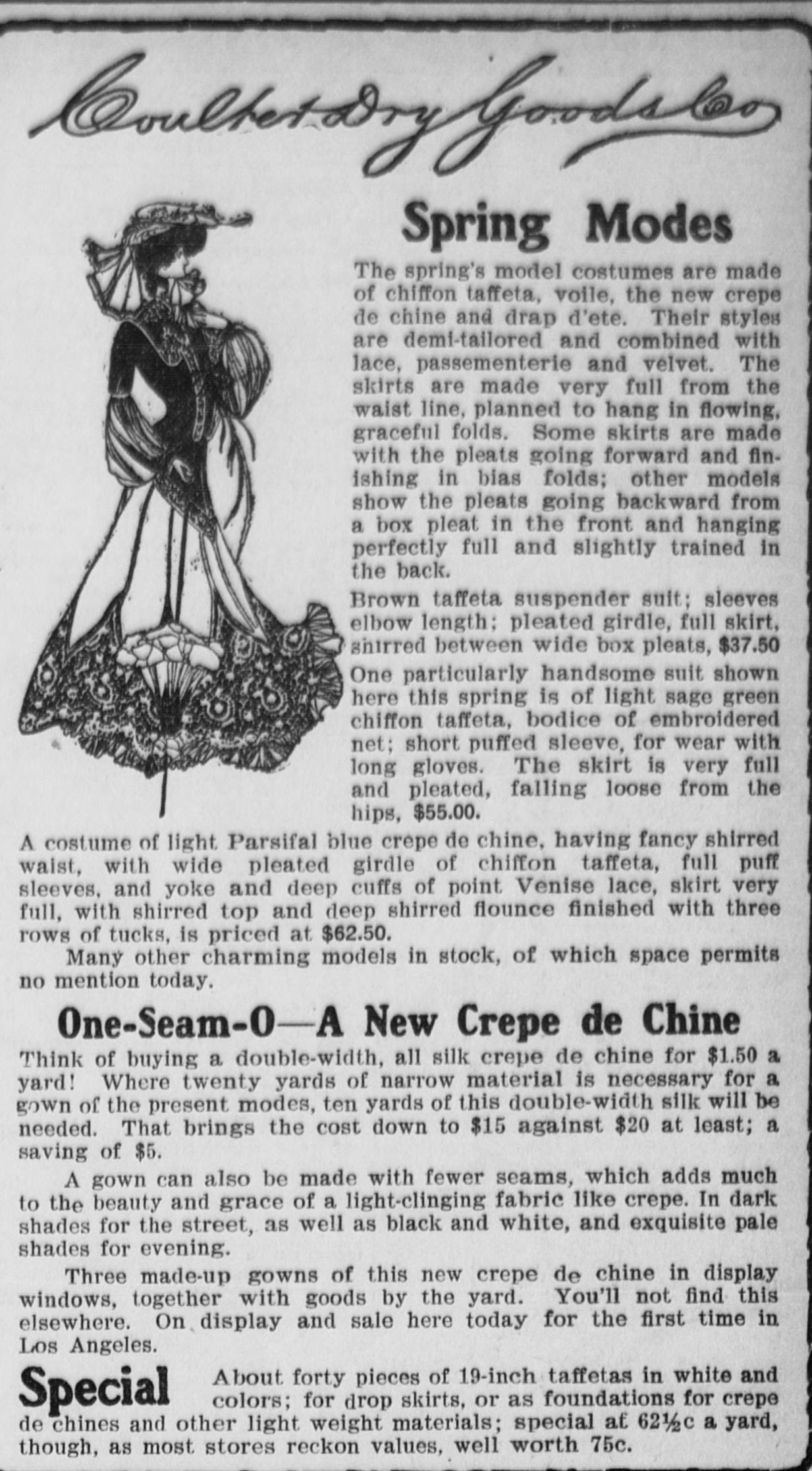
The Coulter Dry Goods Co. ad on the same page as the track meet, Los Angeles Herald, Los Angeles, California, March 29, 1905, page 7. Library of Congress, Chronicling America. Click the clipping to read it full size.
No fence at Capitola
Eight days later some of the same athletes competed again, this time before students from colleges across California and Nevada. Occidental’s young women had raised about $40 at a luncheon to send delegates to a students’ conference at Capitola, near Santa Cruz, and on the afternoon of April 5 the conference held a field day. The San Francisco Call reported that the Southern California colleges won nearly everything. Vera Brooke won the high jump, ahead of Hazel Hetherington of Stanford. Then she won the broad jump, the event that darkness had called off at home. Kate Darling of Occidental won the 100-yard dash, Genevieve Cumberland of Occidental took third in the broad jump, and Vera and Katherine Darling played on the southern basketball team that beat the north 22 to 12. The Call spelled Vera’s name wrong, but its headline still said it plainly: “Miss Brooks the Star.”
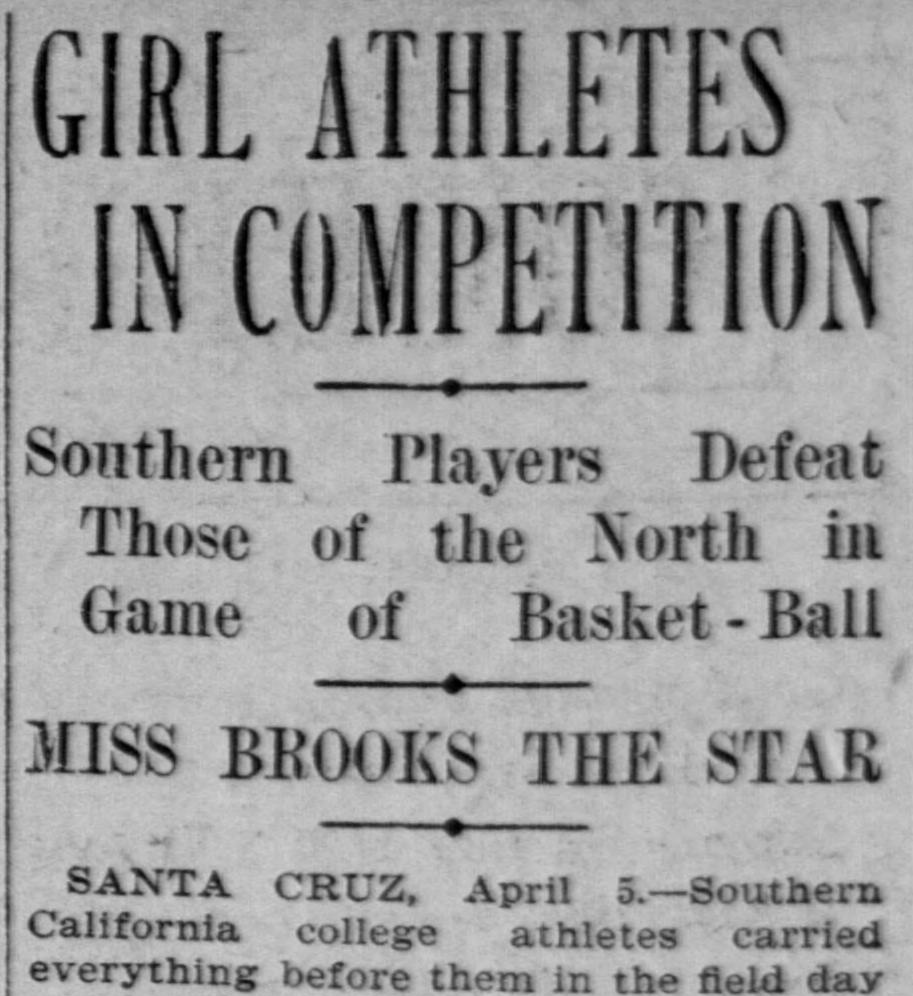
“Girl Athletes in Competition,” The San Francisco Call, San Francisco, California, April 6, 1905, page 14. The Call spelled Vera Brooke’s name “Brooks.” Library of Congress, Chronicling America. Click the clipping to read it full size.
The Call never mentioned a board fence at Capitola. It did say that a minister, the Rev. Horace Day, “was delegated as policeman and was kept busy.” Back home, Occidental kept growing, and in 1914 the college left Highland Park for a new campus in Eagle Rock, where it still stands. The Herald never said whether anyone found a knot hole.
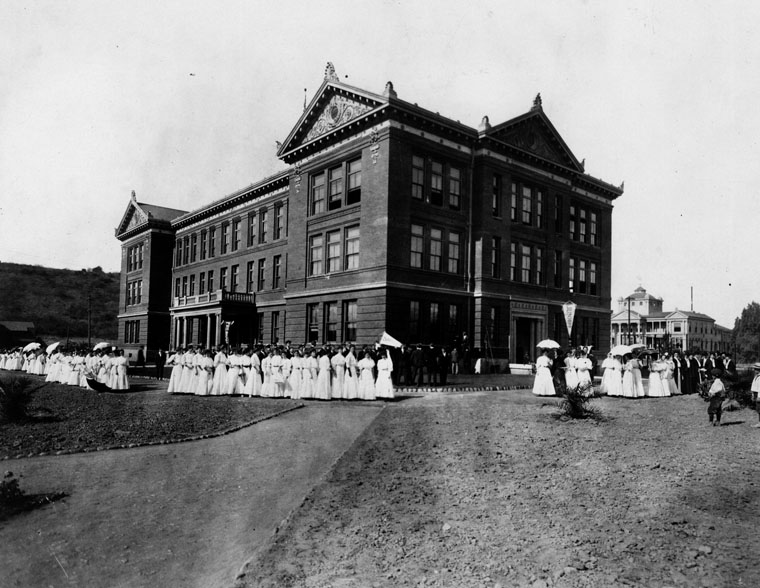
Occidental College in 1904: women in white dresses, some holding parasols, line up beside the Hall of Letters in Highland Park, Los Angeles, California. Los Angeles Public Library, Security Pacific National Bank Collection, via Wikimedia Commons. Public domain. Click the picture to see it full size.
Sources
- Los Angeles Herald (Los Angeles, California), March 29, 1905, page 7 (“Co-Eds Smash Track Records” and the Coulter Dry Goods Co. ad), January 28, 1905, page 10 (“Promising Track Squad of Occidental College”), February 10, 1905, page 10 (“Occidental Tryout”) and April 2, 1905, page 22 (“Highland Park,” the luncheon).
- The San Francisco Call (San Francisco, California), April 6, 1905, page 14 (“Girl Athletes in Competition”).
- All newspaper images: Library of Congress, Chronicling America. Published 1905, public domain.
- Occidental College: “The Road to Eagle Rock,” Occidental magazine, Spring 2014 (the Highland Park campus and the 1914 move), and the Robinson Jeffers exhibition, Occidental College Special Collections (Jeffers, class of 1905).
- Class of 1905 page: “The Occidental: commencement annual, 1905,” USC Digital Library, Wikimedia Commons. Public domain.
- Photograph: “Occidental College in 1904,” Los Angeles Public Library, Security Pacific National Bank Collection (order number 00032720), Wikimedia Commons. Public domain.
- Cover photograph: the Highland Park campus of Occidental College about 1908, with the Stimson Library and the Hall of Letters, California Historical Society Collection, USC Digital Library (CHS-5326), Wikimedia Commons. Public domain.