At 4 o’clock on Saturday afternoon, November 4, 1905, a big crowd filled the post office corner in Clarksburg, West Virginia, waiting for a horse race. Two horses stood ready under blankets, each hitched to a light runabout, a small open buggy. Thomas Heneghan had a black mare, and Millard Bartlett had a bay gelding. The two owners had argued about whose horse was better, and they agreed to settle it on the road: five miles from the post office to the county bridge at Quiet Dell, with $150 for the man who got there first. The Daily Telegram called it “one of the most unique and novel races in the history of local horse circles.”
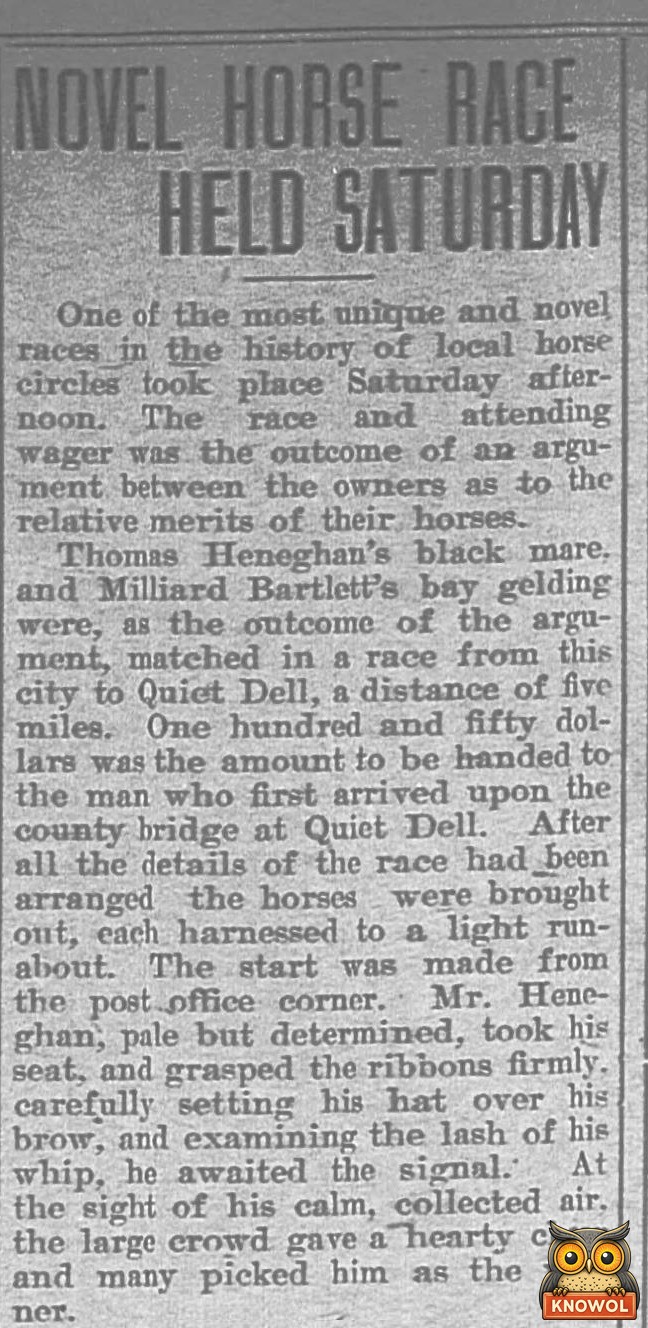
“Novel Horse Race Held Saturday,” The Daily Telegram, Clarksburg, West Virginia, November 6, 1905, page 5. Library of Congress, Chronicling America. Click the clipping to read it full size.
Pale but determined
Mr. Heneghan, “pale but determined, took his seat, and grasped the ribbons firmly.” He set his hat over his brow and checked the lash of his whip. The crowd liked his calm, gave him a hearty cheer, and “many picked him as the winner.” Mr. Bartlett climbed into his seat at almost the same moment. “He appeared excited, but his do or die appearance caused his backers to begin to count their winnings in advance.”
As the last stroke of four sounded from the city clock, Dr. Mike Sheridan stood on the steps of the federal building, home of the post office, and “bellowed forth lustily, ‘go.'” The grooms pulled off the blankets and let the horses go, and the crowd roared, “they’re off.”
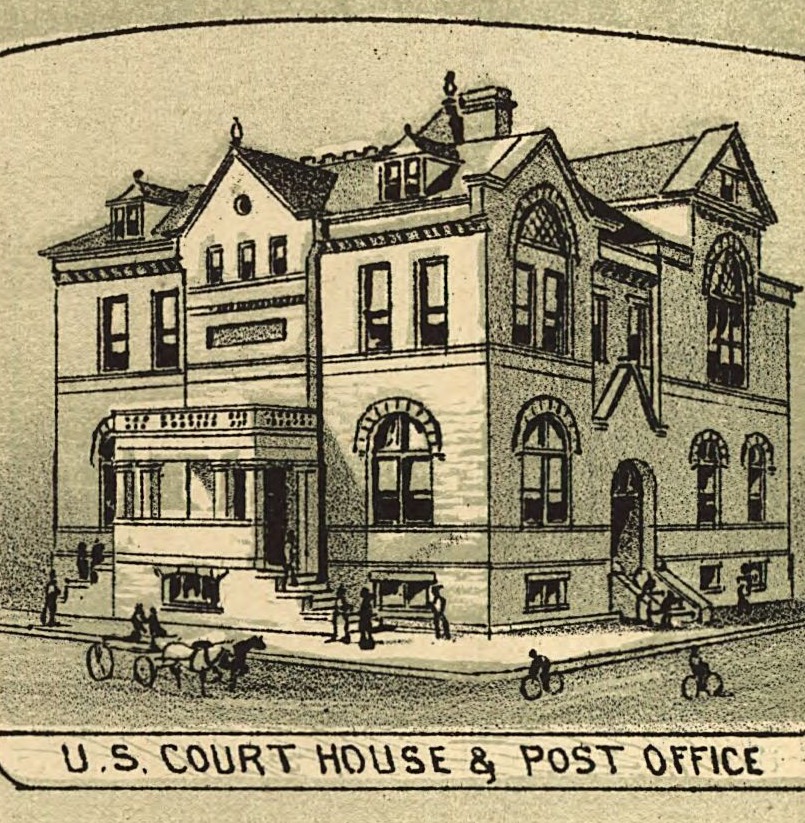
The U.S. Court House and Post Office in Clarksburg, the federal building where the race began, from T. M. Fowler’s 1898 bird’s-eye view of the city. Library of Congress, Geography and Map Division. Public domain. Click the picture to see it full size.
Main or Monticello
The two rigs trotted side by side down the Pike Street hill and across First Street to Main. Where Main met Monticello, the drivers split up. Bartlett went up Main, and Heneghan took the Monticello route. After that, the big crowd waiting for their return lost all news of the racers.
So the town did what a town could do in 1905. “Telephones were called into use and every ‘phone along the route was called up.” The answers all sounded alike: “a sort of bay streak of lightning had flashed into view and flashed out as quickly.” Nobody along the road could find any trace of Heneghan.
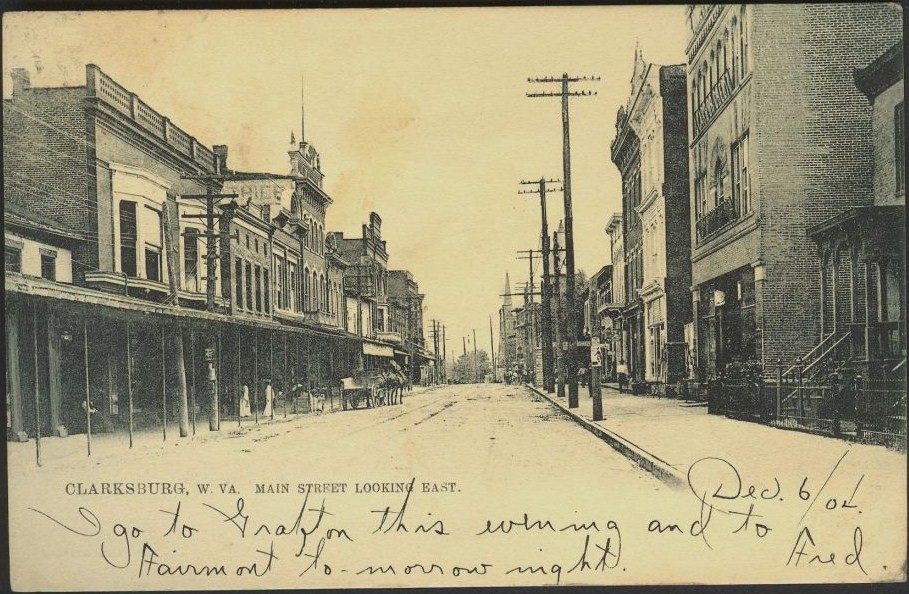
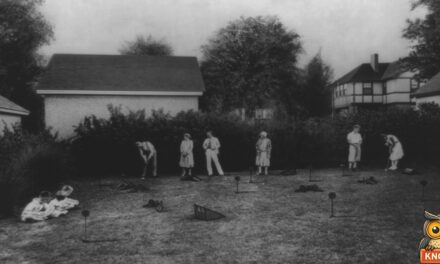
Main Street, looking east, Clarksburg, West Virginia, on a postcard mailed in December 1904, about a year before the race. Wikimedia Commons. Public domain. Click the picture to see it full size.
Won in a walk
It was late in the evening before the whole story got back to town. Bartlett had “won in a walk, by jove.” He covered the five miles in 20 minutes, a mile every four minutes. The road was soft, and “the going was too heavy for Mr. Heneghan’s mare,” so he “abandoned the race, when he discovered that to continue it would be dangerous to his animal.”
Nobody argued with the result. Bartlett “was conceded to have won the race fairly and squarely, and he took down the stakes.” The Telegram couldn’t resist one more joke. A bay horse is reddish brown, so the paper reported that the “superstitious people between here and Quiet Dell, who were alarmed at the appearance of a red comet flitting along the turnpike, are relieved to know that the spector was only Mr. Bartlett and his bay horse going after the money.”
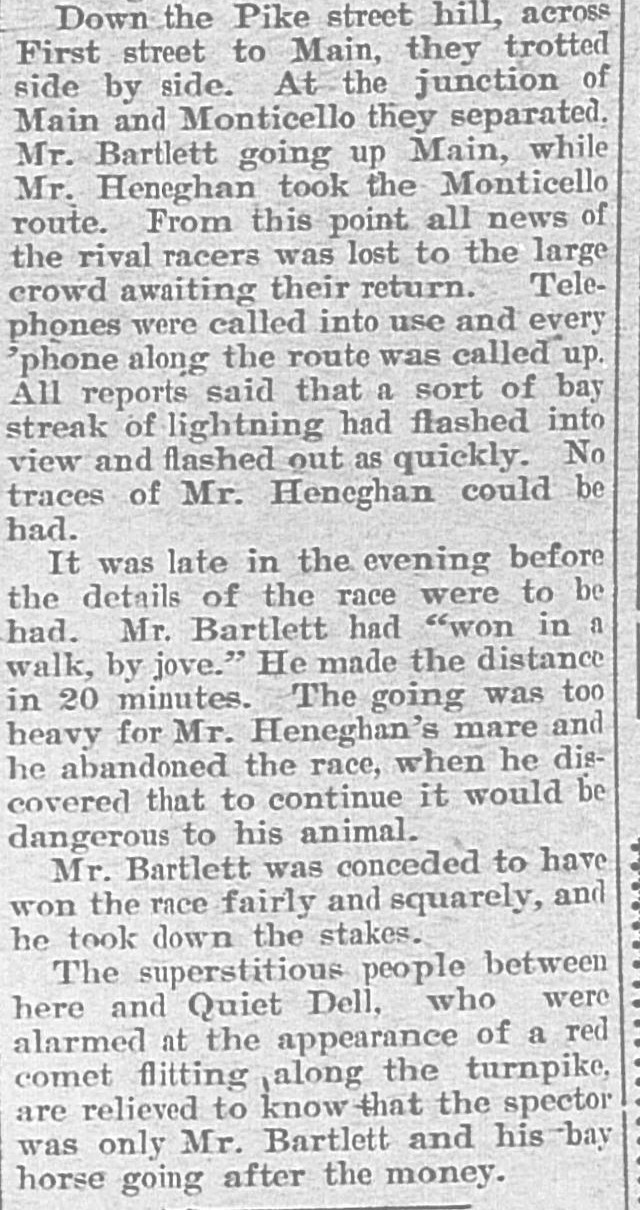
How the race ended, from “Novel Horse Race Held Saturday,” The Daily Telegram, Clarksburg, West Virginia, November 6, 1905, page 5. Library of Congress, Chronicling America. Click the clipping to read it full size.
Who they were
Clarksburg had a Millard F. Bartlett who ran meat markets. In March 1905 he sold a half interest in his three markets, on Pike Street, at Adamston and at Wallace, to John Bartlett, to be run as “Bartlett & Bartlett.” The race story spelled the winner’s first name “Milliard.”
Heneghan was most likely the “Thos. Henaghan” the paper had listed in September among the “Clarksburg race enthusiasts” at the Lewis County fair in Weston. Six weeks after the buggy race, a T. A. Heneghan went out with a hunting party, and the Clarksburg Transfer Company sent one of its largest wagons to haul home the game. The wagon met the hunters “hoofing it in” with nothing to haul, so it carried “their weary bones back home” instead. “It was better than a hay ride,” the paper said.
Ten suits for the winner
The race story shared page 5 with store ads, and they show what $150 meant in Clarksburg that fall. One ad, headed “To Make a Long Story Short,” was for the Globe Clothing House on Pike Street and the Hub Tailoring Company on Third Street. Both stood across from the post office, right where the race began. They sold suits and overcoats for $8 to $15, or “Suits and Overcoats to your measure, $15.00,” and they promised “All Clothing kept pressed free for one year.” The $150 purse would have bought ten made-to-measure suits.
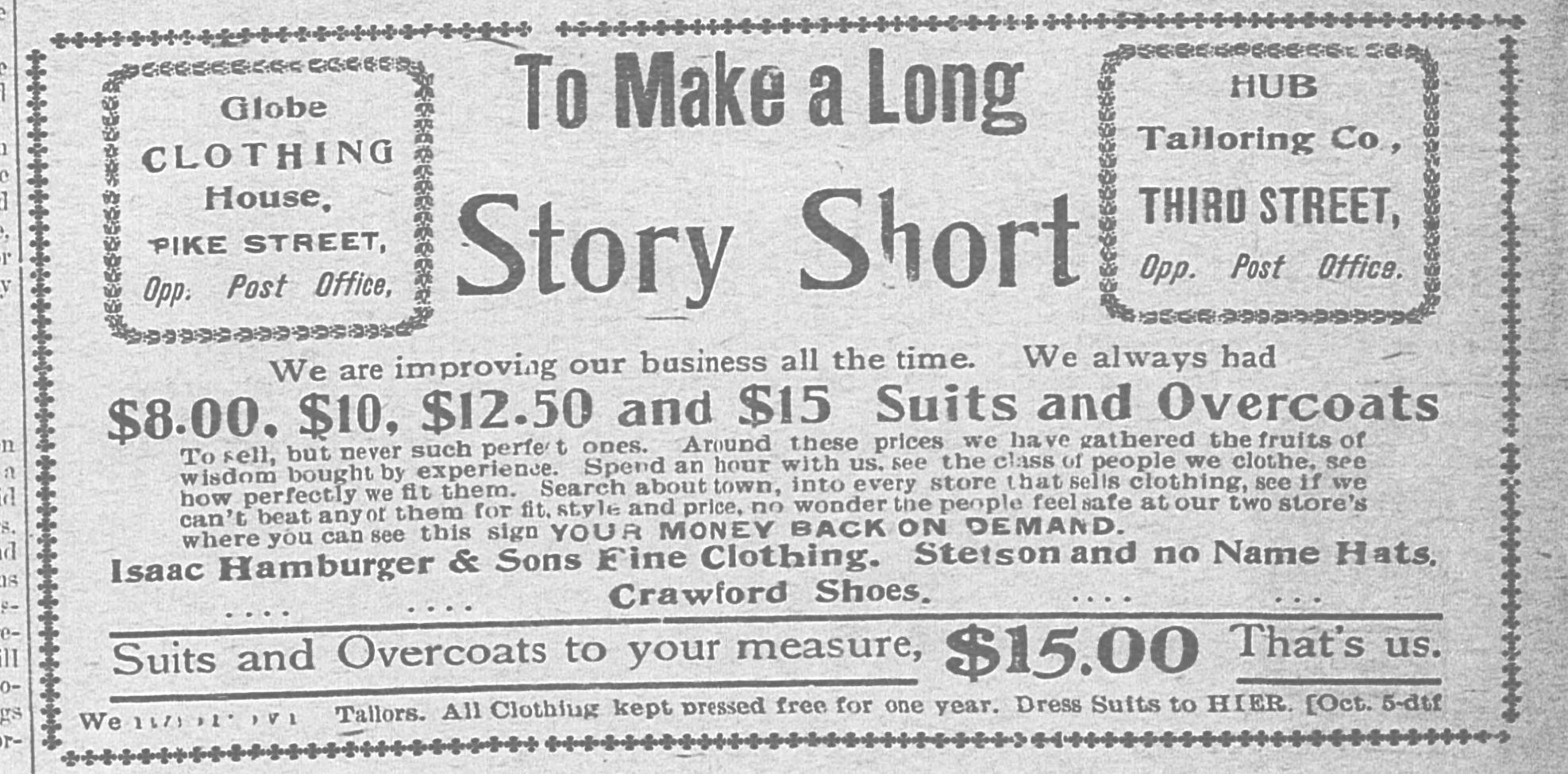
A clothing ad on the same page as the race, The Daily Telegram, Clarksburg, West Virginia, November 6, 1905, page 5. Library of Congress, Chronicling America. Click the picture to see it full size.
Told twice
The paper’s weekly edition, The Clarksburg Telegram, printed the whole story again on Friday, November 10. We found no report of a rematch. For one Saturday afternoon, the road to Quiet Dell belonged to a black mare and a bay gelding, and a crowd at the post office corner waited on the telephones to find out who had won.
Sources
- The Daily Telegram (Clarksburg, West Virginia), November 6, 1905, page 5 (“Novel Horse Race Held Saturday” and the “To Make a Long Story Short” ad), March 10, 1905, page 3 (“Bartlett Sells Interest”), September 13, 1905, page 1 (“Off To The Races”) and December 15, 1905, page 3 (“Mighty Hunters Hauled Home”).
- The Clarksburg Telegram (weekly, Clarksburg, West Virginia), November 10, 1905, page 2 (the same race story, reprinted).
- All newspaper images: Library of Congress, Chronicling America. Published 1905, public domain.
- Drawing: “Clarksburg, West Virginia 1898,” bird’s-eye view by T. M. Fowler and James B. Moyer, Morrisville, Pennsylvania, 1898 (detail: the U.S. Court House and Post Office), Library of Congress, Geography and Map Division. Public domain.
- Postcard: “Clarksburg, W. Va. Main Street Looking East,” mailed December 6, 1904, Wikimedia Commons. Public domain (published before 1931).
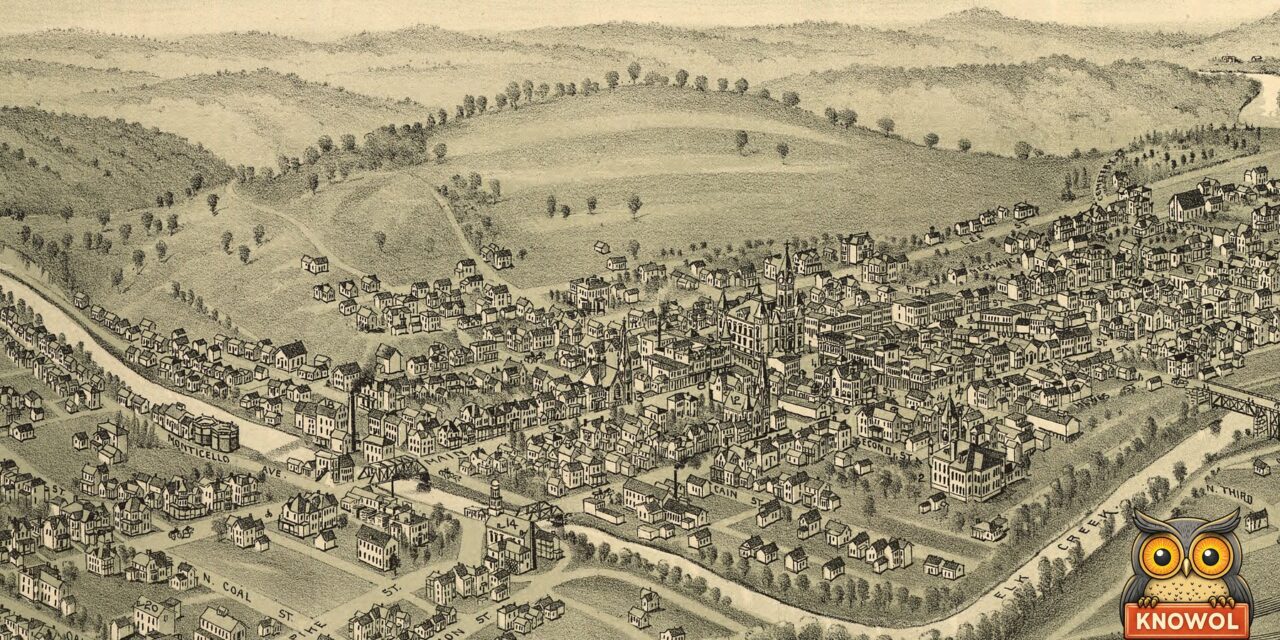
- Cover: detail of “Clarksburg, West Virginia 1898,” bird’s-eye view by T. M. Fowler and James B. Moyer, showing Pike Street, Main Street and Monticello Avenue, where the race began and the two rigs split up, Library of Congress, Geography and Map Division. Public domain.