On the night of March 1, 1900, a few men from Wichita, Kansas, stood on the stage of the Auditorium with a boy, a sack, some sealing wax and a trunk. They put the boy in the sack. They tied it shut and sealed it with wax, so no one could open it without breaking the seal. They put the sack in the trunk and locked it. Then a curtain closed in front of the trunk for about two seconds.
When the curtain opened, the boy was standing out on the platform. The magician was the one inside the sack. The Wichita Daily Eagle called the trunk trick “a stunner,” and the reporter didn’t even try to explain it. “A Wichita committee got the boy, the sack and the wax, put the boy in and locked the trunk,” he wrote. “There’s no telling anything about the rest.”
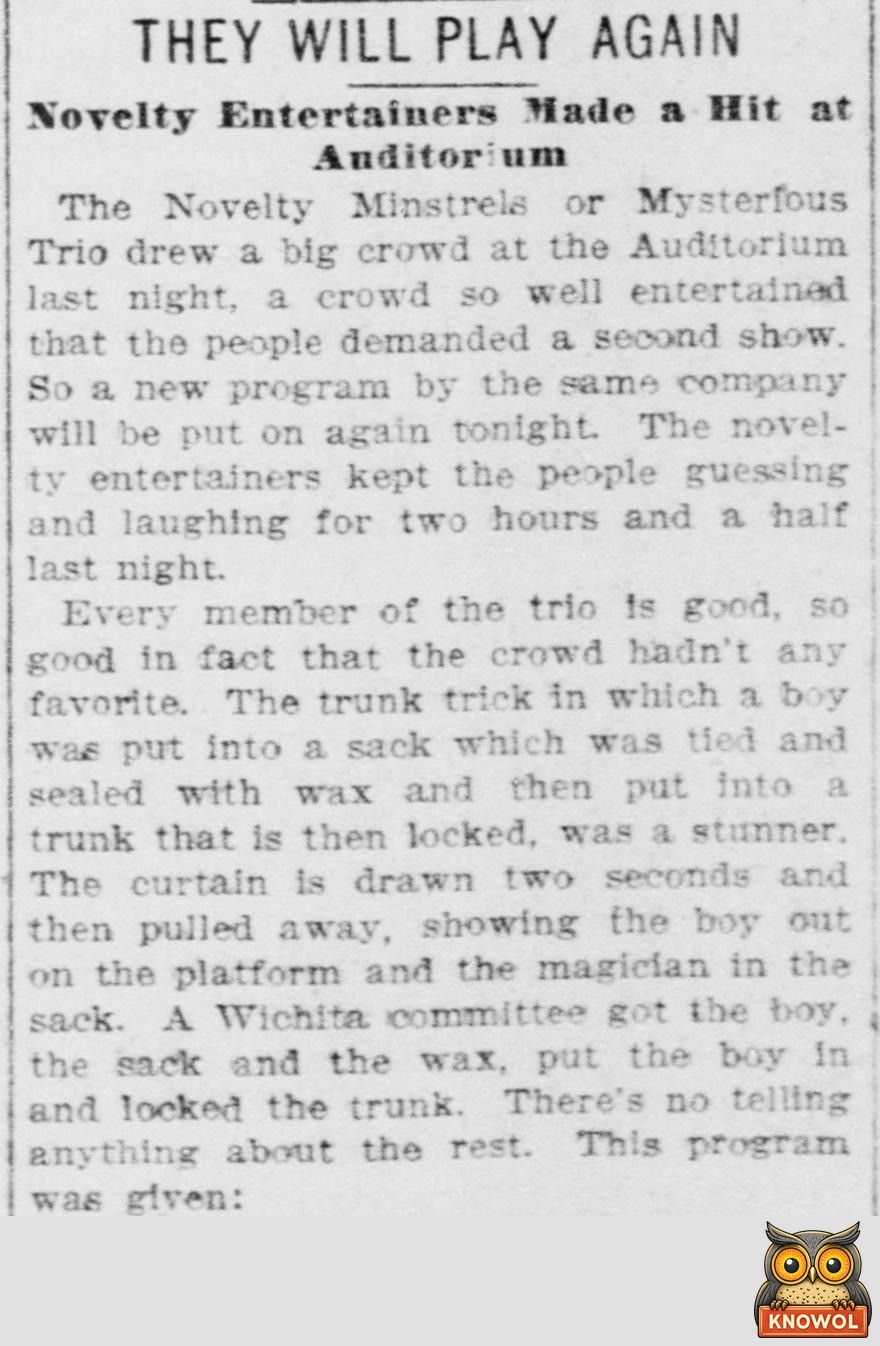
“They Will Play Again.” The Wichita Daily Eagle, Wichita, Kansas, March 2, 1900, page 5. Library of Congress, Chronicling America. Click the clipping to read it full size.
A name in the ads
The magician called himself “Durno.” Wichita readers had been seeing that name for days. On February 20, the Eagle printed a small box that said only “The Mysterious ‘DURNO'” five times on a single page. The boxes sat between ads for gray suits, stoves and groceries. They didn’t say who Durno was or what he did. That was the point. People were supposed to wonder.
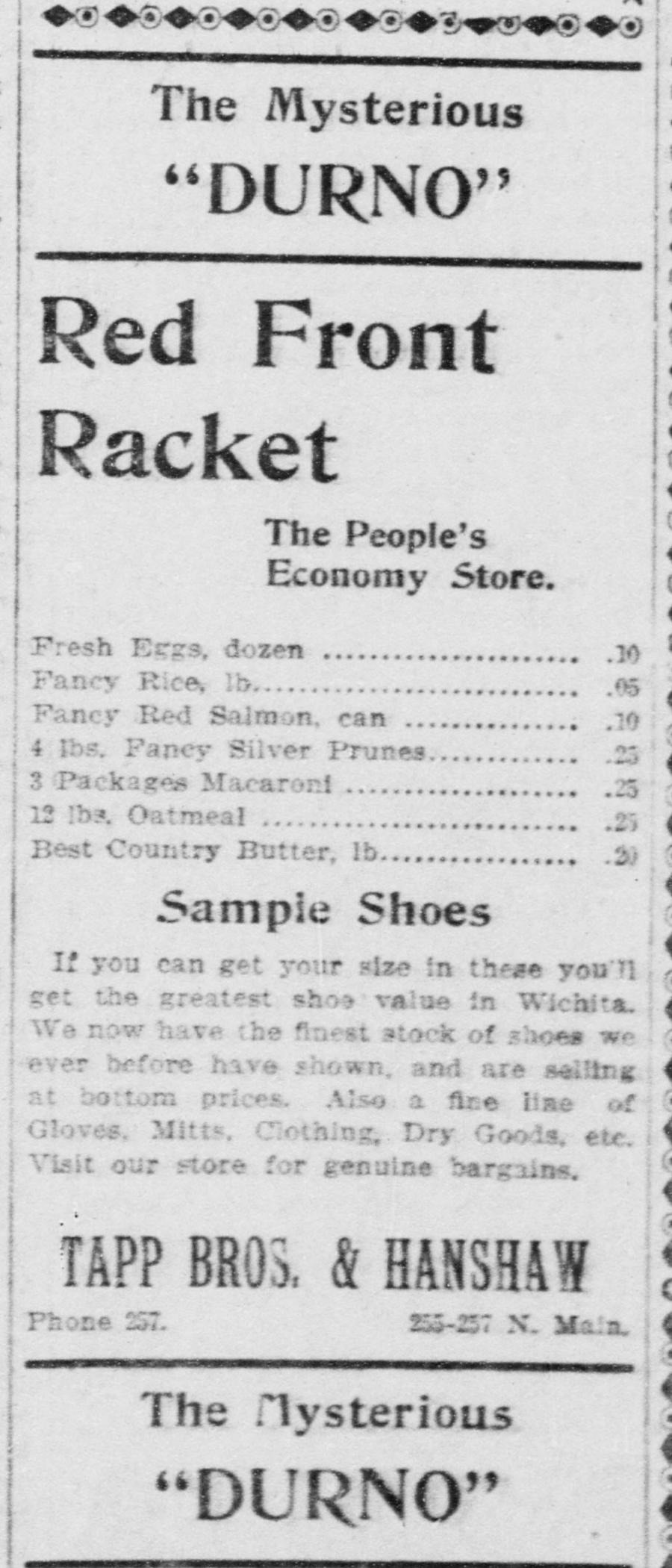
Two of the five “Mysterious Durno” boxes on one page, between grocery and shoe ads. The Wichita Daily Eagle, Wichita, Kansas, February 20, 1900, page 5. Library of Congress, Chronicling America. Click the clipping to read it full size.
A week later the paper explained. Durno was part of “The Mysterious Trio,” three traveling entertainers. Hugh J. Emmett played the violin and was a ventriloquist, the kind of performer who makes a dummy seem to talk. Fred E. Hansell was a whistler. Durno did the magic. On the day of the show, the Eagle said his work was “delightfully fresh and crisp.”
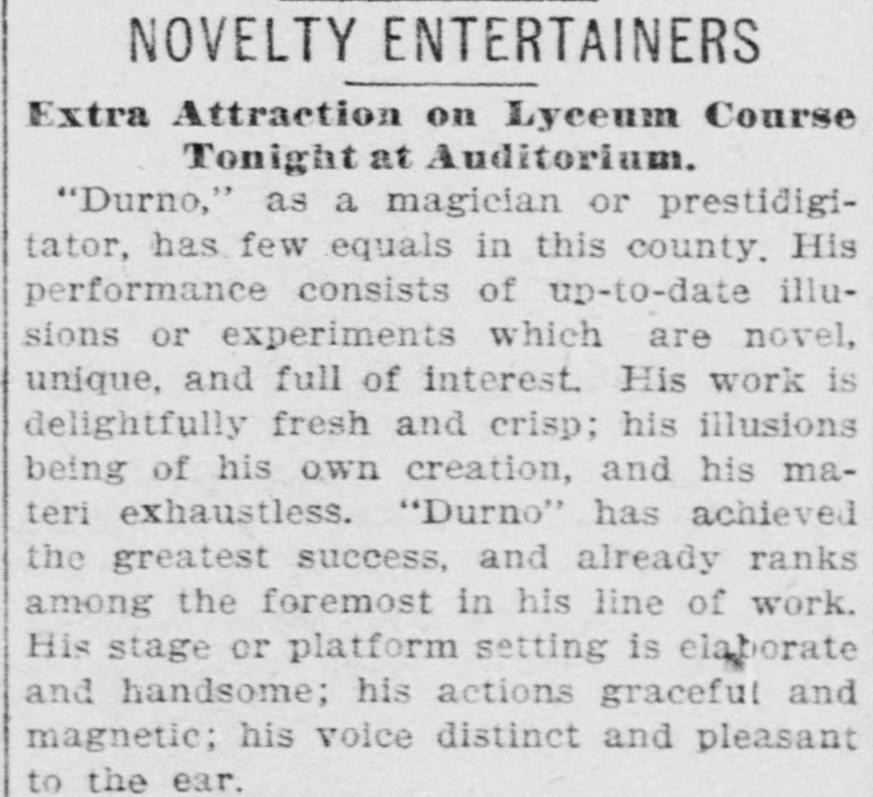
“Novelty Entertainers: Extra Attraction on Lyceum Course Tonight at Auditorium.” The Wichita Daily Eagle, Wichita, Kansas, March 1, 1900, page 6. Library of Congress, Chronicling America. Click the clipping to read it full size.
What a ticket cost
The trio came as an “extra” on the Wichita lyceum course. A lyceum course was a season of lectures, concerts and shows. People could buy one ticket for the whole season, a little like a season pass today. For this extra night, the paper printed the prices: “Ticket holders 10 cents; others 50 cents.”
Ten cents doesn’t sound like much, and it wasn’t. A grocery ad right under one of the Durno boxes sold fresh eggs for 10 cents a dozen. So a season-ticket holder saw the show for the price of a dozen eggs. Everyone else paid the price of five dozen.
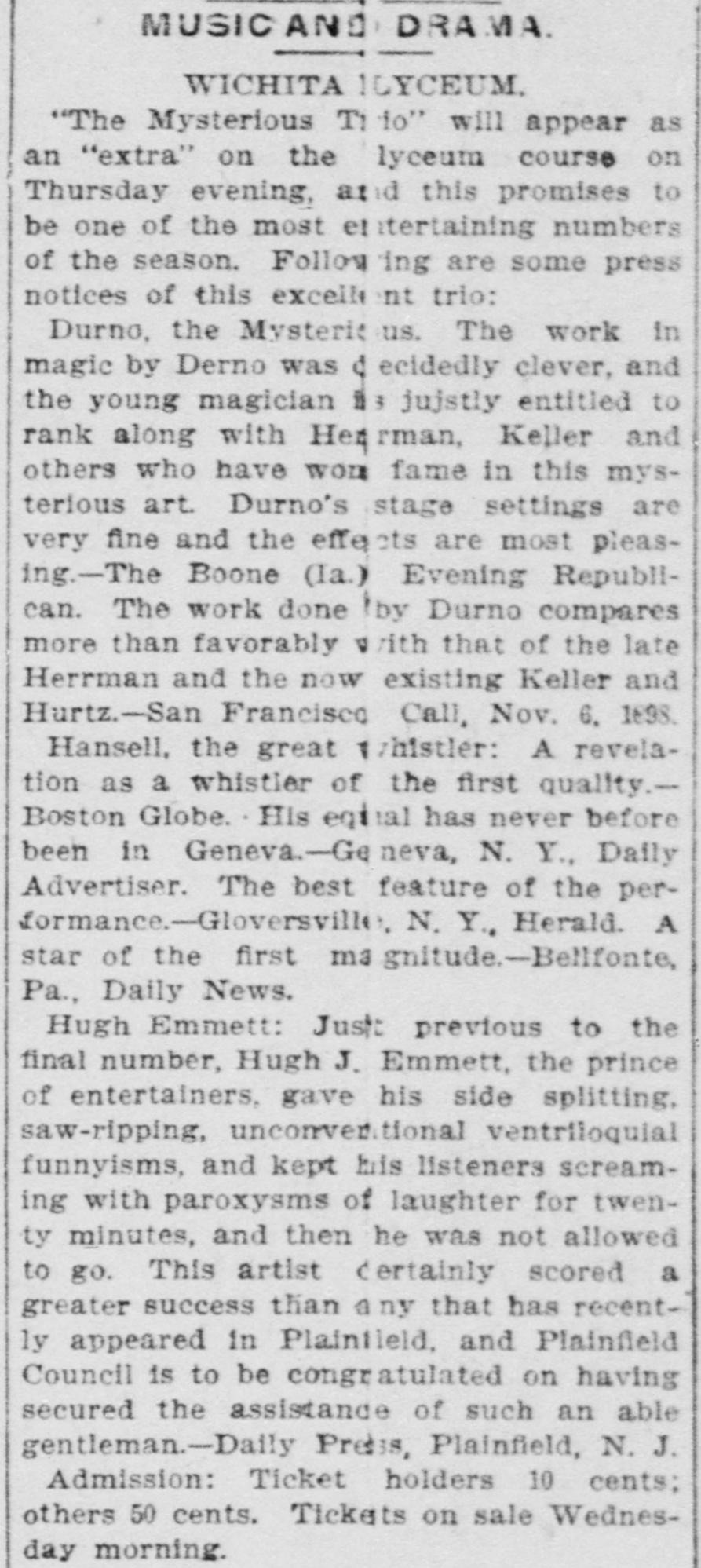
“Wichita Lyceum,” with the trio’s press notices and the ticket prices. The Wichita Daily Eagle, Wichita, Kansas, February 27, 1900, page 3. Library of Congress, Chronicling America. Click the clipping to read it full size.
Two and a half hours of guessing
The show ran long. The trio “kept the people guessing and laughing for two hours and a half,” the Eagle said. Every member was “so good in fact that the crowd hadn’t any favorite.”
Durno’s part of the program had names like “A Restored Hat,” “Money to Burn” and “Instantaneous Growth of Real Rose Bushes.” The trunk trick was listed as “The Metamarphose,” spelled just that way. The program promised “the dematerialization of human bodies.” That’s a fancy way of saying people would seem to melt into thin air.
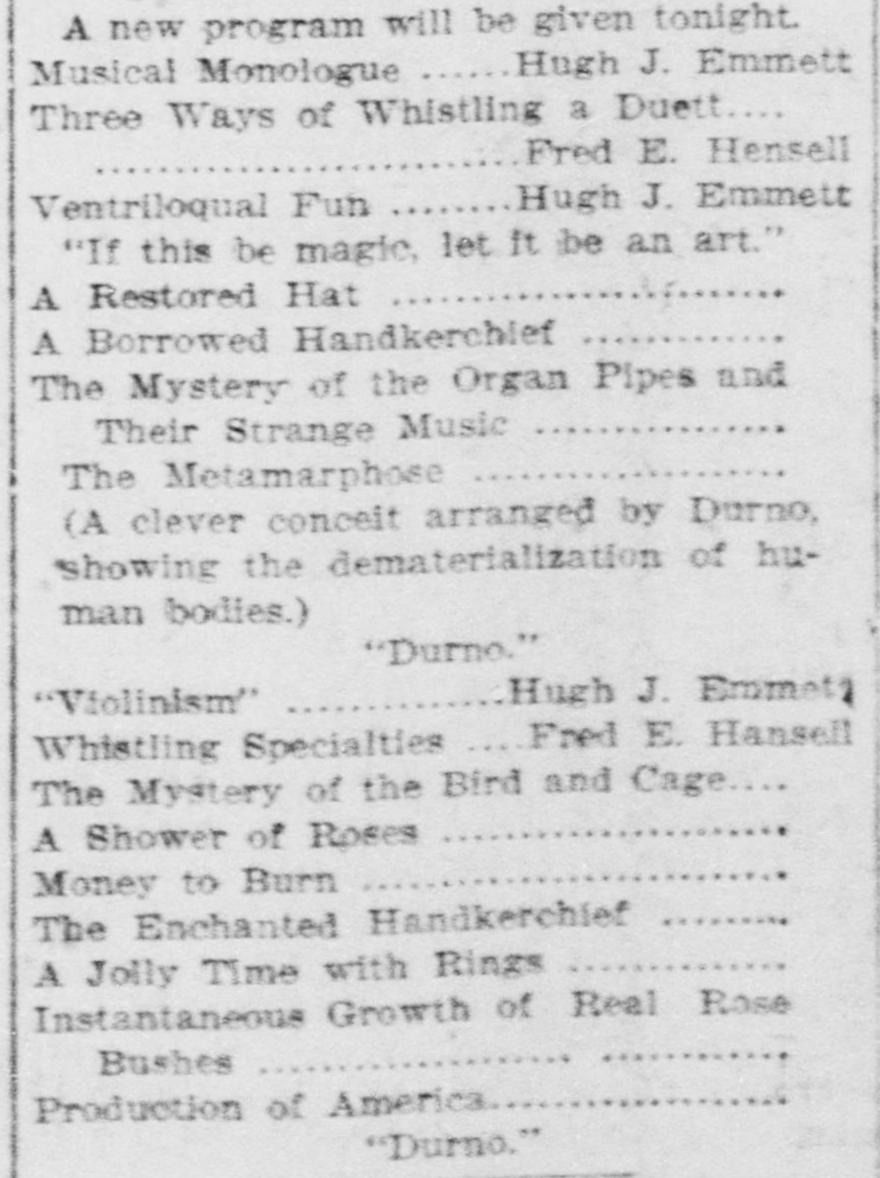
The program from the first night, with the trunk trick listed as “The Metamarphose.” The Wichita Daily Eagle, Wichita, Kansas, March 2, 1900, page 5. Library of Congress, Chronicling America. Click the clipping to read it full size.
When it was over, the people “demanded a second show.” So the paper announced a new program by the same company for the very next night.
How the trick probably worked
Durno never told. He kept doing the trick, though, town after town. On April 25, 1901, he did it in Mankato, Minnesota, and the Mankato Free Press wrote down every step.
The audience picked two men, Judge Cray and George T. Barr, to check “a strong iron bound trunk.” Durno’s assistant got into the sack, and Mr. Barr tied and sealed it himself. Then he locked the trunk and “put the key in his pocket.” A rope went around the trunk, too. Durno closed a curtain in front of it. The two men clapped their hands and ran forward as fast as they could. There, by the trunk, stood only “the assistant.” The rope was still tied. The trunk was still locked. The seal on the sack was not broken. “The cord was cut and, lo, Durno arose.”
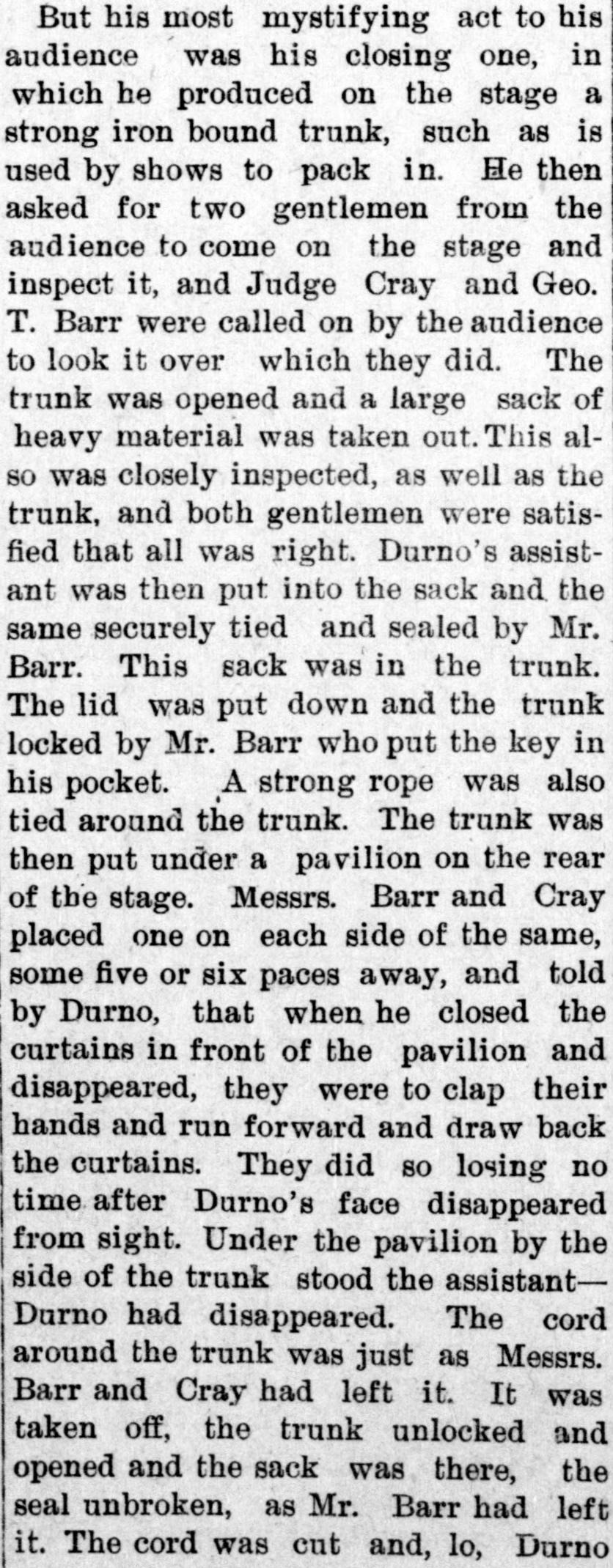
Judge Cray and George T. Barr check the trunk. The Mankato Free Press, Mankato, Minnesota, April 26, 1901, page 1. Library of Congress, Chronicling America. Click the clipping to read it full size.
The Free Press made a guess. It thought there was “a secret door in the trunk,” which Durno was careful to keep clear of the rope. And it thought the sack opened “at the bottom by pulling out a thread.” In other words, the knot and the wax on top were real, but the bottom of the sack was held shut by a thread that could be pulled out. Even so, the paper couldn’t explain how he moved so fast. “But Durno is a master of his art,” it said.
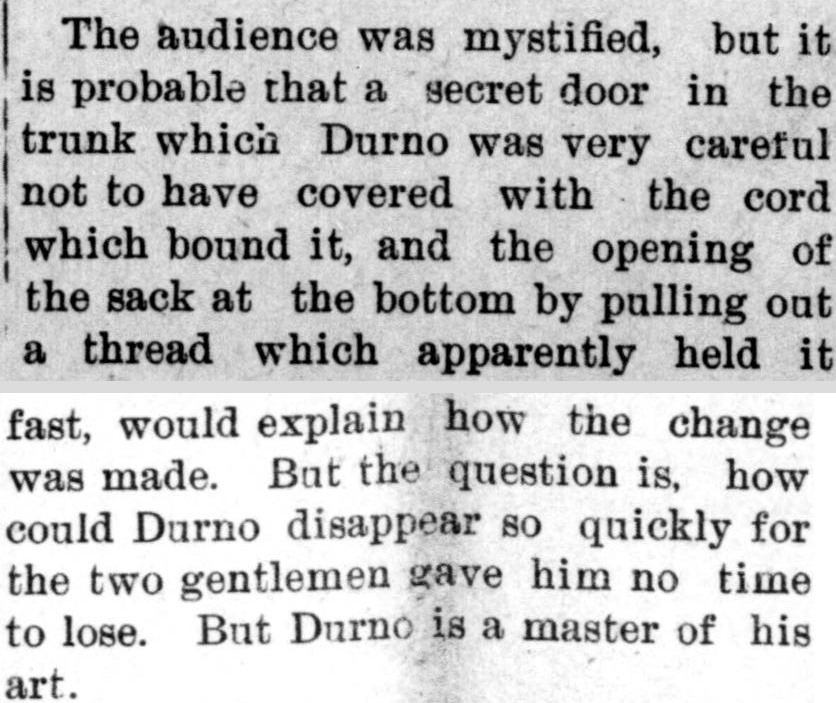
The Mankato paper’s guess: a secret door and a thread. The Mankato Free Press, Mankato, Minnesota, April 26, 1901, page 1. Library of Congress, Chronicling America. Click the clipping to read it full size.
The paper in Yale, Michigan, had more fun with it. There, in February 1901, the trunk was “locked and securely roped by the committee,” and still “out popped Durno himself, who wasn’t put in at all, at all.” The Yale Expositor said, “Space forbids us telling just how the trick was triggered.” It sent anyone curious to “two of Yale’s most talented citizens and able attorneys, who will be happy to tell you all they know about it.” Readers could guess how much that was.
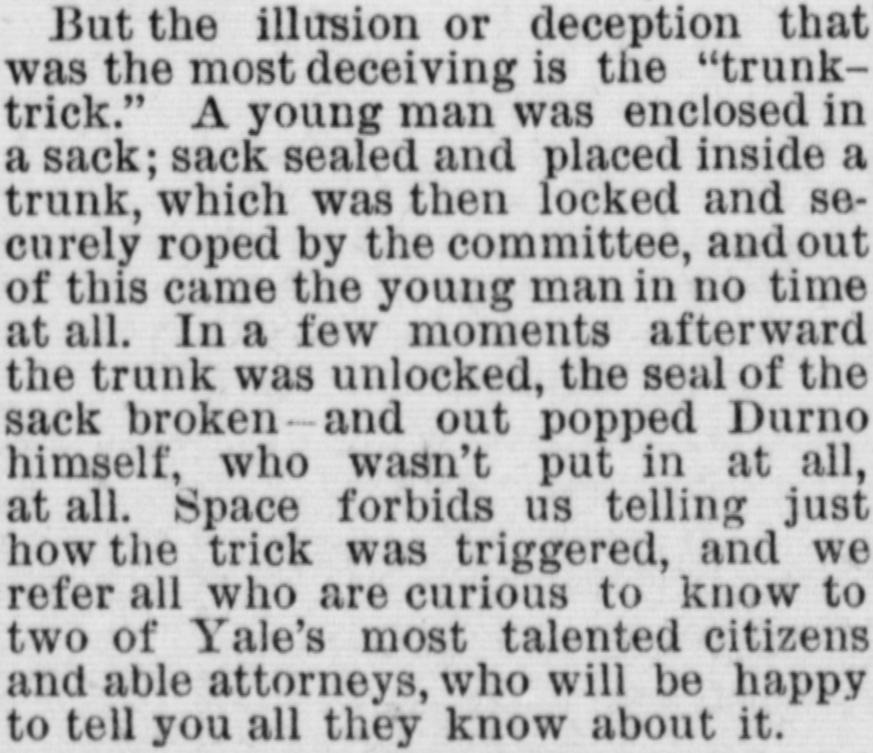
The “trunk trick” in Yale. The Yale Expositor, Yale, Michigan, February 8, 1901, page 1. Library of Congress, Chronicling America. Click the clipping to read it full size.
The same trick as Houdini
Durno wasn’t the only magician with a trunk like that. Around 1895, a young husband-and-wife team, Harry and Bessie Houdini, printed a handbill for the same kind of trick. They called it “Metamorphosis,” a word that means a complete change. Their handbill said a “Committee selected from the Audience” checked everything. Its big promise: “EXCHANGE MADE IN 3 SECONDS.” In Wichita, the Eagle said Durno needed about two.
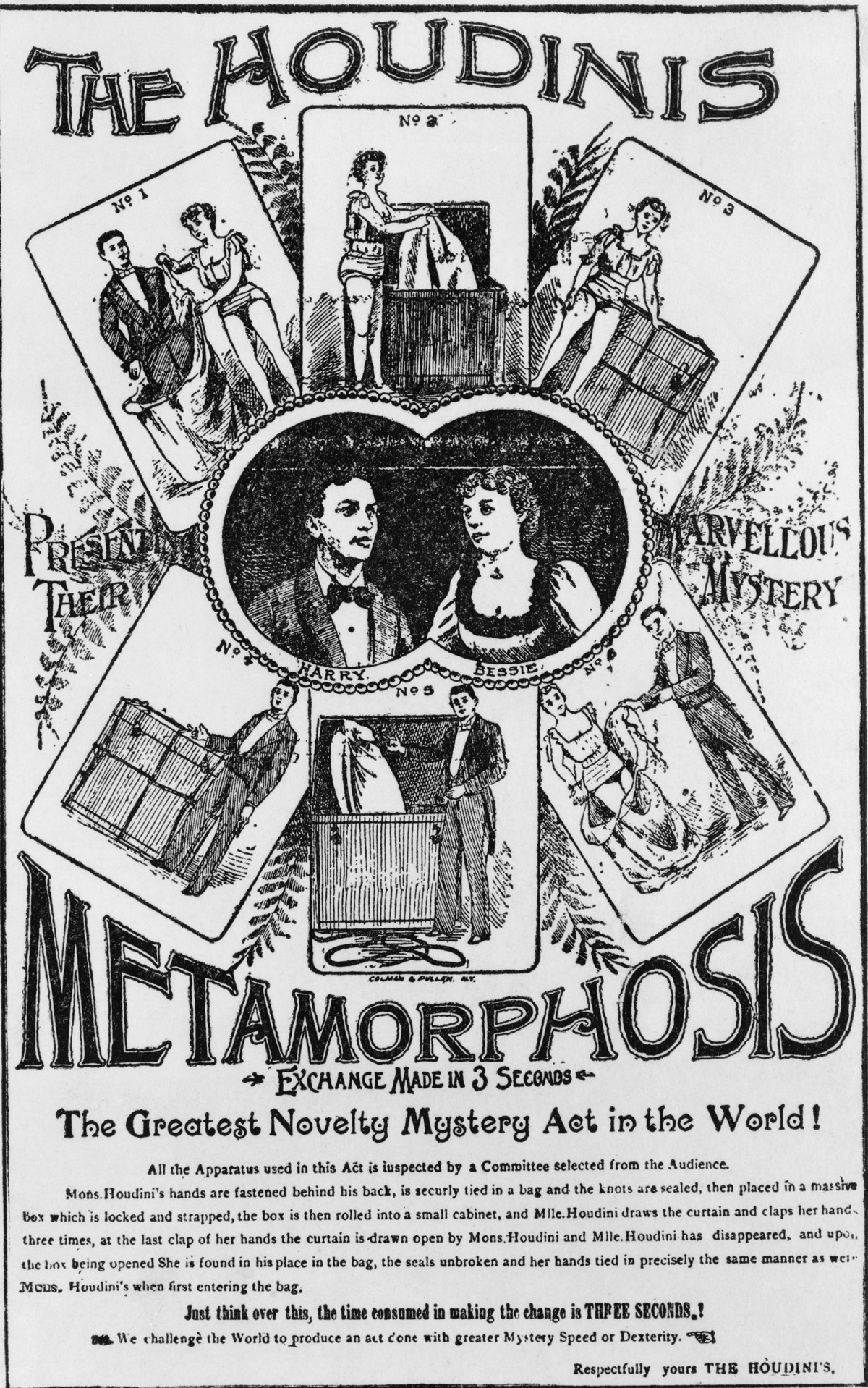
The Houdinis’ handbill for “Metamorphosis,” about 1895. McManus-Young Collection, Library of Congress. Click the picture to see it full size.
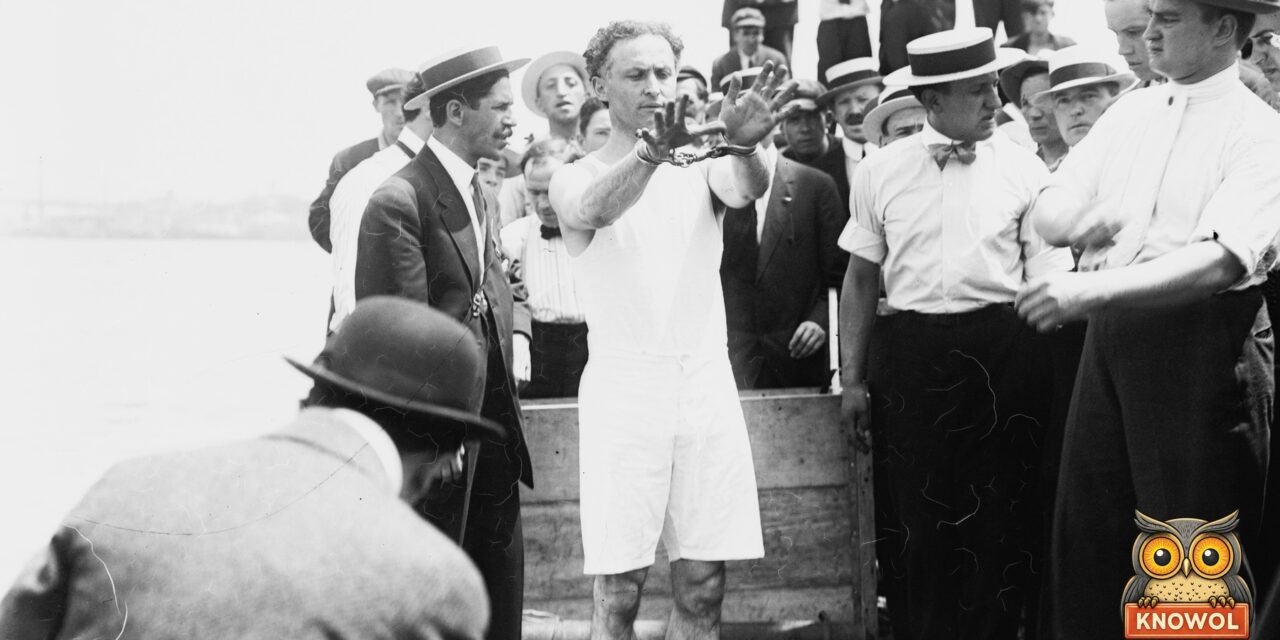
Harry Houdini went on to become the most famous escape artist in the world. The photo at the top of this story shows him in July 1912, handcuffed beside a wooden box, while a crowd of men in straw hats looks on. It’s a different man, a different box and a different year, but it’s the same idea that thrilled Wichita in 1900: let people from the crowd check everything, then do the impossible anyway.
By the numbers
- 2 seconds: about how long the curtain stayed closed in Wichita.
- 5 times: “The Mysterious ‘DURNO'” appeared on one page of the Eagle.
- 10 cents: a season-ticket holder’s seat, the same as a dozen eggs.
- 2 and a half hours: how long the first show ran.
- 1 key, which Mr. Barr put in his own pocket, in Mankato.
Back in Wichita, the committee had done everything right. They chose the boy. They held the sack and the wax. They turned the key. Two seconds later, the boy was standing on the platform and Durno was tied up in his place. The Eagle’s reporter summed it up best, and more than 120 years later it still holds: “There’s no telling anything about the rest.”
Sources
- The Wichita Daily Eagle (Wichita, Kansas): “They Will Play Again,” March 2, 1900, page 5; “Novelty Entertainers,” March 1, 1900, page 6; “Wichita Lyceum,” February 27, 1900, page 3; the “Mysterious Durno” boxes, February 20, 1900, page 5. Page scans from the Library of Congress, Chronicling America.
- “Sly Durno,” The Mankato Free Press (Mankato, Minnesota), April 26, 1901, page 1. Library of Congress, Chronicling America.
- “Durno-Emmett Combination,” The Yale Expositor (Yale, Michigan), February 8, 1901, page 1. Library of Congress, Chronicling America.
- Pictures: “Houdini” (the cover; Bain News Service, July 1912), George Grantham Bain Collection, no known restrictions on publication; “The Houdinis perform Metamorphosis” (handbill, about 1895), McManus-Young Collection, published before 1931. Library of Congress.