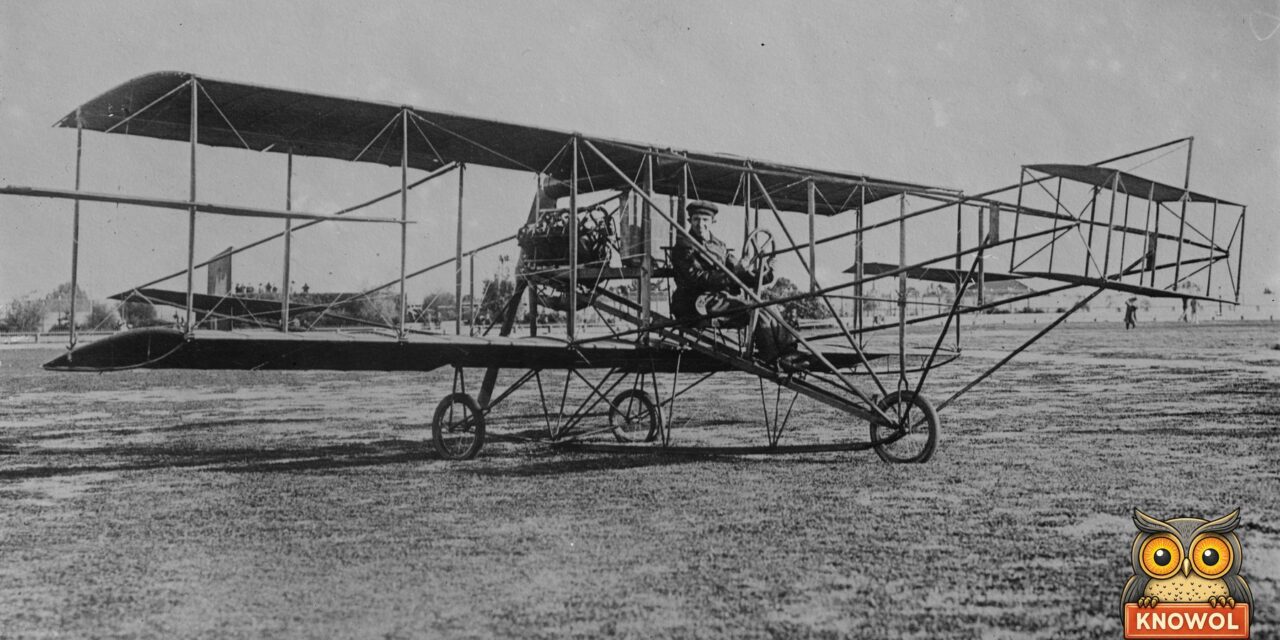
On Saturday afternoon, April 23, 1910, a newspaperman named Frank Tillman climbed onto a flying machine at Highland Park in San Antonio, Texas. The flyer at the wheel was Charles K. Hamilton. Thousands of people watched from the grandstand. Hamilton gave a signal, his helpers let go, and the machine shot across the field. Tillman worked for the San Antonio Light and Gazette, and he had one job when he got back down. He had to tell the town how it felt.
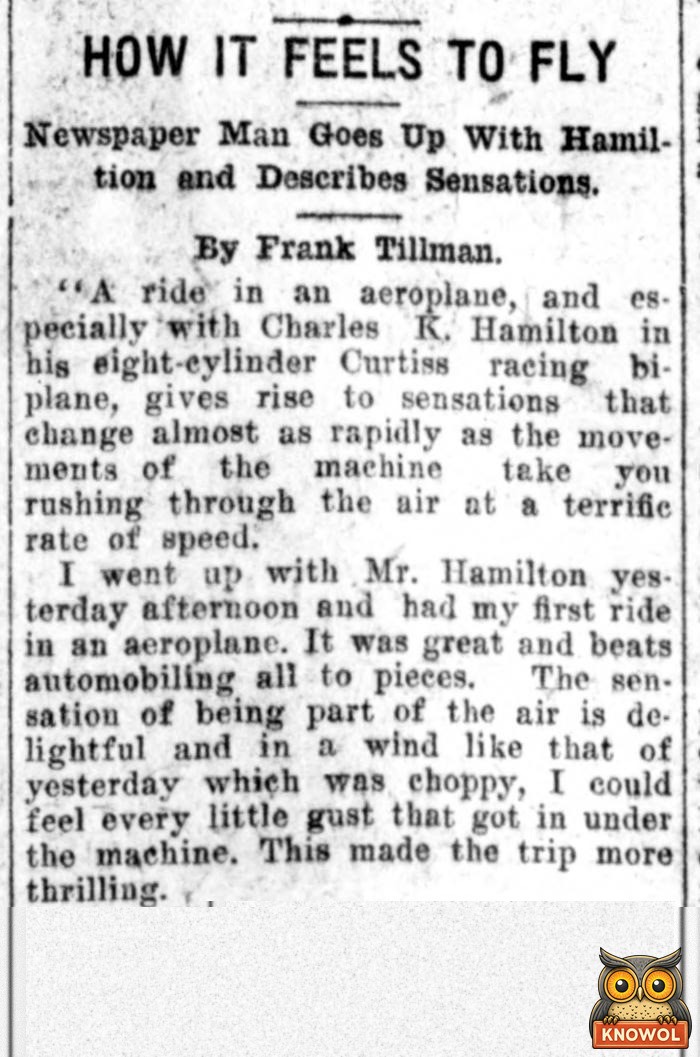
“How It Feels to Fly,” by Frank Tillman. San Antonio Light and Gazette, San Antonio, Texas, April 24, 1910, page 2. Library of Congress, Chronicling America. Click the clipping to read it full size.
A showman’s big promises
The story started in February, when a showman named K. L. Bernard came to town. He spoke for three famous flyers: Glenn Curtiss, Charles Willard and Hamilton. He wanted to bring them to San Antonio’s Spring Carnival in April, and he had big plans.
He told the Light and Gazette he would try for “the first aeroplane procession in the air ever held in San Antonio.” (Aeroplane is the old spelling of airplane.) On a parade night, his flyers would fly right over the marchers. “The airships will carry red fire,” he said, so the people below “can plainly see the men operating the machines.” Red fire was a flare that burned bright red.
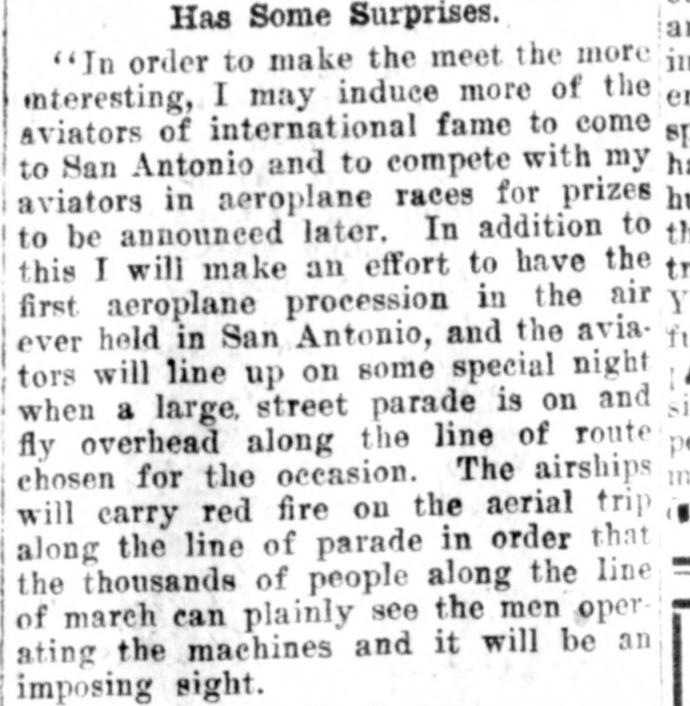
Mr. Bernard promises an airplane parade with red fire. San Antonio Light and Gazette, San Antonio, Texas, February 6, 1910, page 3. Library of Congress, Chronicling America. Click the clipping to read it full size.
Bernard also asked a young woman to ride along. Miss Henrietta Buckler of El Paso was spending the winter in San Antonio with her mother, and she said yes. Her mother had something to say about that. “She is the only daughter we have,” Mrs. Buckler said, “and we do not care to take the risk of losing her at this time.” She called the offer kind, and then she said “but.” “And she meant that ‘but,'” the paper wrote.
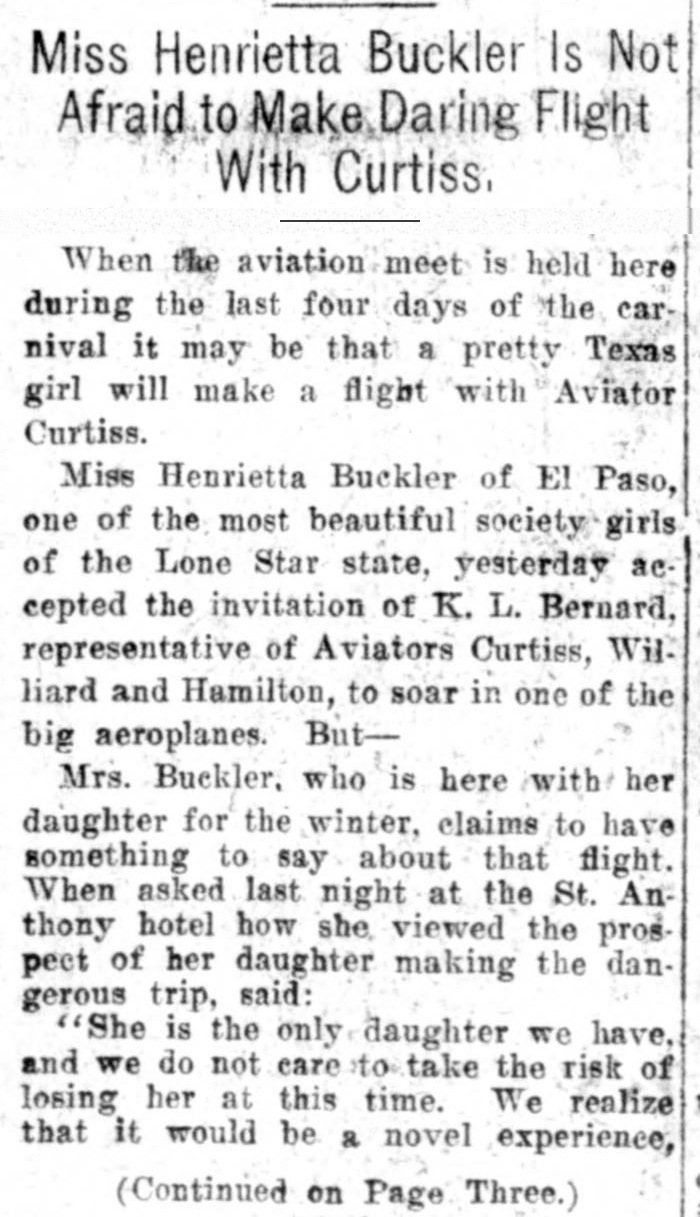
A daughter says yes and a mother says “but.” The headline and the story’s opening, joined. San Antonio Light and Gazette, San Antonio, Texas, February 6, 1910, page 1. Library of Congress, Chronicling America. Click the clipping to read it full size.
A town catches “aeroplaneitis”
Curtiss reached San Antonio on April 14. By the next day the paper had a name for what was going around: “‘Aeroplaneitis,’ the latest disease, has become epidemic in San Antonio.” An epidemic is a sickness that spreads fast. This one was a joke. Opening day was planned “especially for school children,” and a child’s ticket cost 25 cents.
Before the meet even opened, Curtiss told the paper that one of his first San Antonio passengers would be “Frank Tillman, of The Light and Gazette editorial staff.” A line in the headline said it plainly: “Light and Gazette Man to Go Up.”
Five seconds to get off the ground
Saturday, April 23, was the big day. That afternoon Curtiss went after a world record. The contest was the quick start: how fast a flyer could go from standing still to wheels off the ground. Curtiss was in the air in “five seconds and one-fifth,” beating his own best. Two days later the news was in the New-York Tribune.
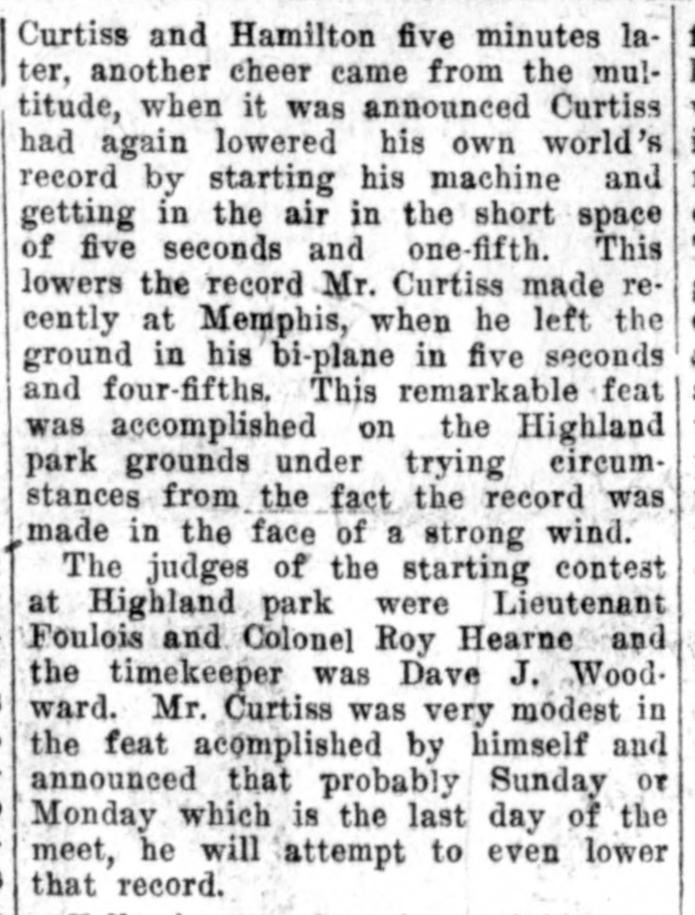
“Five seconds and one-fifth.” San Antonio Light and Gazette, San Antonio, Texas, April 24, 1910, page 2. Library of Congress, Chronicling America. Click the clipping to read it full size.
Three quarters of a mile
Then came the rides. The paper said “two army officers and two newspaper men were given a ride.” Hamilton, the flyer the paper called the “man with the iron nerve,” took Tillman.
It was not a long trip. Each rider went “three quarters of a mile across the course,” at “some sixty feet from the ground.” That is about as high as a five-story building.
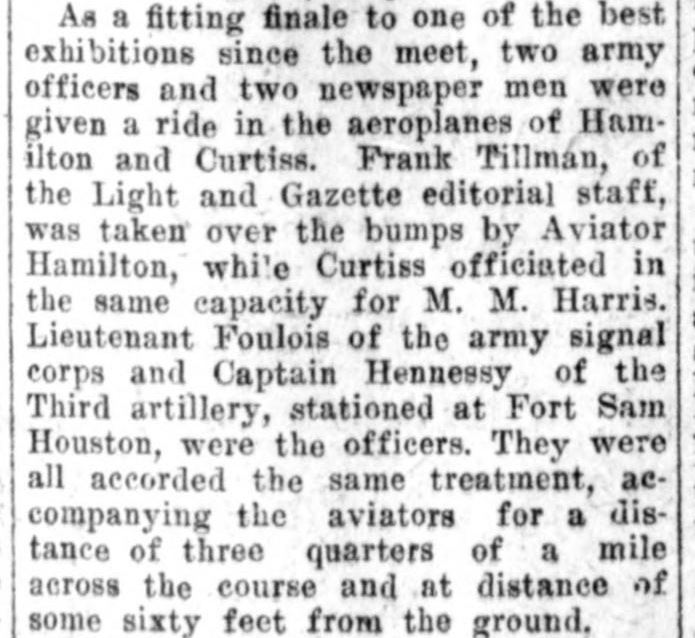
Who got a ride, how far and how high. San Antonio Light and Gazette, San Antonio, Texas, April 24, 1910, page 2. Library of Congress, Chronicling America. Click the clipping to read it full size.
The photo at the top of this story shows a machine of that kind. Bain News Service labeled it “Hamilton in Aeroplane.” The flyer sits out front with the motor right behind his back. The record gives no place or date.
“It beats automobiling all to pieces”
The next morning, Tillman’s story ran under the headline “How It Feels to Fly.” “I went up with Mr. Hamilton yesterday afternoon and had my first ride in an aeroplane,” he wrote. “It was great and beats automobiling all to pieces.” Automobiling just meant riding in a car, which was still a new thrill itself.
While the wheels were on the ground, he wrote, it was “similar to riding in an auto except for the thunderous roar of the motor behind me.” Then the ground let go. “The second the machine leaves the ground you can feel yourself being carried up.” The wind was choppy that day, and he could feel “every little gust that got in under the machine.”
Then he looked down, and he was sorry he did. “I found that watching the retreating earth didn’t agree with me so I watched Mr. Hamilton manipulate the steering gear.” In plain words, the ground rushing away made him feel funny, so he stared at the flyer’s hands on the wheel instead.
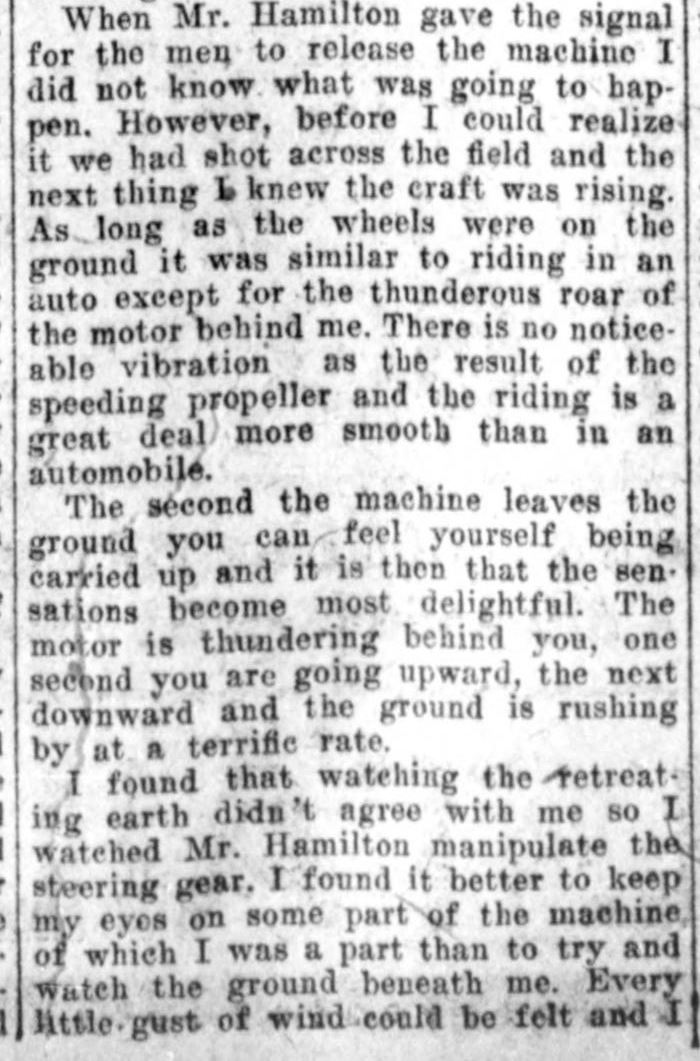
The takeoff, and the look down that “didn’t agree with me.” San Antonio Light and Gazette, San Antonio, Texas, April 24, 1910, page 2. Library of Congress, Chronicling America. Click the clipping to read it full size.
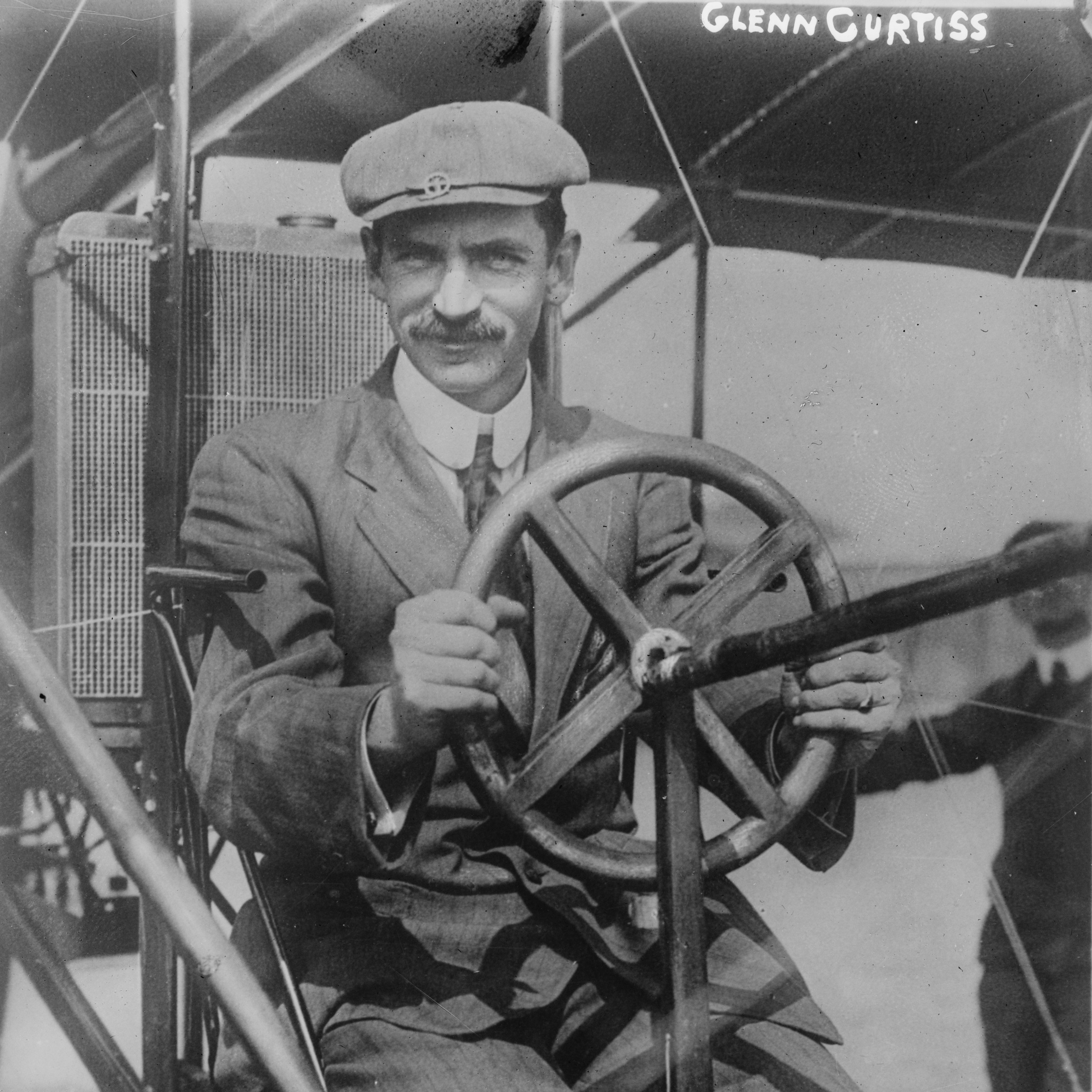
Glenn Curtiss at the wheel of his biplane, a flying machine with two wings, one above the other. A wheel like this was the “steering gear” Tillman kept his eyes on. Bain News Service, no date on the record. Library of Congress. Click the picture to see it full size.
He braced for a hard landing and never got one. “When we landed I expected a jar, but it was all over before I knew it.” By then he had caught the town’s sickness too. “I can readily see why ‘aeroplanitis’ is becoming a mania,” he wrote, and he hoped to go up again on Sunday “for a good little spin.”
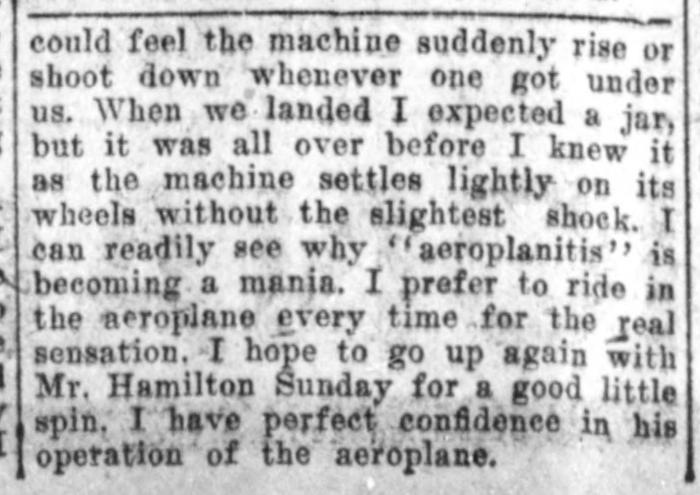
The landing, from the end of Tillman’s story at the top of the next column. San Antonio Light and Gazette, San Antonio, Texas, April 24, 1910, page 2. Library of Congress, Chronicling America. Click the clipping to read it full size.
What the town got out of it
Sunday morning the wind blew thirty miles an hour. Hamilton flew anyway and got off the ground in “three and one eighth seconds,” faster than Curtiss. But no judges were there to see it. L. P. Peck, who was giving one of the prize cups, said it was like “a horse race.” No judges meant no prize. On Monday night Hamilton got Peck’s cup anyway, “for being the best all-around aviator.” An aviator is a flyer.
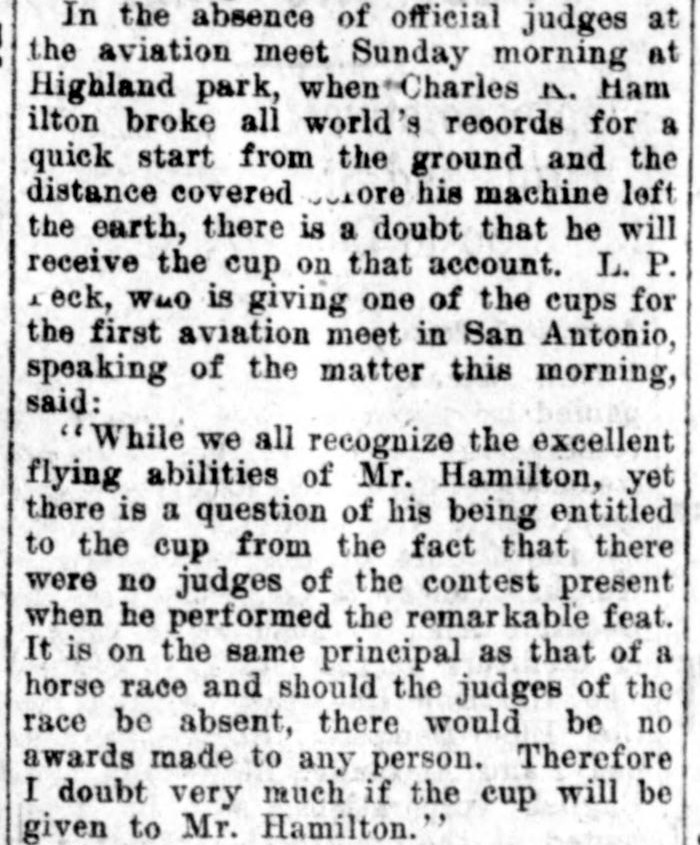
No judges, no cup. San Antonio Light and Gazette, San Antonio, Texas, April 25, 1910, page 3. Library of Congress, Chronicling America. Click the clipping to read it full size.
The night parade in the sky never shows up in the paper’s reports of the meet, and neither does a ride for Miss Buckler. The Spring Carnival’s secretary called the windy meet “a poor financial venture.” He also said it “gave San Antonio more advertising than any other event held here in the history of the city.”
One man on the field took home an idea. Lieutenant Benjamin Foulois had been flying the Army’s Wright biplane at Fort Sam Houston in San Antonio since March. The Smithsonian says it was built with no wheels, only skids, like a sled. Foulois took a ride on Saturday too. Two days later, the paper said he would “discard the starting device he is now using and adopt wheels, such as are being used by the aviators at this meet.” That airplane is in the Smithsonian today.
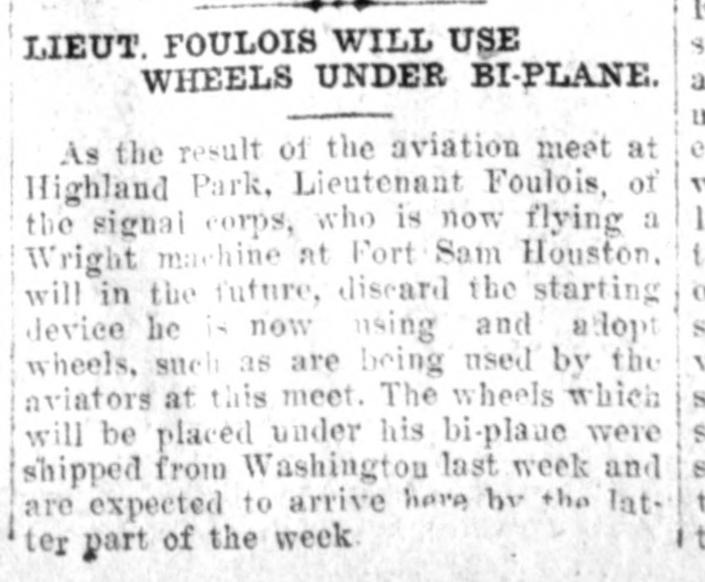
The Army’s flyer decides to try wheels. San Antonio Light and Gazette, San Antonio, Texas, April 25, 1910, page 3. Library of Congress, Chronicling America. Click the clipping to read it full size.
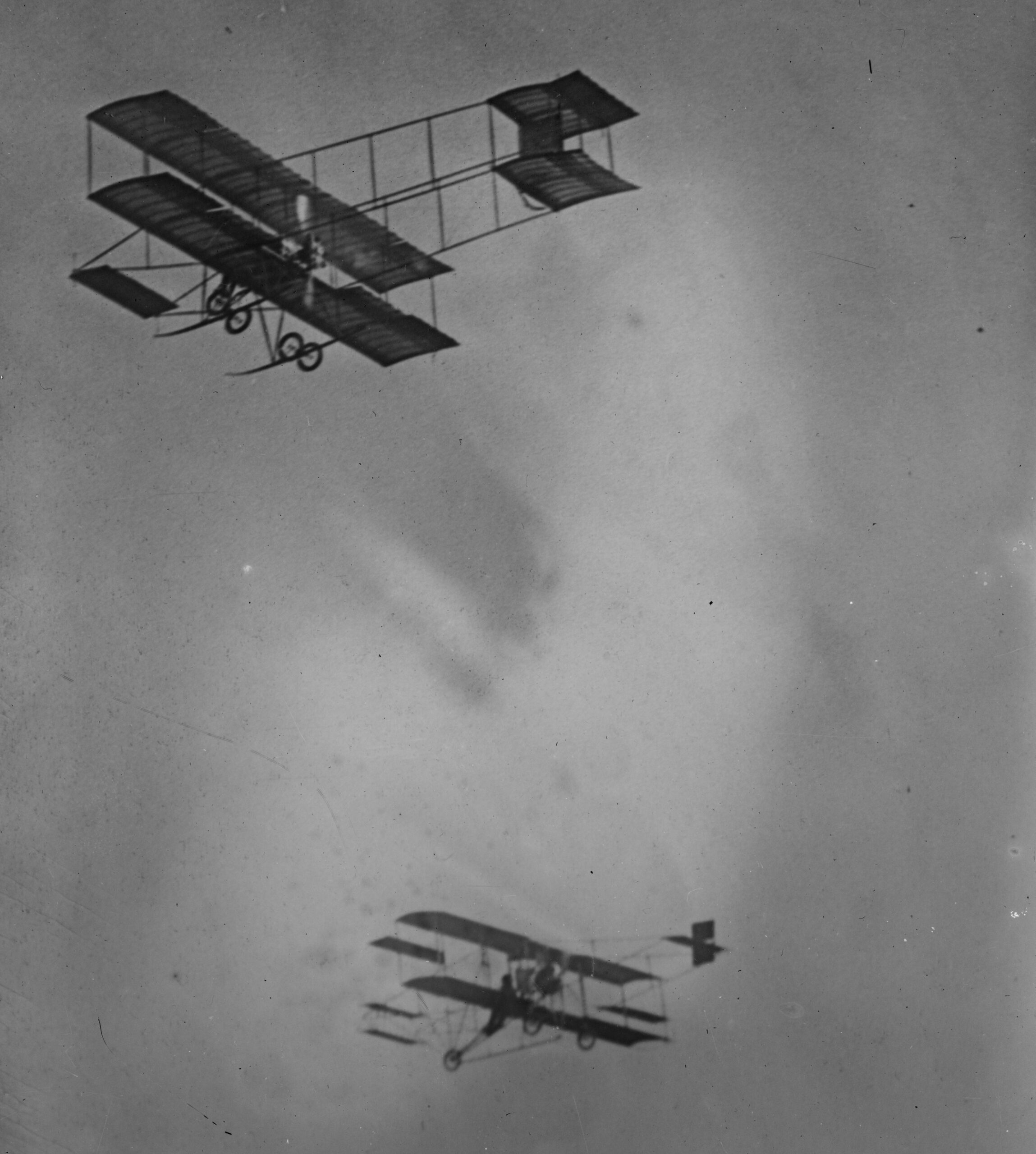
Two flying machines in the air. Bain News Service labeled the glass negative “Paulhan & Hamilton, Los Angeles.” No date on the record. Library of Congress. Click the picture to see it full size.
Today millions of people fly, and plenty of them nap through the whole trip. In 1910, San Antonio needed a newspaperman to go up and find out what it was like. Frank Tillman went three quarters of a mile, sixty feet off the ground, and came down with the news. It beats automobiling all to pieces. Just keep your eyes on the man at the wheel.
Sources
- San Antonio Light and Gazette (San Antonio, Texas), April 24, 1910: “Breaks All Records for Starting,” page 1, and the rest of that story with “How It Feels to Fly,” by Frank Tillman, page 2. Library of Congress, Chronicling America.
- San Antonio Light and Gazette, February 6, 1910: “Miss Henrietta Buckler Is Not Afraid to Make Daring Flight With Curtiss,” page 1, and “Society Girl Would Sail in Aeroplane,” page 3, with Mr. Bernard’s promises. Library of Congress, Chronicling America.
- San Antonio Light and Gazette, before the meet: “Glenn Curtis, King of the Air, Offers City Permanent Aviation Quarters Here,” April 14, 1910, page 1; “Rare Stunts in the Air,” April 15, 1910, page 1; school children’s tickets, April 17, 1910, page 24; “Conditions Are Perfect,” April 23, 1910, page 1. Library of Congress, Chronicling America.
- San Antonio Light and Gazette, after the rides: “More Flights Today” and “Lieut. Foulois Will Use Wheels Under Bi-Plane,” April 25, 1910, page 3; “Curtiss Get Cup,” April 26, 1910, page 2; “Flyers Advertise City,” April 26, 1910, page 12. Library of Congress, Chronicling America.
- “New Aeroplane Record,” New-York Tribune (New York, New York), April 25, 1910, page 2. Library of Congress, Chronicling America.
- 1909 Wright Military Flyer, Smithsonian National Air and Space Museum, for the Army airplane’s skids and its 1910 wheels. “Aviation,” Handbook of Texas Online, Texas State Historical Association, for Lieutenant Foulois at Fort Sam Houston.
- Photos: “Hamilton in Aeroplane” (the cover), “Glenn Curtiss at pilot’s wheel of his biplane” and “Paulhan and Hamilton aeroplanes in flight, Los Angeles”, Bain News Service, Library of Congress Prints and Photographs Division, no known restrictions on publication.