
A river town of two villages, Agawam Center and Feeding Hills, on the west bank of the Connecticut across from Springfield, where the first house in western Massachusetts went up on House Meadow in 1635.
Agawam on the map
Click the map to look closer.
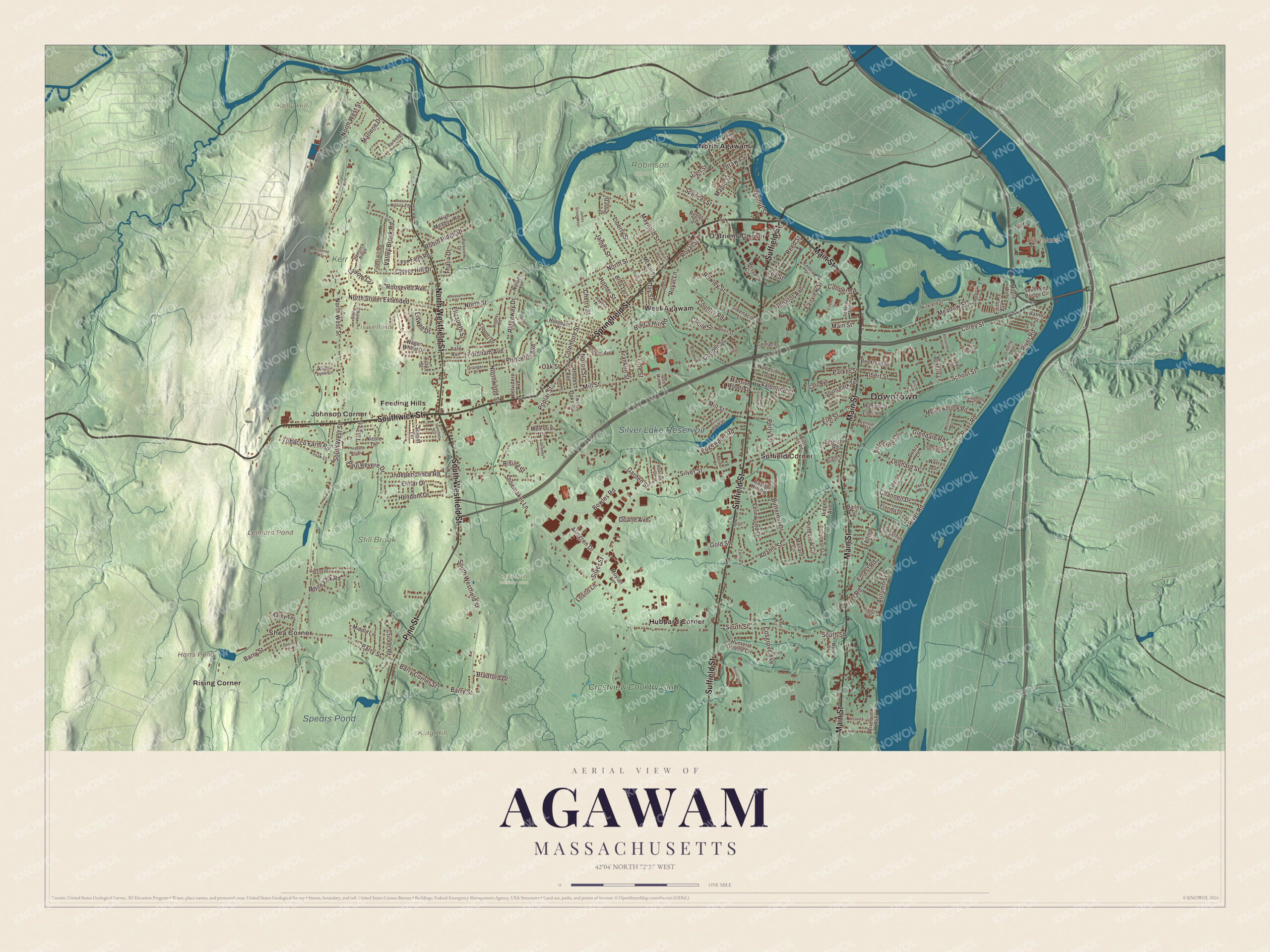
Agawam today
By KNOWOL
Shaded terrain rising to Provin Mountain on the western line, every road from Main Street to South Westfield Street on both sides of Line Street, with Leonard Pond, Harts Pond, Spears Pond, the Silver Lake Reservoir, Kelly Hill, King Hill, Liswell Hill and Big Island.4
The story of Agawam
The house on House Meadow
Agawam's story starts in a meadow. In 1635 William Pynchon sent two men, John Cable and John Woodcock, ahead of his settlers to build a house on the low ground south of the Agawam River, about half a mile above its mouth. The 1879 county history says they built the first dwelling in western Massachusetts, inside today's Agawam. They planted that summer on ground the Native people had already farmed. But those neighbors warned that the meadow went under water in high floods, and the settlement moved across the Connecticut to Springfield. The house left its name on the place, House Meadow. A 1905 book of Indian deeds even reads the word Agawam itself as ground overflowed by water.2567
Two villages, one town
Agawam has long been two places sharing one name, Agawam Center near the river and Feeding Hills to the west, with Line Street between them. When the West Springfield parish divided about 1800, Agawam people bought the frame of a meetinghouse from a society in Suffield and raised it on their common. From 1821 the two churches shared one minister, Rev. Reuben S. Hazen, who preached at each on alternate Sundays. In 1874 the town couldn't agree where to put a town hall, so it built two, brick schools with meeting halls upstairs, one in each village. The 1879 county history called them ornaments to each village. Feeding Hills still keeps its own ZIP code and post office.8910114
Peppermint, gin and cotton
Three-Mile Brook and the Connecticut River gave Agawam its early trades. About 1810 Thomas Belden of Hartford joined four Agawam men to build a small cotton mill near the mouth of the brook, said to be the first of any kind in western Massachusetts. The mill spun the yarn and sent it out to women nearby to weave at home. It never did well and was given up in the 1830s. The Porter family's distillery lasted far longer. A 1926 history says it began with peppermint, turned to whiskey made from potatoes, then made gin from rye and corn, up to 312 gallons a day. It turned out potato chips and cider during Prohibition and closed in 1938.1213141
Through the years
24 moments from 1635 to today.
- 1635John Cable and John Woodcock build a house on the meadow south of the Agawam River, ever after called House Meadow.2
- 1636On May 15 William Pynchon buys the Agawam lands for 10 coats, 10 hoes, 10 hatchets, 10 knives and 10 fathoms of wampum.1
- 1660Thomas Cooper, Abel Leonard and Thomas Merrick settle on the southwest side of the Agawam River.15
- 1750About this year the oldest tavern goes up at Feeding Hills, on one of two main roads through town.16
- 1757Agawam and West Springfield leave Springfield together as the parish of West Springfield.1
- 1764Jonathan Purchase builds the house on Main Street that the Ferre family has owned since 1799.17
- 1780John Porter, in Agawam since 1771, founds the gin distillery his family runs for generations.1
- 1800Benjamin Wade, later a United States senator from Ohio, is born in Feeding Hills.4
- 1800About this year the parish divides, and Agawam people raise a meetinghouse frame bought in Suffield on their common.8
- 1805Captain Charles Leonard builds his Federal house on Main Street and keeps an inn there.18
- 1810About this year a cotton mill goes up near the mouth of Three-Mile Brook, said to be the first in western Massachusetts.12
- 1812The Agawam Woolen Mill starts on Elm Street.4
- 1819The Agawam Congregational Church is organized at Capt. Timothy Allyn's house.9
- 1821Rev. Reuben S. Hazen becomes pastor at Agawam and Feeding Hills, preaching at each on alternate Sundays.9
- 1855Agawam is incorporated as a town on May 17.1
- 1866Anne Sullivan, later Helen Keller's teacher, is born in Feeding Hills.4
- 1874After a dispute over where to build a town hall, the town votes to build two, one in each village.10
- 1875The brick halls are finished; the one at Agawam cost $15,000.11
- 1889The woolen mill on Elm Street is rebuilt in brick after a fire.4
- 1910With no high school of its own, Agawam pays $45 a year for each pupil it sends to West Springfield High School.19
- 1916The Hampden County Training School opens on South Westfield Street.20
- 1935Seabiscuit wins the Springfield Handicap at the Agawam track in record time.4
- 1938The Porter distillery closes for good.1
- 1953WWLP television signs on with its transmitter on Provin Mountain.4
Places to see
Places worth a visit in Agawam today.
- Provin MountainWestern town line. Agawam's highest point, a traprock ridge.
- Metacomet-Monadnock TrailProvin Mountain. Hiking trail along the ridge.
- Feeding HillsWestern Agawam. Anne Sullivan's birthplace, with its own ZIP.
- Line StreetBetween the two sections. The old divide of Agawam and Feeding Hills.
- Liswell HillFeeding Hills. One of the hills Feeding Hills means.
- Main StreetAgawam Center. Taverns, the Leonard House, old homes.
- Agawam Woolen MillElm Street. Founded 1812, rebuilt in brick 1889.
- Six Flags New EnglandConnecticut River. Began as Riverside Park's picnic grove.
- Silver Lake ReservoirAgawam. Open water shown on the map.
On the National Register
All 6 places in Agawam on the National Register of Historic Places that still stand today, oldest first, and why each one matters.3
-
Agawam Center Historic District
The old center along Elm and Main streets grew up as a rest stop on the road from Northampton to Hartford. Its oldest building is a tavern of 1750, and about a dozen houses date to the 1790s.21
-
Thomas and Esther Smith House
One of Agawam's oldest houses, at the foot of Provin Mountain, built with a plank framing method found in the Connecticut River valley. It had no modern amenities until the 1950s and is now a house museum of the Agawam Historical Association.22
-
Purchase-Ferre House
A little-altered Georgian house built by Jonathan Purchase and owned by Moses Ferre's descendants since 1799. It was reportedly used at one time to make boxes for the Springfield Armory.17
-
Capt. Charles Leonard House
Described as Agawam's finest Federal building and attributed to Asher Benjamin, it was built for a militia captain known as the farmer who went to Harvard, who ran an inn here until 1814. Restored after 1938, it serves as a community center and local history museum.18
-
School Street Barn
Agawam's last 19th century barn and its only known double-ramp barn, a rare form in the valley. From 1938 it was part of the Hampden County jail farm, and it now stands in School Street Park.23
-
Hampden County Training School
A Classical Revival school for boys designed by George P. B. Alderman, which ran until 1972 and later housed a police training academy. It reopened as veterans' housing in 2017.20
In their words
“Agawam points with pride to the fact that Hon. Benjamin F. Wade and Hon. Edward Wade, his brother, were natives of the town.”
History of the Connecticut Valley in Massachusetts, 187924
“They are well located, and ornaments to each village.”
History of the Connecticut Valley in Massachusetts, 1879, on the brick halls of Agawam and Feeding Hills11
“the money and care of the residents having been given ungrudgingly for the promotion of schools”
A history of Hampden County, 190210
Nearby towns
Sources
- Agawam, Massachusetts, Wikipedia
- History of the Connecticut Valley in Massachusetts (1879), on the first house, Internet Archive
- National Register of Historic Places listings in Hampden County, Massachusetts, Wikipedia
- Map of Agawam, Massachusetts in 2026, KNOWOL (USGS elevation, Census Bureau roads)
- History of the Connecticut Valley in Massachusetts (1879), on House Meadow, Internet Archive
- History of western Massachusetts (1855), on Cable and Woodcock's house, Internet Archive
- Indian deeds of Hampden County (1905), on the name Agawam, Internet Archive
- "Our county and its people," a history of Hampden County, Massachusetts (1902), on the Agawam church, Internet Archive
- History of the Connecticut Valley in Massachusetts (1879), on the Agawam Congregational Church, Internet Archive
- "Our county and its people," a history of Hampden County, Massachusetts (1902), on Agawam's schools, Internet Archive
- History of the Connecticut Valley in Massachusetts (1879), on the town halls and schools, Internet Archive
- "Our county and its people," a history of Hampden County, Massachusetts (1902), on the first cotton mill, Internet Archive
- History of the Connecticut Valley in Massachusetts (1879), on the cotton and woolen mills, Internet Archive
- Western Massachusetts: a history, 1636-1925 (1926), on the Agawam Distillery, Internet Archive
- History of the Connecticut Valley in Massachusetts (1879), on the first settlers south of the Agawam River, Internet Archive
- History of the Connecticut Valley in Massachusetts (1879), on the old roads and taverns, Internet Archive
- Purchase-Ferre House, Wikipedia
- Capt. Charles Leonard House, Wikipedia
- Town of Agawam, Massachusetts annual report (1911), Internet Archive
- Hampden County Training School, Wikipedia
- Agawam Center Historic District, Wikipedia
- Thomas and Esther Smith House, Wikipedia
- School Street Barn, Wikipedia
- History of the Connecticut Valley in Massachusetts (1879), on the Wade brothers, Internet Archive