
A small hill town on the New York line, once called Podunk, whose farms grazed sheep in the Taconic hills and whose quarries on Tom Ball Mountain sent marble to New York's City Hall.
Alford on the map
Click the map to look closer.
Alford today
By KNOWOL
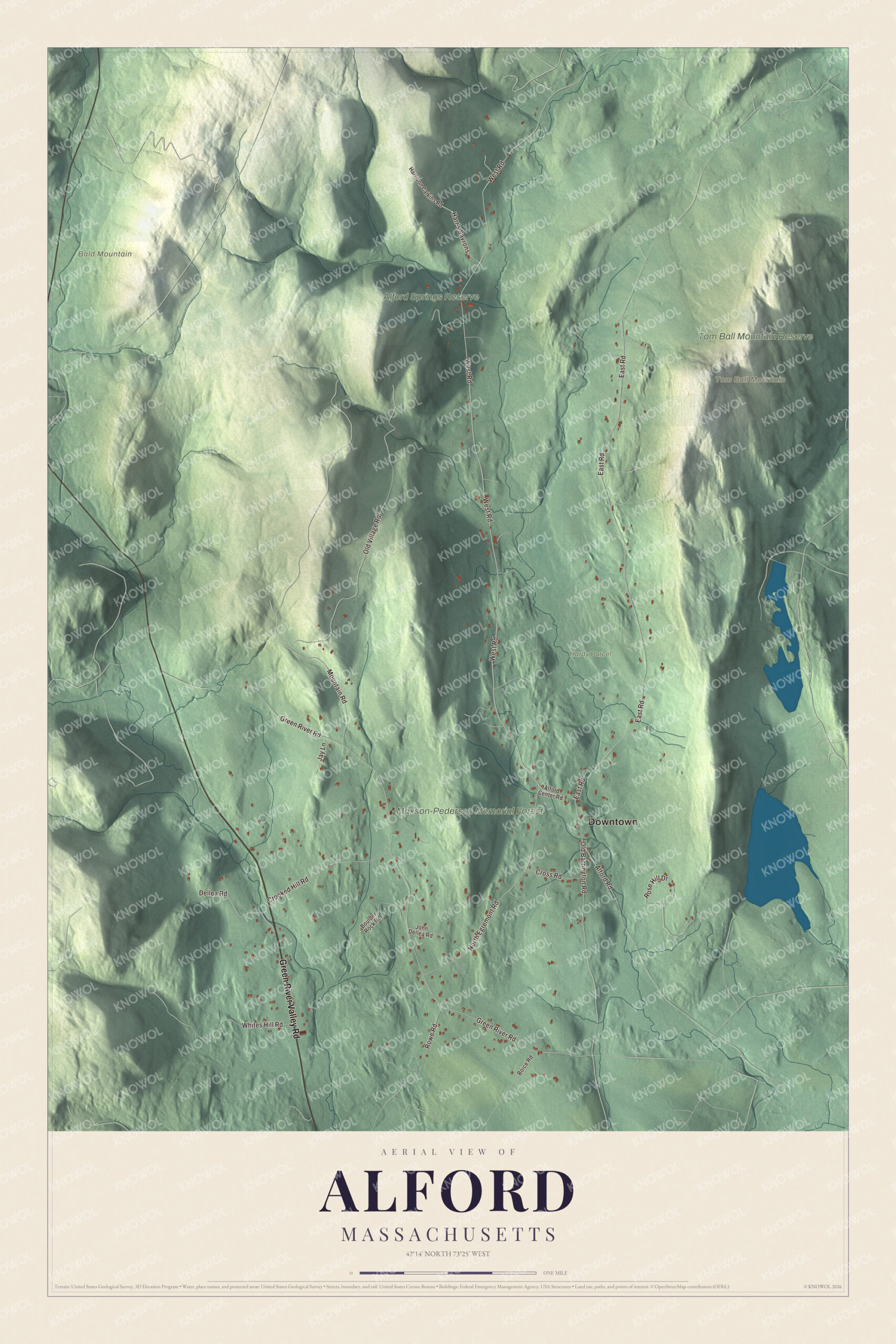
Shaded hill country of the Taconic Range, with Tom Ball Mountain and Bald Mountain, the Alford Springs Reserve, the Tom Ball Mountain Reserve and the Maxson-Pederson Memorial Forest, and roads like Green River Valley Road, East Road and West Road.4
The story of Alford
When Alford was Podunk
Before it had its name, Great Barrington people called this hill country Podunk. Their 1882 town history says an old road ran west past Seekonk and on to Podunk, as Alford was then called, until the town voted it closed in 1799. Families had settled out on the Alford road by 1761. In 1778 some of them asked to be set off to Alford, and Great Barrington protested that it seemed peculiarly hard to be taken off by pieces, since most of Alford had once been its own land. The Council granted the petition anyway in January 1779. Another strip followed in 1819, and in 1882 a stone monument still marked Great Barrington's old northwest corner, about eighty rods west of Frederick Fitch's house in Alford.25678
Marble for City Hall
Large marble deposits were found on the western slopes of Tom Ball Mountain in 1799. By 1855 two quarries were at work in Alford, Milligan's and, just south of it on the same ridge, Frederick Fitch's. A history of western Massachusetts written that year said Fitch's quarry had been worked for at least fifty years and took in about $2,000 a year. Its variegated stone went mainly to New York City, and the writer said most of New York's City Hall was built of it. The quarries ran until 1872. When the railroad came through a neighboring valley, they couldn't compete, and Alford went back to its farms.194
The doctor on the hill
Dr. John Hurlbut came to Alford before 1770, a Princeton graduate who was the only physician in town for a long time. At the first town meeting in 1773 he was chosen town clerk. In the spring of 1787 he rode to Sharon, Connecticut, to raise men for Shays' Rebellion, was arrested, and was let go on his promise to leave the state. Massachusetts took away his commission as a justice of the peace in 1788, yet Alford sent him to the legislature that same year. A woman who knew him as a child remembered his famous flower garden on a rise, up a long flight of stone steps. His son John W. Hulbert went on to Congress.1011121
Through the years
19 moments from 1756 to today.
- 1756Settlers buy the land from the Stockbridge Indians in the Shawanon Purchase.13
- 1761Several families are settled on the Alford road, on land that's in Alford today.5
- 1763The first gristmill is built, and the Green Land Grant adds 15,000 acres.13
- 1769Alford separates from Great Barrington.1
- 1773Alford is incorporated, and Dr. John Hurlbut is chosen its first town clerk.10
- 1776Around New Year's Day, Henry Knox brings the Ticonderoga cannons through town.1
- 1779Families on Great Barrington's west side are set off and annexed to Alford.7
- 1787Dr. Hulbert rides to Sharon, Connecticut, to raise men for Shays' Rebellion.12
- 1799Marble is found on Tom Ball Mountain, and Great Barrington closes its old road to Podunk.12
- 1817The Alford Village Church is built.13
- 1819Another strip of Great Barrington is added to Alford.8
- 1855Two marble quarries are at work, and the Alford Town Hall is built.913
- 1861The Civil War begins. Alford sends 20 men, and five are lost.14
- 1865Alford's hill farms keep 1,062 sheep.3
- 1872The last marble quarry closes.4
- 1874A gazetteer counts two sawmills, two gristmills and a shingle mill, and only 275 sheep.3
- 1886Justin Dewey, born in Alford, becomes a judge of the Superior Court.15
- 1893The old Hamlin house in Alford village is taken down and its frame set up two lots south.16
- 2020The census counts 486 people.1
Places to see
Places worth a visit in Alford today.
- Tom Ball MountainNortheast. Where Alford's marble was found.
- Tom Ball Mountain ReserveNortheast. Protected woods on the mountain.Visit their website
- Alford Springs ReserveNorth. Protected woods and trails.Visit their website
- Bald MountainHills of town. One of the Taconic hills.
- Maxson-Pederson Memorial ForestAlford. Protected forest land.
- Old VillageOld Village Road. The old heart of town.
- Alford Village ChurchAlford village. Built in 1817.
- Alford Town HallAlford village. Built in 1855.
- Alford BrookMiddle of town. Runs south to the Green River.
- Green RiverSouthwest corner. Housatonic tributary Bryant wrote about.
In their words
“The marble here quarried is variegated, and may be seen in the City Hall, New York, which is for the most part built of stone from this quarry.”
History of western Massachusetts, 1855, on Frederick Fitch's quarry9
“The produce of the dairy is of the first quality.”
A gazetteer of the state of Massachusetts, 18743
“And they whose meadows it murmurs through Have named the stream from its own fair hue.”
William Cullen Bryant on the Green River, quoted in A gazetteer of the state of Massachusetts, 18743
Nearby towns
Sources
- Alford, Massachusetts, Wikipedia
- History of Great Barrington, (Berkshire County,) Massachusetts (1882), on the old road to Podunk, Internet Archive
- A gazetteer of the state of Massachusetts (1874), Internet Archive
- Map of Alford, Massachusetts in 2026, KNOWOL (USGS elevation, Census Bureau roads)
- History of Great Barrington (1882), on the first families in what is now Alford, Internet Archive
- The acts and resolves, public and private, of the province of the Massachusetts bay (1869), Great Barrington's answer to the petition, Internet Archive
- The acts and resolves, public and private, of the province of the Massachusetts bay (1869), the 1779 resolve annexing land to Alford, Internet Archive
- History of Great Barrington, (Berkshire County,) Massachusetts (1882), on the 1819 tract and the corner monument, Internet Archive
- History of western Massachusetts (1855), on the Alford marble quarries, Internet Archive
- Encyclopedia of Massachusetts, biographical, genealogical (1916), on Dr. John Hurlbut, Internet Archive
- History of Berkshire County, Massachusetts (1885), on Dr. John Hulbert, Internet Archive
- The Hamlin family (1902), on Dr. Hulbert and Shays' Rebellion, Internet Archive
- History, Town of Alford (archived copy)
- A gazetteer of the state of Massachusetts (1890), Internet Archive
- Professional and industrial history of Suffolk County, Massachusetts (1894), on Justin Dewey, Internet Archive
- The Hamlin family (1902), on the Hamlin house in Alford village, Internet Archive