
A town of hills and valley farms between Fresh Pond and Beaver Brook, carved out of Watertown, Waltham and West Cambridge in 1859 after six years in the Legislature, named for John Perkins Cushing's estate and once known for the first strawberries in the Boston market.
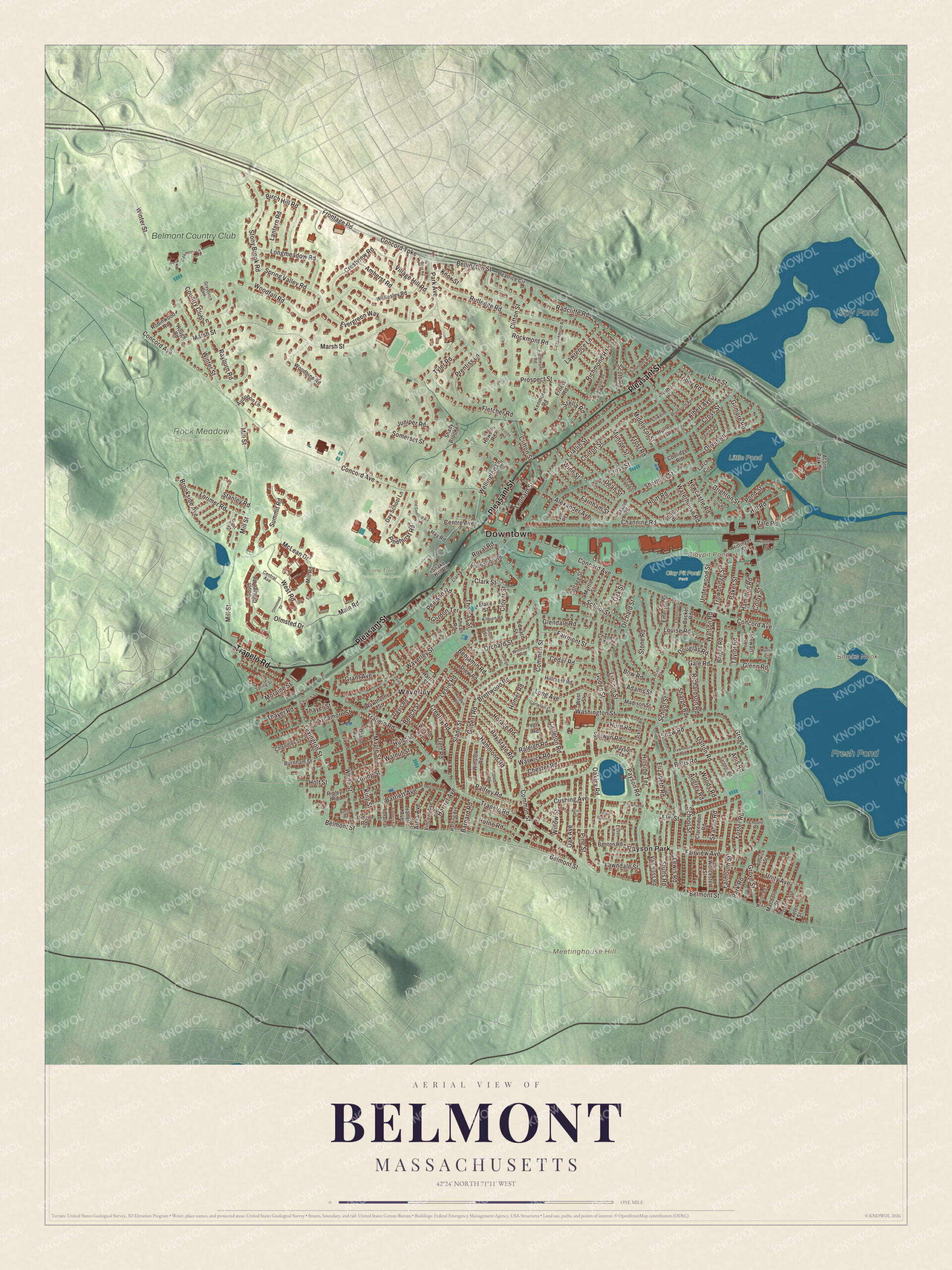
Belmont, Massachusetts on the map
Click the map to look closer.
Belmont today
By KNOWOL
Belmont drawn in the style of an old atlas, with the rise and fall of its hills, Pleasant Street, Trapelo Road, Park Avenue, Payson Road, Clifton Street and Elm Street, Payson Park, Claypit Pond, Rock Meadow and Meetinghouse Hill, and Fresh Pond and Spy Pond just over the town line.5
The history of Belmont, Massachusetts
Six years and six petitions
The farm families around Wellington Hill first asked the Legislature for a town of their own in 1854, with Charles Stone and 127 others signing. Watertown, West Cambridge and Waltham fought back every year. Watertown's lawyer called the plan a little community of rich men. One senator said the petitioners picked the name Belmont to flatter John P. Cushing, and another said the town line bent to take in a row of icehouses so Belmont could tax ice cut in West Cambridge. Senator Eben S. Poor answered that the farmers' wealth came from early vegetables, autumn fruit and winter ice. Jacob Hittinger headed the petition year after year, and on March 18, 1859, Governor Nathaniel P. Banks signed the bill. The new town then voted to pay the lobbying bills, until a lawsuit forced the money back into the treasury.67891011
First berries in the Boston market
Belmont stayed a farm town long after it became a town. The 1890 county history says its strawberries were always the first in the Boston markets, and guests came from far and near to its strawberry festivals. Joseph O. Wellington was remembered as one of the first growers to raise the berries large. In January, farmers grew lettuce, dandelions and spinach under glass while others cut ice on the ponds, and the Hittinger greenhouses once sent 14,000 cucumbers to Boston in a single day. Up on the hill, Winthrop W. Chenery kept what the history calls the first purebred Holstein herd in the country. The 1885 census put Belmont first in Middlesex County for fruit, and the town seal of 1882 shows Pomona, goddess of fruits and gardens.12131431516
The hill, the estate and the name
Two names on the map tell how Belmont began. Wellington Hill, about 300 feet high, is named for Jeduthun Wellington, a Revolutionary lieutenant and later militia colonel, who kept his yoke of oxen ready to help loaded teams up the steep turnpike past his house. Belmont itself was the name John Perkins Cushing gave his estate after making a fortune in China. About 1830 he built a mansion there with a deer park, a walled flower garden and a grand conservatory, and he opened the grounds to the public; thousands came every season. The road beside it, once the Back Road, took the estate's name, and then the new town did. Samuel R. Payson owned the place after Cushing died in 1862, and in 1886 the Payson Park Land Company began dividing it up.171819
Belmont, Massachusetts through the years
25 moments from 1636 to today.
- 1636Roger Wellington buys the 14 acres where the Homer House stands, the date the state gives for settlement here.5
- 1775On April 19, women and children of the valley take refuge in a house on the hill, on today's Prospect Street.20
- 1789Isaac Hill, later governor of New Hampshire, is born in the part of West Cambridge that is now Belmont.21
- 1830About this year John P. Cushing builds his mansion on the estate he calls Belmont.19
- 1843The Fitchburg Railroad opens to Waltham, with a station called Wellington Hill at the Concord Turnpike crossing.22
- 1851A tornado tears through, doing about $10,000 in damage to estates now in Belmont.23
- 1854Charles Stone and 127 others ask the Legislature for a new town; they are given leave to withdraw.6
- 1855The Waverley Company is incorporated, and the village of Waverley grows from its 300 acres.24
- 1856The Senate passes a bill to incorporate Belmont, 17 to 13, but the House rejects it.7
- 1857The Senate argues over the Belmont bill again, and one opponent charges that its crooked line bends around a row of icehouses.9
- 1859Governor Nathaniel P. Banks signs the act on March 18, and the first town meeting follows on March 28.6
- 1862The Supreme Court orders the town's payment of the petitioners' expenses returned to the treasury.11
- 1868The public library begins, with David Mack, once of Brook Farm, as its first librarian.25
- 1872Winthrop W. Chenery prepares the Holstein Herd-Book.15
- 1875The Waverley Company sells 100 acres on the Waverley Highlands to the Massachusetts General Hospital.24
- 1878William Dean Howells moves into Redtop on Belmont Hill.26
- 1880Cambridge annexes 670 acres around Fresh Pond, including most of the Mount Auburn village.27
- 1882The new Town Hall and library building, on a lot given by Elisha Atkins, is dedicated on June 22.28
- 1885The state census ranks Belmont first in Middlesex County for the value of its fruit.12
- 1888Parry Brothers open a brickyard off Concord Avenue, the pit that becomes Claypit Pond.5
- 1891State gypsy moth crews begin the season's field work at Gilman Osgood's farm in Belmont.29
- 1895McLean Hospital opens at Waverley on October 1, with room for 180 patients.30
- 1907The railroad is raised over the road at Belmont Center on a stone arch bridge.1
- 1927The Belmont Woman's Club buys the Homer House to save it from demolition.5
- 1933The town turns Wellington Brook into the old clay pit, making Claypit Pond.5
Places to see in Belmont, Massachusetts
Places worth a visit in Belmont today.
- Belmont CenterConcord Avenue and Common Street. Town Hall and the 1908 fieldstone station.
- Cushing SquareSouth Belmont. Named for China trader John Perkins Cushing.
- Waverley SquareWest Belmont. Village begun by the 1855 Waverley Company.
- Payson ParkNear the Watertown line. Built on Cushing's old Belmont estate.
- Homer HousePleasant Street. Italianate summer house of 1853.Visit their website
- Wellington Hill StationBelmont Center. The 1840s schoolhouse once used as a depot.Visit their website
- Claypit PondConcord Avenue. Old brickyard pit, flooded in 1933.
- Rock MeadowWest Belmont, near Waltham. Old farm meadow, now conservation land.Visit their website
- Beaver Brook ReservationWaltham line. First Metropolitan Park reservation, 1893.Visit their website
- McLean HospitalMill Street. Psychiatric hospital on its hill since 1895.
Belmont on the National Register of Historic Places
All 6 places in Belmont on the National Register of Historic Places that still stand today, oldest first, and why each one matters.4
-
Abraham Hill House
One of the oldest houses in Belmont. Local historians date it to 1693, but its framing points to about 1725 to 1750; Abraham Hill's son James, who was born in the house, enlarged it in the 1790s, and the Hill family kept it until 1942.31
-
Red Top
National Historic Landmark
The novelist and critic William Dean Howells lived in this Shingle Style house, designed by his brother-in-law William Rutherford Mead, and finished The Lady of the Aroostook and The Undiscovered Country here. Mark Twain visited eight times. It became a National Historic Landmark in 1971.26
-
McLean Hospital National Register District
McLean, founded in 1811 in Charlestown (now Somerville), moved its campus to Waverley in 1895, and Frederick Law Olmsted and the engineer Joseph Curtis were consulted on the site. More than 300 acres of the Belmont campus were listed in 2003.32
-
Belmont Railroad Station
Belmont Center's station went up in 1908, after the tracks were raised over Concord Avenue in 1907. The two-story California Bungalow building was made from 365 tons of fieldstone quarried on Belmont Hill by a local farmer, and the Belmont Lions Club now owns it.33
-
Metropolitan State Hospital
A state hospital for people with mental illness, founded in 1927 and opened in 1930 on grounds that cross Waltham, Lexington and Belmont. It closed in 1992; its main buildings became apartments, and its wooded grounds are protected open space whose trails connect to Rock Meadow in Belmont.34
-
Pleasant Street Historic District
Pleasant Street (Route 60) from Winn Street to just south of Concord Avenue, lined with mid- to late-1800s houses on large lots, along with Belmont's town hall and library.35
Belmont in their words
“No town in New England, unless it be a railroad centre, owes its existence as a distinct municipality more directly to railroad enterprise, than does the town of Belmont.”
History of Middlesex County, 189022
“Their wealth, Sir, is the rich reward of persevering industry.”
Senator Eben S. Poor, defending Belmont's farmers in the Massachusetts Senate, 185710
“In independence of thought, sound judgment, and loyalty to right, the citizens of Belmont stand second to none of their sister communities”
History of Middlesex County, 189036
Towns near Belmont, Massachusetts
Sources for the history of Belmont
- Belmont, Massachusetts, Wikipedia
- History of Middlesex County, Massachusetts (1880), Belmont chapter by John L. Alexander, on the six-year contest, Internet Archive
- History of Middlesex County, Massachusetts (1890), Belmont chapter, on the Hittinger greenhouses, Internet Archive
- National Register of Historic Places listings in Middlesex County, Massachusetts, Wikipedia
- Map of Belmont, Massachusetts in 2026, KNOWOL (USGS elevation, Census Bureau roads)
- History of Middlesex County, Massachusetts (1890), Belmont chapter, on the petitions for a town, Internet Archive
- Argument of Ivers J. Austin, counsel for the remonstrants from Watertown, against the petition for the incorporation of the town of Belmont (1857), Internet Archive
- Watertown, Massachusetts [1853-1857], speech of Senator Gideon Haynes against the Belmont bill, March 20, 1857, Internet Archive
- Watertown, Massachusetts [1853-1857], Senate speech against the Belmont bill on the icehouses, April 1857, Internet Archive
- Watertown, Massachusetts [1853-1857], speech of Senator Eben S. Poor on the Belmont bill, April 2, 1857, Internet Archive
- History of Middlesex County, Massachusetts (1890), Belmont chapter, on the suit over the town's expenses, Internet Archive
- History of Middlesex County, Massachusetts (1890), Belmont chapter, on strawberries and the 1885 census, Internet Archive
- Biographical review of leading citizens of Middlesex County, Massachusetts (1898), on Joseph Oliver Wellington, Internet Archive
- History of Middlesex County, Massachusetts (1880), Belmont chapter by John L. Alexander, on winter farming and ice, Internet Archive
- History of Middlesex County, Massachusetts (1890), Belmont chapter, on Chenery's Holstein herd, Internet Archive
- History of Middlesex County, Massachusetts (1890), Belmont chapter, on the town seal, Internet Archive
- History of Middlesex County, Massachusetts (1890), Belmont chapter, on Wellington Hill, Internet Archive
- History of Middlesex County, Massachusetts (1880), on John P. Cushing's garden, Internet Archive
- History of Middlesex County, Massachusetts (1890), Belmont chapter, on the Cushing estate, Internet Archive
- History of Middlesex County, Massachusetts (1890), Belmont chapter, on April 19, 1775, Internet Archive
- History of Middlesex County, Massachusetts (1880), Belmont chapter by John L. Alexander, on Isaac Hill, Internet Archive
- History of Middlesex County, Massachusetts (1890), Belmont chapter, on the railroad, Internet Archive
- History of Middlesex County, Massachusetts (1890), Belmont chapter, on the tornado of 1851, Internet Archive
- Historic homes and places and genealogical and personal memoirs relating to the families of Middlesex County, Massachusetts (1908), on Waverley, Internet Archive
- History of Middlesex County, Massachusetts (1890), Belmont chapter, on the public library, Internet Archive
- Red Top, Wikipedia
- History of Middlesex County, Massachusetts (1890), Belmont chapter, on the 1880 annexation, Internet Archive
- History of Middlesex County, Massachusetts (1890), Belmont chapter, on the Town Hall, Internet Archive
- The gypsy moth. Porthetria dispar (1896), on the work of 1891, Internet Archive
- Massachusetts General Hospital, Memorial and historical volume (1921), on McLean Hospital at Waverley, Internet Archive
- Abraham Hill House, Wikipedia
- McLean Hospital National Register District, Wikipedia
- Belmont Railroad Station, Wikipedia
- Metropolitan State Hospital, Wikipedia
- Pleasant Street Historic District, Wikipedia
- History of Middlesex County, Massachusetts (1890), Belmont chapter, on the town's old families, Internet Archive