
A shoreline town east of New Haven, first called Totoket, where Yale's first books were kept, red granite was cut at Stony Creek, and Indian Neck, Pine Orchard and the Thimble Islands filled with summer cottages after the railroad came.
Then and now
The same town 121 years apart. Click either map to look closer.
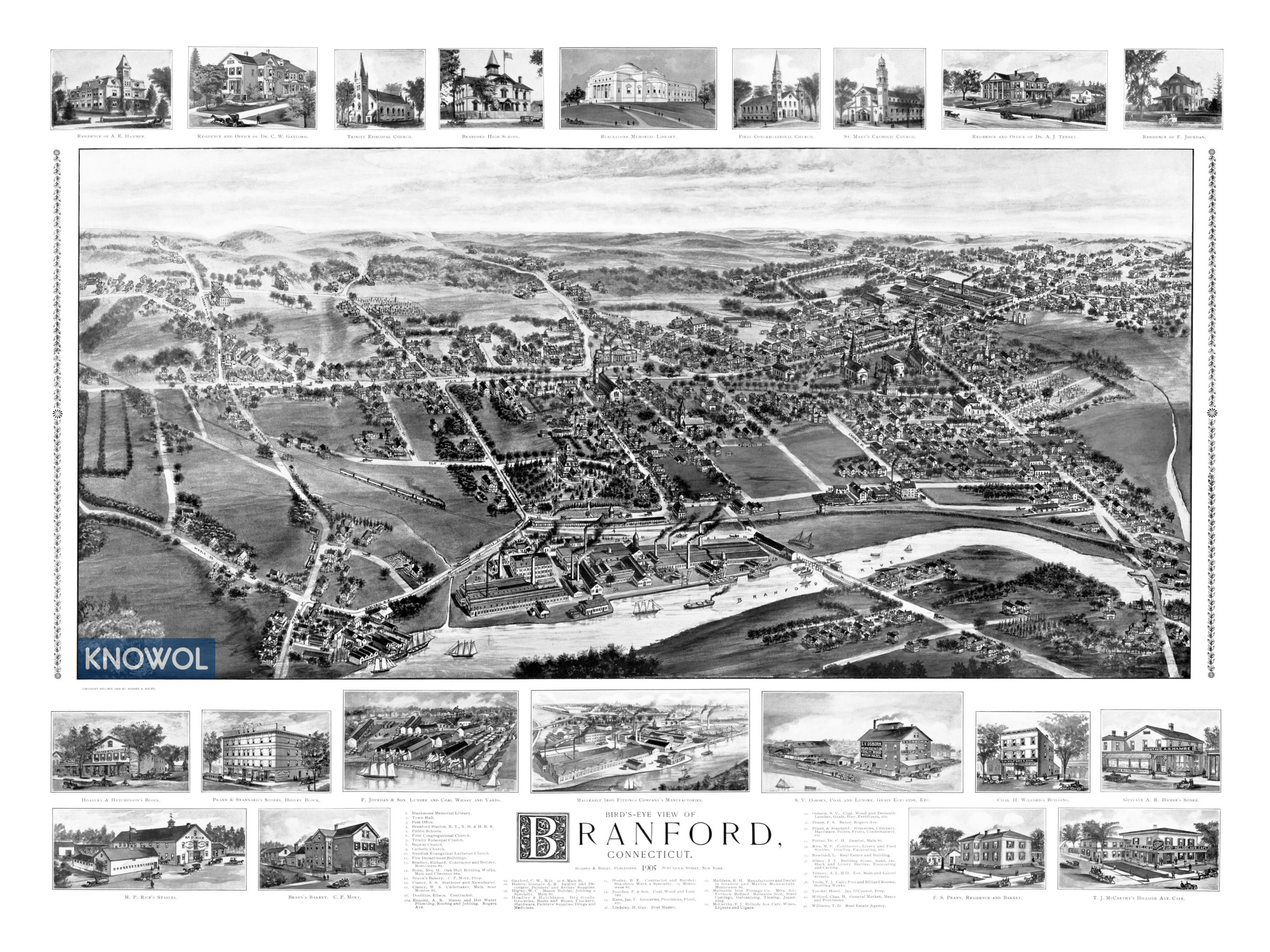
The bird's-eye view
By Hughes & Bailey
Branford drawn as if from the sky in 1905, with its street names and old landmarks, and pictures of Branford High School, the Blackstone Memorial Library, McCarthy's Hillside Ave Cafe, churches, homes and factories.5
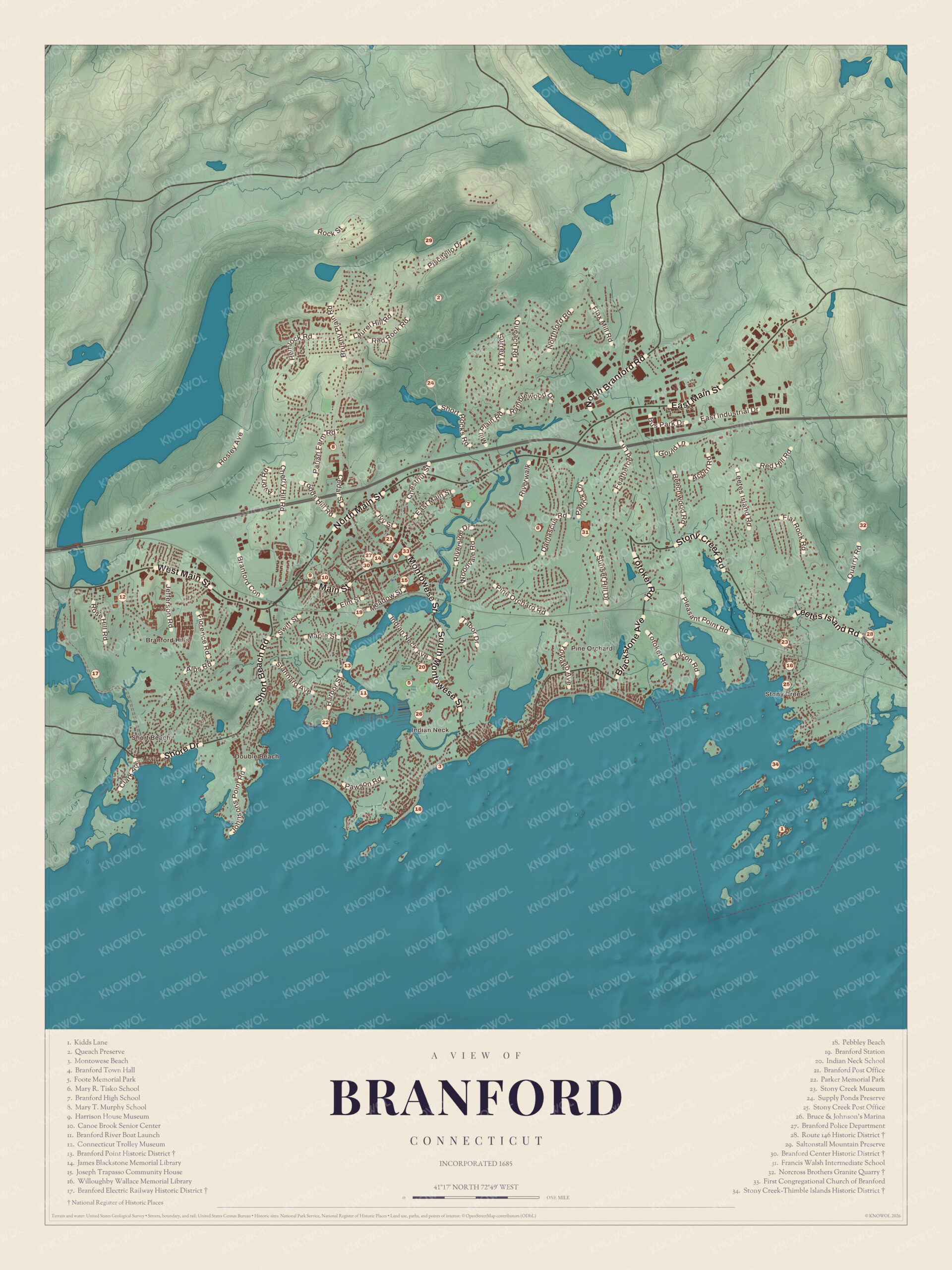
Branford today
By KNOWOL
Shaded hills from downtown out to Hoadley Neck, the shoreline drawn to its true shape, every street from Main Street to Shore Drive, and a guide of 34 numbered landmarks with the National Register sites marked.6
The story of Branford
Books on Mr. Russell's table
Branford's minister, Rev. Samuel Russell, was one of the leaders in the plan for a Connecticut college. By the old account, the founding ministers met at Branford, and each laid books on a table, saying, "I give these books for the founding of a college in this colony." About forty large volumes were given, and Mr. Russell was made keeper of the library. A Branford tradition adds that one book was scorched in his house, when a thick pane of old window glass caught the sun like a burning glass and burned a hole right through it. Later Yale historians doubted some of the details, but the story stuck. In the same years Gurdon Saltonstall, who married a Branford heiress, built a mansion near the lake in 1707.789
Hotels, cottages and a dry lease
After the railroad came through in 1852, Branford's shore filled with summer people. At Short Beach the first house for summer guests went up about then, when the place was still mostly woods. By 1871 the hotel at Branford Point had room for 140 guests and ran an omnibus to New Haven every day, and the new Montowese House at Indian Neck could take about 200. Pine Orchard, named for a grove of pines by the sandy beach, was known for the cooking of Mother Sheldon. Most of Indian Neck belonged to the First Church, and its 99-year lease of 1867 opened the neck to cottages on one condition: no liquor could ever be sold there. Out on the Thimble Islands, about 50 cottages stood by 1892.10111213
Locks, fittings and red granite
Branford's factories grew up beside the railroad. By 1892 the Branford Lock Works could turn out 500 dozen complete locks and knobs a day, and the Malleable Iron Fittings Company at Page's Point, with about four acres of brick buildings, employed nearly 300 people. At Stony Creek, quarrymen found the ledges along the new line were valuable. A red granite quarry opened about 1875 supplied stone for columns in the legislative chambers at Albany and Hartford, and its stone was likened to the famous red granite of Aberdeen, Scotland. Norcross Brothers of Worcester opened their quarry in 1887, and its granite went into the base of the Statue of Liberty. In 1882 the quarry district at Hoadley's Neck was set off to Guilford.3141516
Through the years
23 moments from 1638 to today.
- 1638New Haven's settlers buy the land called Totoket from the Mattabesech.1
- 1644Families from Wethersfield arrive and divide the meadows by lot. Branford is established.2
- 1655Branford joins New Haven in backing iron works at the Great Pond, now Lake Saltonstall.3
- 1666The church, its pastor, its deacons and most of its members move to New Jersey and found Newark.17
- 1685Branford receives a new patent on February 16, after years with few people left.18
- 1700By the old account, ministers meet at Branford and give books to found the college that becomes Yale.7
- 1707Gurdon Saltonstall, soon to be governor, builds a mansion near the lake.8
- 1724Nathaniel Harrison II builds the saltbox that is now the Harrison House Museum.19
- 1752Samuel Barker builds a new wharf at the old Dutch House landing.20
- 1757Ezekiel Hayes, great-grandfather of President Hayes, builds a house and makes cow bells in his shop on the brook.21
- 1776The town makes and stores gunpowder and keeps watch at Branford Point, Indian Neck and Stony Creek.22
- 1814British sailors land at Stony Creek and Indian Neck and carry off all the boats.23
- 1852The Shore Line railroad opens through town, and Short Beach gets its first house for summer guests.10
- 1862Thomas Kennedy, a New York lock maker, takes over the works that become the Branford Lock Works.3
- 1867The First Church leases Indian Neck for 99 years, on condition that no liquor is ever sold there.12
- 1871The hotel at Branford Point has room for 140 guests, and the new Montowese House at Indian Neck about 200.11
- 1874Stony Creek becomes the town's second voting district.13
- 1882Hoadley's Neck, with John Beattie's granite quarries, is set off to Guilford.14
- 1887Norcross Brothers open their granite quarry, whose stone goes into the base of the Statue of Liberty.16
- 1896The marble James Blackstone Memorial Library opens on June 17.24
- 1897The Pine Orchard Union Chapel is dedicated on the Fourth of July.25
- 1901A trolley line is built to link Branford center and Short Beach with the East Haven Green.6
- 1905Hughes & Bailey publish their bird's-eye view of Branford.5
Places to see
The numbers match the landmark guide printed on the 2026 map.
- 4Branford Town HallBranford Center. Town offices on the green.
- 9Harrison House MuseumMain Street. Saltbox house of 1724.Visit their website
- 13Branford Point Historic DistrictBranford Point. Old resort point and harbor homes.
- 14James Blackstone Memorial LibraryBranford Center. Marble library opened in 1896.Visit their website
- 17Branford Electric Railway Historic DistrictShort Beach. Trolley line shared with East Haven.
- 23Stony Creek MuseumStony Creek. Village history by the harbor.Visit their website
- 30Branford Center Historic DistrictDowntown. The green, churches and town hall.
- 32Norcross Brothers Granite QuarryStony Creek. Granite for the Statue of Liberty's base.
- 33First Congregational Church of BranfordBranford Center. The church gathered in 1644.Visit their website
- 34Stony Creek-Thimble Islands Historic DistrictStony Creek. Quarry village and island cottages.
On the National Register
All 31 places in Branford on the National Register of Historic Places that still stand today, oldest first, and why each one matters.4
-
Branford Center Historic District
The traditional town center, about 250 acres with 557 contributing buildings, the Center Cemetery, the 1857 Greek Revival town hall and the domed marble James Blackstone Memorial Library of 1893 to 1896.26
-
Canoe Brook Historic District
First settled by Daniel Swaine in the 1680s, this neighborhood west of the center keeps more than 200 years of houses, from the 1720s Harrison houses to Tudor Revival homes. It's named for a brook now mostly built over.27
-
John Tyler House
Built by John Tyler Jr. on land granted to his father George, it's a well-preserved center-chimney house from the end of the First Period, one of Branford's few surviving early houses.28
-
Norton House
A classic saltbox built in what is now Madison and moved to Branford about 1940, then restored.29
-
Thomas Harrison House
A gambrel-roofed house mentioned as a new frame when Thomas Harrison inherited the land in 1723. Its low gambrel form is unusual among the town's early houses.30
-
Swain-Harrison House (Harrison House Museum)
Nathaniel Harrison II built this saltbox in 1724. Architectural historian J. Frederick Kelly restored it after 1938, and the Branford Historical Society runs it as a museum with period rooms, a barn and an herb garden.19
-
Timothy Bradley House
An early 18th-century house in the Canoe Brook neighborhood, bought by Timothy Bradley in 1778 and kept by his family for more than a century.31
-
Eliphalet Howd House
Long dated to 1754, land records suggest it may go back to about 1730. It's one of the few two-story 18th-century houses left in Branford, with an overhanging second story.32
-
Blackstone House
A Blackstone family farmhouse that E. M. Hotchkiss of Waterbury bought in 1886 and turned into a summer resort. The land was divided in 1907 for the cottage neighborhood around it.33
-
Edward Frisbie House
Long said to be the home of first settler Edward Frisbie, its building methods point to about 1750. It's a well-preserved Georgian house with an early barn.34
-
House at 161 Damascus Road
A small story-and-a-half colonial house that kept its 26-acre farm until 1963.35
-
John Rogers House
Long thought to date from about 1810, research placed it in the middle 1700s. It belonged for many years to the locally prominent Rogers family.36
-
Isaac Hoadley House
A Georgian house of 1757, updated about 1840 with a Greek Revival doorway.37
-
Solomon Tyler House
Built by Solomon Tyler, a well-kept Georgian house and one of Branford's few surviving 18th-century homes.38
-
Zaccheus Baldwin House
The farmhouse of Zaccheus Baldwin, from a family long settled in this part of town, one of Branford's few well-preserved houses of the period.39
-
Orrin Hoadley House
Built between 1785 and 1815 in a style that looks decades older, it's one of the town's modest group of 18th-century buildings.40
-
Edward Frisbie Homestead
Built by the grandson of a first settler, it's unusually elegant for its neighborhood, probably thanks to his success as a smuggler during the Revolution. The family kept it until 1870.41
-
Samuel Beach House
A house with an unusually steep roof, dated to 1790 by a 1930s survey and still owned by the Beach family when it was listed.42
-
House at 29 Flat Rock Road
Known in the 1800s as the "24 acre homestead," it's a rare survivor of the modest farmhouses of 18th-century Branford.43
-
John Hoadley House
A saltbox built between 1809 and 1812, when John Hoadley owned the land, in a late colonial style.44
-
Isaac Palmer House
A Federal house probably built by Linus Robinson and kept by the Palmer family through most of the 1800s.45
-
Timothy Baldwin House
Probably built by Zaccheus Baldwin when his son Timothy married, with 18 acres of farmland. It stayed in the Baldwin family until 1913.46
-
Branford Point Historic District
Farmland until Harbor Street and Maple Avenue were laid out in 1819, it grew into a day resort and a neighborhood for foundry workers. George Parker's heirs gave the point to the town as Parker Memorial Park.47
-
Hezekiah Palmer House
A saltbox with the year 1830 carved on a beam, though it was probably built earlier by James Palmer. It's a late example of colonial building in Branford.48
-
Stony Creek-Thimble Islands Historic District
About 1,400 acres taking in Stony Creek and all the major Thimble Islands, with summer cottages from after the 1852 railroad, quarry workers' housing and a well-known group of Stick style houses.49
-
Route 146 Historic District
Two centuries of farmhouses along an early 18th-century road, including Leete family farms and a row of quarry workers' houses, with stone railroad overpasses from the 1890s.50
-
Stick Style House at Stony Creek (William J. Clark House)
Henry Austin designed this towered Stick style house for William J. Clark, a Civil War veteran and Southington industrialist. It's the most architecturally important house in Stony Creek.51
-
Isaac C. Lewis Cottage
A Victorian seaside cottage with a mansard tower and hand-painted ceilings, built for Meriden silver manufacturer Isaac C. Lewis.52
-
Norcross Brothers Granite Quarry
Opened by the Worcester builders Norcross Brothers, it supplied granite for the base of the Statue of Liberty and the Corcoran Gallery, and drew many immigrants to town. It worked until 1980 and is now town land.16
-
Pine Orchard Union Chapel
A Queen Anne summer chapel built by Pine Orchard's summer people for $1,532 and dedicated on July 4, 1897. It still hosts weddings and meetings.25
-
Short Beach Historic District
The center of Short Beach, a shoreline vacation village of cottages that became a year-round neighborhood from the late 1950s.53
In their words
“I give these books for the founding of a college in this colony.”
The founders of Yale at Branford, as told in A complete history of Connecticut, 18987
“The little town was alive with preparations for war”
Sketches of church life in colonial Connecticut, 1902, on Branford in the Revolution22
“thousands now visit Stony Creek during the summer months to enjoy the beauty and rest afforded.”
History of New Haven County, 189213
Nearby towns
Sources
- Branford, Connecticut, Wikipedia
- History of New Haven County, Connecticut (1892), on the first settlers of Totoket, Internet Archive
- History of New Haven County, Connecticut (1892), on Branford's mills and factories, Internet Archive
- National Register of Historic Places listings in New Haven County, Connecticut, Wikipedia
- Bird's-eye view of Branford, Connecticut in 1905, restored by KNOWOL
- Map of Branford, Connecticut in 2026, KNOWOL (USGS elevation, Census Bureau roads)
- A complete history of Connecticut, civil and ecclesiastical (1898), on the founding of Yale at Branford, Internet Archive
- Papers of the New Haven Colony Historical Society (1882), Branford annals, Internet Archive
- A selection from the miscellaneous historical papers of fifty years (1918), Internet Archive
- History of New Haven County, Connecticut (1892), on the Branford shore resorts, Internet Archive
- New Haven directory (1871), on the Branford shore hotels, Internet Archive
- A history of the First church and society of Branford, Connecticut, 1644-1919 (1919), Internet Archive
- History of New Haven County, Connecticut (1892), on Stony Creek and the Thimble Islands, Internet Archive
- History of New Haven County, Connecticut (1892), on the Stony Creek granite quarries, Internet Archive
- Commemorative biographical record of New Haven County, Connecticut (1902), on the Stony Creek Red Granite Company, Internet Archive
- Norcross Brothers Granite Quarry, Wikipedia
- The history of Newark, New Jersey (1878), Internet Archive
- History of the colony of New Haven, before and after the union with Connecticut (1838), Internet Archive
- Harrison House Museum, Wikipedia
- History of New Haven County, Connecticut (1892), on Branford's growth before the Revolution, Internet Archive
- History of New Haven County, Connecticut (1892), on Branford village, Internet Archive
- Sketches of church life in colonial Connecticut (1902), Internet Archive
- The Connecticut quarterly (1895), on the War of 1812 at New Haven, Internet Archive
- The Connecticut magazine (1905), on the Blackstone Memorial Library, Internet Archive
- Pine Orchard Union Chapel, Wikipedia
- Branford Center, Connecticut, Wikipedia
- Canoe Brook Historic District, Wikipedia
- John Tyler House (Branford, Connecticut), Wikipedia
- Norton House (Branford, Connecticut), Wikipedia
- Thomas Harrison House (Branford, Connecticut), Wikipedia
- Timothy Bradley House, Wikipedia
- Eliphalet Howd House, Wikipedia
- Blackstone House (Branford, Connecticut), Wikipedia
- Edward Frisbie House (Branford, Connecticut), Wikipedia
- House at 161 Damascus Road, Wikipedia
- John Rogers House (Branford, Connecticut), Wikipedia
- Isaac Hoadley House, Wikipedia
- Solomon Tyler House, Wikipedia
- Zaccheus Baldwin House, Wikipedia
- Orrin Hoadley House, Wikipedia
- Edward Frisbie Homestead, Wikipedia
- Samuel Beach House, Wikipedia
- House at 29 Flat Rock Road, Wikipedia
- John Hoadley House, Wikipedia
- Isaac Palmer House, Wikipedia
- Timothy Baldwin House, Wikipedia
- Branford Point Historic District, Wikipedia
- Hezekiah Palmer House, Wikipedia
- Stony Creek-Thimble Islands Historic District, Wikipedia
- Route 146 Historic District, Wikipedia
- William J. Clark House, Wikipedia
- Isaac C. Lewis Cottage, Wikipedia
- Short Beach, Wikipedia