
A hill town on the Massachusetts line, settled in 1765, where a Revolutionary forge refined iron for the state, the Phelps family has kept its farm since the 1700s and the general store has been open since 1812.
Colebrook on the map
Click the map to look closer.
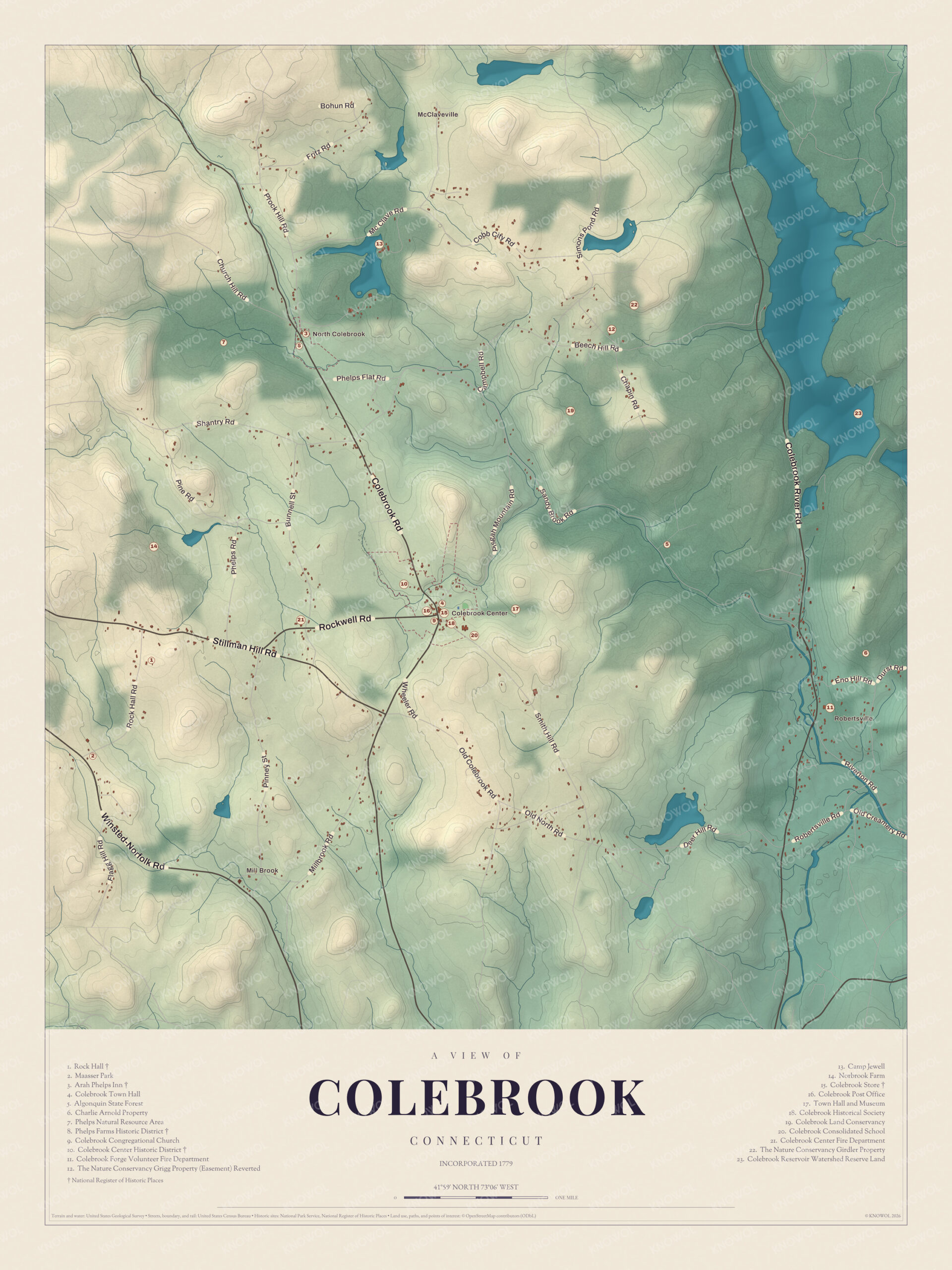
Colebrook today
By KNOWOL
Shaded hills from McClaveville in the north down to Mill Brook, every road from Prock Hill Road to Cobb City Road, the villages of Colebrook Center, North Colebrook and Robertsville, and a guide of 23 numbered landmarks with the National Register sites marked.6
The story of Colebrook
Iron for the Revolution
During the Revolution, Colebrook had a forge the state badly needed. It stood on land that had belonged to Richard Smith, whose estate was thought to be forfeited to the state, and Jacob Ogden of Newark, New Jersey, ran it, making iron and steel. In 1780 the state excused Ogden and eleven of his workmen from the draft, calling the work so necessary to the public. The next year it ordered ten tons of pig iron hauled from the Salisbury furnace to be refined at Colebrook. Then, on August 30, 1781, the works burned, with a large stock of charcoal and ore on hand. The state gave Ogden leave to rebuild, but he soon moved to Hartford and became a merchant there.78910
The first families
Benjamin Horton was Colebrook's first settler, building about three quarters of a mile south of the center on the Norfolk road in December 1765. Joseph Rockwell came a few weeks later. In February 1767 Samuel Rockwell moved up from East Windsor onto a hundred acres of wild land, two miles from anyone else. His one story house had a ballroom under the roof, and for years the whole town gathered there, for entertainment and for religious meetings. That September his son was born, the first child in Colebrook, and was named Alpha. With no church in town yet, the baby was carried to Norfolk to be baptized. Colebrook became a town in 1779 and then argued for years over where its meetinghouse should stand.21112313
Mills, falls and timber
Colebrook never had much good farmland, but its streams worked hard. In the 1780s Arah Phelps dammed Sandy Brook in the north of town and built a sawmill. The Old Forge at Robertsville was one of the earliest factories in the region, and in 1782 an apprentice rode over from Granby to fetch its iron, fording the river three times on the way. Robertsville later had the Union Chair Company works. By 1895 the Tunxis Falls at Robertsville had been harnessed for 225 horsepower to make the electric light for Winsted, and a cotton mill at the village of Colebrook River employed about 150 people making cotton duck. Not everyone wanted the woods cut. Allen Deming of Robertsville planted trees and counted his mountainside of native timber among his best assets.14151617418
Through the years
24 moments from 1765 to today.
- 1765Benjamin Horton becomes Colebrook's first settler, south of the center on the Norfolk road.2
- 1767Samuel Rockwell moves up from East Windsor in February as the fifth settler.11
- 1767Alpha Rockwell, the first child born in Colebrook, is carried to Norfolk to be baptized.12
- 1774The Assembly names Joseph Rockwell captain of Colebrook's militia company.19
- 1779The Assembly incorporates Colebrook and Barkhamsted as towns.3
- 1780Jacob Ogden and eleven workmen at the Colebrook iron and steel works are excused from the draft.7
- 1780Roger Stillman, a Bunker Hill veteran, is building his Colebrook house on the morning of the Dark Day.20
- 1781The state sends ten tons of Salisbury pig iron to be refined at Colebrook.8
- 1781Ogden's ironworks burn on August 30.9
- 1782The town asks the Assembly for a new committee to choose where its meetinghouse will stand.13
- 1787Arah Phelps and his father build the inn on the Hartford to Albany stage road.21
- 1788The portrait painter Ammi Phillips is born in Colebrook.1
- 1796Jonathan Edwards the younger is installed as Colebrook's pastor.22
- 1800Rev. Chauncey Lee begins a pastorate that lasts twenty-seven years.23
- 1807Lee publishes The Trial of Virtue, a poem on the Book of Job.23
- 1812William Swift, a carpenter who made bedsteads, builds the Colebrook Store.24
- 1837Abiram Chamberlain, later governor of Connecticut, is born at Colebrook River.25
- 1842The Greek Revival church is built at the south end of the common.14
- 1850The murder of Bernice White near Colebrook River leads to a trial so crowded it moves into a church.26
- 1895The Tunxis Falls at Robertsville make Winsted's electric light, and a Colebrook River cotton mill employs about 150.4
- 1912Addison Mizner designs Rock Hall as a country house for Jerome and Violet Alexandre.27
- 1917A county survey notes that Colebrook's last patch of primeval forest has been cut.28
- 1991Colebrook Center is listed on the National Register as a historic district.14
- 2015Two wind turbines go up in Colebrook.1
Places to see
The numbers match the landmark guide printed on the 2026 map.
- 1Rock HallRock Hall Road. Addison Mizner's Tudor Revival country house.
- 3Arah Phelps InnRoute 183 and Prock Hill Road. Stagecoach inn of 1787.
- 4Colebrook Town HallColebrook Center. Across from the general store.
- 5Algonquin State ForestCentral Colebrook. Trails and two protected preserves.
- 8Phelps Farms Historic DistrictSandy Brook. One family's farm since the 1700s.
- 9Colebrook Congregational ChurchColebrook Center. Greek Revival church of 1842.
- 10Colebrook Center Historic DistrictColebrook Center. Village little changed since 1860.
- 11Colebrook Forge Volunteer Fire DepartmentRobertsville. The firehouse in the southeast.
- 15Colebrook StoreColebrook Center. General store since 1812.
- 18Colebrook Historical SocietyColebrook Center. The town's history keepers.Visit their website
On the National Register
All 5 places in Colebrook on the National Register of Historic Places that still stand today, oldest first, and why each one matters.5
-
Colebrook Center Historic District
The town center in an isolated valley, built around a triangular common with the Greek Revival church of 1842 at its south end. Most of its main buildings went up before 1880, and the village has changed little since about 1860.14
-
Phelps Farms Historic District
A nearly intact mid 1800s farmstead on Sandy Brook, owned by one family since the 1700s. Arah Phelps dammed the brook for a sawmill in the 1780s, and his son Edward built most of the surviving farm buildings, including a Gothic Revival cottage for the farm hands.15
-
Arah Phelps Inn
One of Colebrook's oldest buildings, it served travelers on the Hartford to Albany stagecoach road for many years. A ballroom filled the whole front of the second floor, so the main stairs went at the back. Part of it burned in 1942 and was carefully rebuilt.21
-
Colebrook Store
Built by William Swift, a local carpenter who mostly made bedsteads, with a two story temple front of four slender Tuscan columns. It has been a general store ever since and was often used as a landmark in 1800s descriptions of the area.24
-
Rock Hall
A 10,000 square foot Tudor Revival house of stone and stucco designed by Addison Mizner for Jerome and Violet Alexandre. It's said to be Mizner's only surviving work in the northern United States, and it opened as a hotel in 2007.27
In their words
“At Colebrook his labours were less arduous, and his abode was rendered pleasant by the uninterrupted harmony which subsisted between him and the people.”
Connecticut Evangelical Magazine, 1809, on Jonathan Edwards the younger's years as Colebrook's pastor22
“Her geese were picked at the proper time of the moon, and everything thoroughly done.”
The history and genealogies of ancient Windsor, 1891, on the wife of Samuel Rockwell, Colebrook's fifth settler11
“A reputation for goodness and uprightness that was a byword for many miles in each direction.”
The Connecticut magazine, 1904, on Deacon Abiram Chamberlain of Colebrook River25
Nearby towns
Sources
- Colebrook, Connecticut, Wikipedia
- The history of Connecticut, from the first settlement of the colony to the adoption of the present constitution (1855), on Colebrook's first settlers, Internet Archive
- The public records of the state of Connecticut (1894), on the incorporation of Colebrook and Barkhamsted, Internet Archive
- The Connecticut quarterly (1895), on the Farmington River and Sandy Brook, Internet Archive
- National Register of Historic Places listings in Litchfield County, Connecticut, Wikipedia
- Map of Colebrook, Connecticut in 2026, KNOWOL (USGS elevation, Census Bureau roads)
- The public records of the state of Connecticut (1894), on Jacob Ogden's iron and steel works, 1780, Internet Archive
- The public records of the state of Connecticut (1894), on pig iron sent to the Colebrook refinery, 1781, Internet Archive
- The memorial history of Hartford County, Connecticut, 1633-1884 (1886), on Jacob Ogden, Internet Archive
- The public records of the state of Connecticut (1894), on the burning of Ogden's forge, Internet Archive
- The history and genealogies of ancient Windsor, Connecticut (1891), on Samuel Rockwell, Internet Archive
- History of Norfolk, Litchfield County, Connecticut, 1744-1900 (1900), on Alpha Rockwell, Internet Archive
- The public records of the state of Connecticut (1894), on the Colebrook meetinghouse site, 1782, Internet Archive
- Colebrook Center Historic District, Wikipedia
- Phelps Farms Historic District, Wikipedia
- Barkhamsted, Conn., and Its Centennial, 1879 (1881), on the Old Forge at Robertsville, Internet Archive
- Genealogical and family history of the state of Connecticut (1911), on the Union Chair Company works, Internet Archive
- Genealogy of the descendants of John Deming of Wethersfield, Connecticut (1904), on Allen Deming, Internet Archive
- The public records of the colony of Connecticut (1850), on Colebrook's militia officers in 1774, Internet Archive
- Commemorative biographical record of New Haven County, Connecticut (1902), on Roger Stillman, Internet Archive
- Arah Phelps Inn, Wikipedia
- Connecticut Evangelical Magazine (July 1809), sketch of the life of Dr. Jonathan Edwards, Internet Archive
- The memorial history of Hartford County, Connecticut, 1633-1884 (1886), on Rev. Chauncey Lee, Internet Archive
- Colebrook Store, Wikipedia
- The Connecticut magazine (1904), on Governor Abiram Chamberlain, Internet Archive
- The bench and bar of Litchfield County, Connecticut, 1709-1909 (1909), on the 1850 murder trial, Internet Archive
- Rock Hall (Colebrook, Connecticut), Wikipedia
- Rural life in Litchfield County (1917), Internet Archive