
Once Salem Village, where the witch trials of 1692 began, Danvers grew into a town of villages, with shipyards and iron works at Danversport, carpet weavers in the moved houses of Tapleyville, and onions and bricks known far beyond Essex County.
Danvers, Massachusetts on the map
Click the map to look closer.
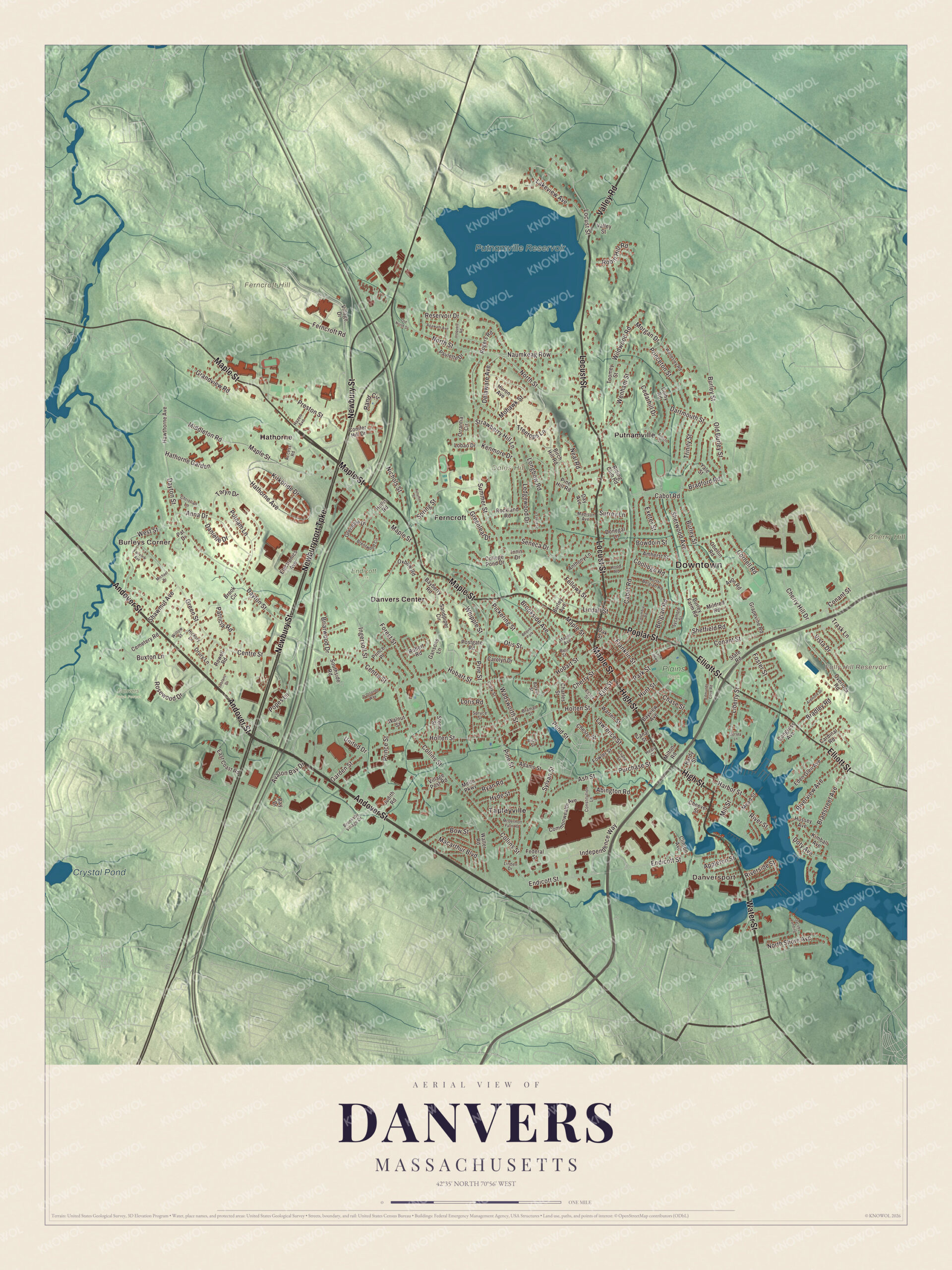
Danvers today
By KNOWOL
Danvers from Danversport on the tidal river out to Putnamville, Hathorne and Ferncroft, with Maple, Locust, High and Water Streets, the Putnamville and Folly Hill reservoirs, Crystal Pond, and Cherry, Dales and Ferncroft hills.2
The history of Danvers, Massachusetts
The village of moved houses
Until the 1830s Tapleyville was simply "the Village," a few farmhouses spread across well-tilled land. In 1843 Perley Tapley moved an old box shop to the brook at Hadlock's bridge, and there he and his brother Gilbert went into the carpet business. They needed skilled weavers, and after a few came from Connecticut mill towns, whole families arrived from England and Scotland. Housing them was the trouble, so Perley, who was handy at moving buildings, rolled houses in from far and near. Holten Street filled up with homes made from anything from a church steeple to a schoolhouse. In 1844 the Danvers Eagle joked that Tapleyville was a city where no building could be put up, only moved in, and that its writer feared he'd wake up, house and all, rolling away behind forty oxen.6
Ships and anchors at New Mills
Danversport used to be called New Mills, and almost as soon as Archelaus Putnam built his grist mills there, shipbuilders followed. During the Revolution the privateers Harlequin, Jupiter and Grand Turk came off its ways. One big ship, ordered by a London house, sat unfinished when the war began, and the English agent wouldn't let her be launched, so the ship carpenters gathered one night and slid her into the water anyway. They never got paid, and she rotted in the river. In the summer of 1789 Nathan Read, a Salem apothecary, ran a little boat with hand-turned paddle wheels on the Waters River while John Hancock looked on. Ten years later Read started iron works there, and they forged the anchor for the frigate Essex.789
Whittier's home at Oak Knoll
In the spring of 1875 John Greenleaf Whittier gave up his home in Amesbury and moved to a wooded estate off Summer Street that his cousin, Colonel Edmund Johnson of Boston, had bought. The poet named it Oak Knoll, for the oak on the knoll in front of the house. He kept voting in Amesbury, but when people asked, he said, "Say it is my home." He loved driving the back roads of Danvers, and his birthdays there turned into open houses, with friends bringing fruit and flowers. Oliver Wendell Holmes came often. Whittier once told him that his poem "The Broomstick Train" gave Beverly her beans but cheated Danvers of her onions. In the winter of 1877 he wrote "The Witch of Wenham" at Oak Knoll.10
Danvers, Massachusetts through the years
25 moments from 1636 to today.
- 1636The land is settled for good as Salem Village, the farming parish of Salem.2
- 1648Lt. Thomas Putnam builds the house on Maple Street where Putnams will live for more than three centuries.2
- 1692The witch trials begin in Salem Village, and Rebecca Nurse, an elderly resident, is among the innocent people executed.2
- 1708The village minister, Rev. Joseph Green, builds the first schoolhouse in what is now Danvers.11
- 1718Israel Putnam, later the general at Bunker Hill, is born in the Putnam house on January 7.2
- 1740About this year the Salem merchant William Browne builds a mansion on the summit of Folly Hill.12
- 1752Salem Village is set off from Salem as the district of Danvers.2
- 1755An earthquake shakes Browne's Hall on Folly Hill, and the house is later moved down to Liberty and Conant streets.12
- 1757Massachusetts makes Danvers a town on June 9; by legend the king's veto comes back marked "The King Unwilling."2
- 1787On December 1 the Ohio Company's first party of settlers sets out from Danvers for Marietta.3
- 1788The New Mills people build a wooden bridge over Porter's River, soon nicknamed Spite Bridge.13
- 1789Nathan Read tries out a boat with hand-turned paddle wheels on the Waters River.8
- 1792Amos Pope, a farmer's son who taught himself mathematics, publishes the first of his almanacs.14
- 1799Nathan Read forms the Salem Iron Factory Company to build iron works on the Waters River.9
- 1828The town's first post office opens at Danversport.15
- 1831Grenville M. Dodge, later chief engineer of the Union Pacific Railroad, is born in Putnamville on April 12.16
- 1833Samuel Preston patents his machine for pegging shoes.17
- 1843Perley Tapley moves a building to Hadlock's bridge, and he and his brother Gilbert start making carpets in Tapleyville.6
- 1845On June 10 a fire, said to have been started by children playing with matches, burns eighteen buildings at the Plains.18
- 1846Over the year, 157 vessels arrive at the wharves of Danversport with wood, flour, corn, lime, salt, molasses and coal.4
- 1855The southern part of town breaks off as South Danvers, renamed Peabody in 1868.2
- 1875The poet John Greenleaf Whittier moves to Oak Knoll.10
- 1878The State Lunatic Hospital on Hathorne Hill opens for patients.19
- 1885A monument to Rebecca Nurse goes up in her family's burying ground at Tapleyville.20
- 1889Danvers Electric is founded, the first publicly owned municipal light plant in Massachusetts.2
Places to see in Danvers, Massachusetts
Places worth a visit in Danvers today.
- DanversportOn the tidal Danvers River. The old shipyards of New Mills.
- Rebecca Nurse HomesteadPine Street. Her house of about 1700, a museum.Visit their website
- Salem Village Historic DistrictCentre, Hobart and Ingersoll Streets. Heart of seventeenth-century Salem Village.
- General Israel Putnam House431 Maple Street. Putnam family home for three centuries.
- Judge Samuel Holten House171 Holten Street. Home of a Continental Congress delegate.
- Glen Magna FarmsIngersoll Street. Joseph Peabody's country estate.Visit their website
- Derby Summer HouseGlen Magna Farms. McIntire's summer house, moved here 1901.Visit their website
- Endicott ParkBeside Glen Magna Farms. Much of the old estate, now parkland.Visit their website
- Endicott Pear TreeGovernor Endecott's old Orchard Farm. Planted by Governor Endecott before 1640.
- Putnamville ReservoirNorth end of town. Drinking water for Salem and Beverly.
Danvers on the National Register of Historic Places
All 13 places in Danvers on the National Register of Historic Places that still stand today, oldest first, and why each one matters.5
-
Gen. Israel Putnam House
Lt. Thomas Putnam built this house about 1648, and Putnams lived in it for more than three centuries. In 1692 Joseph Putnam, who lived here, spoke out against the witch trial hysteria, and his son Israel, the general at Bunker Hill, was born here on January 7, 1718.21
-
Rea-Proctor Homestead
The oldest part was built about 1692 by Joshua Rea Sr., whose son testified for John Proctor at the witch trials. Timothy Pickering owned it from 1804 to 1806 and ran farm experiments here, and Daniel Proctor's descendants have held it since 1812.22
-
Salem Village Historic District
The district takes in the early center of Salem Village along Centre, Hobart, Ingersoll, Forest and Collins Streets, including the Rebecca Nurse Homestead, now a house museum, and the remains of the village parsonage.23
-
Prince Osborne House
The older half of this First Period house was standing by 1696 on the farm of Robert Prince, whose widow, Sarah Osborne, died in prison in 1692 while awaiting trial in the witch trials. The two parts were joined about 1720, and the house was moved to Maple Street in 1915.24
-
Rea Putnam Fowler House
The oldest part of this saltbox, its western three bays and leanto, was built about 1700, and the eastern bays were added about 1725. Its leanto runs past one side in what's called a Beverly jog, and it was carefully restored in the 1930s under the Society for the Preservation of New England Antiquities.25
-
James Putnam Jr. House
The house grew from a First Period house of about 1715; its mid-1700s front section was finished by the last attorney general under King George III, who fled to Nova Scotia when the Revolution began. Timothy Pickering leased it from 1802 to 1804, while he was a United States Senator.26
-
White-Preston House
The oldest part of this First Period house, at the front right, dates to about 1722, and the front rooms on the left were added soon after. In the 1800s the rear was raised to a full two stories and the house was given a modest Greek Revival look.27
-
High Street Cemetery
The cemetery was first used in the 1700s, and its oldest dated gravestone, from 1758, is for the wife of Amos Putnam. It sits in the town center, and the last new burial was in 1875.28
-
Derby Summerhouse
National Historic Landmark
Samuel McIntire designed this ornate Federal garden house in 1793 for Elias Hasket Derby's farm, topped with carved wooden figures of a reaper and a milkmaid, some of the earliest American sculpture. It was moved about four miles to Glen Magna in 1901, and the Danvers Historical Society has owned it since 1958.29
-
Fowler House
Built in 1810 for Samuel Fowler Jr., a Revolutionary War veteran and early Danvers industrialist, this brick Federal house in Danversport was little changed when it was listed. In 1912 it became the second property bought by the Society for the Preservation of New England Antiquities.30
-
Sprague House
This well preserved Federal house was built in 1810 for Joseph Sprague Jr., son of a wealthy Salem merchant. Its finest feature is the central doorway, with a semicircular fanlight and a pedimented hood on pilasters.31
-
Fox Hill School
Built in 1879 and in use as a school until the 1970s, it is one of two surviving one-room schoolhouses in the town. It now houses a preschool.32
-
Peabody Institute
George Peabody gave $50,000 for a library in Danvers. Its first building, of 1868 to 1869, burned in 1890, and the trustees rebuilt on the same knoll; Little & Browne's Classical Revival building was finished in 1892 and sits in a park of more than 4 acres.33
Danvers in their words
“Probably there is no town of its size in the Commonwealth that has more houses of Colonial time now standing than has the town of Danvers.”
Historic houses and spots in Cambridge, Massachusetts, and near-by towns, 189734
“Danvers bricks rival Danvers onions in their reputation for sterling qualities.”
History of Essex County, Massachusetts, 188835
“Not only the State of Ohio, but the Great Northwest is, in a certain sense, the offspring of Danvers.”
Chronicles of Danvers, 1923, on the settlers who left for Ohio in 178736
Towns near Danvers, Massachusetts
Sources for the history of Danvers
- Danvers, Massachusetts, Wikipedia
- Map of Danvers, Massachusetts in 2026, KNOWOL
- Chronicles of Danvers (1923), on the Ohio Company's first party, Internet Archive
- Chronicles of Danvers (1923), on the trade at New Mills, Internet Archive
- National Register of Historic Places listings in Essex County, Massachusetts, Wikipedia
- Chronicles of Danvers (1923), on Tapleyville and the carpet business, Internet Archive
- Chronicles of Danvers (1923), on shipbuilding at New Mills, Internet Archive
- Chronicles of Danvers (1923), on Nathan Read's paddle-wheel boat, Internet Archive
- Chronicles of Danvers (1923), on the Salem Iron Factory and the anchor for the frigate Essex, Internet Archive
- Chronicles of Danvers (1923), on John Greenleaf Whittier at Oak Knoll, Internet Archive
- Chronicles of Danvers (Old Salem Village), Massachusetts, 1632-1923 (1923), on the first schoolhouse, Internet Archive
- Chronicles of Danvers (1923), on Browne's Hall and Folly Hill, Internet Archive
- Chronicles of Danvers (1923), on Spite Bridge, Internet Archive
- Chronicles of Danvers (1923), on Amos Pope's almanacs, Internet Archive
- Danvers, Massachusetts (1899), on the post offices, Internet Archive
- Chronicles of Danvers (1923), on Gen. Grenville M. Dodge, Internet Archive
- Chronicles of Danvers (1923), on Samuel Preston's pegging machine, Internet Archive
- History of Essex County, Massachusetts (1888), Danvers chapter, on the fire of 1845, Internet Archive
- Danvers, Massachusetts (1899), on the hospital on Hathorne Hill, Internet Archive
- Danvers, Massachusetts (1899), on the Rebecca Nurse monument, Internet Archive
- Gen. Israel Putnam House, Wikipedia
- Rea-Proctor Homestead, Wikipedia
- Salem Village Historic District, Wikipedia
- Prince Osborne House, Wikipedia
- Rea Putnam Fowler House, Wikipedia
- James Putnam Jr. House, Wikipedia
- White-Preston House, Wikipedia
- High Street Cemetery, Wikipedia
- Derby Summerhouse, Wikipedia
- Fowler House, Wikipedia
- Sprague House, Wikipedia
- Fox Hill School, Wikipedia
- Peabody Institute, Wikipedia
- Historic houses and spots in Cambridge, Massachusetts, and near-by towns (1897), Danvers, Internet Archive
- History of Essex County, Massachusetts (1888), Danvers chapter, on brickmaking, Internet Archive
- Chronicles of Danvers (1923), on Danvers and the settling of Ohio, Internet Archive