
A hill town on the Connecticut line between the French and Quinebaug rivers, where the Nipmuc gave the hilltop for the first meeting-house, Amasa Nichols's academy grew into a college and Henry Stevens built a granite linen mill.
Dudley, Massachusetts on the map
Click the map to look closer.
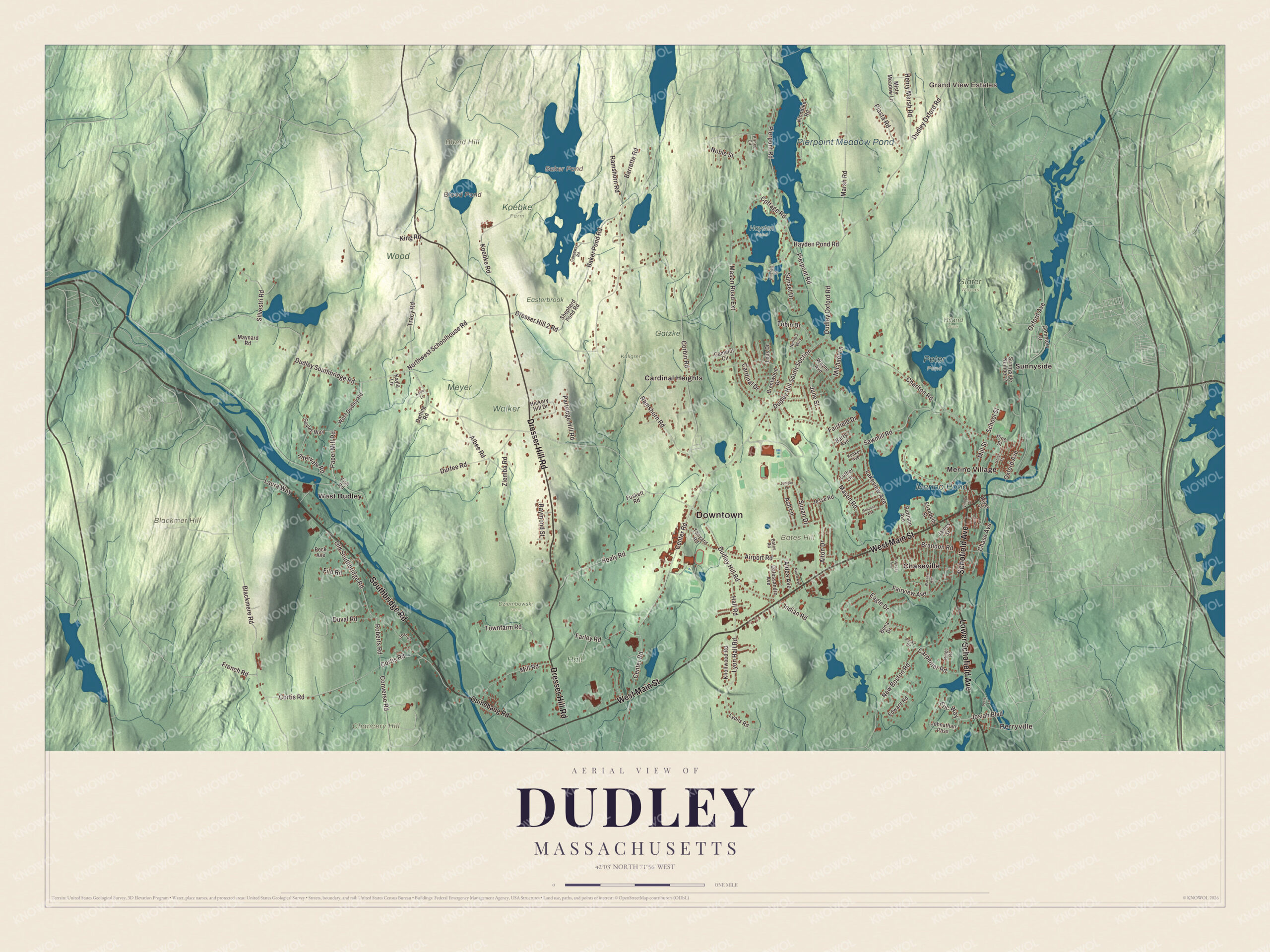
Dudley today
By KNOWOL
Shaded relief from United States Geological Survey elevation data, with West Main Street, Schofield Avenue, Southbridge Road, Dudley Southbridge Road and Dresser Hill Road, Merino, Baker, Blood and Pierpoint Meadow ponds, Dresser Hill and Merino Village.5
The history of Dudley, Massachusetts
The hilltop the Nipmuc gave
Dudley Hill was Nipmuc land long before it was a town. In 1681 the Nipmuc sold a huge tract to the colony's agents, Joseph Dudley and William Stoughton, but kept a reservation five miles square. Stoughton and Dudley got a deed to half of it in 1682, and in 1707 Black James and others sold the rest to William Dudley for ten pounds, leaving the families about one square mile around the hill by 1724. When the new town wanted a meeting-house, it voted to build on Joshua Pegan's old field, and in March 1734 the Nipmuc of Dudley Hill gave four acres on the summit, asking only for seats inside. The frame went up that October. Joseph, Samuel and Ebenezer Peagon later served in Dudley's Continental companies.6782
The academy that burned before it opened
Amasa Nichols, a Universalist who owned a cotton mill on the French River, spent about ten thousand dollars of his own on a school with a meeting hall inside. It burned on April 11, 1816, just as it was finished, and he believed someone set the fire out of religious spite. He built again, opened the school late in 1818, and saw it incorporated as Nichols Academy in 1819. When trustees of another faith were elected in 1823, he resigned and never took an interest in it again. The school carried on. In the 1880s Hezekiah Conant, a Dudley farm boy who made his fortune in thread at Pawtucket, gave it three brick buildings and an observatory. In 1931 Nichols Junior College opened on the old academy grounds.910115
Granite, flax and fifty yoke of oxen
In 1846 Henry H. Stevens of North Andover bought the old Merino wool mill by the French River and began making crash and burlap from American-grown flax. Then he built big. For about ten years his payroll for the mills and dams alone sometimes ran two thousand dollars a day, and fifty yoke of oxen hauled granite from his own quarry. The main mill, five stories of stone, went up from 1862 to 1865, driven by a water wheel forty feet across. The 1859 wheel-house carries the words All was others', all will be others', cut in its stone. It came true sooner than he expected: by 1879 he had no stock left in the company. Still, the 1889 county history called it much the largest mill in the country making nothing but crash.312
Dudley, Massachusetts through the years
24 moments from 1674 to today.
- 1674A Nipmuc praying town called Chabanakongkomun is set up under the influence of John Eliot.5
- 1681On February 10 the Nipmuc deed a great tract, Dudley included, to William Stoughton and Joseph Dudley for fifty pounds.6
- 1684A Nipmuc reservation five miles square is surveyed in October for Black James and others.6
- 1707Black James and others sell William Dudley the rest of the reservation, about 8,000 acres, for ten pounds.7
- 1721Paul and William Dudley begin selling farms here, and John Healy is among the first buyers.6
- 1724William Dudley sets aside about one square mile for the Nipmuc families, taking in today's town center.7
- 1725The first birth in the town records, Obadiah Sabin's, is entered on January 14.13
- 1732Dudley holds its first town meeting on June 20, at William Carter's house.6
- 1734The Nipmuc of Dudley Hill give four acres for a church, and the meeting-house frame goes up on October 23.8
- 1775Dudley minute-men are on the road to Boston the day after news of Lexington arrives.2
- 1776The town adopts the Declaration of Independence as soon as it's read in town meeting.14
- 1797The last 200 acres of Nipmuc land are sold under a state act, the money to go to the families' support.7
- 1803Hezekiah Healy builds the Black Tavern, a stagecoach stop between Boston and Hartford.15
- 1812The Merino Wool Factory Company, by the French River, is incorporated on February 13.3
- 1816Amasa Nichols's new academy building burns on April 11, just as it's finished.9
- 1819Nichols Academy is incorporated on June 18, with fifteen Universalist trustees.9
- 1825Joseph H. and Richard Perry build a log dam and start making satinet at Perryville.3
- 1832All of Dudley east of the French River goes to the new town of Webster, with 37 percent of its people.16
- 1846Henry H. Stevens buys the old Merino mill and starts making crash and burlap from American-grown flax.3
- 1860John Chase and his sons lay the foundation of the cassimere mills at what becomes Chaseville.3
- 1872Eben Stevens's new village of Dundee, on the Quinebaug, has its first goods on the market in March.11
- 1887The West Dudley Co-operative Creamery opens, and nearly all its butter goes to Boston hotels.3
- 1909The Sons and Citizens of Dudley put up the Soldiers War Memorial on July 5.1
- 1931James L. Conrad opens Nichols Junior College on the old academy grounds.5
Places to see in Dudley, Massachusetts
Places worth a visit in Dudley today.
- Black TavernDudley Center Road. Stagecoach stop of about 1803.
- Nichols CollegeDudley Hill. On the old Nichols Academy grounds.Visit their website
- Dudley Soldiers War MemorialBefore the First Congregational Church. Honors veterans of three wars.
- Stevens Linen Works Historic DistrictWest Main Street. Henry Stevens's granite linen mill.
- Merino VillageEast side, by the Webster line. Mill village by the French River.
- ChasevilleFrench River. The Chase family's woolen mill village.
- PerryvilleSoutheast corner, on the French River. Perry family mill village since 1825.
- West DudleyQuinebaug River. Old grist mill, paper mill and creamery village.
- French RiverThe Webster line. Named for Huguenot settlers in Oxford.
Dudley on the National Register of Historic Places
All 3 places in Dudley on the National Register of Historic Places that still stand today, oldest first, and why each one matters.4
-
Black Tavern
Hezekiah Healy built it about 1803 as a stop on the stagecoach road between Boston and Hartford, and the story goes that he painted it black because that color needed less upkeep. It's one of the town's finest Federal buildings; Nichols College used it as a dormitory until 1980, and the Black Tavern Society now keeps it.15
-
Stevens Linen Works Historic District
Henry Hale Stevens built its granite linen mill in the 1860s, a five-story U with two seven-story towers, and it made linen and flax fabric into the 1990s. The district holds ten buildings, a mill pond and a dam.17
-
Dudley Hill Historic District
The historic heart of Dudley, strung along the ridge of Dudley Hill from the village cemetery to the Nichols campus, on land where a Nipmuc settlement stood and where the first church went up in 1734. Its finest building is the brick Conant Memorial Church of 1890, beside a Grange hall built about 1840 as a school, across from the Black Tavern.18
Dudley in their words
“Parties of extensive traveled experience pronounce it lovely, and artists have put some of it on canvas that has been admired.”
Rev. Zephaniah Baker on Dudley's scenery, History of Worcester County, 187919
“Indeed, it may be doubted whether a tract of land can be found in New England better adapted to the various purposes of agriculture than that embracing the whole extent of Dudley Hill”
Rev. Joshua Bates, anniversary discourse at Dudley, 185320
“Pretty good horse, pretty good horse, harness worth more than the horse.”
Rev. Abiel Williams, Dudley's minister, sizing up a young man's horse, as told in the History of Worcester County, 187921
Towns near Dudley, Massachusetts
Sources for the history of Dudley
- Dudley, Massachusetts, Wikipedia
- History of Worcester County, Massachusetts (1889), Dudley chapter, on the Revolution, Internet Archive
- History of Worcester County, Massachusetts (1889), Dudley chapter, on the mills and the creamery, Internet Archive
- National Register of Historic Places list, Wikipedia
- Map of Dudley, Massachusetts in 2026, KNOWOL
- History of Worcester County, Massachusetts (1889), Dudley chapter by J. J. Gillis, on the land and the first settlers, Internet Archive
- Collections of the Worcester Society of Antiquity, John E. Lynch's paper on the Dudley or Pegan Indians (library date 1881), Internet Archive
- An anniversary discourse, delivered at Dudley, Massachusetts, March 20, 1853, by Joshua Bates (1853), on the first meeting-house, Internet Archive
- History of Worcester County, Massachusetts (1879), on Nichols Academy, Internet Archive
- History of Worcester County, Massachusetts (1889), Dudley chapter, on Nichols Academy and Hezekiah Conant, Internet Archive
- History of Worcester County, Massachusetts (1879), Dudley chapter, on West Dudley, Dundee and the Chase mills, Internet Archive
- History of Worcester County, Massachusetts (1879), Dudley chapter, on the Stevens Linen Works, Internet Archive
- An anniversary discourse, delivered at Dudley, Massachusetts, March 20, 1853, by Joshua Bates (1853), on the first settlers, Internet Archive
- An anniversary discourse, delivered at Dudley, Massachusetts, March 20, 1853, by Joshua Bates (1853), on the Revolution, Internet Archive
- Black Tavern, Wikipedia
- History of Worcester County, Massachusetts (1889), Dudley chapter, on the loss of the east part to Webster, Internet Archive
- Stevens Linen Works Historic District, Wikipedia
- Dudley Hill Historic District, Wikipedia
- History of Worcester County, Massachusetts (1879), Dudley chapter by Rev. Zephaniah Baker, Internet Archive
- An anniversary discourse, delivered at Dudley, Massachusetts, March 20, 1853, by Joshua Bates (1853), on Dudley Hill, Internet Archive
- History of Worcester County, Massachusetts (1879), Dudley chapter, on Rev. Abiel Williams, Internet Archive