
A shore town across the harbor from New Haven, once called the Iron Works village, where Connecticut's first iron works ran by the Great Pond in 1655 and a congregation that argued its way toward a charter built the Old Stone Church in 1774.
East Haven on the map
Click the map to look closer.
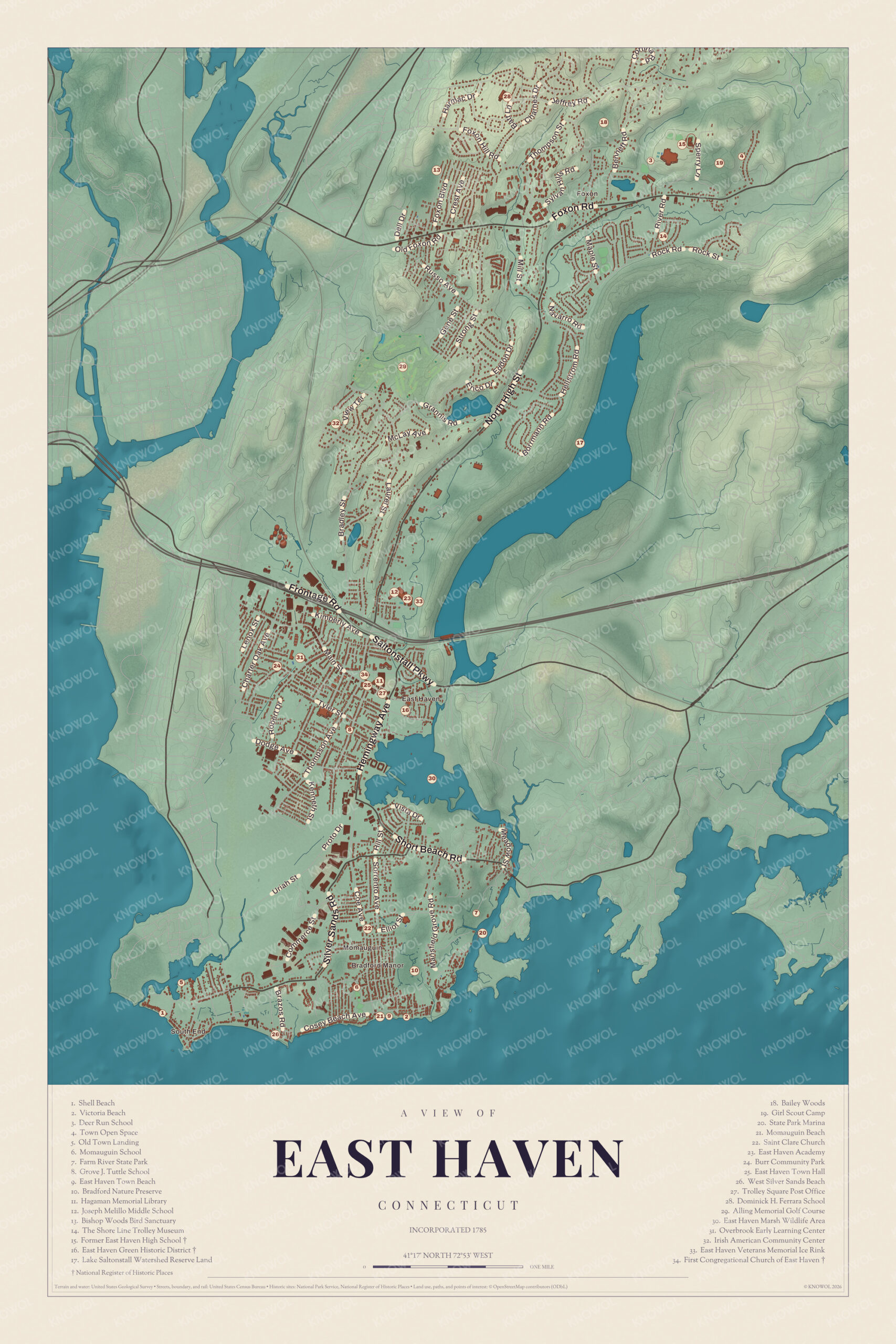
East Haven today
By KNOWOL
Shaded ground from the hills of Foxon down to the shore at the South End, every street, Lake Saltonstall and Long Island Sound, and a guide of 34 numbered landmarks with the National Register sites marked.6
The story of East Haven
The geese that cost a charter
East Haven spent about a hundred years trying to become its own town. In 1684 the farmers across the Quinnipiac chose their own selectmen and constable with New Haven's consent, which an 1886 history calls the first and last time part of a town took up the powers of a town without the Legislature. In 1707 the colony granted a charter that East Haven read as a township. Then Governor Gurdon Saltonstall, living on his wife's land in East Haven, found the village geese crossing from the Furnace Pond onto his farm and made a great slaughter among them. At the next election not one East Haven vote went to Saltonstall, and the Assembly soon reduced the village to a parish again. East Haven finally became a town in 1785 and held its first town meeting in the meetinghouse that July.71892
Iron, oysters and Kentucky mules
The first iron works in Connecticut were set up here in 1655 under Stephen Goodyear, near the shore of the Great Pond that's now Lake Saltonstall, and they ran about twenty-five years on bog ore from North Haven. In 1709 a fulling mill went up where the forge had stood. In 1894 the Iron Master's stone house still stood on the west bank of Stony River near the Stone Bridge. The water paid too. Rev. Stephen Dodd wrote in 1824 that oysters were taken in vast quantities in the Quinnipiac, and those of superior flavor in the Cove and Stony River. And for a time East Haven was a gathering place for Kentucky mules bound for the West Indies, so the village blacksmith on the north side of the green pulled off their shoes before the sea voyage.31011121314
The Old Stone Meetinghouse
George Lancraft, a stonemason from Fair Haven, raised the stone meetinghouse in 1772 to 1774 for Rev. Nicholas Street, who served as pastor for fifty-one years and died on the anniversary of his ordination in 1806. The congregation built in stone because it was cheaper than wood, since they had the stone, the lime, the teams and the men. When the British came through in July 1779, their advance got as far as the meetinghouse and ransacked it for the church silver. By 1798, with a clock that Edmond Bradley and others put in the steeple at no cost to the society, it stood complete. It was remodeled in 1850, and in 1874 it got a Centennial Chapel, built by Lancraft's great-grandson, William M. Lancraft.4151617181920
Through the years
24 moments from 1638 to today.
- 1638On November 24, Momauguin, sachem of the Quinnipiac, agrees to the English purchase of the land of Quinnipiack.21
- 1644Thomas Gregson is granted 133 acres at Solitary Cove, now Morris Cove, and settles the first family in East Haven.3
- 1655The first iron works in Connecticut start up here under Stephen Goodyear.3
- 1683The village grants land at Foxon's Farms to the first three settlers in that part of town.22
- 1684On August 4, East Haven chooses its own selectmen, constable and recorder, with New Haven's consent.7
- 1704The village asks young Jacob Hemingway for "a taste of his gifts" as a preacher.23
- 1707The colony grants a township, and the name changes from Iron Works Village to East Haven.1
- 1709A fulling mill goes up where the old iron forge had stood.11
- 1711The church is organized on October 8, and Jacob Hemingway is ordained its pastor the same day.24
- 1755Rev. Nicholas Street is ordained, beginning a pastorate of fifty-one years.15
- 1774George Lancraft finishes the stone meetinghouse, today's Old Stone Church.4
- 1779British troops march through in July, and East Haven's losses come to at least $25,000.25
- 1779On October 4, Amos Morris Jr. gets written permission to catch two bushels of oysters.26
- 1785East Haven becomes a town and holds its first town meeting in the meetinghouse that July.2
- 1796The General Assembly lets East Haven build a toll bridge to New Haven at Leavenworth's Ferry.27
- 1798With a clock in its steeple, the stone meetinghouse stands complete, 29 years after the first vote to build.18
- 1824Rev. Stephen Dodd publishes his history of the town, the East Haven Register.13
- 1850The Old Stone Church is remodeled and dedicated again on October 16.19
- 1874A Centennial Chapel is built, with George Lancraft's great-grandson as contractor.20
- 1936The town's first public high school is built on Tyler Street.28
- 1945The Branford Electric Railway Association is founded to save the trolleys.29
- 1947The association takes over the trolley line from East Haven to Short Beach.29
- 1997The present East Haven High School opens and the old one closes.28
- 1998The state buys the land for Farm River State Park.6
Places to see
The numbers match the landmark guide printed on the 2026 map.
- 5Old Town LandingSouth End. The old landing in the South End.
- 7Farm River State ParkFarm River estuary. 62 acres of marsh and rocky shore.Visit their website
- 9East Haven Town BeachMomauguin. The town beach on the Sound.
- 11Hagaman Memorial LibraryThe Center. The town's public library.Visit their website
- 14Shore Line Trolley MuseumRiver Street. Restored trolleys on 1.5 miles of track.Visit their website
- 15Former East Haven High SchoolTyler Street. The 1936 high school, now apartments.
- 16East Haven Green Historic DistrictThe Center. Bandstand, cannon and veterans' monuments.
- 17Lake Saltonstall Watershed Reserve LandEastern edge, Foxon. Woods around the glacial lake.
- 25East Haven Town HallThe Center. The hub of town government.
- 34First Congregational Church of East HavenEast end of the green. The Old Stone Church of 1774.
On the National Register
All 4 places in East Haven on the National Register of Historic Places that still stand today, oldest first, and why each one matters.5
-
East Haven Green Historic District
The town green, with a bandstand and a Revolutionary War cannon at its center and monuments to the town's veterans, including one to Lafayette and his troops, who camped on the green. The district takes in houses from the late 1600s on and the old town cemetery to the south.30
-
First Congregational Church of East Haven
The Old Stone Church, built of red sandstone by George Lancraft, a stonemason from Fair Haven, is one of Connecticut's few surviving churches from before the Revolution. It was looted of its silver in a British raid during the war, and its interior dates from an 1850 renovation.4
-
Branford Electric Railway Historic District
The Shore Line Trolley Museum, founded in 1945, is the oldest continuously operating trolley museum in the United States. Visitors ride restored trolleys on its 1.5 miles of track, part of the old line to Short Beach, and the listing takes in the line and its cars.29
-
East Haven High School
The town's first public high school, designed by New Haven architect Roy W. Foote and built with help from the federal Public Works Administration. Before it opened, East Haven sent its students to New Haven High School. It served until 1997 and has since been converted to housing.28
In their words
“Geese once saved Rome, but they ruined East Haven”
The republic of New Haven, 1886, on Governor Saltonstall and the village geese8
“this spot is one of the most picturesque and pretty bits of landscape in this section of the country.”
Papers of the New Haven Colony Historical Society, 1894, on the Iron Master's stone house at Stony River12
“by far the finest church edifice in New Haven County”
Rev. Mr. Havens in his centennial sermon on the Old Stone Meetinghouse, as quoted in History of East Haven, 190818
Nearby towns
Sources
- East Haven, Connecticut, Wikipedia
- The public records of the State of Connecticut (1894), the act making East Haven a town, Internet Archive
- History of the colony of New Haven, before and after the union with Connecticut (1838), on East Haven, Internet Archive
- First Congregational Church of East Haven, Wikipedia
- National Register of Historic Places listings in New Haven County, Connecticut, Wikipedia
- Map of East Haven, Connecticut in 2026, KNOWOL (USGS elevation, Census Bureau roads)
- The republic of New Haven: a history of municipal evolution (1886), on the town officers of 1684, Internet Archive
- The republic of New Haven: a history of municipal evolution (1886), on the geese and Governor Saltonstall, Internet Archive
- History of East Haven (1908), on the geese and Governor Saltonstall, Internet Archive
- The evolution of an old New England church, being the history of the Old Stone Church in East Haven (1924), on the Great Pond, Internet Archive
- History of East Haven (1908), on the forge and the fulling mill, Internet Archive
- Papers of the New Haven Colony Historical Society (1894), on the iron works at Stony River, Internet Archive
- History of Connecticut in monographic form (1925), on Dodd's East Haven Register, Internet Archive
- History of New Haven County, Connecticut (1892), on the Bradley blacksmith shop, Internet Archive
- Genealogical and family history of the state of Connecticut (1911), on Rev. Nicholas Street, Internet Archive
- History of East Haven (1908), on building the stone meetinghouse, Internet Archive
- History of East Haven (1908), on the British invasion, Internet Archive
- History of East Haven (1908), on the steeple clock, Internet Archive
- History of East Haven (1908), on the 1850 remodeling, Internet Archive
- History of East Haven (1908), on the Centennial Chapel, Internet Archive
- History of the colony of New Haven, before and after the union with Connecticut (1838), on the purchase from Momauguin, Internet Archive
- History of New Haven County, Connecticut (1892), on Foxon's Farms, Internet Archive
- The republic of New Haven: a history of municipal evolution (1886), on calling Jacob Hemingway, Internet Archive
- By-laws, rules of procedure, and catalogue of churches of the New Haven East Consociation (1854), Internet Archive
- The British invasion of New Haven, Connecticut (1879), on East Haven's losses, Internet Archive
- History of Connecticut in monographic form (1925), on the 1779 oyster permit, Internet Archive
- The public records of the State of Connecticut (1894), the East Haven toll bridge grant, Internet Archive
- Old East Haven High School, Wikipedia
- Shore Line Trolley Museum, Wikipedia
- East Haven Green Historic District, Wikipedia