
The old East Village of Longmeadow, a town of red sandstone quarries whose stone went into buildings from Harvard to New Orleans, gathered around a center where seven roads meet like the spokes of a wheel.
East Longmeadow on the map
Click the map to look closer.
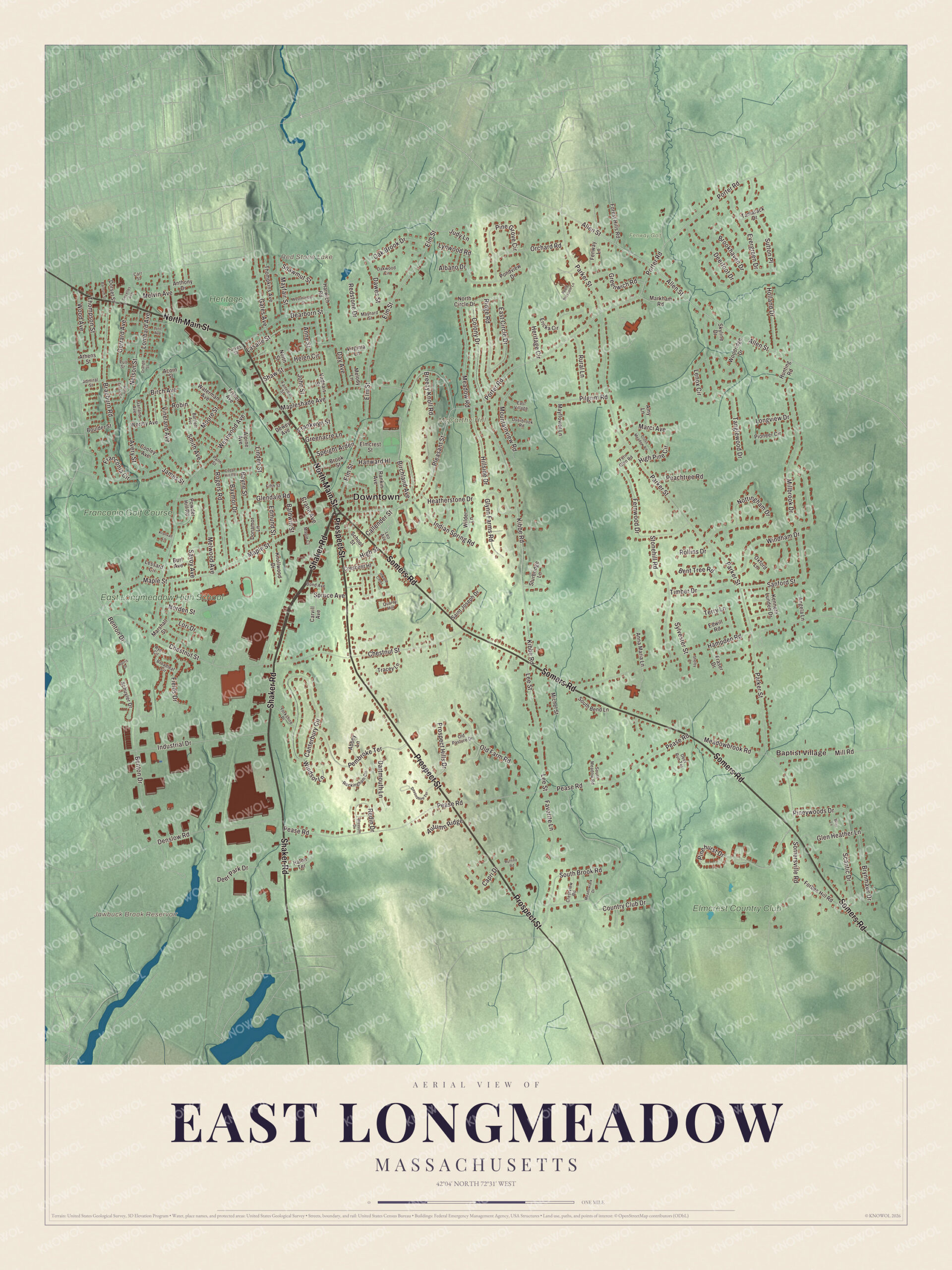
East Longmeadow today
By KNOWOL
Shaded relief with every road from the Rotary out along Shaker Road, Prospect Street, North Main Street, Somers Road, Maple Street and Pleasant Street, with the Jawbuck Brook Reservoir, Red Stone Lake, McCarthy Hill and Baptist Village.6
The story of East Longmeadow
Red stone for half the country
The hills in the east of town are full of red sandstone, and it's been dug since the first settlers came. At first the stone was treated as common property, and a man who found a ledge had the first right to work it, even on a neighbor's land. Early on it was cut for gravestones. Later it went into the Armory buildings in Springfield and the foundation of the Armory's iron fence. By 1902 the county history listed Sever Hall and the Law School at Harvard, Vanderbilt Hall at Yale, a library in New Orleans and the Ames monument in Wyoming. One teamster hauled stone to Springfield for ten years, sometimes with 48 horses a day.784
Seven roads and a meetinghouse
This was forest once, full of deer, bears, wildcats and wild turkeys, and the first settlers didn't come until about 1740. For years East Village families went miles through the woods every Sunday to the old church on the Longmeadow green. In 1828 they built their own meetinghouse on the hill, and in 1859 they moved it down into the village, where it still stands as the Church on the Rotary. Willis Phelps kept a tavern there from about 1829. A 1926 history pictured the center with seven roads coming in like the spokes of a wheel. Robert Ripley later made the Rotary famous for those seven streets with no traffic lights.910111231
Parting from Longmeadow
For more than a century the East Village was simply the back half of Longmeadow. Town meetings were held in the west village until about 1820, when the growing east side won the right to host every other one. The railroad came through in 1876, and in 1882 the east side got its own town hall, upstairs in a school built of stone from its own quarries. Each village did its business with Springfield, and the two drifted apart. In 1894 the legislature set off East Longmeadow as its own town, taking a little more than half the land and leaving the old town with just 620 people.1314215
Through the years
20 moments from 1720 to today.
- 1720Sometime between 1720 and 1740 the Elijah Burt House goes up on what's now Chestnut Street.16
- 1740Jonathan and Elijah Burt and Silas Hale settle on the forested Longmeadow commons, about this year.9
- 1748A man goes up Poverty Hill to cut brooms, by the 1879 history the first stirring of settlement in the east part of town.12
- 1750sHouses start to appear in the eastern part of Longmeadow, known as the East Village.1
- 1793Benjamin Swetland probably builds the house on what's now Pease Road, about this year.17
- 1820About this year Longmeadow's annual town meetings start alternating between the west and east villages.13
- 1827The East Village Congregationalists incorporate their own religious society.11
- 1828Their meetinghouse is built on the hill above the village for $3,500.11
- 1829A tavern opens at East Longmeadow village, kept by Willis Phelps for about ten years.12
- 1859The meetinghouse is moved down the hill into the village and remodeled.11
- 1876The Connecticut Central Railroad opens with a station at East Longmeadow village.14
- 1882A town hall opens on the upper floor of a new school built of stone from the village quarries.13
- 1883Catholics begin holding meetings in the town hall, about this year.18
- 1887St. Michael's, a church seating 300, is built.18
- 1894On May 19 the legislature approves the act setting off East Longmeadow as its own town, effective July 1.2
- 1896The East Longmeadow public library is started that winter.18
- 1960sMilton Bradley moves its manufacturing from Springfield to a huge new plant in East Longmeadow.6
- 1984Hasbro buys Milton Bradley.6
- 2016A new charter brings a Town Council and a town manager, and Cartamundi buys the old game plant.1
- 2021The old train depot reopens as an ice cream stand beside the Redstone Rail Trail.1
Places to see
Places worth a visit in East Longmeadow today.
- The RotaryTown center. Seven streets meet with no traffic lights.
- Elijah Burt HouseChestnut Street. Believed the oldest house in town.
- Baptist VillageEast Longmeadow. The town's named village.
- Heritage ParkBlackman's Pond. Pond, ball fields and picnic grounds.
- Redstone Rail TrailMaple Street to Denslow Road. Bike path on the old railroad.
- Old train depotRedstone Rail Trail. Now an ice cream stand.
- Red Stone LakeEast Longmeadow. Printed on the 2026 map.
- Jawbuck Brook ReservoirEast Longmeadow. A reservoir on Jawbuck Brook.
- McCarthy HillEast Longmeadow. One of the town's hills.
- East Longmeadow High SchoolEast Longmeadow. Home of the July 3 fireworks.
On the National Register
All 3 places in East Longmeadow on the National Register of Historic Places that still stand today, oldest first, and why each one matters.5
-
Elijah Burt House
Believed to be the oldest building in East Longmeadow, it was an early stagecoach stop. Before the Civil War its abolitionist owner is said to have hidden people escaping slavery in the basement, and it's believed to have been a station on the Underground Railroad.16
-
Swetland-Pease House
Probably built by Benjamin Swetland, it's one of only two documented 18th-century houses in town and one of the best preserved, with four fireplaces and its original wainscoting. Pease Road is named for the family that later owned it.17
-
First Congregational Church of East Longmeadow
The town's oldest church building and oldest congregation. It was built on the hill in 1828, moved down to the center in 1859, and held town meetings until the town hall of 1882. Today it's known as the Church on the Rotary.19
In their words
“No less than seven roads centering there like the spokes of a wheel.”
Western Massachusetts: a history, 1636-1925, 1926, on East Longmeadow village3
“The stone has been shipped to all parts of the country, and has been used in many public buildings and other works.”
A history of Hampden County, 1902, on East Longmeadow's red sandstone7
“The old church on the village green remained for many years the Mecca to which the residents of the eastern portion turned their steps on the Sabbath.”
A history of Hampden County, 1902, on the East Village before it had its own church10
Nearby towns
Sources
- East Longmeadow, Massachusetts, Wikipedia
- "Our county and its people": A history of Hampden County, Massachusetts (1902), on the act of 1894, Internet Archive
- Western Massachusetts: a history, 1636-1925 (1926), on East Longmeadow village, Internet Archive
- Encyclopedia of Massachusetts, biographical, genealogical (1916), on hauling stone, Internet Archive
- National Register of Historic Places listings in Hampden County, Massachusetts, Wikipedia
- Map of East Longmeadow, Massachusetts in 2026, KNOWOL (USGS elevation, Census Bureau roads)
- "Our county and its people": A history of Hampden County, Massachusetts (1902), on the red sandstone quarries, Internet Archive
- "Our county and its people": A history of Hampden County, Massachusetts (1902), on buildings of East Longmeadow stone, Internet Archive
- "Our county and its people": A history of Hampden County, Massachusetts (1902), on the first settlers, Internet Archive
- "Our county and its people": A history of Hampden County, Massachusetts (1902), on the old church, Internet Archive
- "Our county and its people": A history of Hampden County, Massachusetts (1902), on the Congregational church, Internet Archive
- History of the Connecticut Valley in Massachusetts (1879), on early settlement and taverns, Internet Archive
- "Our county and its people": A history of Hampden County, Massachusetts (1902), on town meetings and the town hall, Internet Archive
- History of the Connecticut Valley in Massachusetts (1879), on quarries and railroads, Internet Archive
- "Our county and its people": A history of Hampden County, Massachusetts (1902), on the division of Longmeadow, Internet Archive
- Elijah Burt House, Wikipedia
- Swetland-Pease House, Wikipedia
- "Our county and its people": A history of Hampden County, Massachusetts (1902), on St. Michael's and the library, Internet Archive
- First Congregational Church of East Longmeadow, Wikipedia