
A river town of five villages, where sloops once unloaded at Warehouse Point, the farms' rye went into gin, and the mill at Broad Brook wove cassimere for a hundred years.
Then and now
The same town 157 years apart. Click either map to look closer.
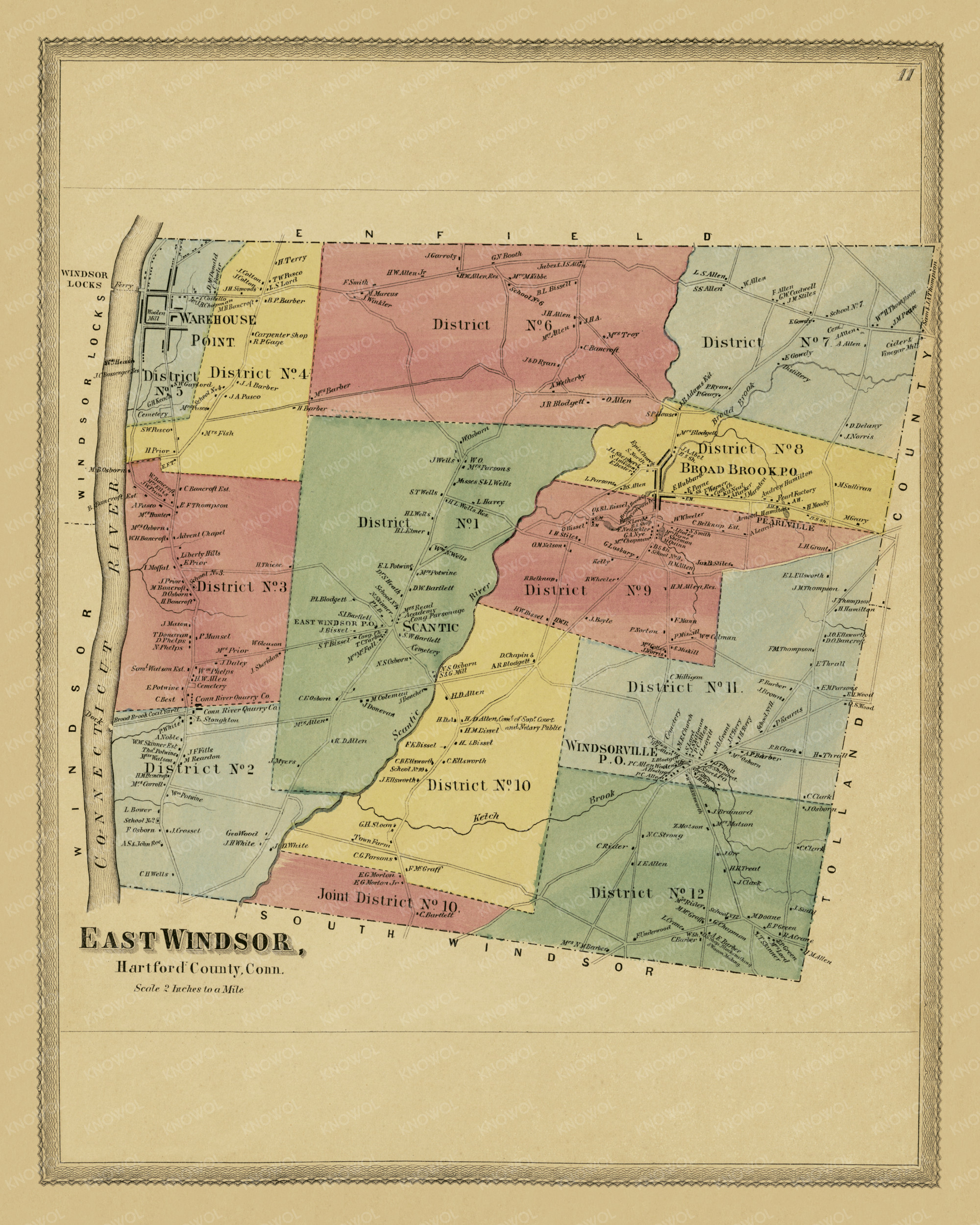
The landowners map
By Baker & Tilden
East Windsor in 1869, with every plot labeled with its owner's name, twelve districts including Broad Brook, Windsorville, Warehouse Point and Pearlville, and landmarks like the Gowdy Distillery, the East Windsor Cider & Vinegar Mill, the Connecticut River Quarry Co., the Broad Brook Coal Yard and the East Windsor Pearl Factory.4
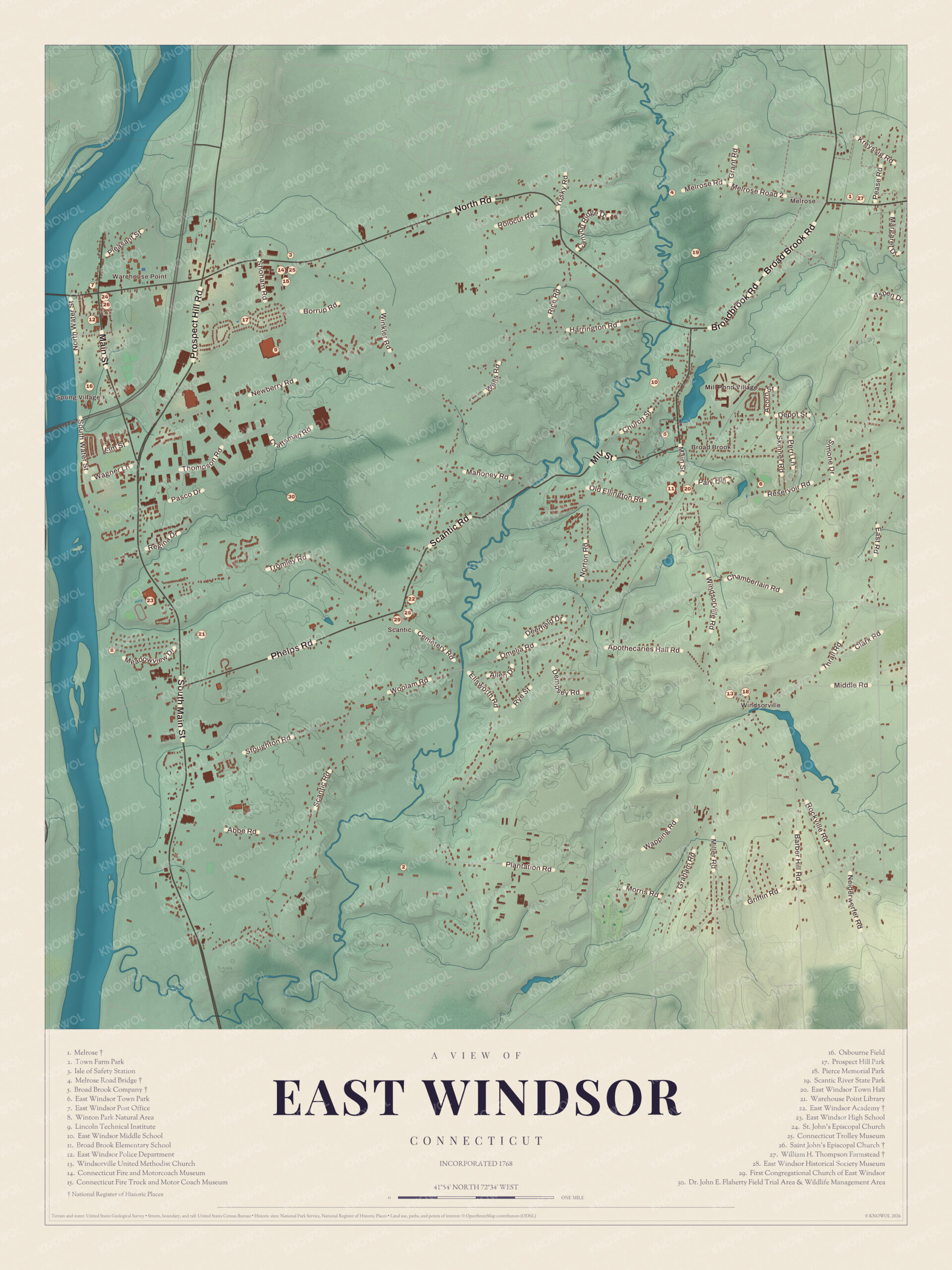
East Windsor today
By KNOWOL
Shaded ground from the Connecticut River at Warehouse Point out to the farm fields of Melrose, every street, the five villages and the Scantic River, and a guide of 30 numbered landmarks with the National Register sites marked.5
The story of East Windsor
Rye, gin and Warehouse Point
In 1836 John Warner Barber wrote that the eastern and northern parts of East Windsor were best for rye, and that 70,000 bushels had been raised in one season. Much of it became gin. A county history of 1886 remembered several large gin distilleries in town before the temperance movement took hold, with Osborn's mill in Scantic and other gristmills grinding the rye. The 1869 map shows the Gowdy Distillery, and the Melrose historic district still holds the ruins of a small distillery on Broad Brook. Barber had called gin a business of the past in 1836, but it came back. Year after year in the 1880s and 1890s the state register said rye gin was made in quantity at Warehouse Point, and by 1897 at Melrose as well.264789
Where the sloops turned back
Warehouse Point sits at the foot of the Enfield Falls, the first big falls on the Connecticut River. William Pynchon of Springfield built a warehouse here in 1636, and old Windsor residents later swore that Francis Stiles had laid out a park of 2,000 acres here for Sir Richard Saltonstall, with a high palisade fence on its south side. Through colonial times, freight came up the river on sloops and was moved onto flatboats here, until the first Hartford bridge of 1809 blocked the bigger sloops. Tobacco kept the village busy after that. By 1825 a tobacco warehouse stood here, and in the 1880s Clinton T. Inslee, born in the village, made cigars, served as ferry commissioner and argued in the legislature for a bridge to Windsor Locks.110111213
The drummer at the woodpile
Scantic, named for its river, became a parish of its own in 1752 and ordained its first pastor, Thomas Potwine, in 1754. Its meetinghouse stood only a mile and a half from the river road, and still the people along that road grumbled that it was too far off in the woods. When word of Lexington arrived in April 1775, the young drummer Asahel Stiles was chopping wood near what's now Broad Brook. Family tradition says he struck his axe into the log, jumped the fence, slung his drum over his shoulder and hurried to the muster north of the Scantic meetinghouse. The company left for Roxbury the next day. In Scantic stood the house of Capt. Hezekiah Bissell, who served through the whole war and once copied the plan of Fort Ticonderoga.14151617
Through the years
24 moments from 1636 to today.
- 1636William Pynchon of Springfield builds a warehouse at the foot of the Enfield Falls, the start of Warehouse Point.1
- 1752Scantic, the North Society, becomes a parish of its own.14
- 1754The Rev. Thomas Potwine is ordained Scantic's first pastor.14
- 1768The east side of Windsor becomes the town of East Windsor on May 10.1
- 1775Word of Lexington arrives, and the company musters north of the Scantic meetinghouse and marches for Roxbury.16
- 1789Warehouse Point asks to become its own school district, and the request is granted.18
- 1809The first Hartford bridge blocks the bigger sloops, ending Warehouse Point's long run as the place where river freight changed boats.11
- 1809St. John's Church, designed by Samuel Belcher, is built on the Warehouse Point green.19
- 1817The brick East Windsor Academy is built in Scantic.20
- 1818Solomon Ellsworth Jr., blasting for a well, finds bones later identified as a dinosaur, an Anchisaurus.1
- 1825A tobacco warehouse is set up at Warehouse Point.12
- 1829The Methodist church is built in the place later called Ketch Mills and then Windsorville.21
- 1832The Broad Brook mill is started at the waterfall of the Mill Pond.1
- 1836John Warner Barber reckons that 70,000 bushels of rye have been raised in town in one season.2
- 1845South Windsor is set off, leaving East Windsor with its present northern half.22
- 1850The Melrose district schoolhouse is built. It's a library today.7
- 1869Baker & Tilden publish their landowners map of East Windsor.4
- 1875The Connecticut Central railroad opens, with a branch from Rockville to Melrose.23
- 1876The Windsorville Methodist church burns. A new church is dedicated in 1878.21
- 1885Warehouse Point cigar maker Clinton T. Inslee argues in the legislature for a bridge to Windsor Locks.13
- 1888The Berlin Iron Bridge Company builds the Melrose Road Bridge over the Scantic River.24
- 1897The state register reports rye gin made in quantity at Warehouse Point and Melrose.9
- 1940The Connecticut Trolley Museum is founded at Warehouse Point.25
- 1954The Broad Brook Company closes its mill after more than a century.26
Places to see
The numbers match the landmark guide printed on the 2026 map.
- 1MelroseNortheast corner. Farm village once called Irish Row.
- 4Melrose Road BridgeScantic River. Iron lenticular truss of 1888.
- 5Broad Brook CompanyBroad Brook. Textile mill from the 1830s to 1954.
- 13Windsorville United Methodist ChurchWindsorville. Church in the southeast village.
- 19Scantic River State ParkAlong the Scantic. River park through three towns.Visit their website
- 22East Windsor AcademyScantic Road. Brick academy of 1817, now a museum.
- 24Saint John's Episcopal ChurchMain Street, Warehouse Point. Belcher's church, Gothic inside since 1855.
- 25Connecticut Trolley MuseumWarehouse Point. Electric railroading museum founded 1940.Visit their website
- 27William H. Thompson FarmsteadMelrose Road. Greek Revival farmhouse of about 1850.
- 29First Congregational Church of East WindsorScantic. Near the old Scantic parish center.
On the National Register
All 5 places in East Windsor on the National Register of Historic Places that still stand today, oldest first, and why each one matters.3
-
St. John's Episcopal Church
Designed by Samuel Belcher and first set on the village green, it served Methodists and Episcopalians together until 1832 and was moved to its present spot in 1844. In 1855 Henry Austin of New Haven remade the inside as a Gothic English country church.19
-
East Windsor Academy
A brick private academy whose pupils included Junius Morgan, father of J. P. Morgan. It later served as a parish hall, a school again and apartments, and is now the historical society's museum.20
-
Melrose
More than 250 acres of farm village settled in the early 1700s, with 19th-century farmhouses and barns, the ruins of a small distillery and an 1850 district schoolhouse that's now a library.7
-
William H. Thompson Farmstead
A Greek Revival farmhouse built by William H. Thompson, a descendant of early settlers who served as selectman and legislator, with 19th-century barns and a 1917 bungalow.27
-
Melrose Road Bridge
A wrought iron lenticular pony truss made by the Berlin Iron Bridge Company and bought by the town for $750. When it was listed it was one of only 15 lenticular trusses left in the state.24
In their words
“This town, occupying the fertile lands lying along the Connecticut River, is pointed out by Nature as agricultural rather than manufacturing.”
The memorial history of Hartford County, 18866
“Warehouse Point is a considerable village on the Connecticut river, near the northern boundary of the town, at the head of sloop navigation.”
John Warner Barber, Connecticut historical collections, 18362
“When the Scantic meeting-house was built, near where it now stands, it was only a mile and a half from The Street, and yet the dwellers along that thoroughfare complained that it was too far off in the woods.”
The memorial history of Hartford County, 188615
Nearby towns
Sources
- East Windsor, Connecticut, Wikipedia
- Connecticut historical collections, John Warner Barber (1836), on East Windsor, Internet Archive
- National Register of Historic Places listings in Hartford County, Connecticut, Wikipedia
- Landowners map of East Windsor, Connecticut from 1869, restored by KNOWOL
- Map of East Windsor, Connecticut in 2026, KNOWOL (USGS elevation, Census Bureau roads)
- The memorial history of Hartford County, Connecticut, 1633-1884 (1886), on East Windsor's farms and mills, Internet Archive
- Melrose, Connecticut, Wikipedia
- Register and manual of the state of Connecticut (1888), Internet Archive
- Register and manual of the state of Connecticut (1897), Internet Archive
- The public records of the colony of Connecticut (1850), on Saltonstall's park, Internet Archive
- The Connecticut River and the valley of the Connecticut (1906), Internet Archive
- Connecticut as a colony and as a state (1904), on tobacco, Internet Archive
- Evening post annual, biographical sketches of the General Assembly of Connecticut (1885), on Clinton T. Inslee, Internet Archive
- Connecticut historical collections, John Warner Barber (1836), on the Scantic parish, Internet Archive
- The memorial history of Hartford County, Connecticut, 1633-1884 (1886), on the Scantic parish, Internet Archive
- The Stiles family in America (1895), on Asahel Stiles, Internet Archive
- Chapter sketches, Connecticut Daughters of the American Revolution (1901), on Hezekiah Bissell, Internet Archive
- History of ancient Windsor, Connecticut (1859), on school districts, Internet Archive
- St. John's Episcopal Church (Warehouse Point, Connecticut), Wikipedia
- East Windsor Academy, Wikipedia
- The memorial history of Hartford County, Connecticut, 1633-1884 (1886), on the Windsorville Methodist church, Internet Archive
- Historic towns of the Connecticut River valley (1906), on East and South Windsor, Internet Archive
- A century of Vernon, Connecticut, 1808-1908 (1911), on the Melrose branch, Internet Archive
- Melrose Road Bridge, Wikipedia
- Connecticut Trolley Museum, Wikipedia
- Broad Brook Company, Wikipedia
- William H. Thompson Farmstead, Wikipedia