
Connecticut's southwest corner, bought for 25 coats in 1640, where Putnam rode down the hill at Horseneck, oystermen worked the mouth of the Mianus and Cos Cob painters filled the Bush-Holley House.
Greenwich then and now
The same town 122 years apart. Click either map to look closer.
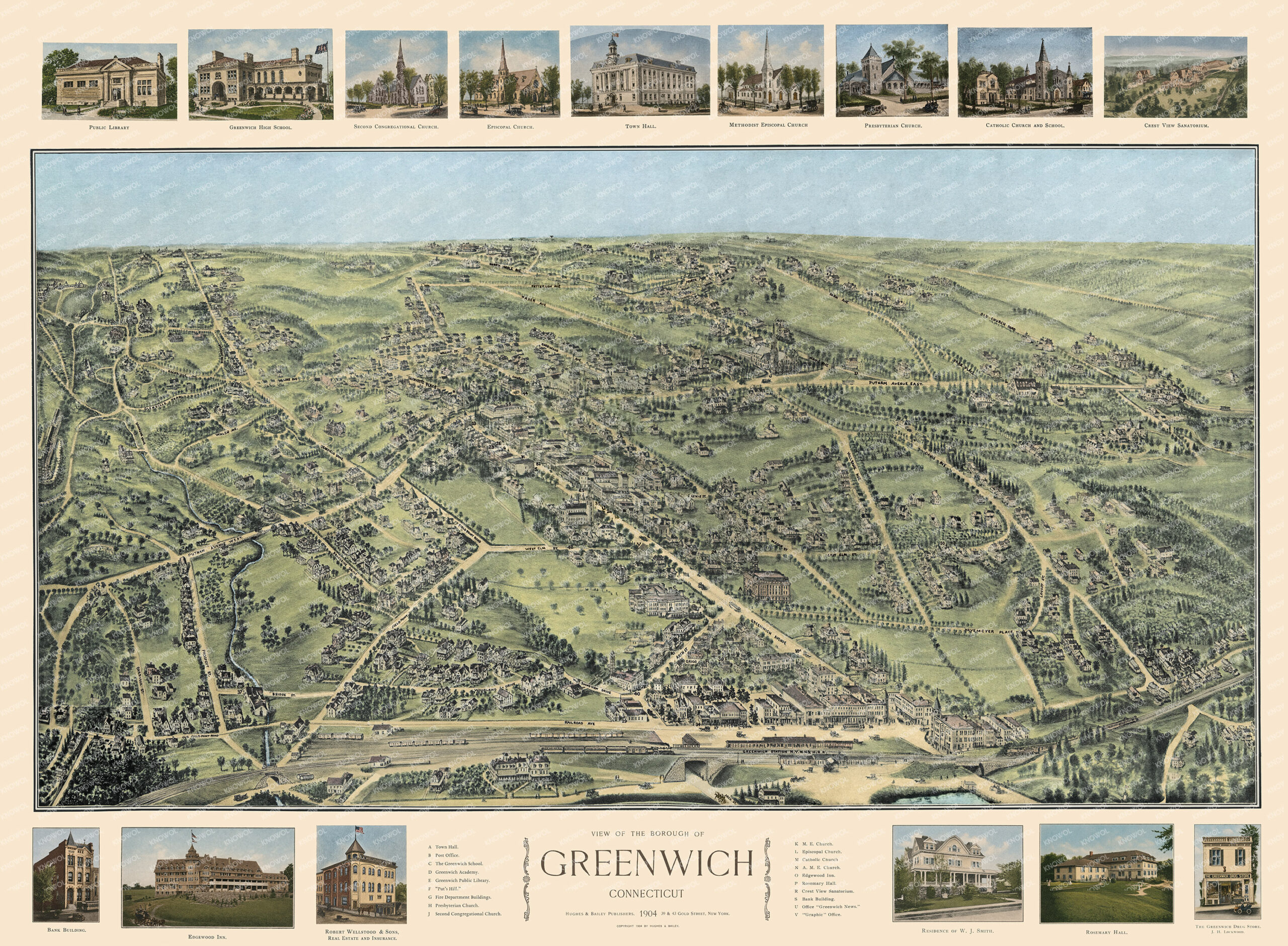
The bird's-eye view
By O.H. Bailey
Greenwich drawn from the sky as the railroad was turning it into a suburb of New York, with Greenwich Academy, Rosemary Hall, Put's Hill, the Edgewood Inn, the station of the New York and New Haven Railroad, the Public Library, the Town Hall, Greenwich High School and many churches that still stand.4
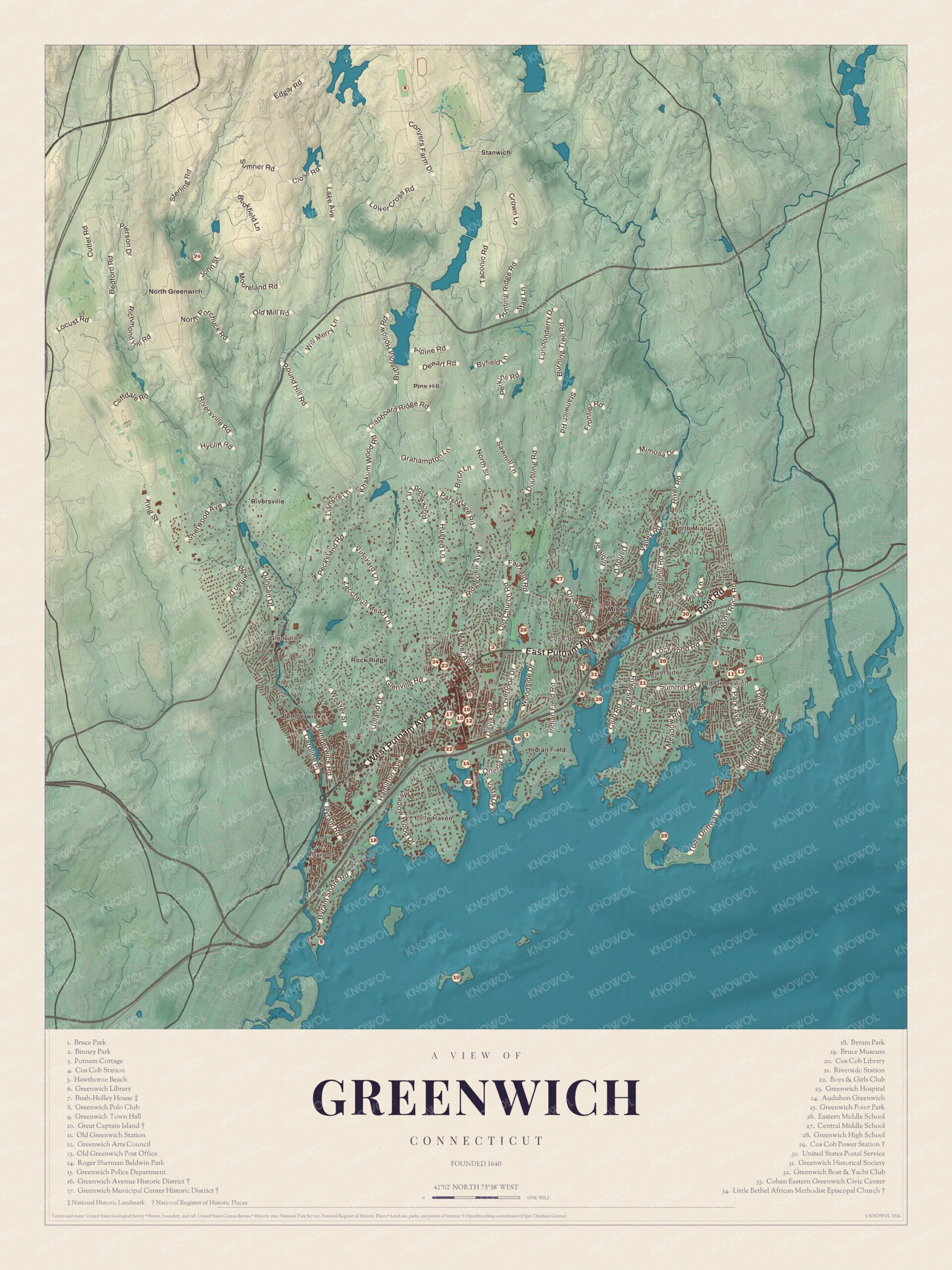
Greenwich today
By KNOWOL
Shaded hills from North Greenwich down to Greenwich Cove and Long Island Sound, every street and the town line, the villages from Cos Cob to Old Greenwich, and a guide of 34 numbered landmarks with the National Historic Landmark and National Register sites marked.5
The history of Greenwich, Connecticut
The ride down Put's Hill
On February 26, 1779, British troops came into Greenwich, and General Israel Putnam got away by riding down the steep hill at Horseneck, then warned Stamford. A 1911 town history says one ball fired at him passed through his hat. For years people pointed to a flight of stone steps as his route, but the same book calls that a fancy sketch for picture books, and says the steps people showed off were cut into the rock by the town in 1902. Lafayette came through on August 20, 1824. He left his carriage and walked down the hill under an arch of hemlock, wild brier and roses made by the women of the town. In 1900 the Daughters of the American Revolution marked the spot with a monument.167
Oysters, iron and hoopskirt wire
Greenwich is known for its estates, but its rivers and shore once kept people working. Robert Cox, an ironworker from England, started a rolling mill on the Mianus River in 1829, and during the Civil War the spike iron it made went from $60 to $200 a ton. The wire mill just below it made hoopskirt wire from 1859 to 1868 and closed when the fashion passed. Upriver, Walter Swan had made fine linen paper for ledgers since about 1800. On the water, Captain Henry S. Lockwood began planting oyster shells at the mouth of the Mianus in 1850, and in 1878 he built the first steamboat in the country made for oystering. Stone from Greenwich quarries went into four of the town's churches.891011
How Horseneck became downtown
The center of town was long called Horseneck, after a neck of land on the Sound used as a pasture for horses. When it became the Borough of Greenwich in 1854, Greenwich Avenue had only three or four small stores and a couple of meat markets. After the Civil War, William M. Tweed built the Americus Club on a point by the harbor and started a steamboat company. Its John Romer was said to be the fastest boat on the Sound, and two or three hundred passengers might land at Rocky Neck on a fine day. Mianus and Cos Cob stayed the business centers until after 1886. Then the borough pulled ahead, and gifts from Henry O. Havemeyer and Robert M. Bruce gave Greenwich Avenue its civic buildings.12131415
Greenwich, Connecticut through the years
24 moments from 1640 to today.
- 1640On July 18, Daniel Patrick and Robert Feake land at Greenwich Point and buy land from the Siwanoy for 25 coats.2
- 1665The General Assembly declares Greenwich a township.1
- 1730About this year the Bush-Holley House goes up on a hill above Cos Cob harbor.16
- 1756Greenwich already has nine school districts.17
- 1779On February 26, General Israel Putnam escapes the British down the hill at Horseneck and warns Stamford.1
- 1787A flood on the Mianus River carries away a bridge and the mill beside it.18
- 1796Sylvanus Selleck builds his gristmill in northern Greenwich.19
- 1800About this year Walter Swan builds a paper mill on the Mianus that makes fine linen paper.9
- 1824On August 20, Lafayette walks down Put's Hill under an arch of hemlock and roses.7
- 1829Robert Cox, an ironworker from England, starts the rolling mills on the Mianus River.8
- 1848On Christmas Day the last track from New Haven to New York is laid over the Cos Cob Bridge.20
- 1850Captain Henry S. Lockwood starts planting oyster shells at the mouth of the Mianus.10
- 1854Horseneck becomes the Borough of Greenwich, with three or four small stores on Greenwich Avenue.13
- 1859The wire mill on the Mianus starts nine years of making hoopskirt wire.8
- 1866William M. Tweed's steamboat company puts the John Romer on the run from Rocky Neck to New York.14
- 1868A granite lighthouse is finished on Great Captain Island.21
- 1876William E. Ward finishes his concrete house on the state line.22
- 1878Captain Lockwood builds the first steamboat in the country made for the oyster business.10
- 1882The Little Bethel AME congregation is founded, the town's first African American congregation.23
- 1890About this year artists begin gathering at the Bush-Holley House, the start of the Cos Cob Art Colony.16
- 1900On June 16 the Daughters of the American Revolution unveil a monument to Putnam's ride.6
- 1902The town cuts the stone steps on Put's Hill that people still show as Putnam's route.6
- 1907Palmer and Duff's shipyard at Cos Cob closes. Its partners are 88 and 83.24
- 1938The Merritt Parkway opens from Greenwich to Norwalk.25
Places to see in Greenwich, Connecticut
The numbers match the landmark guide printed on the 2026 map.
- 1Bruce ParkDowntown. Park beside the Bruce Museum.
- 2Binney ParkOld Greenwich. Town park in Old Greenwich.
- 3Putnam CottageEast Putnam Avenue. Knapp's Tavern during the Revolution.
- 7Bush-Holley HouseCos Cob. Home of the Cos Cob Art Colony.Visit their website
- 10Great Captain IslandLong Island Sound. Granite lighthouse of 1868.
- 16Greenwich Avenue Historic DistrictDowntown. Main street from Putnam Avenue to the tracks.
- 17Greenwich Municipal Center Historic DistrictDowntown. Classical town buildings around Havemeyer Field.
- 19Bruce MuseumDowntown. Robert M. Bruce's gift of 1908.Visit their website
- 25Greenwich Point ParkOld Greenwich. The old Elizabeth's Neck.
- 34Little Bethel African Methodist Episcopal ChurchLake Avenue. Congregation founded in 1882.
Greenwich on the National Register of Historic Places
20 of the 34 places in Greenwich on the National Register of Historic Places that still stand today, oldest first, and why each one matters. See the full list of National Register places in Greenwich.3
-
Knapp Tavern (Putnam Cottage)
Knapp's Tavern on the old Boston Post Road was a gathering place in the Revolution, and Putnam's escape of 1779 took place close by. The Daughters of the American Revolution keep it as a museum.26
-
Putnam Hill Historic District
A former town center with the Second Congregational and Christ Episcopal churches, Putnam Cottage, the DAR marker for Putnam's ride, fine Victorian houses and the bluestone wall built by Boss Tweed.27
-
Round Hill Historic District
The old farm village of the back country, with a house of about 1728, a church of 1828, its cemetery, and a district schoolhouse built by 1750.28
-
Bush-Holley House
National Historic Landmark
A National Historic Landmark. From 1890 to 1920 this boarding house was the center of the Cos Cob Art Colony, Connecticut's first art colony, where students came to study with Twachtman, Weir, Robinson and Hassam.16
-
Thomas Lyon House
A Colonial saltbox, one of the oldest buildings in Greenwich, lived in by the Lyon family into the 20th century and now being restored by the Greenwich Preservation Trust.29
-
Strickland Road Historic District
The old Lower Landing at Cos Cob, a packet-boat port where sea captains built houses. It holds 28 buildings from about 1740 to 1934, including the Bush-Holley House.30
-
Sylvanus Selleck Gristmill
One of only two known 18th-century mill buildings in the state, a braced-frame gristmill on Converse Pond Brook that ran until 1895.19
-
Glenville Historic District
The town's most complete mill village, at the falls of the Byram River, home over the years to Irish and then Polish families who worked in its mills.31
-
Great Captain Island Lighthouse
A granite keeper's house with a lantern on the roof, built to replace a cracked stone light of 1829. The town bought it in 1973 and restored it in 2009.21
-
Riverside Avenue Bridge
The only cast-iron bridge in Connecticut. It was first part of a railroad bridge over the Housatonic and was put up again here in 1895.32
-
William E. Ward House
Ward's Castle, built entirely of reinforced concrete to be fireproof and often called the first such building in the country. It sits on the state line, mostly in Greenwich.22
-
New Mill and Depot Building, Hawthorne Woolen Mill
Unusually decorative mill and depot buildings on the Byram River. The depot was built for a railroad that was never finished. They are now shops and offices.33
-
Greenwich Point Historic District
Elizabeth's Neck, bought in 1640, later John Kennedy Tod's estate Innis Arden. The town bought it in 1944, and many of Tod's buildings are still in use.34
-
Greenwich Avenue Historic District
The town's main street, from the Post Road down to the station, with commercial blocks from the late 1800s through the 1920s.15
-
Mianus River Railroad Bridge
The Cos Cob Bridge, a rolling-lift drawbridge 1,059 feet long that carries the Northeast Corridor over the Mianus River.35
-
Greenwich Town Hall
A Beaux Arts town hall given by Robert M. Bruce and his sister Sarah, the seat of town government until 1977 and now the Senior Center.36
-
US Post Office-Greenwich Main
A Classical Revival post office with a curved front of six Corinthian columns, from the last years of individually designed post offices. It is now a store.37
-
Little Bethel African Methodist Episcopal Church
Founded in 1882 as Greenwich's first African American congregation of any denomination. The Gothic Revival church stands on the site of its first church of 1883.23
-
Indian Harbor Yacht Club
A yacht club founded in 1889 with a Mediterranean Revival clubhouse of 1921. It has sent more boats to the Newport Bermuda Race than any other club.38
-
Merritt Parkway
One of the first parkways in the country, known for its overpasses, each decorated differently. It begins at the state line in Greenwich and is shared with seven other towns.25
Greenwich in their words
“The pioneers who established themselves in Greenwich found in its air a delightful mingling of sea and mountain fragrance.”
The Connecticut Magazine, 190639
“As charming a hill and valley nestling community as the most persistent natural beauty searcher can find in all New England.”
The Connecticut Magazine, 1906, on Stanwich39
“This parish is the largest, richest, and most populous part of the town.”
Connecticut Historical Collections, 1836, on Horseneck12
Towns near Greenwich, Connecticut
Sources for the history of Greenwich
- Greenwich, Connecticut, Wikipedia
- Ye historie of ye town of Greenwich (1911), on the first settlement, Internet Archive
- National Register of Historic Places listings in Greenwich, Connecticut, Wikipedia
- Vintage map of Greenwich, Connecticut from 1904, restored by KNOWOL
- Map of Greenwich, Connecticut in 2026, KNOWOL (USGS elevation, Census Bureau roads)
- Ye historie of ye town of Greenwich (1911), on Putnam's ride, Internet Archive
- Ye historie of ye town of Greenwich (1911), on Lafayette's visit, Internet Archive
- Ye historie of ye town of Greenwich (1911), on the rolling mills and wire mill, Internet Archive
- Ye historie of ye town of Greenwich (1911), on Swan's paper mill, Internet Archive
- Ye historie of ye town of Greenwich (1911), on oysters, Internet Archive
- Ye historie of ye town of Greenwich (1911), on the quarries, Internet Archive
- Connecticut historical collections (1836), on Greenwich, Internet Archive
- Ye historie of ye town of Greenwich (1911), on the Borough of Greenwich, Internet Archive
- Ye historie of ye town of Greenwich (1911), on the John Romer, Internet Archive
- Greenwich Avenue Historic District, Wikipedia
- Bush-Holley House, Wikipedia
- Ye historie of ye town of Greenwich (1911), on the school districts, Internet Archive
- Ye historie of ye town of Greenwich (1911), on the Mianus mills, Internet Archive
- Sylvanus Selleck Gristmill, Wikipedia
- Cos Cob station, Wikipedia
- Great Captain Island Light, Wikipedia
- William E. Ward House, Wikipedia
- Little Bethel African Methodist Episcopal Church, Wikipedia
- Ye historie of ye town of Greenwich (1911), on Palmer and Duff's shipyard, Internet Archive
- Merritt Parkway, Wikipedia
- Putnam Cottage, Wikipedia
- Putnam Hill Historic District, Wikipedia
- Round Hill Historic District, Wikipedia
- Thomas Lyon House, Wikipedia
- Strickland Road Historic District, Wikipedia
- Glenville Historic District, Wikipedia
- Riverside Avenue Bridge (Greenwich, Connecticut), Wikipedia
- New Mill and Depot Building, Hawthorne Woolen Mill, Wikipedia
- Greenwich Point, Wikipedia
- Mianus River Railroad Bridge, Wikipedia
- Greenwich Town Hall (Connecticut), Wikipedia
- United States Post Office (Greenwich, Connecticut), Wikipedia
- Indian Harbor Yacht Club, Wikipedia
- The Connecticut magazine (1906), Greenwich, a community of beautiful estates, Internet Archive