
A shore town of farms, salt marsh and granite, settled in 1639 around a green that still keeps its first shape, with the stone house of its first minister standing half a mile to the south.
Then and now
The same town 145 years apart. Click either map to look closer.
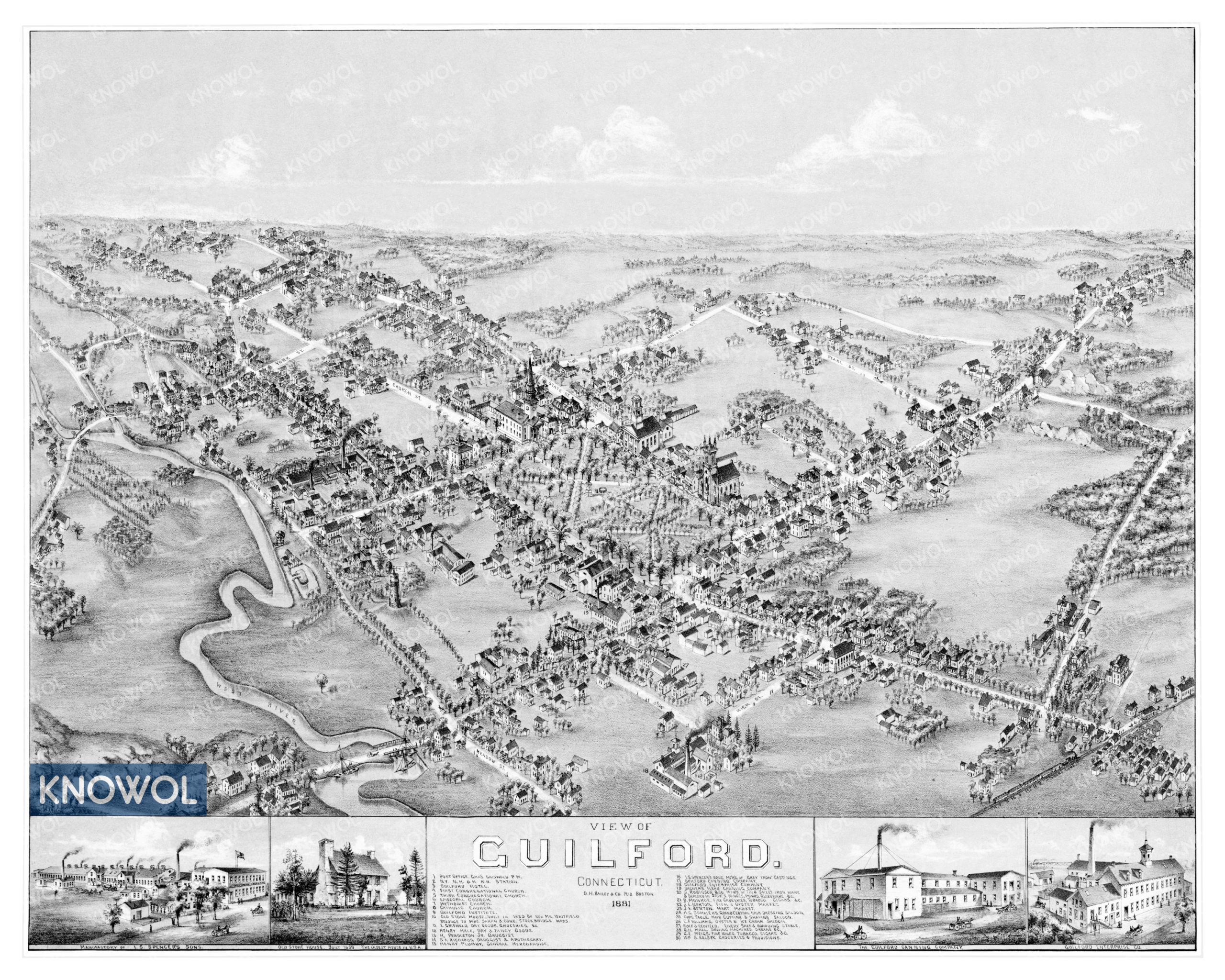
The bird's-eye view
By O.H. Bailey
The town drawn as if from the sky, with its streets and churches, the railroad station, the Guilford Hotel, the Guilford Institute, the Old Stone House, the Guilford Canning Company and Norton's Fish and Oyster Market.5
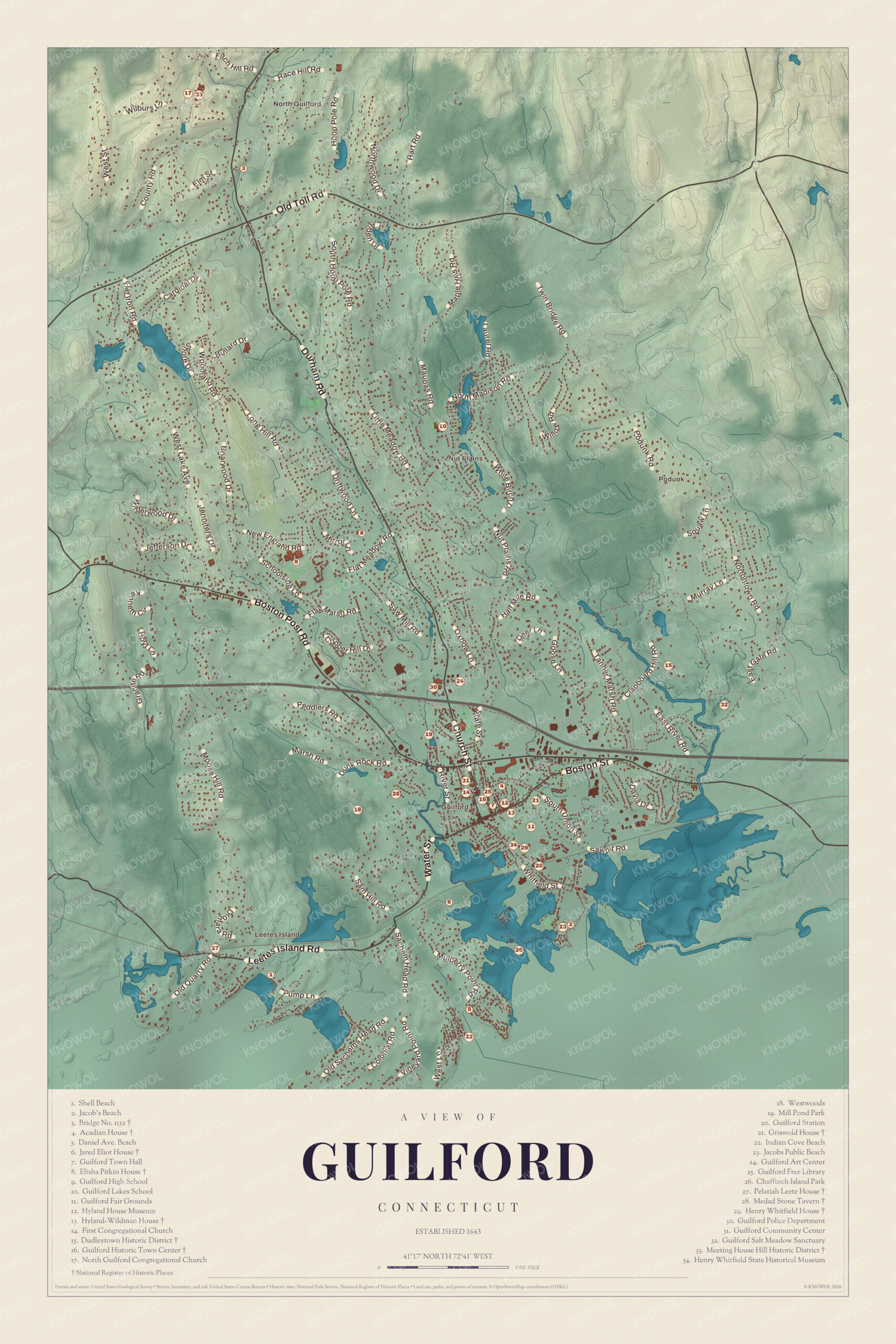
Guilford today
By KNOWOL
Shaded hills from the traprock ridge of Totoket Mountain down to Guilford Harbor and Sachems Head, every street, and a guide of 34 numbered landmarks with the National Register sites marked.6
The story of Guilford
The stone house and the first planters
The settlers began a stone house for their minister, Henry Whitfield, in September 1639, and Menunkatuck people helped carry the stone to the site on hand barrows. The walls went up nearly two feet thick, and the house served as home, church, meeting hall and fort. The first planters were farmers almost to a man. A history of 1818 says there wasn't a merchant among them and scarcely a mechanic, and it took great expense and trouble to get even a blacksmith to settle. In 1837 John Warner Barber wrote that the first wedding in town was held inside the stone house, and that the supper was pork and pease. He also believed it was the oldest house then standing in the United States.278
Granite, ships and tomatoes
Guilford is remembered as a farm town, but the old histories tell of busy trades along its shore. A shipyard at Jones' bridge built vessels for many years, and about 1849 William W. Baldwin built a fully rigged schooner there that sailed for California with gold seekers aboard. In 1837 a granite quarry opened at the sawpits, on Henry Whitfield's old farm, and the Leake and Watts Orphan Asylum in New York City was built of its stone. John Beattie came to Leete's Island in 1870, and by 1892 he employed from 125 to 600 men. Guilford granite went into Boston's new railroad terminal and New York's Third Avenue Bridge. And by 1892 the Sachem's Head Canning Company on Water Street could put up 20,000 cans a day.39
A town that kept its books
In 1737 people in Guilford and the towns to the east started a library together. When that company broke up before 1800 it held about 400 volumes, and some of the books went into a new library in the village. In 1823 it joined one the young people had started, to form the Union Library, which had 600 volumes by 1838. Later it was let go, and the books sat in an old loft until 1880, when they went to the Guilford Institute's library. The Institute began in 1854, when Sarah Griffing, widow of Nathaniel Griffing, gave land and $10,000 for a school of a higher order than the district school. The town's first general newspaper, the Shore Line Sentinel, came out on March 8, 1877, and lasted about a year.310
Through the years
25 moments from 1637 to today.
- 1637During the Pequot War, English soldiers and their allies capture and put to death Pequot sachems at the neck of land now called Sachem's Head.1
- 1639On the voyage from England, the settlers sign the Plantation Covenant, and in September they get a land grant from Shaumpishuh, the woman sachem of Menunkatuck.1
- 1639Work begins on the stone house for the minister, Henry Whitfield.2
- 1643Menunkatuck takes the name Guilford and joins the New Haven Colony. The church is gathered on seven men, the "seven pillars."18
- 1661The king's messengers come to Guilford hunting the judges of Charles I, but Governor William Leete and the leading men of the town are in no hurry to help them.11
- 1670About this year Joseph Clay builds the house on Union Street later called the Acadian House.12
- 1713About this year the Hyland House on Boston Street is built, by tree-ring dating.13
- 1729Nearly fifty church members walk out after Thomas Ruggles is ordained over their objections, and the quarrel lasts for years.7
- 1737People of Guilford and the towns to the east start a shared library.3
- 1776Samuel Brown's sloop Polly makes five trips to Long Island, bringing people, household goods and livestock to safety in Guilford.14
- 1777Return Meigs sails from Sachem's Head with 170 men in whaleboats, raids Sag Harbor and comes back with 90 prisoners, without losing a man.15
- 1781Local militia under Captain Peter Vail fight a band of Loyalists on Leete's Island.1
- 1790The legislature moves the eastern town line, giving all of Killingworth harbor to Killingworth.10
- 1802The lighthouse on Falkner Island is built, commissioned by President Thomas Jefferson.16
- 1815The borough of Guilford is incorporated. Shoemaking is its biggest trade, with 11 shops.17
- 1826East Guilford and North Bristol are set off as the new town of Madison.10
- 1837A granite quarry opens at the sawpits, on Henry Whitfield's old farm. Its stone builds the Leake and Watts Orphan Asylum in New York City.9
- 1849About this year William W. Baldwin builds a fully rigged schooner at Jones' bridge that sails for California with gold seekers aboard.3
- 1852Trains first stop at Guilford.6
- 1854Sarah Griffing gives land and $10,000 to found the Guilford Institute.10
- 1865In June, fire destroys the big summer hotel at Sachem's Head, which had room for several hundred guests.3
- 1870John Beattie settles at Leete's Island and opens the granite quarries that will employ hundreds of men.3
- 1877On March 8, the town's first general newspaper, the Shore Line Sentinel, comes out. It lasts about a year.3
- 1881O.H. Bailey draws his bird's-eye view of the town.5
- 1899The Henry Whitfield House opens as the first Connecticut state museum.2
Places to see
The numbers match the landmark guide printed on the 2026 map.
- 4Acadian HouseUnion Street. Built about 1670.
- 7Guilford Town HallThe green. On the east side of the green.
- 12Hyland House MuseumBoston Street. A museum since 1918.Visit their website
- 14First Congregational ChurchThe green. At the north end, from 1829.Visit their website
- 16Guilford Historic Town CenterGuilford Center. More than 600 historic buildings.
- 21Griswold HouseBoston Street. A saltbox of about 1764.Visit their website
- 27Pelatiah Leete HouseLeete's Island Road. The Leete family's oldest house.
- 28Medad Stone TavernThree Mile Course. A tavern that never opened.Visit their website
- 29Henry Whitfield HouseOld Whitfield Street. The oldest house in Connecticut.Visit their website
- 33Meeting House Hill Historic DistrictNorth Guilford. Two churches side by side.
On the National Register
All 15 places in Guilford on the National Register of Historic Places that still stand today, oldest first, and why each one matters.4
-
Henry Whitfield House
National Historic Landmark
The oldest house in Connecticut and the oldest stone house in New England, built for the town's first minister. It was home, church, meeting hall and fort, and in 1899 it became the first Connecticut state museum.2
-
Guilford Historic Town Center
More than 600 historic buildings around the green laid out in 1639, which keeps almost exactly its first shape. The district shows three centuries of slow, steady growth.18
-
Acadian House
One of Connecticut's oldest surviving houses, built by Joseph Clay. It takes its name from a family of Acadians from Grand Pre who lived here after they were sent away from Nova Scotia in 1755.12
-
Elisha Pitkin House
One of Connecticut's small number of surviving 17th-century buildings. Threatened with demolition, it was moved here in 1955 from Main Street in East Hartford.19
-
Pelatiah Leete House
Built by a grandson of William Leete, a founder of Guilford and a governor of the New Haven Colony. It's the oldest surviving house of the Leete family.20
-
Hyland-Wildman House
Long dated to about 1660, but tree-ring dating puts it at about 1713. It's one of the town's best-preserved houses of that time and has been open as a museum since 1918.13
-
Jared Eliot House
The summer home of Jared Eliot, a minister and doctor who experimented with growing mulberry trees, which gave Mulberry Point its name.21
-
Thomas Burgis II House
One of Guilford's finest and best-documented colonial houses. Thomas Burgis, for whose son it was built, was a successful shoemaker who also ran a tannery.22
-
Sabbathday House
Families who came a long way to church rested in small houses like this between the morning and afternoon services. As many as thirty were built near the church, and this is one of two left.23
-
Griswold House
A classic saltbox that stayed in the Griswold family until 1958. The Guilford Keeping Society runs it as a museum, with a blacksmith shop and a barn of farm tools.24
-
Dudleytown Historic District
Also called Clapboard Hill, 490 acres of farmland and marsh along 1.4 miles of road. It was William Dudley's land in 1639, and his descendants owned all of it until the 1860s.25
-
Falkner Island Light
The second oldest lighthouse still standing in Connecticut, commissioned by Thomas Jefferson. Its keeper's house burned in 1976, but the brownstone tower still stands.16
-
Medad Stone Tavern
Medad Stone built it beside a planned new route for the Boston Post Road. The road was never moved, so the tavern never opened, and the Davis family farmed around it for nearly 200 years.26
-
Meeting House Hill Historic District
Two churches side by side on a North Guilford hilltop, Congregational and Episcopal, built after the two congregations made peace following long disputes over church taxes.27
-
Dudley Farm Historic District
A North Guilford farm built by Erastus Dudley on land the Dudley family farmed for almost 300 years. It's a farm museum now.2829
In their words
“The scenery in the vicinity of Sachem's Head is wild and picturesque.”
Connecticut Historical Collections, 18378
“The people of Guilford have always been well educated.”
History of New Haven County, 18923
Nearby towns
Sources
- Guilford, Connecticut, Wikipedia
- Henry Whitfield House, Wikipedia
- History of New Haven County, Connecticut (1892), Internet Archive
- National Register of Historic Places listings in New Haven County, Connecticut, Wikipedia
- Bird's-eye view of Guilford, 1881, restored by KNOWOL
- Map of Guilford, Connecticut in 2026, KNOWOL (USGS elevation, Census Bureau roads)
- A Complete History of Connecticut, Civil and Ecclesiastical (1818), Internet Archive
- Connecticut Historical Collections (1837), Internet Archive
- A History of the Plantation of Menunkatuck and of the Original Town of Guilford, Connecticut (1897), Internet Archive
- The History of Guilford, Connecticut, from its First Settlement in 1639 (1877), Internet Archive
- A Complete History of Connecticut (1797), Internet Archive
- Acadian House (Guilford, Connecticut), Wikipedia
- Hyland House Museum, Wikipedia
- The Refugees of 1776 from Long Island to Connecticut (1913), Internet Archive
- A History of Connecticut (1887), Internet Archive
- Falkner Island Light, Wikipedia
- A Gazetteer of the States of Connecticut and Rhode Island (1819), Internet Archive
- Guilford Historic Town Center, Wikipedia
- Elisha Pitkin House, Wikipedia
- Pelatiah Leete House, Wikipedia
- Jared Eliot House, Wikipedia
- Thomas Burgis II House, Wikipedia
- Sabbathday House (Guilford, Connecticut), Wikipedia
- Griswold House (Guilford, Connecticut), Wikipedia
- Dudleytown Historic District, Wikipedia
- Medad Stone Tavern, Wikipedia
- Meeting House Hill Historic District, Wikipedia
- History, Dudley Farm Museum
- Dudley Farm Historic District marker, William G. Pomeroy Foundation