
The capital of Connecticut, settled in 1635 beside a Dutch trading fort on the Connecticut River, where the colony's charter was hidden in an oak and the city later built the gold-domed Capitol, Colt's armory and the insurance companies that made it famous.
Then and now
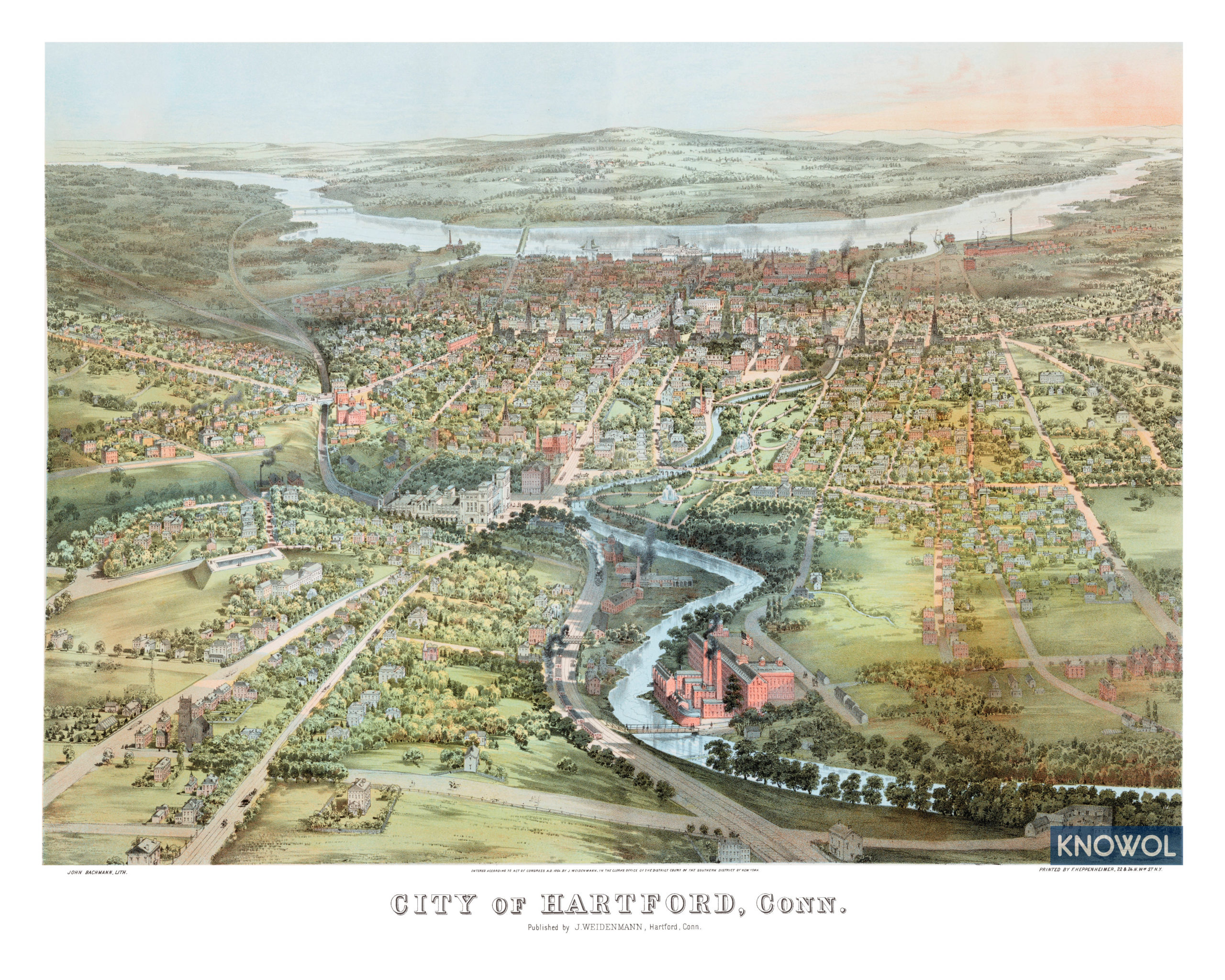
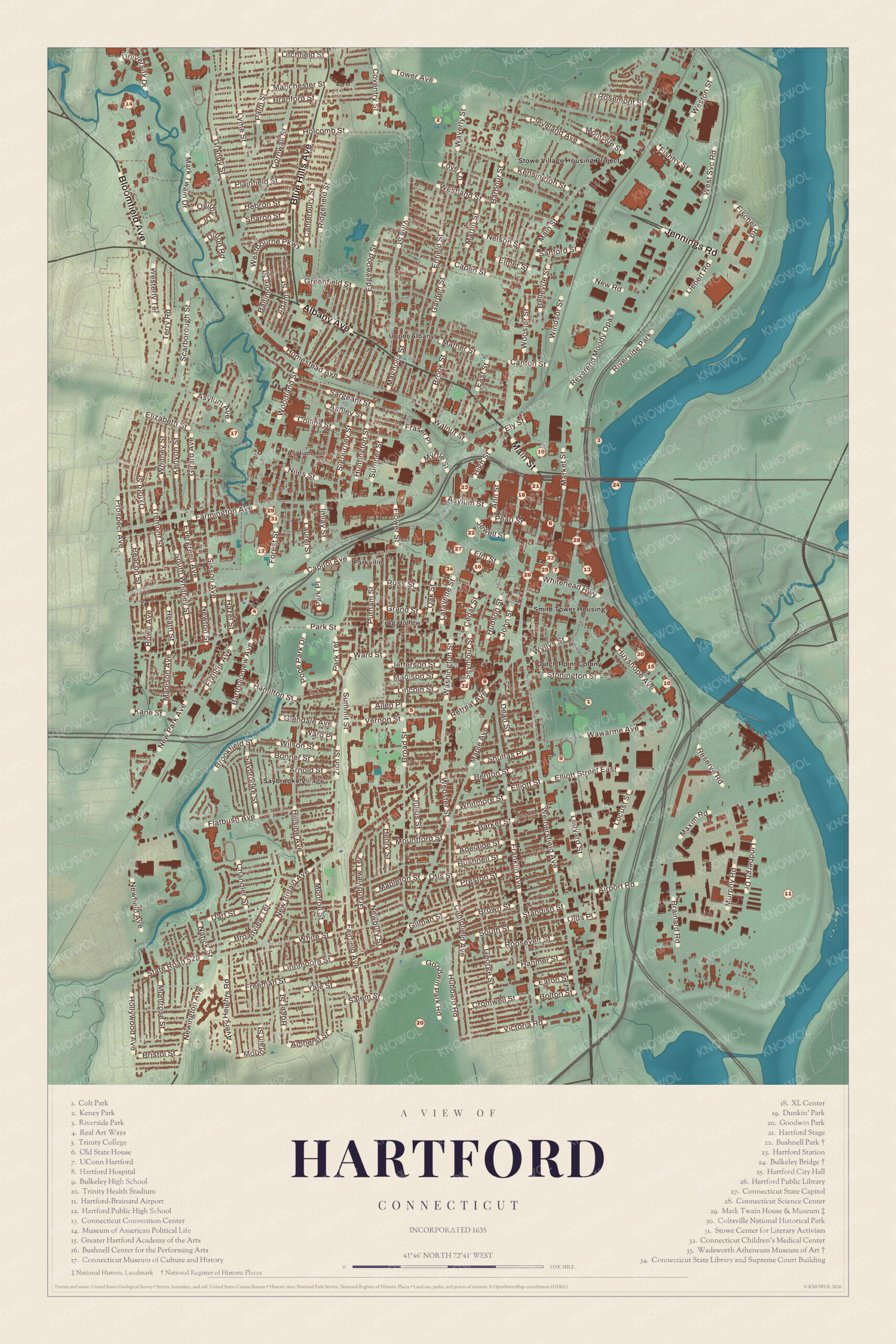
The same town 162 years apart. Click either map to look closer.
The bird's-eye view
By Jacob Weidenmann
Hartford drawn as if from the sky by Jacob Weidenmann, the landscape architect who designed Bushnell Park, with steamboats on the Connecticut River, smoke pouring from factory stacks, trains moving in and out of the city and streets bustling with people.5
Hartford today
By KNOWOL
Shaded ground from the Blue Hills down to downtown and the river meadows, every street, neighborhoods from Parkville and Frog Hollow to Blue Hills, and a guide of 34 numbered landmarks with the National Historic Landmark and National Register sites marked.2
The story of Hartford
Wolves, blackbirds and the town chain
Hartford's earliest town records read like a chore list for a frontier village. Anyone who borrowed the town chain paid two pence a day, and paid for mending it if it broke. In 1640 a man named Woodward was set to killing wolves, with four shillings and six pence a week for his board in any week he didn't get a wolf or a deer. From 1643 the watch rang a bell an hour before daybreak, and every house was expected to be up with a light soon after. That same year Mr. Andrews was hired to teach the town school, and children whose families couldn't pay were taught at the town's charge. In 1711 every taxpayer had to kill a dozen blackbirds each spring or pay a shilling.6
The tavern where the candles went out
Hartford's first tavern opened in 1644, with Jeremy Adams as its keeper. In 1651 he bought a lot on the east side of Main Street, where the Travelers building later stood, and kept a tavern there for years. A 1906 history says the General Court was meeting in that inn in 1687 when Sir Edmund Andros came to take the colony's charter. The candles went out, and Captain Wadsworth slipped away with the charter and hid it in a hollow oak in front of Samuel Wyllys's house. In 1836 the tree still stood at the foot of Wyllys Hill, its trunk twenty one feet around, and a Wyllys daughter wrote that the hollow had been large enough to hold a child.78
Steamboats, books and dog power
John Warner Barber's 1836 portrait of Hartford shows a busy river city. Eight small steamboats worked the river above town, two of them carrying passengers to Springfield every day and the rest towing flat-bottomed boats as far as Wells River, 220 miles upstream, while three more made a daily run to New York. Barber counted twelve churches, five banks and three fire and marine insurance offices, and he wrote that Hartford published more than twice as many books a year as any other place its size in the country. Among its shops were two factories making wire cards that were run by dogs. A single stone arch with a span of 104 feet carried the street across the river that split the city.3
Through the years
25 moments from 1633 to today.
- 1633Dutch traders build a fort and trading house, the House of Hope, at what's now Dutch Point.9
- 1635The first English settlement is begun by John Steel and his party from Newtown, Massachusetts.3
- 1636Thomas Hooker and Samuel Stone lead about 100 settlers overland from Newtown.1
- 1637The settlement, first called Newtown, is renamed Hartford for Stone's hometown of Hertford, England.1
- 1638Hooker preaches the sermon that inspires the Fundamental Orders of Connecticut.1
- 1639John Gunning is appointed the town's chimney sweeper.10
- 1640The town pays a man named Woodward to spend his time hunting wolves.6
- 1643Mr. Andrews is hired to teach the town school, and children whose families can't pay are taught at the town's charge.6
- 1644Hartford's first tavern opens, with Jeremy Adams as its keeper.7
- 1687Captain Wadsworth carries off the colony's charter and hides it in a hollow oak, the Charter Oak.8
- 1711Every taxpayer is ordered to kill a dozen blackbirds each spring or pay a shilling.6
- 1764The Hartford Courant is founded.2
- 1784Hartford is incorporated as a city.2
- 1796The Old State House is completed.11
- 1814Delegates from the New England states meet at the Hartford Convention.1
- 1824The Retreat for the Insane opens on April 1 under Dr. Eli Todd.12
- 1833The Stone Bridge is built across the Park River, the largest single-span stone bridge in the country at the time.13
- 1844Dentist Horace Wells breathes laughing gas, has a tooth pulled and says he didn't feel it so much as the prick of a pin.14
- 1848Samuel Colt opens his first factory in Hartford.2
- 1854Voters approve buying the land for Bushnell Park with public money.2
- 1864Jacob Weidenmann draws his bird's-eye view of the city.5
- 1874Samuel Clemens and his family move into their house on Farmington Avenue.2
- 1875Hartford becomes the sole capital of Connecticut.1
- 1878The State Capitol is finished, of marble and granite, with its gold-leafed dome.2
- 1908The Bulkeley Bridge opens across the Connecticut River.2
Places to see
The numbers match the landmark guide printed on the 2026 map.
- 2Keney ParkNorth End. Largest municipal park in New England.
- 6Old State HouseDowntown. Completed 1796, a National Historic Landmark.Visit their website
- 22Bushnell ParkBelow the Capitol. Second oldest publicly funded park.Visit their website
- 23Hartford StationUnion Place. George Keller's brownstone station of 1889.
- 24Bulkeley BridgeConnecticut River. Nine stone arches, opened 1908.
- 27Connecticut State CapitolCapitol Avenue. Gold-domed capitol finished in 1878.
- 29Mark Twain House & MuseumFarmington Avenue. The Clemens family home, 1874 to 1891.Visit their website
- 30Coltsville National Historical ParkSouth End. Colt's armory under the blue dome.Visit their website
- 31Stowe Center for Literary ActivismNook Farm. Harriet Beecher Stowe's last home.Visit their website
- 33Wadsworth Atheneum Museum of ArtMain Street. Oldest continually operating public art museum.Visit their website
On the National Register
22 of the 143 places in Hartford on the National Register of Historic Places that still stand today, oldest first, and why each one matters. See the full list of National Register places in Hartford.4
-
First Church of Christ and the Ancient Burying Ground
Hartford's oldest congregation, founded in 1636 by Thomas Hooker. The present meetinghouse, its fourth, dates from 1807, and the burying ground beside it, set apart in 1640, was the city's only cemetery until 1803.15
-
Butler-McCook Homestead
One of the city's few surviving 18th-century houses, now a house museum and garden run by Connecticut Landmarks.16
-
Connecticut Statehouse (Old State House)
National Historic Landmark
Generally believed to be Charles Bulfinch's first public building. The Hartford Convention met here in 1814 and the Amistad trial began here in 1839.11
-
Henry Barnard House
National Historic Landmark
The lifelong home of Henry Barnard, the education reformer who set up the statewide school systems of Connecticut and Rhode Island.17
-
Christ Church
Designed by Ithiel Town, it's one of the earliest known Gothic Revival buildings in the United States, and today the cathedral of the Episcopal Diocese of Connecticut.18
-
Stone Bridge
Built across the Park River, it was the largest single-span stone bridge in the United States when finished. It now carries Main Street over the Whitehead Highway.13
-
Wadsworth Atheneum
Founded in 1842 and opened in 1844, it's the oldest continually operating public art museum in the United States. Its castle-like first building was designed by Ithiel Town and Alexander Jackson Davis.19
-
Bushnell Park
The second oldest publicly funded park in the United States, after Boston Common. The Rev. Horace Bushnell proposed it in the 1850s for land that held tanneries, a soapworks and a dump.20
-
Coltsville Historic District
National Historic Landmark
Samuel Colt's factory, workers' housing and family homes, a 260-acre site of early precision manufacturing. It became a National Historic Landmark in 2008.21
-
Cedar Hill Cemetery
A rural cemetery designed by Jacob Weidenmann, first used in 1866, where J. P. Morgan's family monument stands. It reaches into Newington and Wethersfield.22
-
Harriet Beecher Stowe House
National Historic Landmark
The home where the author of Uncle Tom's Cabin lived for the last 23 years of her life, now the Stowe Center.23
-
Mark Twain House
National Historic Landmark
Home of Samuel Clemens and his family from 1874 to 1891, where he wrote Tom Sawyer and Huckleberry Finn. Its biographer called it part steamboat, part medieval fortress and part cuckoo clock.24
-
Cheney Building
Designed by H. H. Richardson for the Cheney Brothers silk makers, it later held Brown Thomson's department store.25
-
Temple Beth Israel
Designed by George Keller, it's the oldest purpose-built synagogue in Connecticut. Saved from demolition, it's now the Charter Oak Cultural Center.26
-
Connecticut State Capitol
National Historic Landmark
Built after Hartford became the sole capital, on the site of the old Trinity College, with marble walls and a gold-leafed dome above Bushnell Park.27
-
Trinity College Long Walk Historic District
Seabury Hall, Northam Tower and Jarvis Hall, designed by the English architect William Burges, the oldest buildings on Trinity's campus.28
-
Hartford Union Station
A brownstone Richardsonian Romanesque station designed by George Keller, rebuilt after a 1914 fire and still in service.29
-
Elizabeth Park
Charles M. Pond left his estate to the city to be named for his late wife, Elizabeth. Its rose garden was created in 1904. Most of the park now lies in West Hartford.30
-
Bulkeley Bridge
Nine stone arches, the oldest of the three highway bridges between Hartford and East Hartford.31
-
Main Street Historic District No. 2
A block of insurance buildings dominated by the Travelers Tower of 1919, for years the city's tallest.32
-
A. Everett Austin House
National Historic Landmark
Wadsworth Atheneum director Chick Austin built this house, only one room deep, after the villas he saw on his honeymoon in Italy.33
-
Phoenix Life Insurance Company Building
The Boat Building, designed by Max Abramovitz, called the world's first two-sided building.34
In their words
“More than twice as many books are published here, annually, as are manufactured in any other place of equal population in the United States.”
Connecticut Historical Collections, John Warner Barber, 18363
“There is no city in New England, in which public hospitality for travelers is greater, or the accommodations more comfortable and elegant, than in Hartford.”
Historic towns of the Connecticut River valley, 19067
“Hereafter no one can visit Hartford without having the truth of this discovery brought very visibly before him.”
The Connecticut Quarterly, 1895, on the tablet marking Dr. Horace Wells's discovery of anesthesia14
Nearby towns
Sources
- Hartford, Connecticut, Wikipedia
- Map of Hartford, Connecticut in 2026, KNOWOL (USGS elevation, Census Bureau roads)
- Connecticut historical collections, John Warner Barber (1836), on the city of Hartford, Internet Archive
- National Register of Historic Places listings in Hartford, Connecticut, Wikipedia
- Bird's-eye view of Hartford, Connecticut from 1864, restored by KNOWOL
- Connecticut historical collections, John Warner Barber (1836), extracts from the early records of the town of Hartford, Internet Archive
- Historic towns of the Connecticut River valley (1906), on Hartford's first taverns, Internet Archive
- Connecticut historical collections, John Warner Barber (1836), on the Charter Oak, Internet Archive
- Connecticut historical collections, John Warner Barber (1836), on Dutch Point, Internet Archive
- Historic towns of the Connecticut River valley (1906), on Hartford's first officials, Internet Archive
- Old State House (Hartford, Connecticut), Wikipedia
- Connecticut historical collections, John Warner Barber (1836), on the Retreat for the Insane, Internet Archive
- Stone Bridge (Hartford, Connecticut), Wikipedia
- The Connecticut quarterly (1895), on Dr. Horace Wells, Internet Archive
- First Church of Christ and the Ancient Burying Ground, Wikipedia
- Butler-McCook Homestead, Wikipedia
- Henry Barnard House, Wikipedia
- Christ Church Cathedral (Hartford, Connecticut), Wikipedia
- Wadsworth Atheneum, Wikipedia
- Bushnell Park, Wikipedia
- Coltsville Historic District, Wikipedia
- Cedar Hill Cemetery (Hartford, Connecticut), Wikipedia
- Harriet Beecher Stowe House (Hartford, Connecticut), Wikipedia
- Mark Twain House, Wikipedia
- Cheney Building, Wikipedia
- Temple Beth Israel (Hartford, Connecticut), Wikipedia
- Connecticut State Capitol, Wikipedia
- Trinity College Long Walk, Wikipedia
- Hartford Union Station, Wikipedia
- Elizabeth Park (Connecticut), Wikipedia
- Bulkeley Bridge, Wikipedia
- Main Street Historic District No. 2, Wikipedia
- A. Everett Austin House, Wikipedia
- Phoenix Life Insurance Company Building, Wikipedia