
A hill town set off from the north half of Worcester in 1741, where John Hancock gave the common, the Abbott Tavern kept its doors open for more than a century, and mill villages like Jefferson, Quinapoxet and Chaffinville grew up on the streams.
Holden, Massachusetts on the map
Click the map to look closer.
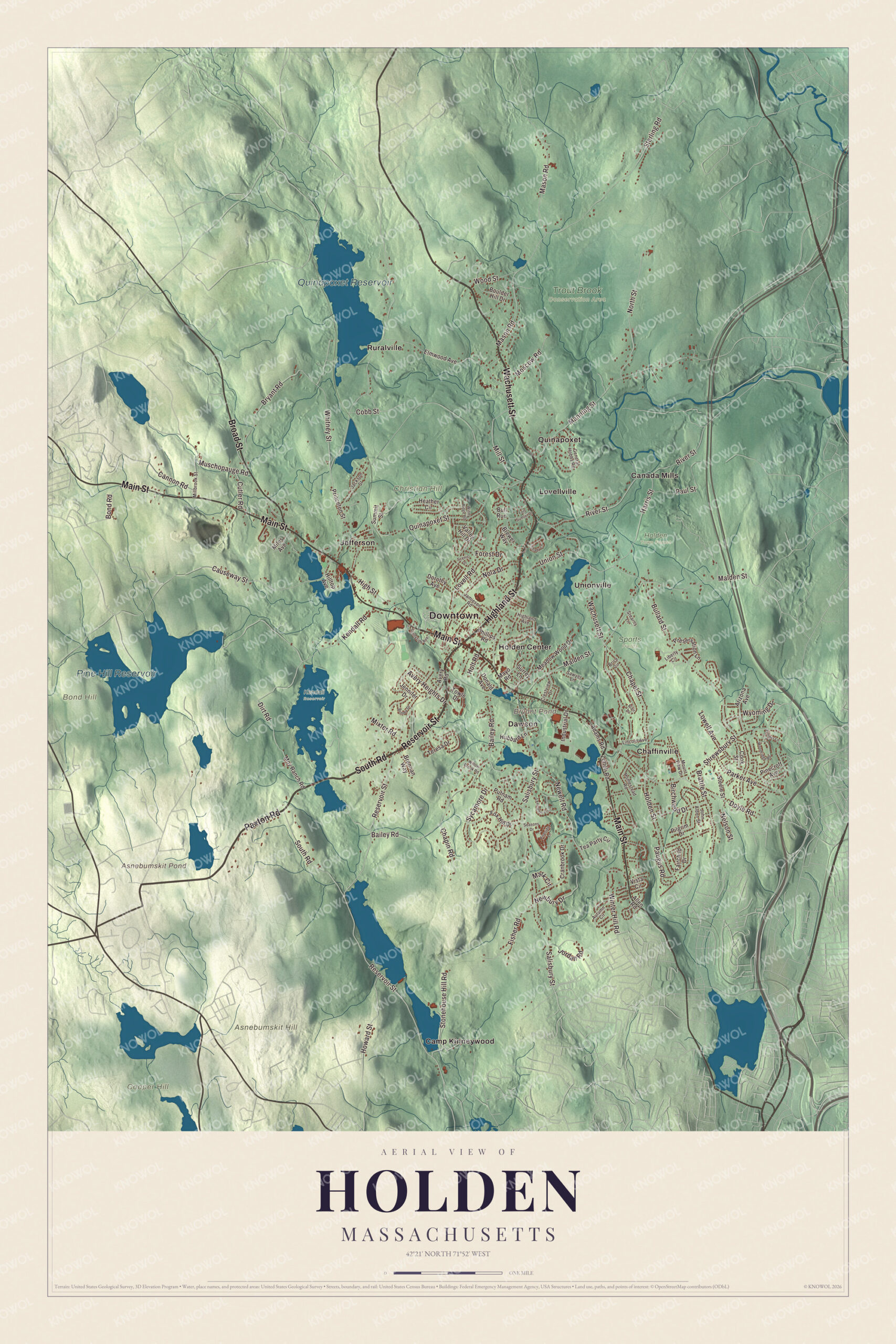
Holden today
By KNOWOL
Hills and reservoirs on the edge of Worcester, with Main, Highland, Reservoir and Wachusett Streets, the Quinapoxet Reservoir, Pine Hill Reservoir, Asnebumskit Hill and Christian Hill, and the villages from Jefferson to Holden Center.6
The history of Holden, Massachusetts
Lime, a meetinghouse and a common
Holden began as the north half of Worcester, and its first settlers may have come for lime. In the spring of 1723 Jonas Rice found limestone on the farm later called the Bullard Farm, and Worcester's proprietors voted to encourage him to burn lime for the town. Samuel Damon's 1841 town history says the first settlement grew up beside that lime lot. The north half became the town of Holden in January 1741, and at its first business meeting the voters chose to have the gospel preached and to keep a writing and reading school. In 1789 John Hancock deeded an acre for a meetinghouse and a common, and a town committee laid in rum and sugar to treat the crowd that came to watch the frame go up.728910
Abbott's, on the road to Boston
In the turnpike days, travelers from northwestern Massachusetts, New Hampshire and Vermont passed through Holden Center on their way to and from Boston. The Sixth Massachusetts Turnpike, chartered in 1799, ran 43 miles from Shrewsbury to Amherst and was built in a single summer. The most famous inn in town was the Abbott Tavern, built in 1763 and kept by three generations of Abbotts for more than a hundred years. The town's 1894 history says people still remembered the beer the last landlord brewed and the flip he made his own way. From 1824 to 1831 the Worcester County Knights Templar met in the tavern's hall, and when they came back for their fiftieth anniversary in 1875, they carried its old chandelier home to Worcester.111213
From Chaffinville to French Woods
Holden's villages grew up around water power. By tradition John Bigelow built the first mill at Chaffinville in 1726. Spinning began at Unionville in 1809, and in 1824 nineteen bales of sheeting from that mill were shipped to Batavia, reported at the time as the first American cotton goods to sail around the Cape of Good Hope. In Jefferson, once called Drydenville, Howe and Jefferson turned a one-set woolen mill into two mills with 250 hands, and the village grew to eight times its size. Eagleville, now part of Jefferson, was nicknamed Brick City for a house that was long the only brick building in town. Quinapoxet was French Woods, after woodland once owned by citizens of France. On the Quinapoxet River, the Springdale mill ran until the Metropolitan Water Commission took its site.141516171819
Holden, Massachusetts through the years
24 moments from 1723 to today.
- 1723Jonas Rice finds limestone in Worcester's north half, and the first settlement grows up near the lime lot.7
- 1724The north half is surveyed and divided into lots of sixty and one hundred acres.7
- 1726By tradition, John Bigelow builds the first mill in town at Chaffinville.14
- 1733The Rogers House on Boyden Road is standing by this year, possibly the oldest building in Holden.20
- 1741On January 9 the governor signs the act making the north half of Worcester the town of Holden, named for the London merchant Samuel Holden.2
- 1741At its first business meeting the town votes to have the gospel preached and to keep a writing and reading school.8
- 1746Worcester votes sixpence for each rattlesnake killed at Stone House Hill in Holden.21
- 1763The Abbott Tavern is built, and three generations of Abbotts keep it for more than a hundred years.12
- 1775Holden has a company of seventy men ready to march at the Lexington alarm.4
- 1786Holden men march into Worcester with Daniel Shays in December, then go home through the drifting snow.22
- 1789John Hancock deeds the town an acre for a meetinghouse and a common, and the meetinghouse is built.9
- 1799The Sixth Massachusetts Turnpike, from Shrewsbury to Amherst through the Center, is chartered.11
- 1808The town petitions the President against the Embargo, with a single vote against.23
- 1809Eleazar Rider and Sons start spinning cotton yarn at Unionville, the town's first manufacturing.15
- 1824Unionville sheeting is shipped to Batavia, reported at the time as the first American cotton goods to round the Cape of Good Hope.16
- 1824The Worcester County Encampment of Knights Templar is formed at Holden and meets in the Abbott hotel's hall.13
- 1836Holden gets its first Town House, and the first town meeting there is held on November 14.24
- 1861On April 20 the Holden Rifles leave Worcester for Washington.25
- 1871On Sunday, June 11, a cyclone wrecks houses and barns in the village in about two minutes.26
- 1871The Boston, Barre and Gardner Railroad opens for passengers on September 4.27
- 1888Samuel C. Gale's gift, the Damon Memorial, a stone building for the high school and library, is completed.28
- 1892Fire destroys the lower mill of the Jefferson Manufacturing Company on December 8.29
- 1894Worcester Polytechnic Institute's hydraulic laboratory, today's Alden Research Laboratory, begins on an old woolen mill site.6
- 1955Wachusett Regional High School opens in Holden.6
Places to see in Holden, Massachusetts
Places worth a visit in Holden today.
- Holden Center Historic DistrictMain, Maple, Highland and Reservoir Streets. Town hall, churches and the burying ground.
- First Congregational ChurchHolden Center. On the acre John Hancock gave.
- Old Burying GroundHolden Center. The village graveyard of 1759.
- Rogers HouseBoyden Road. Possibly the oldest building in town.
- Eagleville Historic DistrictJefferson, northwestern Holden. Mill village once nicknamed Brick City.
- Alden Research LaboratorySoutheast of the Center. Hydraulic laboratory on an old mill site.
- Quinapoxet ReservoirQuinapoxet River valley. Part of Worcester's drinking water supply.
- Trout Brook Conservation AreaAlong Trout Brook. More than 600 acres of town land.
- Wachusett Regional High SchoolMain Street. Opened in 1955 for five towns.Visit their website
- Asnebumskit HillThe Paxton line. Its summit stands just over in Paxton.
Holden on the National Register of Historic Places
All 9 places in Holden on the National Register of Historic Places that still stand today, oldest first, and why each one matters.5
-
Rogers House
A one-and-a-half-story Cape built sometime before 1733, possibly the oldest building in Holden; a traditional date of 1722 has no firm evidence. It is the best-preserved house of its once common style in the area.20
-
Holden Center Historic District
The historic village center, with the 1836 town hall, the 1789 First Congregational Church, the 1835 First Baptist Church, the 1880 Old Post Office and the 1759 Old Burying Ground. In 1995 the district was enlarged to take in the village's historic houses.30
-
Brown-Davis-Frost Farm
Now called Lantern House Farm, its brick farmhouse may have been built as early as 1763 by Isaiah Brown, a Revolutionary War veteran, or as late as 1795 by Ethan Davis, making it one of Holden's few 18th-century brick houses. At its listing the owner believed it the oldest operating farm in town.31
-
Willard-Fisk House
Built about 1772 by Daniel Willard, it is one of the two earliest known brick houses in Holden, both on Whitney Street. In 1777 Willard's widow sold it to David Fisk, a Continental Army soldier.32
-
Manning-Ball House
A well-preserved four-bay Cape, unusual in Holden, built about 1790 by Captain Israel Manning, a Revolutionary War veteran. It passed to Josiah Ball, who had married Manning's daughter, and stayed with Ball descendants until 1947.33
-
Stony Farm
Its Federal farmhouse was most likely built in the early 1790s by Tilla Chafin, who put together a farm of more than 50 acres. The house, barn and stone walls are a reminder of Holden's farming past.34
-
Hubbard-Dawson House
A rambling house that is the only surviving example of Colonial Revival and Queen Anne styling in Holden, around an older core that may date to 1832. It belonged to Charles Dawson, whose Dawson Manufacturing Company was a major local employer from 1872 to 1910.35
-
Paddock Farm
The main house, built about 1840 by Jonathan Paddock and joined to an ell of about 1780, is the best-preserved example of a local Cape style with short windows set below the eaves of a knee-walled second story.36
-
Eagleville Historic District
A mill village in northwestern Holden, now part of Jefferson. Its dam and mill complex were built about 1850 and extended into the early 20th century, and much of its mill worker housing survives.37
Holden in their words
“Holden lies like a diamond above the 'Heart of the Commonwealth'.”
The history of Holden, Massachusetts, 1894, on the town's shape on the map38
“It is no exaggeration to state that Abbott's Hotel was known from the Pacific to the Atlantic Ocean.”
The history of Holden, Massachusetts, 1894, on the old Abbott Tavern12
“Elevated so that it is swept by life-giving breezes, having no miasmatic marshes within its borders, with a water supply of the purest”
The history of Holden, Massachusetts, 1894, on the town's hills39
Towns near Holden, Massachusetts
Sources for the history of Holden
- Holden, Massachusetts, Wikipedia
- The history of Holden, Massachusetts, 1684-1894 (1894), on the incorporation and Samuel Holden, Internet Archive
- The history of Holden, Massachusetts, 1684-1894 (1894), on Stone House Hill, Internet Archive
- The history of Holden, Massachusetts, 1684-1894 (1894), on the Revolution, Internet Archive
- National Register of Historic Places listings in Worcester County, Massachusetts, Wikipedia
- Map of Holden, Massachusetts in 2026, KNOWOL
- The history of Holden, Massachusetts, 1684-1894 (1894), on the lime lot and the first settlement, Internet Archive
- The history of Holden, Massachusetts, 1684-1894 (1894), on the first town votes, Internet Archive
- The history of Holden, Massachusetts, 1667-1841 (1841), on John Hancock's deed, Internet Archive
- The history of Holden, Massachusetts, 1684-1894 (1894), on the raising of the meetinghouse, Internet Archive
- The history of Holden, Massachusetts, 1684-1894 (1894), on the Sixth Turnpike, Internet Archive
- The history of Holden, Massachusetts, 1684-1894 (1894), on the Abbott Tavern, Internet Archive
- The history of Holden, Massachusetts, 1684-1894 (1894), on the Knights Templar, Internet Archive
- The history of Holden, Massachusetts, 1684-1894 (1894), on the mill at Chaffinville, Internet Archive
- The history of Holden, Massachusetts, 1684-1894 (1894), on the first manufacturing at Unionville, Internet Archive
- The history of Holden, Massachusetts, 1684-1894 (1894), on the sheeting shipped to Batavia, Internet Archive
- The history of Holden, Massachusetts, 1684-1894 (1894), on Martin V. B. Jefferson and the Jefferson mills, Internet Archive
- The history of Holden, Massachusetts, 1684-1894 (1894), on Brick City and French Woods, Internet Archive
- Encyclopedia of Massachusetts, biographical, genealogical (1916), on James Dorr and the Springdale Mills, Internet Archive
- Rogers House, Wikipedia
- The history of Holden, Massachusetts, 1684-1894 (1894), on the rattlesnake bounty, Internet Archive
- The history of Holden, Massachusetts, 1667-1841 (1841), on Shays' Rebellion, Internet Archive
- The history of Holden, Massachusetts, 1684-1894 (1894), on the Embargo petition, Internet Archive
- The history of Holden, Massachusetts, 1684-1894 (1894), on the first Town House, Internet Archive
- The history of Holden, Massachusetts, 1684-1894 (1894), on the Holden Rifles, Internet Archive
- The history of Holden, Massachusetts, 1684-1894 (1894), on the cyclone of 1871, Internet Archive
- The history of Holden, Massachusetts, 1684-1894 (1894), on the Boston, Barre and Gardner Railroad, Internet Archive
- The history of Holden, Massachusetts, 1684-1894 (1894), on the Damon Memorial, Internet Archive
- The history of Holden, Massachusetts, 1684-1894 (1894), on the Jefferson mill fire of 1892, Internet Archive
- Holden Center Historic District, Wikipedia
- Brown-Davis-Frost Farm, Wikipedia
- Willard-Fisk House, Wikipedia
- Manning-Ball House, Wikipedia
- Stony Farm, Wikipedia
- Hubbard-Dawson House, Wikipedia
- Paddock Farm, Wikipedia
- Eagleville Historic District, Wikipedia
- The history of Holden, Massachusetts, 1684-1894 (1894), on the town's location, Internet Archive
- The history of Holden, Massachusetts, 1684-1894 (1894), on the town's healthfulness, Internet Archive