Sometime in March 1886, the 14 players of the Chicago ball club stepped on a scale in Hot Springs, Arkansas. The captain, Cap Anson, weighed 227 pounds. Jim McCormick, a pitcher, weighed 226, and Ed Williamson, the shortstop, 221. The lightest were John Flynn, a new pitcher, at 143, and a fast young outfielder named Billy Sunday, at 149. They were the Chicago White Stockings, champions of the National League, the same club that’s called the Cubs today. Their club had sent them south to get the winter out of their systems.
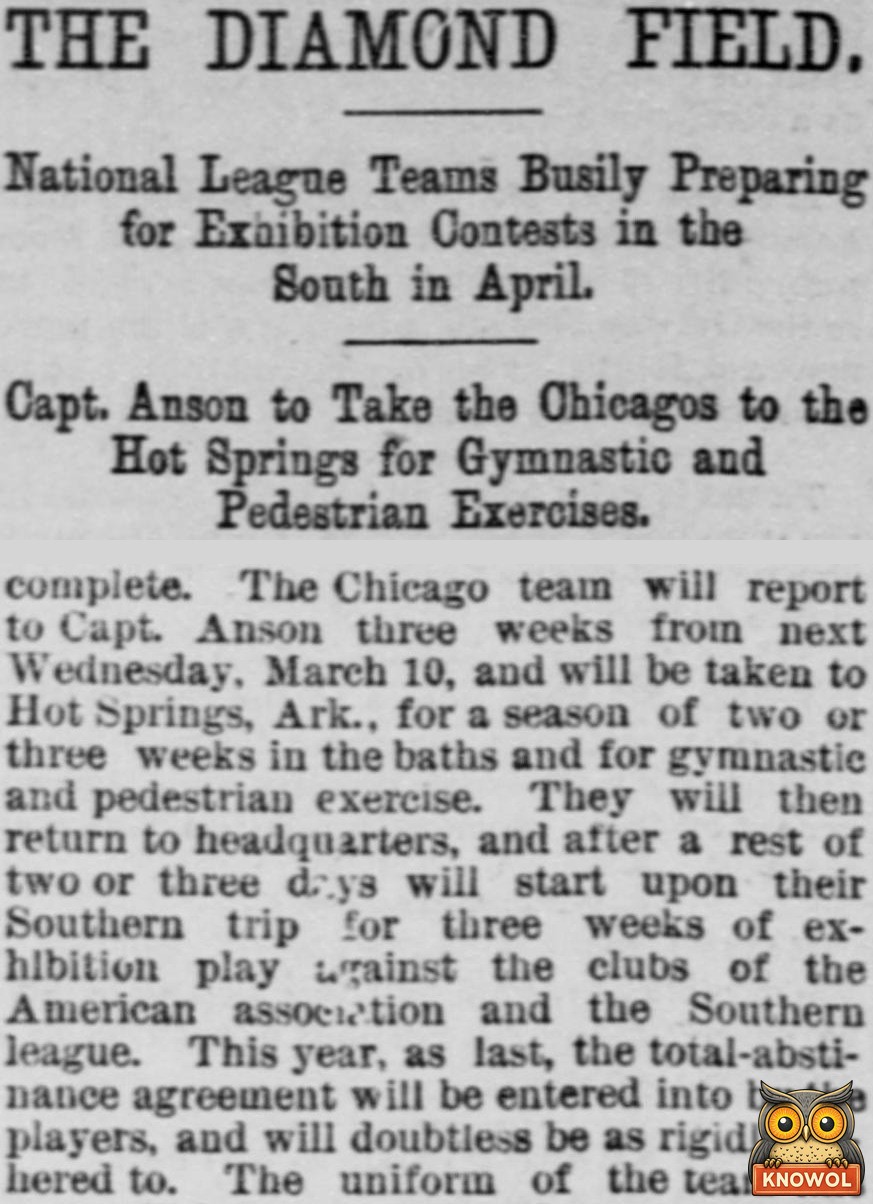
“The Diamond Field,” the St. Paul Daily Globe, Saint Paul, Minnesota, February 15, 1886. Library of Congress, Chronicling America. Click the clipping to read it full size.
A pledge and a bath
The plan was in the papers that February. The players would report to Anson on March 10 and then go to Hot Springs “for a season of two or three weeks in the baths and for gymnastic and pedestrian exercise.” Each man would also sign a pledge not to drink, as they had the year before. The reporter in Chicago was sure the pledge “will doubtless be as rigidly adhered to.”
The baths were the main point, the Encyclopedia of Arkansas says. The club’s president, A. G. Spalding, hoped the hot water would clear the alcohol out of his players. They stayed at the Avenue Hotel, later the Majestic, climbed the mountains for wind and practiced on a field behind where the Garland County Courthouse stands today.
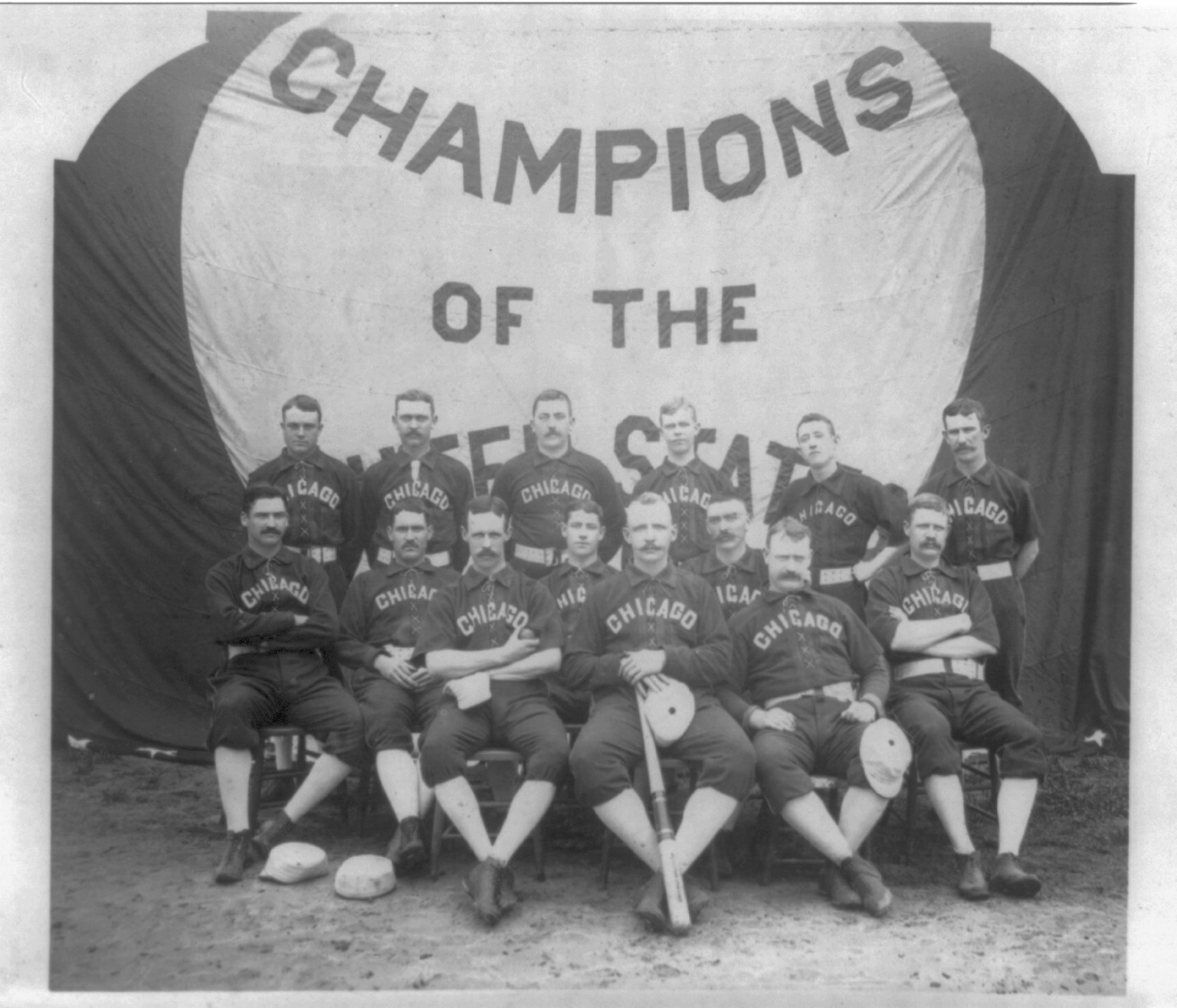
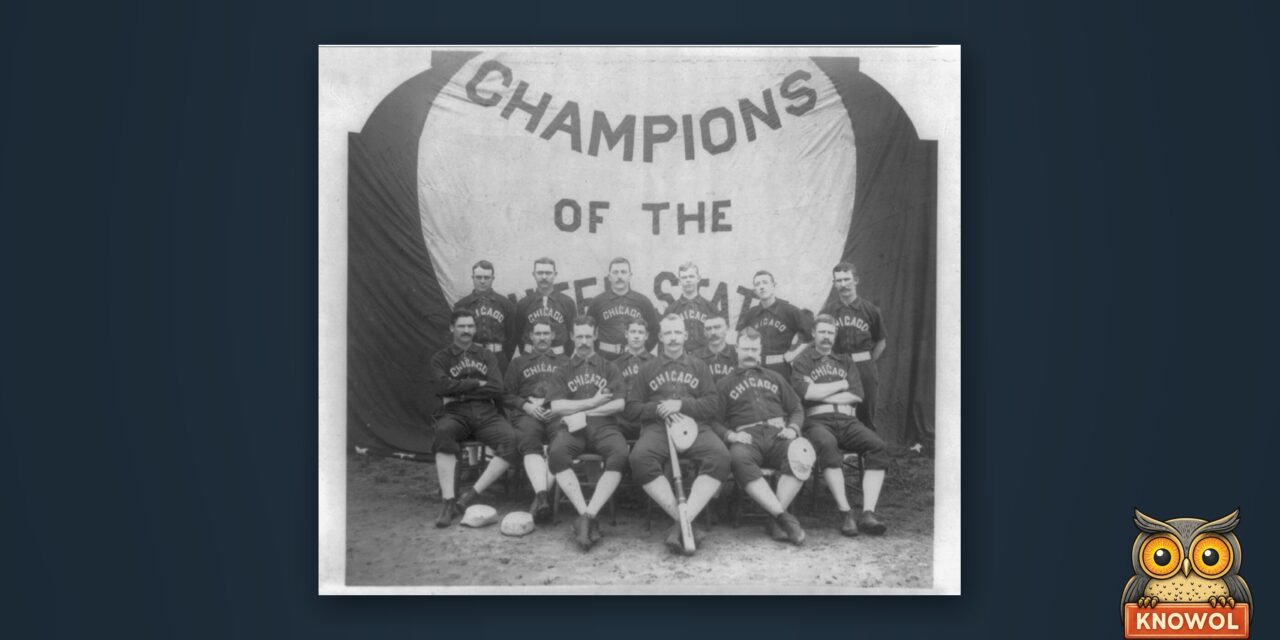
The Chicago club, champions of 1885, photographed about 1886 by William B. Fariss. The 14 players include Anson, Kelly, Williamson, McCormick and Sunday. Library of Congress Prints and Photographs Division. Click the picture to see it full size.
$8 for 21 baths
Hot Springs had 8,000 or 10,000 people that winter and nearly as many visitors, a newspaper writer reported. The water came out of a hillside on a government reservation at 100 to 120 degrees. Ten private bath houses charged $8 for 21 baths, and $3 of that went to the attendants, called rubbers.
The government also ran a free bath house, with one big pool for men and another for women. It was crowded from 6 a.m. to 7 p.m. With 15 or 20 heads above the water, the writer said, the pool sometimes “resembles a pond with a flock of ducks on it.”
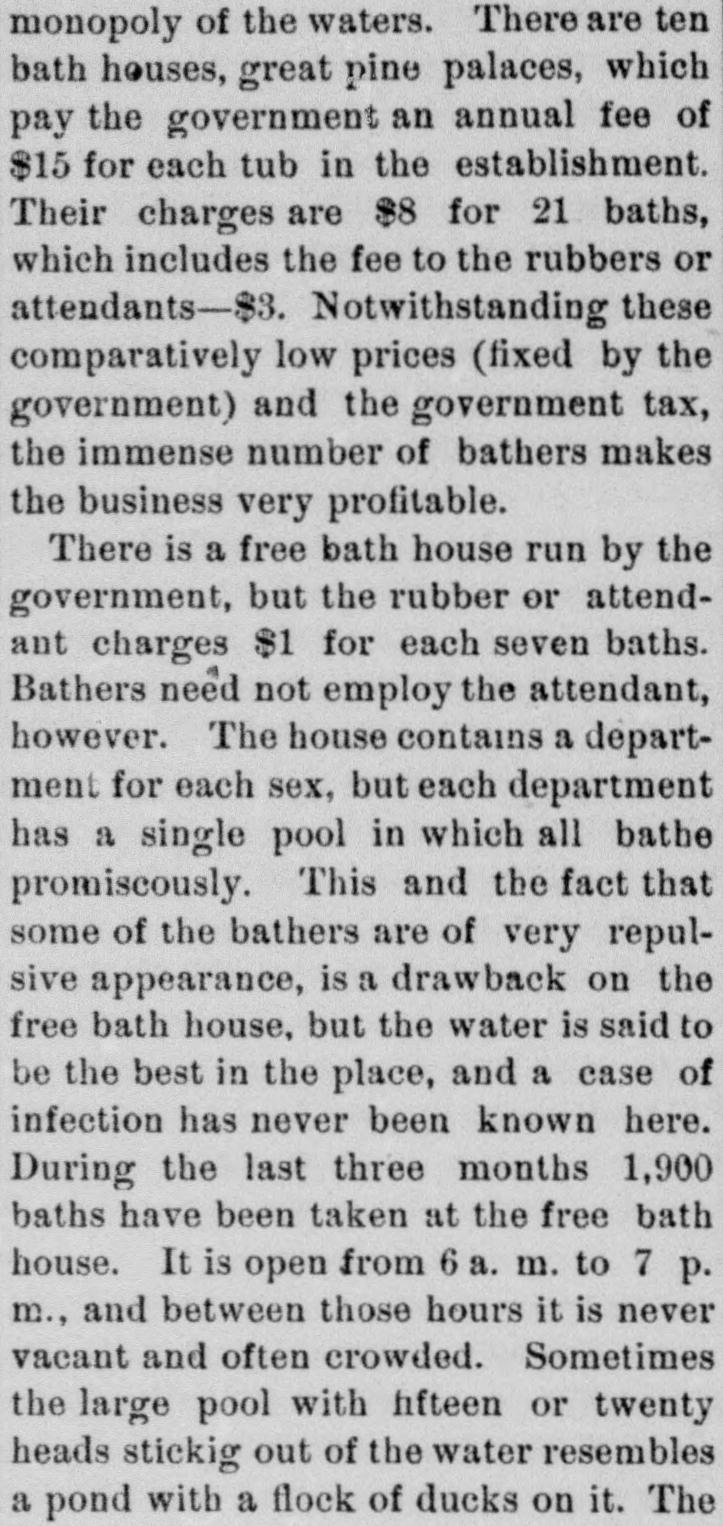
“Something About Hot Springs,” the Grant County Herald, Lancaster, Wisconsin, February 25, 1886. Library of Congress, Chronicling America. Click the clipping to read it full size.
The detectives’ report
From the springs, the team went on to exhibition games in Memphis, Nashville, Savannah, Atlanta and Macon, and it opened the season at Kansas City on April 29. By July, Spalding kept hearing that some of his men had broken the pledge. He hired detectives, who followed the team for six weeks and wrote down when each man went to bed and who slipped out for a nightcap.
Spalding read the whole report aloud to the players in their club room. It said Tom Burns, the third baseman, had smoked a cigar after dinner in St. Louis, though everyone knew Burns never smoked. The rest, the players had to admit, was pretty close. Then Spalding named names. “Kelly, McCormick, Flint, Gore, Williamson, Flynn and Ryan I shall fine $25 each for drinking liquor, in violation of your agreements,” he said. “Now, boys, keep your mouths closed about this affair, and go ahead and win the championship.” The story was in the Chicago papers the next morning.
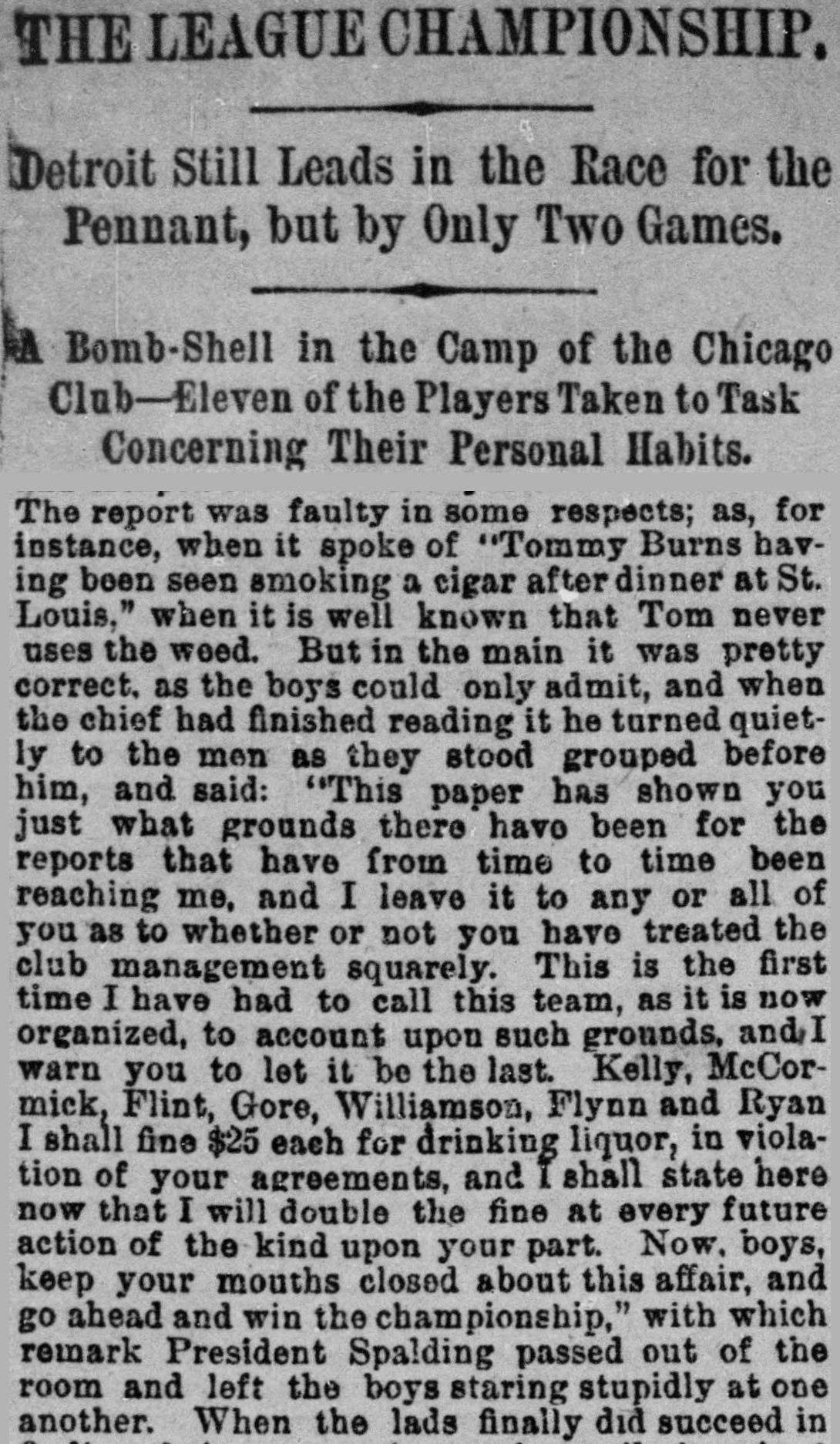
“The League Championship,” the Indianapolis Journal, Indianapolis, Indiana, July 31, 1886. Library of Congress, Chronicling America. Click the clipping to read it full size.
A pennant and a $10,000 sale
They did win it, the club’s sixth pennant in 11 seasons. Then they lost a postseason series to the St. Louis Browns, four games to two, and Anson wrote later that some of his players hadn’t taken good care of themselves before it. That winter Spalding sold Mike Kelly to Boston for $10,000, the most ever paid for a ball player up to then.
Other clubs copied the trip. For years, big-league teams came to Hot Springs every spring to bathe, hike and play practice games, and the Chicago trip is usually counted as the start of spring training. Ed Williamson, the 221-pound shortstop, left baseball and ran a saloon in Chicago. He came back to the springs for treatment of his liver and heart, and he died near there on March 3, 1894, at 36.
“Bill, I’m proud of you”
Billy Sunday, the 149-pound outfielder, became one of the best-known preachers in America and a leader in the fight against saloons. He told how it started in his sermons for years. One afternoon in Chicago, he and some other ball players went into a saloon. “It was Sunday afternoon and we got tanked up and then went and sat down on a corner,” he said in 1915. Across the street, people from the Pacific Garden Mission were playing horns and singing the gospel hymns his mother used to sing back in their log cabin in Iowa. He stood up, told the others he was through, and walked to the mission.
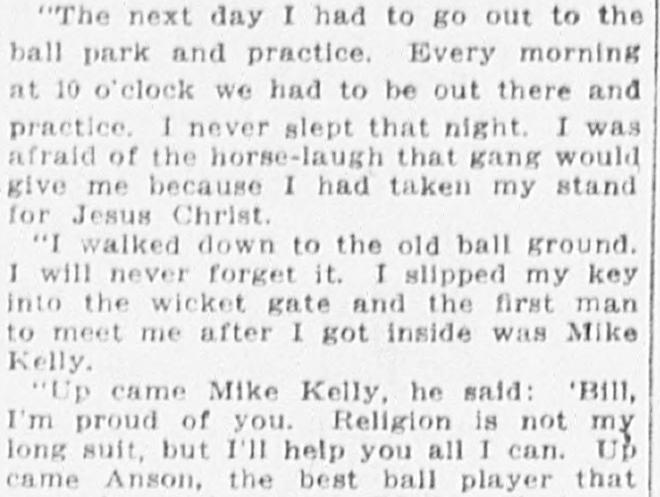
Billy Sunday tells his story in the Evening Public Ledger, Philadelphia, Pennsylvania, January 25, 1915. Library of Congress, Chronicling America. Click the clipping to read it full size.
He couldn’t sleep that night. He was afraid of the laughing that waited for him at morning practice. He slipped his key into the gate at the ball grounds, and the first man to meet him was Mike Kelly, the first name on Spalding’s list. “Bill, I’m proud of you,” Kelly said. “Religion is not my long suit, but I’ll help you all I can.”
Sources
- St. Paul Daily Globe (Saint Paul, Minn.), February 15, 1886, page 3 (the plan and the pledge); the Sun (New York, N.Y.), February 28, 1886, page 10.
- Gloucester County Democrat (Woodbury, N.J.), April 8, 1886, page 1 (the weights taken at Hot Springs); Savannah Morning News, April 7, 1886, page 8.
- Grant County Herald (Lancaster, Wis.), February 25, 1886, page 2 (“Something About Hot Springs”).
- Omaha Daily Bee (Omaha, Neb.), April 14, 1886, page 5 (the trip to the springs and the exhibition games).
- The Indianapolis Journal (Indianapolis, Ind.), July 31, 1886, page 5 (the detectives’ report); the Salt Lake Herald, August 8, 1886, page 10.
- Lancaster Daily Intelligencer (Lancaster, Pa.), February 15, 1887, page 1 (Kelly signs with Boston).
- Evening Star (Washington, D.C.), March 5, 1894, page 12, and the Indianapolis Journal, March 5, 1894, page 2 (Williamson’s death).
- Evening Public Ledger (Philadelphia, Pa.), January 25, 1915, page 6 (Billy Sunday’s story).
- All newspaper images: Library of Congress, Chronicling America. No known copyright restrictions.
- “Chicago National League base ball team, 1885-6,” photograph by William B. Fariss, Library of Congress Prints and Photographs Division, LC-USZ62-37429. No known restrictions on publication.
- Adrian C. Anson, *A Ball Player’s Career* (1900), Project Gutenberg (the 1886 pennant, the St. Louis series and the Kelly sale).
- Don Duren, “Major League Spring Training in Hot Springs,” Encyclopedia of Arkansas.
- Society for American Baseball Research, “Billy Sunday” (biography).
- Cover: “Chicago National League base ball team, 1885-6,” photograph by William B. Fariss. Library of Congress Prints and Photographs Division. No known restrictions on publication.