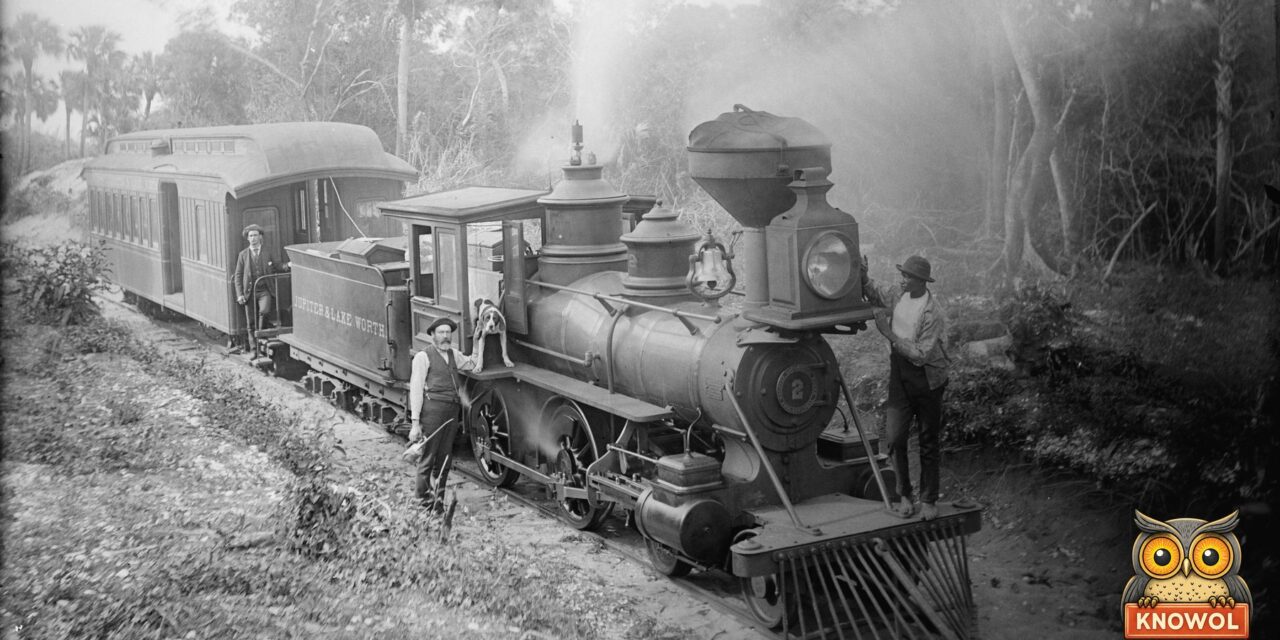
On the afternoon of February 1, 1898, a passenger train ran south through central Florida with its whistle screaming. It wasn’t warning anyone off the tracks. It was giving a weather report.
The next day, the Ocala Evening Star in Ocala, Florida, explained. The train “went tearing through the state emitting the long blasts from the locomotive whistle, warning the farmers of a cold wave.” Frost was coming, and the train was the alarm.
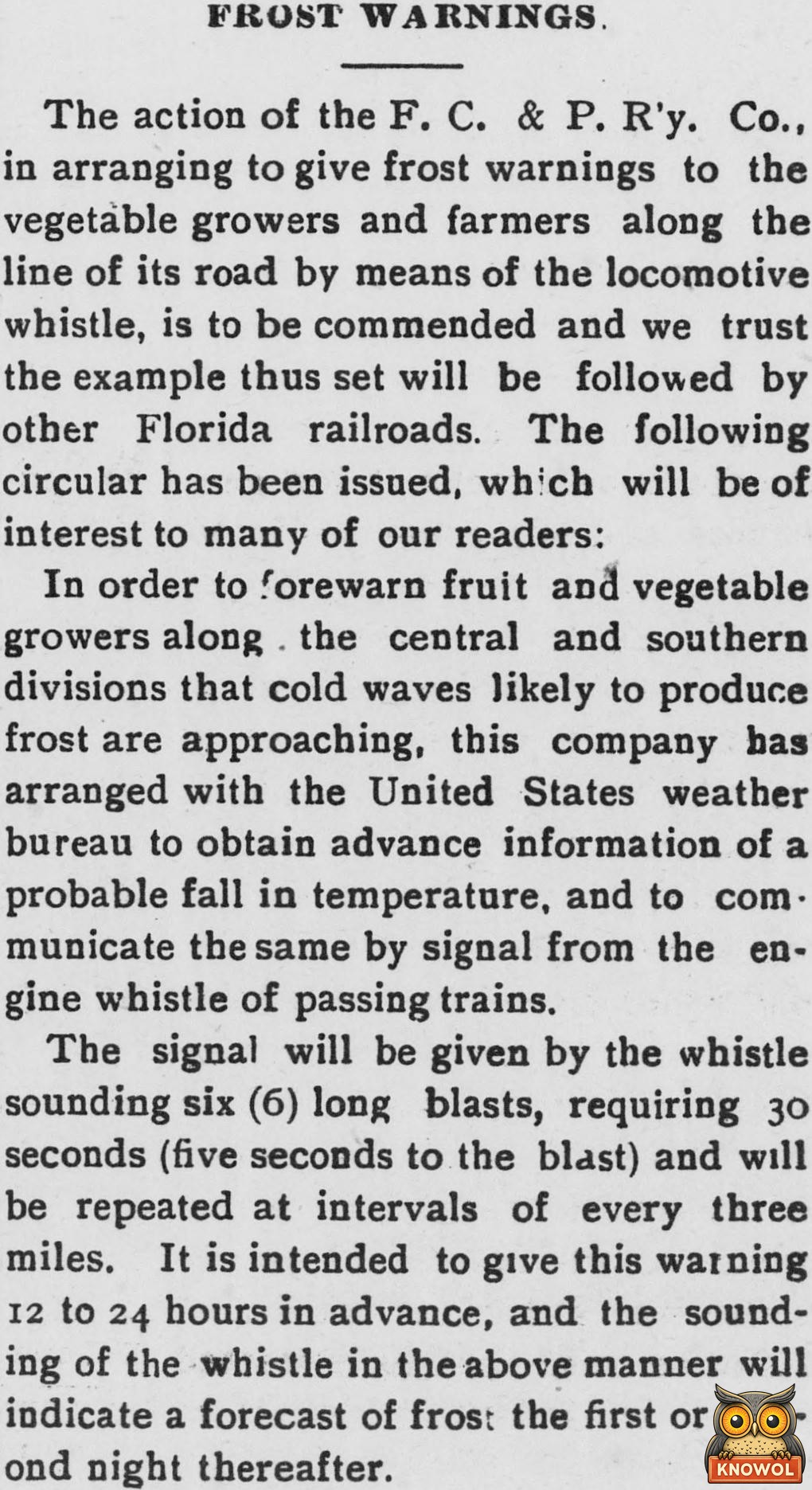
“Frost Warnings.” The Florida Agriculturist, DeLand, Florida, February 26, 1896, page 8. Library of Congress, Chronicling America. Click the clipping to read it full size.
Six long blasts meant frost
The plan started in the winter of 1896. The Florida Central and Peninsular railroad, called the F.C.&P., made a deal with the United States Weather Bureau. When the Bureau saw a hard cold wave heading for Florida, it would tell the railroad. Then the engineers would blow the frost signal as their trains rolled along.
The signal was simple. The whistle sounded “six (6) long blasts, requiring 30 seconds (five seconds to the blast).” It was “repeated at intervals of every three miles,” so farms all along the line could hear it. The warning came 12 to 24 hours early. It meant frost “the first or second night thereafter.”
The Ocala paper put it in plain words. The signal “will warn the truck raisers,” it said, “so that they may protect their tender stuff.” Truck raisers grew vegetables to sell, and tender stuff meant young plants that frost could kill overnight.
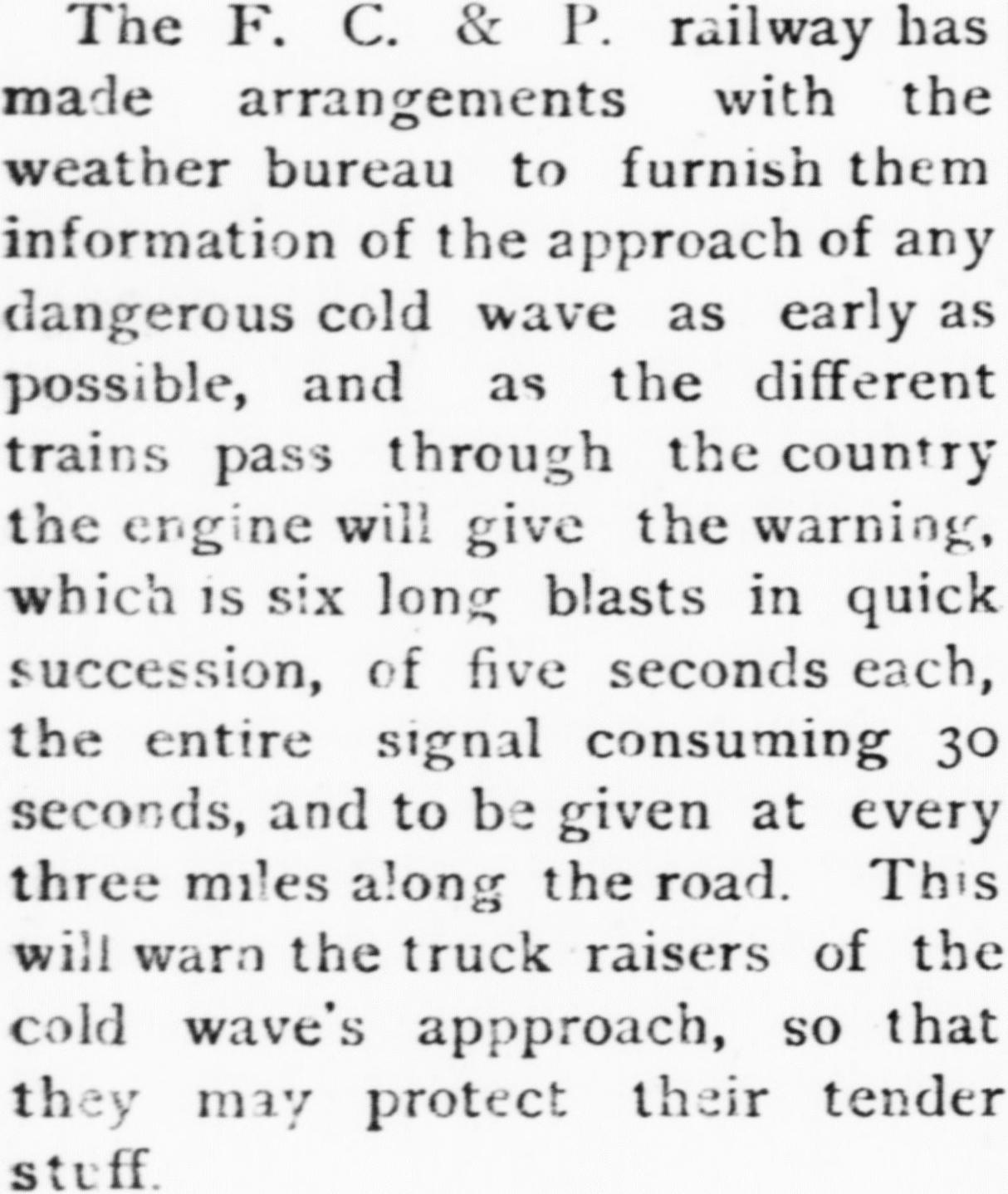
The Ocala Evening Star, Ocala, Florida, February 17, 1896, page 1. Library of Congress, Chronicling America. Click the clipping to read it full size.
Why Florida needed a whistle
Florida had just lived through a disaster. In the winter of 1894 to 1895, two hard freezes killed most of the state’s orange trees. A year later, the Florida Agriculturist said there were “hundreds of orange growers in Florida who are on the ‘flat of their financial backs.'” Their groves had stopped earning any money.
The Weather Bureau could see cold waves coming, but it sent its warnings by telegraph. Plenty of farms were miles from the nearest telegraph office. Trains, though, went right past them. Alexander J. Mitchell, the Weather Bureau’s man in Florida, called the frost whistle “an exceedingly valuable medium to reach sections isolated from telegraphic sources.”
The railroad wanted everyone to know the code. Its notice said, “Post one copy of this notice at the postoffice, and request the newspaper nearest you to give it prominent publication.” That’s likely how it ended up in papers like the Ocala Evening Star.
A warning gave farmers time to cover their plants or pile up firewood to burn in the fields. At one growers’ meeting, a man named Dr. Davis said that “with plenty of fuel he could save any grove from being seriously damaged.”
The idea came from 1891
Weather by whistle wasn’t a brand-new idea. In 1891, the Weather Bureau’s chief, Professor Mark Harrington, worked out a whole whistle code for farmers. Papers printed it, including the Watertown Republican in Watertown, Wisconsin.
First came a warning blast “lasting twenty seconds.” Then long blasts gave the weather and short blasts gave the temperature. One long meant “Fair weather.” Two long meant “Rain or snow.” Three short meant “Cold wave.” The Bureau also planned weather flags on railroad cars, so “every person can ascertain the forecast by looking at any passing train.”
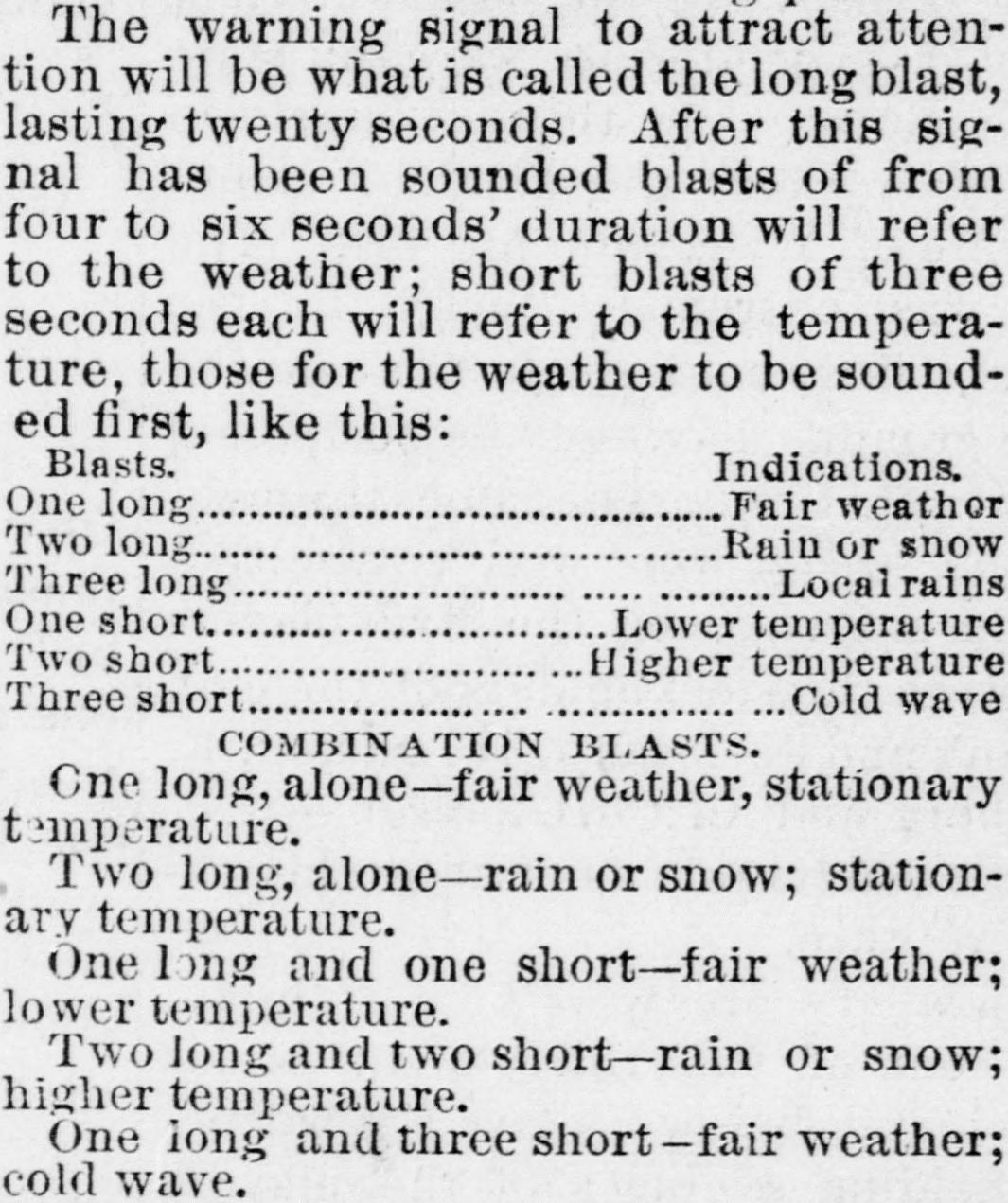
The 1891 whistle code. Watertown Republican, Watertown, Wisconsin, October 21, 1891, page 6. Library of Congress, Chronicling America. Click the clipping to read it full size.
There was one big problem. Trains already used whistle signals to talk to their crews. Even that 1891 article worried that “the public mind may become confused by the two.” That same month, the Bureau’s observer in Savannah, Georgia, said trains wouldn’t whistle the weather after all. There would be “too much danger of disastrous mistakes.” The plan switched to the steam whistles at mills and factories instead.
Florida’s railroad kept its signal short. Six long blasts meant one thing: frost.
Not always first with the news
The whistle didn’t always beat the weather. In February 1898, the Ocala paper’s correspondent in nearby Spring Park wrote that “we were aware of the fact before the locomotive whistle gave us the warning as it went screeching through the town.” The cold had arrived first.
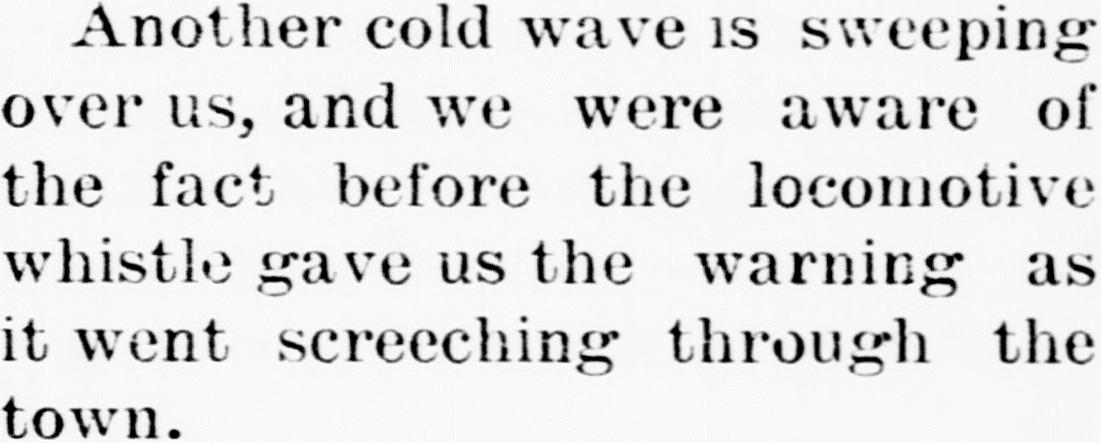
Spring Park news. The Ocala Evening Star, Ocala, Florida, February 24, 1898, page 2. Library of Congress, Chronicling America. Click the clipping to read it full size.
Learn to speak train
The regular railroad whistle code was a language of its own. In 1903, the Atlanta Constitution printed a list:
- One long blast: “We are approaching a station, a crossing or a junction.”
- One short blast: “Put on the brakes. We are going to stop here.”
- Two short blasts: “All right. Your signals are understood.”
- Three short blasts: “Look out. The train is going to back.”
- Four short blasts: “Show your signals, you lubbers, so that we may know what to do.” A lubber is a clumsy person.
Trains still talk this way. Today, an engineer coming up to a road crossing blows two long blasts, one short and one more long one.
Sources
- The Ocala Evening Star (Ocala, Florida): February 17, 1896, page 1 (six long blasts; “tender stuff”), February 2, 1898, page 4 (the southbound train) and February 24, 1898, page 2 (Spring Park).
- The Florida Agriculturist (DeLand, Florida): February 26, 1896, page 8 (“Frost Warnings”; orange growers), May 20, 1896, page 3 (A. J. Mitchell) and October 7, 1896, page 6 (Dr. Davis; the whistle continued).
- Watertown Republican (Watertown, Wisconsin): October 21, 1891, page 6 (the 1891 flag and whistle code).
- The Morning News (Savannah, Georgia): October 27, 1891, page 8 (“disastrous mistakes”).
- The Atlanta Constitution (Atlanta, Georgia): August 10, 1903, page 9 (railroad whistle signals).
- All newspaper images: Library of Congress, Chronicling America. Published 1891 to 1903, public domain.
- Cover: “Jupiter & Lake Worth R.R.,” photograph by William Henry Jackson, Detroit Publishing Co., between 1880 and 1897, Library of Congress, no known restrictions.