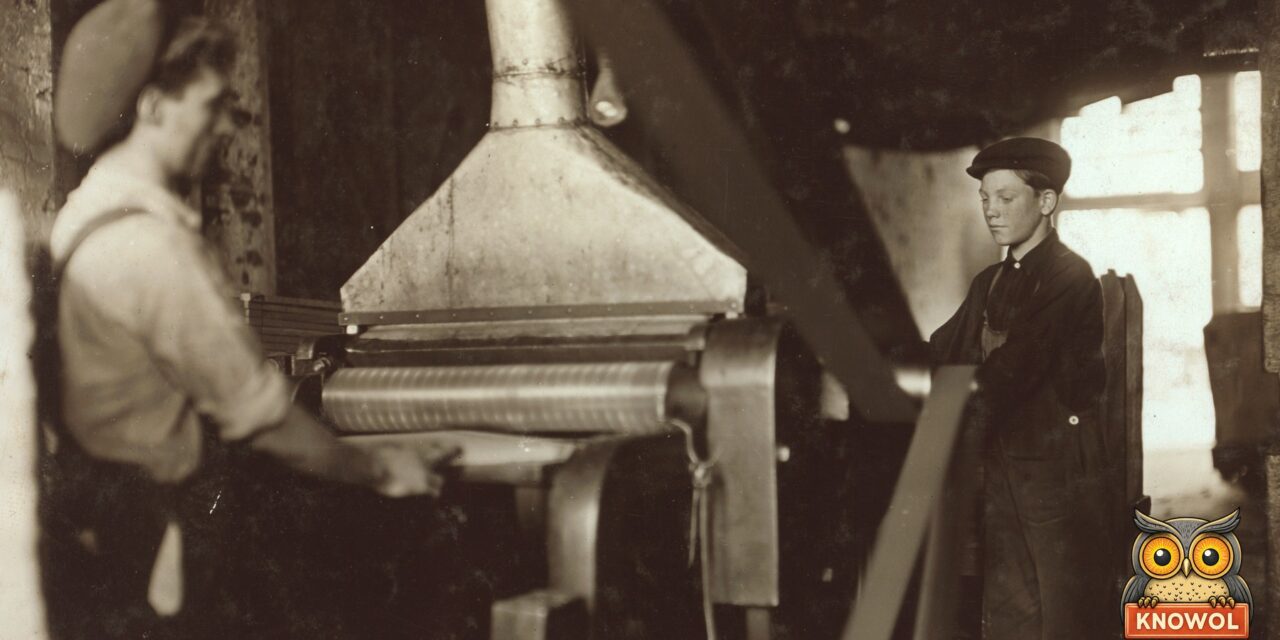
In April 1887, people came from out of town to stare at a machine inside a planing mill in Peru, Indiana. It was a steam engine about the size of a pump, and it stood on four thin iron legs. Ordinary steam engines of the day sat on heavy stone foundations, because they shook and pounded as they ran. This one stayed still. A reporter wrote that it “looks as though suspended in mid air.”
The engine belonged to Daniel Wilkinson, the 56-year-old owner of the mill, and he had built it himself. The Indianapolis Journal’s Peru correspondent sent the story in on April 16, and the next morning it ran under the headline “SOMETHING NEW IN MECHANICS.” The paper said Wilkinson’s engine “ranks as one of the great discoveries of the age.”
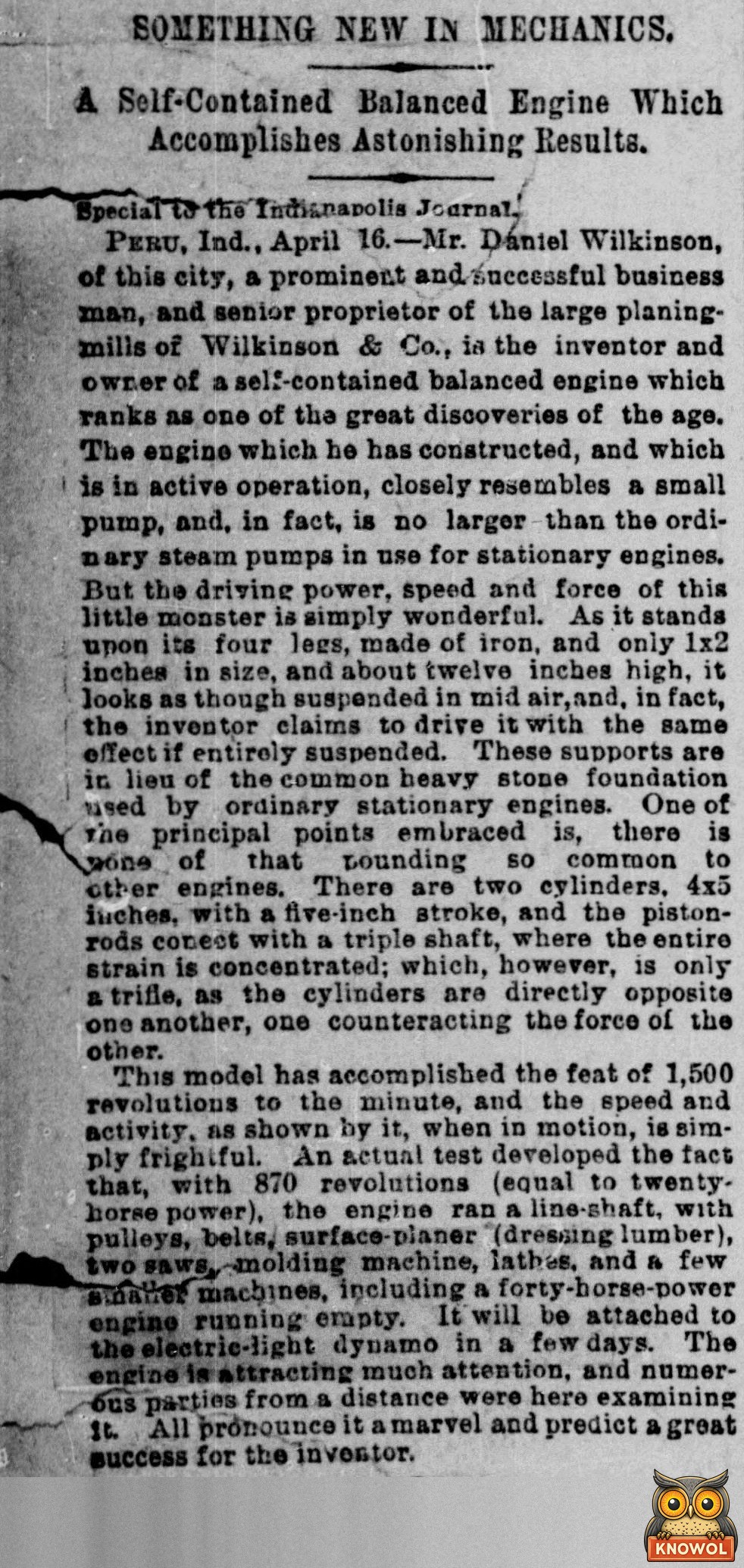
“Something New in Mechanics. A Self-Contained Balanced Engine Which Accomplishes Astonishing Results.” The Indianapolis Journal, Indianapolis, Indiana, April 17, 1887, page 12. Library of Congress, Chronicling America. Click the clipping to read it full size.
A Little Engine on Skinny Legs in Peru
The Journal described Daniel Wilkinson’s engine in Peru, Indiana, piece by piece. It “closely resembles a small pump,” the paper said, and “is no larger than the ordinary steam pumps in use for stationary engines.” It stood “upon its four legs, made of iron, and only 1×2 inches in size, and about twelve inches high.” Each leg was about a foot tall, one inch thick and two inches wide.
“But the driving power, speed and force of this little monster is simply wonderful,” the reporter wrote. Wilkinson even claimed his engine would run just as well hanging in the air. Its thin legs stood “in lieu of the common heavy stone foundation used by ordinary stationary engines.” In lieu of means in place of.
How Two Cylinders Kept Wilkinson’s Engine Still
Here is how Daniel Wilkinson’s engine in Peru worked. Inside a steam engine, steam pushes a piston, a metal plug that slides back and forth inside a tube called a cylinder. The piston turns a shaft, the way your legs turn the pedals of a bike. But every hard push also shoves the engine the other way. That is why ordinary engines rocked and thumped, and why people bolted them to big blocks of stone.
Wilkinson’s engine had “two cylinders, 4×5 inches, with a five-inch stroke.” The stroke is how far the piston slides each way. His trick was where he put them. The paper said “the cylinders are directly opposite one another, one counteracting the force of the other.” When one piston shoved one way, the other shoved the opposite way at the same moment. Picture two people in a rowboat. If one leans left just as the other leans right, the boat stays steady. So there was “none of that pounding so common to other engines.”
The Day the Little Engine Ran the Mill
Daniel Wilkinson’s planing mill in Peru shaved rough boards smooth and made them into doors, window sashes and blinds. Like other mills, it ran on a line shaft, a long iron rod near the ceiling that spun all day. Leather belts looped from wheels on the shaft down to each machine.
The photograph at the top of this page shows a planing machine and its belts in Peru, 21 years later. Lewis Hine took it in 1908 at the Indiana Manufacturing Company, a big woodworking factory there, for the National Child Labor Committee, a group working to get children out of factories. Its belts are a blur because they were running.
In the test, Wilkinson’s little engine “ran a line-shaft, with pulleys, belts, surface-planer (dressing lumber), two saws, molding machine, lathes,” and a few more machines. A surface planer shaves boards flat. A molding machine cuts the fancy edges on trim. The little engine even turned “a forty-horse-power engine running empty,” an engine rated at twice its own power.
That day it made 870 turns a minute, which the paper said was “equal to twenty-horse power.” It could go much faster. “This model has accomplished the feat of 1,500 revolutions to the minute,” the reporter wrote, “and the speed and activity, as shown by it, when in motion, is simply frightful.” That is 25 turns every second.
“The engine is attracting much attention, and numerous parties from a distance were here examining it,” the story ended. “All pronounce it a marvel and predict a great success for the inventor.”
Who Was Daniel Wilkinson of Peru?
Daniel Wilkinson knew metal machines long before he ran a wood mill in Peru, Indiana. A history of Miami County printed in 1887 says he was born in Zanesville, Ohio, on July 26, 1830. “At sixteen years of age he began to learn the machinists trade,” it says, and he stuck with it for about seventeen years. A machinist makes and fixes the metal parts of machines.
Then he went into sawmills, and around 1860 he moved to Peru. “In 1868 he opened a planing mill in Peru, and was burned out in 1872, but which was immediately rebuilt,” the book says. The new mill was brick. By 1887 it made “doors, sash, blinds, and everything of that order in first-class style,” with ten to twelve workmen. His nephew Walter Wilkinson was his partner.
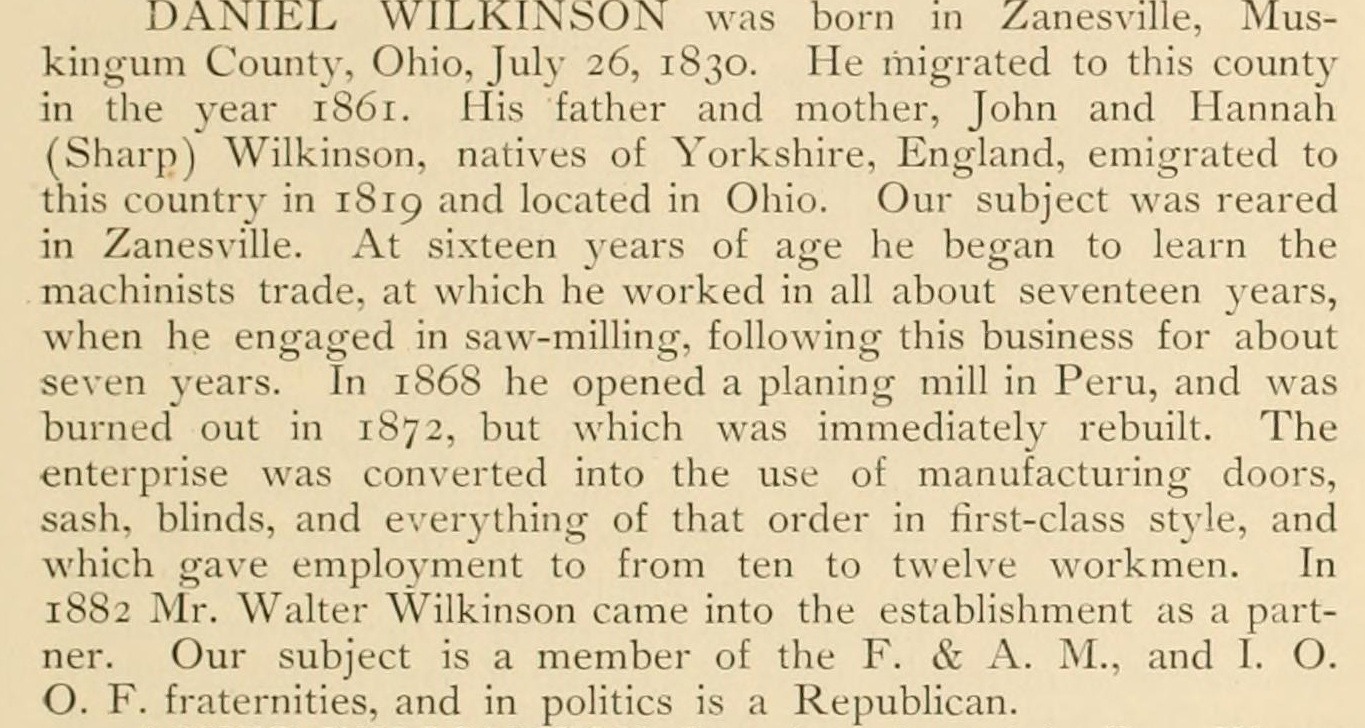
Daniel Wilkinson’s life story in “History of Miami County, Indiana,” Chicago, 1887, page 487. Internet Archive, public domain. Click the clipping to read it full size.
The Peru Engine Goes to Indianapolis
Twelve days later, Daniel Wilkinson’s engine from Peru, Indiana, was on show in the state capital. On April 29, 1887, the Indianapolis Journal reported that one of his engines “is on exhibition at the Brush electric-light works.” That was a plant in Indianapolis where engines spun dynamos, the machines that made electricity for lamps.
“A number of mechanics and machinists have witnessed its operation, and are more than gratified with the results,” the Journal said. Even at high speed there was “no friction or even a jar of the plate on which the engine rests.” A jar is a jolt, and the plate was the engine’s base.
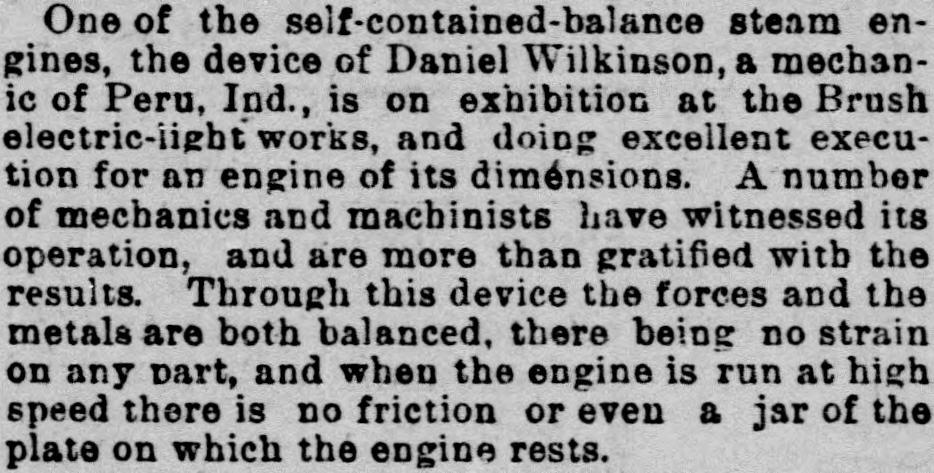
Wilkinson’s engine on show at the Brush electric-light works. The Indianapolis Journal, Indianapolis, Indiana, April 29, 1887, page 7. Library of Congress, Chronicling America. Click the clipping to read it full size.
Electric companies wanted exactly that: engines that were fast and smooth. Two years later, in the engine room of the electric-light plant in Portland, Maine, a reporter heard “the hum and whir of ten high speed, well balanced engines that run twice as many big dynamos.”
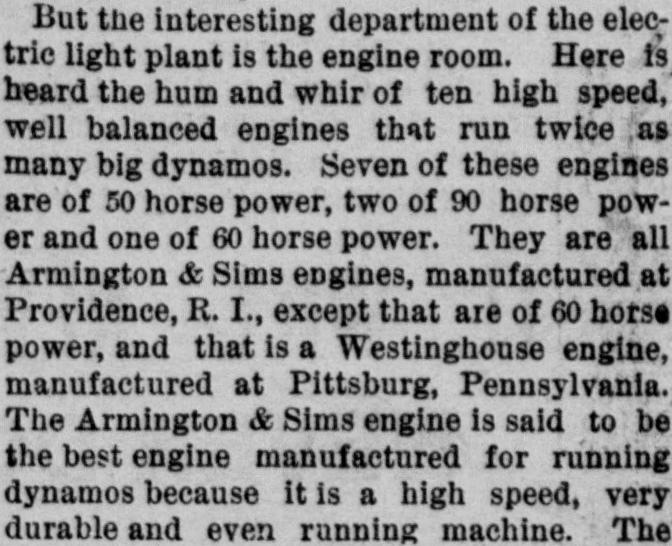
Fast, balanced engines in an electric-light plant. The Portland Daily Press, Portland, Maine, March 30, 1889, page 4. Library of Congress, Chronicling America. Click the clipping to read it full size.
A Farm Engine at the Indiana State Fair
Daniel Wilkinson of Peru, Indiana, showed an engine at the Indiana State Fair in the fall of 1888. The State Board of Agriculture printed a list of the steam engines on display. Most came from big companies, like J. I. Case of Racine, Wisconsin. In the middle of the list is one plain line: “Daniel Wilkinson, Peru, farm engine.” The list does not say which engine he brought.
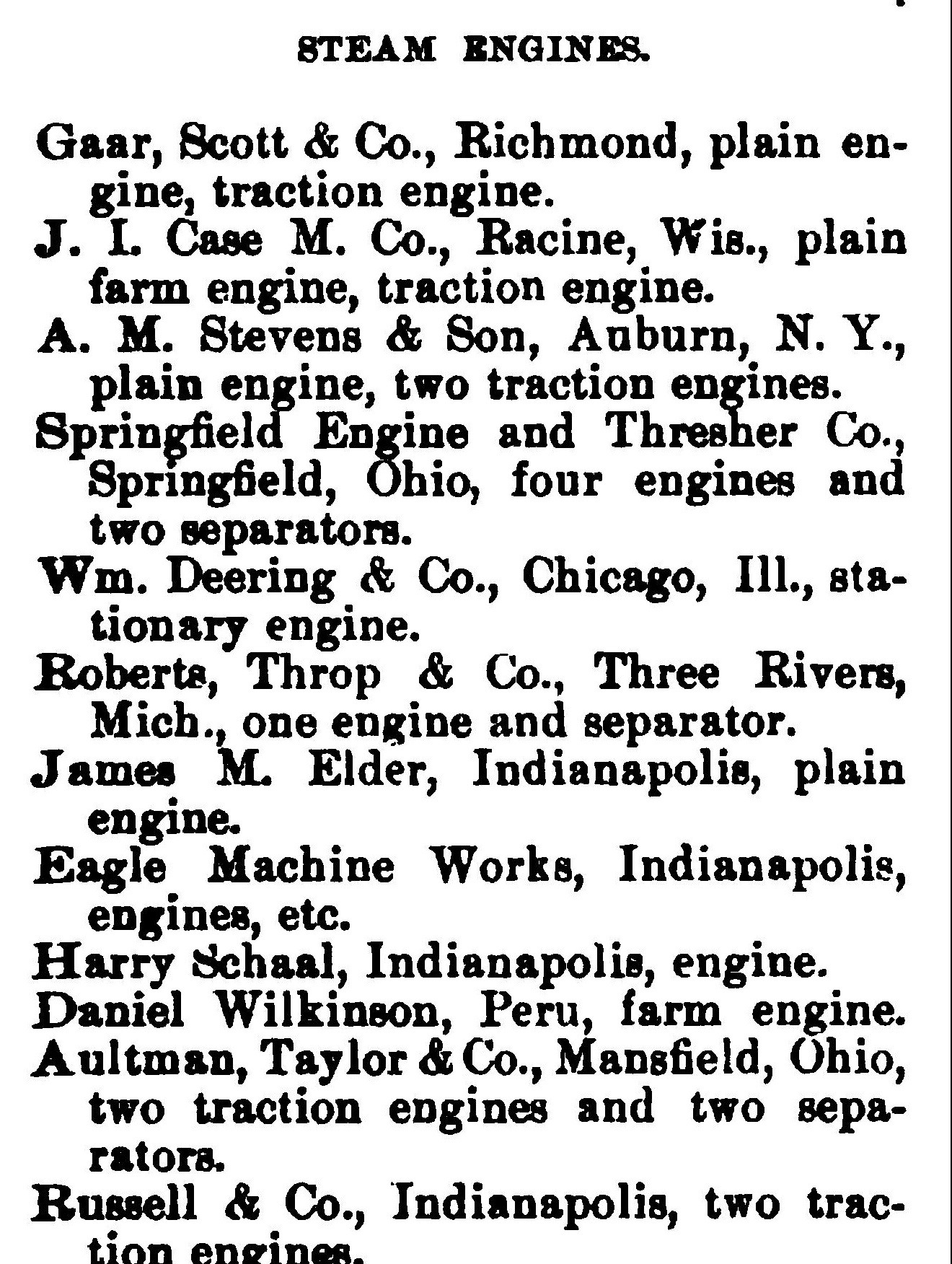
The steam engines at the Indiana State Fair of 1888, from the “Annual Report of the Indiana State Board of Agriculture,” volume 30. Internet Archive, public domain. Click the clipping to read it full size.
What Happened to the Peru Engine
After that fair, we could not find Daniel Wilkinson’s engine from Peru in the papers again, and we found no patent for it. Wilkinson died in Peru on January 11, 1890, at the age of 59. A 1910 book about his son gives the date.
His mill outlived him. A county history printed in 1914 says the mill, by then called Wilkinson & Pomeroy, “manufactures fine interior woodwork, sash, doors, office and store fixtures,” and that “his nephew, Walter Wilkinson, became his successor in the firm.”
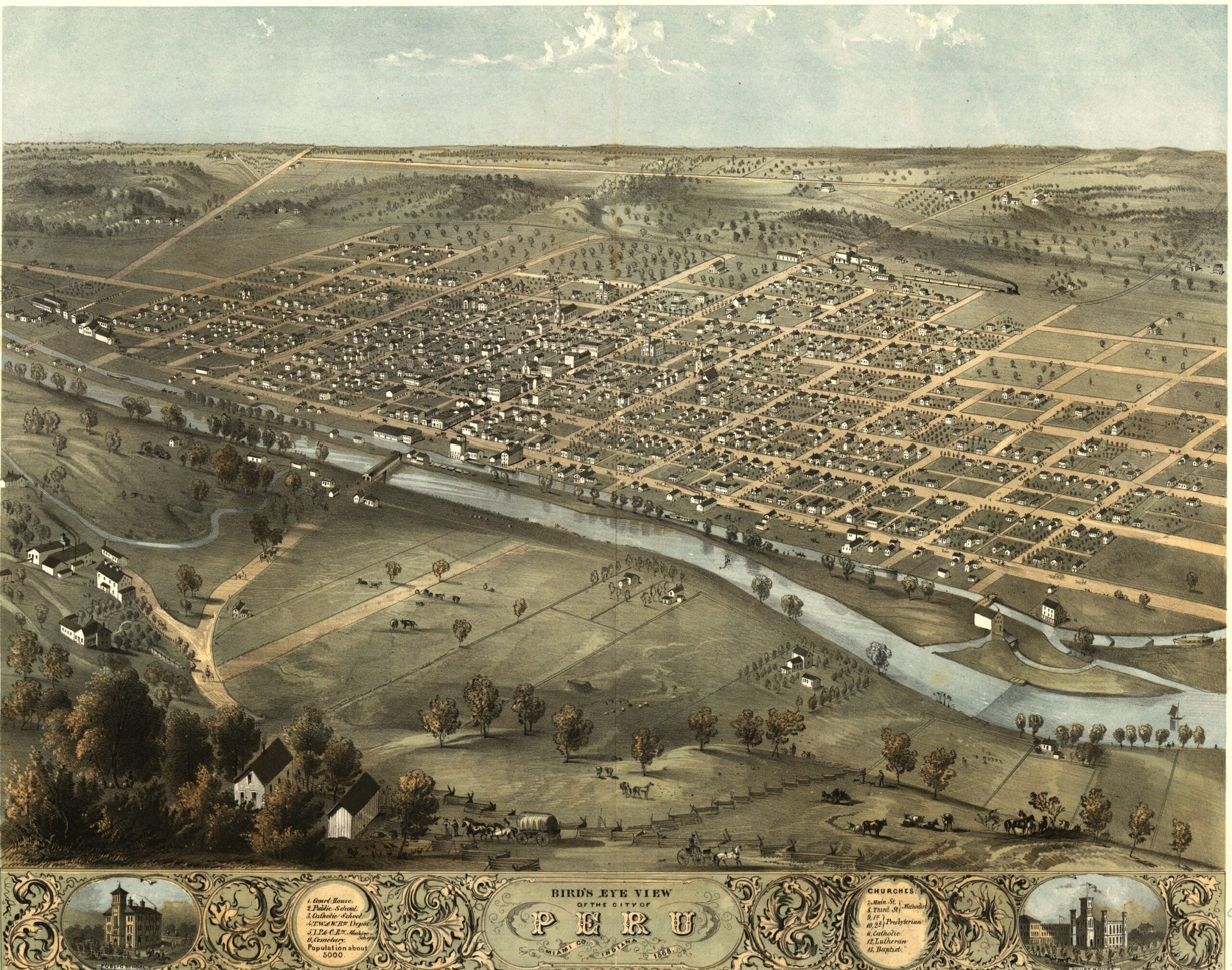
Peru, Indiana, in 1868, the year Daniel Wilkinson opened his planing mill, drawn as if seen from the air. Bird’s-eye view by A. Ruger, Library of Congress. Click the picture to see it full size.
Wilkinson was not the only builder chasing a smooth engine, and the idea of facing cylinders lives on. Many small airplanes and some cars today use “boxer” engines, with their cylinders laid flat and set opposite each other, partly for the reason the Peru paper gave: the pushes cancel out. Back in 1887, a mill owner who learned machines at sixteen set two cylinders face to face and stood his engine on four skinny legs. People came to Peru from out of town to see a steam engine that ran hard and still didn’t shake.
Sources
- “Something New in Mechanics,” The Indianapolis Journal (Indianapolis, Indiana), April 17, 1887, page 12. Library of Congress, Chronicling America.
- Item on the engine at the Brush electric-light works, The Indianapolis Journal, April 29, 1887, page 7. Library of Congress, Chronicling America.
- “Where Electricity Is Generated,” The Portland Daily Press (Portland, Maine), March 30, 1889, page 4. Library of Congress, Chronicling America.
- “History of Miami County, Indiana,” Brant and Fuller, Chicago, 1887, page 487 (Daniel Wilkinson) and the Peru planing mills. Internet Archive.
- “Annual Report of the Indiana State Board of Agriculture,” volume 30, 1888-1889, classified exhibits at the State Fair, steam engines. Internet Archive.
- Jacob Piatt Dunn, “Greater Indianapolis,” volume 2, 1910, pages 1141 and 1142 (Philip Wilkinson and his father). Internet Archive.
- Arthur L. Bodurtha, “History of Miami County, Indiana,” 1914, pages 276 and 277 (Wilkinson & Pomeroy). Internet Archive.
- Lewis Hine, “Boy at planing machine,” Indiana Manufacturing Company, Peru, Indiana, 1908, National Child Labor Committee Collection. Library of Congress Prints and Photographs Division. No known restrictions on publication.
- A. Ruger, “Bird’s eye view of the city of Peru, Miami Co., Indiana 1868”. Library of Congress Geography and Map Division.
- The newspapers, books and pictures were all published before 1931 and are in the public domain.