At 7:15 on the evening of November 4, 1908, Chief Joseph Martin, Sergeant Dowling and a few other men sat around the stove in the police station in Gary, Indiana. They had worked all day in the cold, and the warm stove felt good. Then several shots cracked into the air outside, and nobody in the room had to ask what that meant. “It was the old familiar fire alarm,” the Lake County Times of nearby Hammond reported the next day.
The men grabbed the hose cart, a reel of fire hose pulled by hand, and the chemical engine, a fire-fighting tank on wheels. They “dashed down the street without hesitation.” When they reached Sixth avenue, “panting and excited,” they found no fire at all, just one young man pushing another down Broadway in a wheelbarrow, with a crowd behind them carrying torches and fireworks.
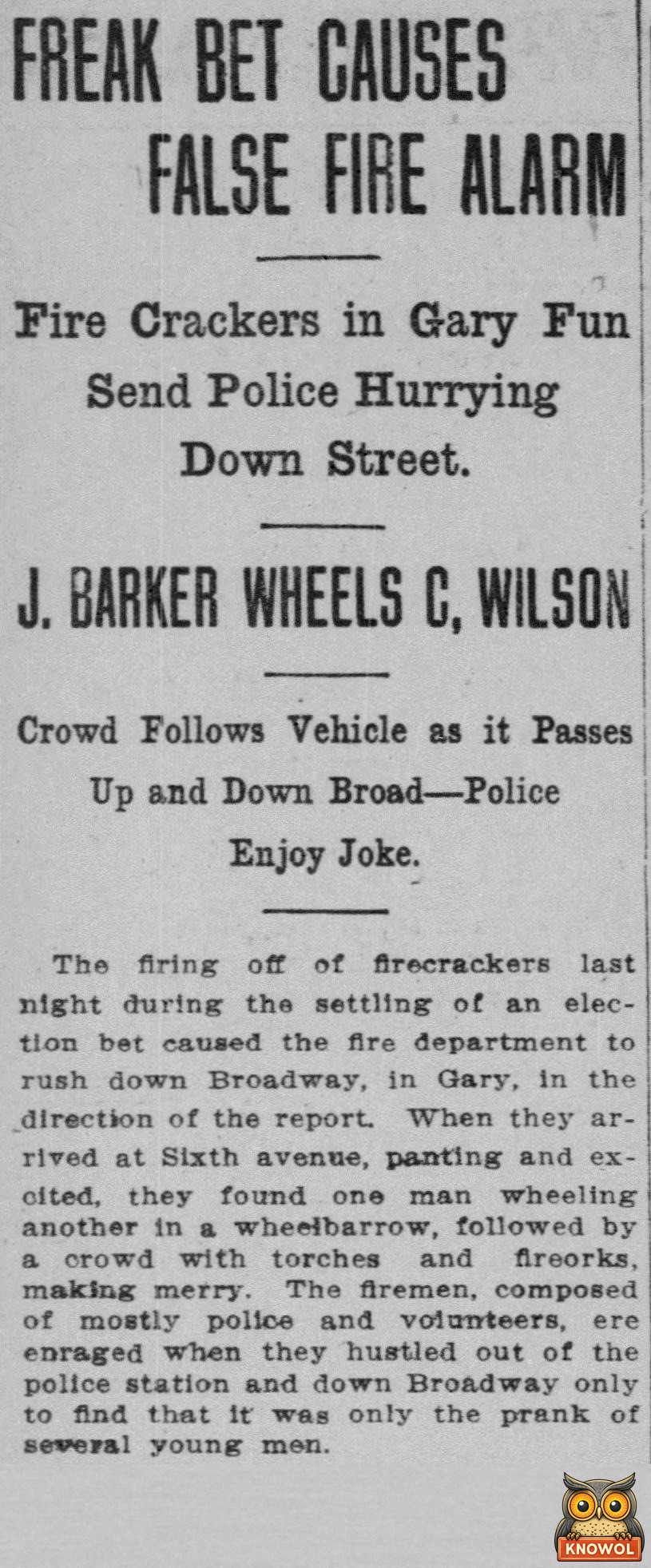
“Freak Bet Causes False Fire Alarm.” The Lake County Times, Hammond, Indiana, November 5, 1908, page 8. Library of Congress, Chronicling America. Click the clipping to read it full size.
Gary, Indiana, Was Only Two Years Old
Gary, Indiana, was brand new in 1908. The United States Steel Corporation broke ground for a giant steel mill on the sand at the south end of Lake Michigan on June 1, 1906. Its land company laid out a whole town right next to the mill. That November, the Richmond Palladium, a paper in eastern Indiana, called Gary “the baby city of Indiana.” It said the place “two years ago, was only a waste of sand on the shore” of the lake.
The city kept count as it grew, and its 1910 report has a list called “Gary at a Glance.” The first house went up in June 1906. One line simply says, “Population in May, 1906, none.” By November 23, 1908, less than three weeks after the wheelbarrow ride, Gary had 10,246 people.
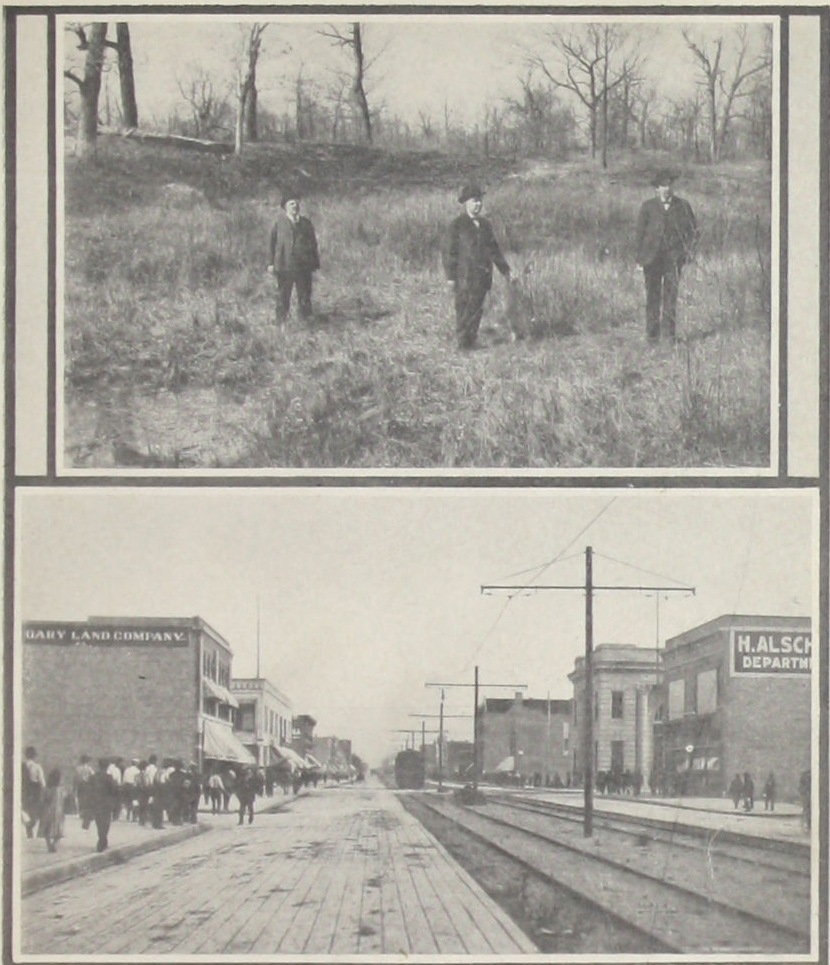
The same corner of Fifth Avenue and Broadway in Gary, looking south, in 1906 (top) and 1908 (bottom). The sign on the left says Gary Land Company. From the City of Gary’s annual report for 1910. Lake County Public Library copy, Internet Archive. Click the picture to see it full size.
A town that grows that fast runs short of everything, and in early 1908 Gary had almost nothing to fight fires with. In April, the Lake County Times said Gary’s “new fire equipment” had arrived: “a few feet of hose and a small reel.” The reel would sit behind the police station, and “the police will act as firemen.”
That made Joseph Martin the chief of police, the street commissioner and now the fire chief, too. The paper joked that if things kept up, “Martin will have so many titles that he won’t know what he is and what he isn’t.”
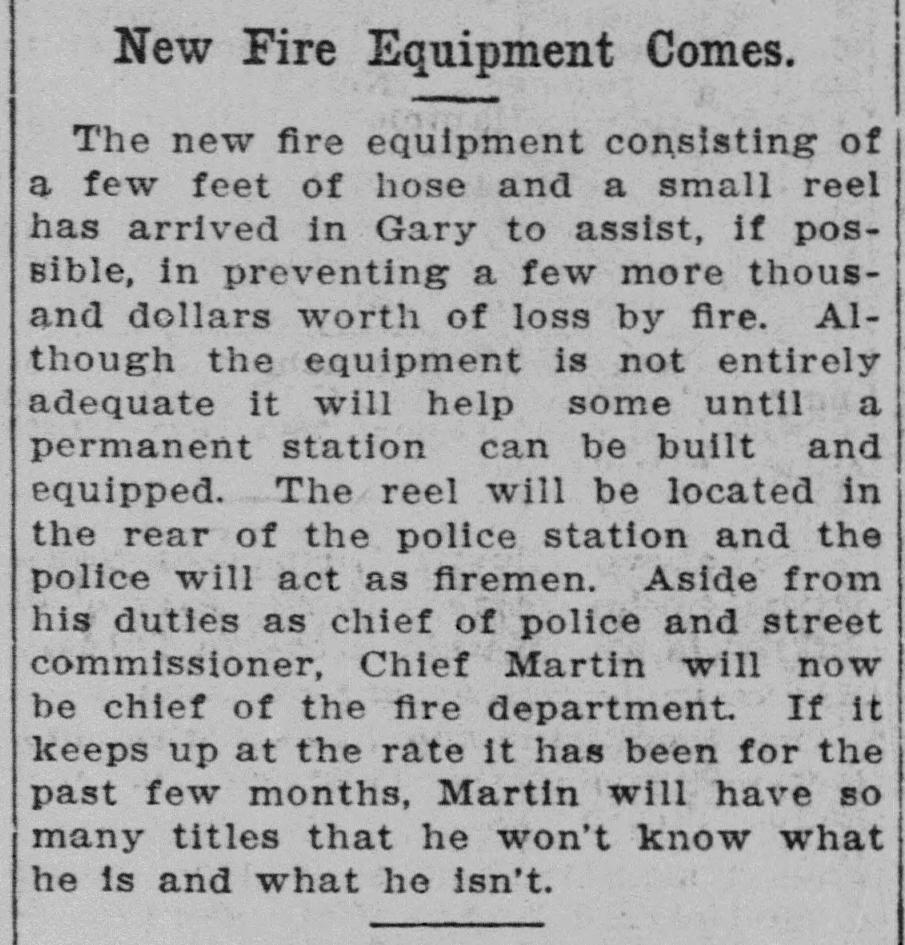
“New Fire Equipment Comes.” The Lake County Times, Hammond, Indiana, April 6, 1908, page 6. Library of Congress, Chronicling America. Click the clipping to read it full size.
How Gary, Indiana, Called Its Firemen
Gary, Indiana, had no proper fire alarm yet, so the town used the loudest thing it had. Whoever saw a fire fired a gun into the air. People down the street heard it and fired, too, and the bangs carried the news across town.
In October 1908, a traveling reporter for the Indianapolis News, W. H. Blodgett, learned how it worked the hard way. He was asleep at the Gary Hotel when the alarm went off at 4 o’clock in the morning. His story, which the Lake County Times reprinted on October 8, began: “A fusillade of shots awakened Gary at 4 o’clock this morning.” A fusillade is a lot of shots all at once. He heard pistols, a shotgun and a rifle, and wrote that it “sounded as if a battle was in progress.”
He ran outside, and there on the hotel porch stood the young night clerk, swinging a heavy Colt’s revolver and firing shot after shot into the sky.
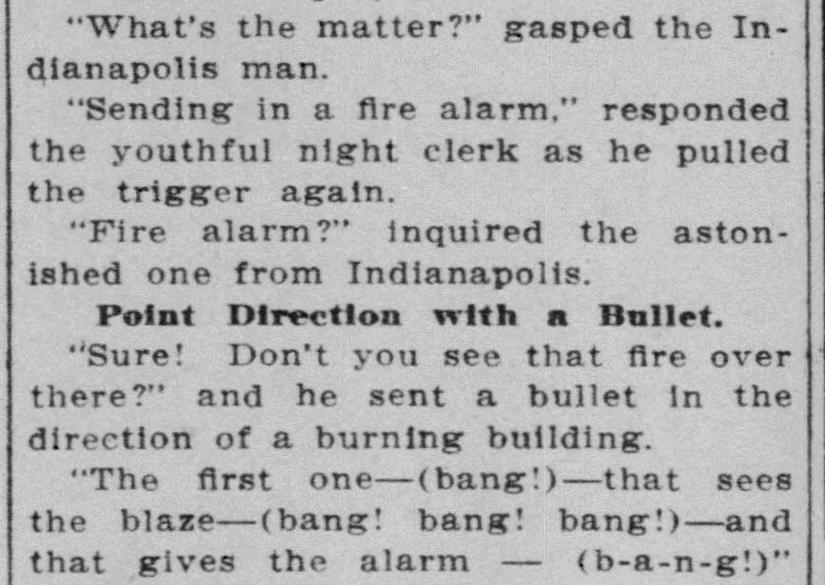
The Indianapolis News reporter’s story, reprinted in the Lake County Times, Hammond, Indiana, October 8, 1908, page 3. Library of Congress, Chronicling America. Click the clipping to read it full size.
The clerk even used his gun to point: he sent a bullet toward the burning building and explained, between bangs, that the first one who sees the blaze is the one who gives the alarm. Before the shooting was over, the chief of police and a clothing clerk came running down the street, hauling a hose reel. The building burned down, but the men kept the fire from spreading.
The reporter summed up Gary in one line: it was, he wrote, “the only place on earth where an alarm of fire is sent in with a six-shooter.” A six-shooter is a revolver that holds six bullets.
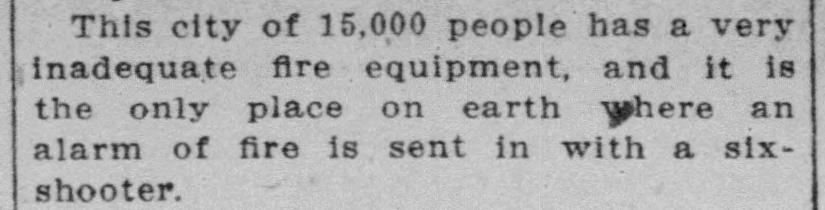
The reporter’s last line. The Lake County Times, Hammond, Indiana, October 8, 1908, page 3. Library of Congress, Chronicling America. Click the clipping to read it full size.
A Wheelbarrow Bet on Broadway in Gary, Indiana
Four weeks after the reporter’s visit to Gary, Indiana, the whole country voted for president. On Tuesday, November 3, 1908, William Howard Taft, a Republican, beat William Jennings Bryan, a Democrat. In Gary, two young men had a bet on it. Charles Wilson “wagered on the election of Taft.” John Barber bet against him and lost. The paper’s headline spelled his name “J. Barker,” but its story said Barber.
The loser had to pay with his arms and his pride. He had to push the winner down the main street in a wheelbarrow, in front of everybody. These “freak” bets were popular all over Lake County that fall. A few days later, a barber pushed his friend through Hammond, Indiana, in a wheelbarrow to pay off the same kind of bet.
On Wednesday night, November 4, Barber took the handles and Wilson climbed in. They started at Fifth avenue, the corner in the photo above, and headed down Broadway toward the Wabash railroad tracks. Nearly a hundred young men followed with torches, Roman candles and firecrackers. They all belonged to the General Electric club. Gary’s 1908-1909 city directory shows the club was also a boarding house, where more than a dozen working men lived, from an electrician to a mason foreman.
Those firecrackers sounded just like Gary’s fire alarm. So the police and volunteers came running with the hose cart and the chemical engine. When they turned north on Broadway, they saw a crowd near the Brennan block, the building with the drugstore at Broadway and Sixth avenue, and figured the fire had started there.
“Police Enjoy Joke” in Gary, Indiana
Then someone in the crowd on Broadway in Gary, Indiana, lit several Roman candles, and the firemen could see the whole crowd was on the move. Next they spotted the wheelbarrow. Chief Martin called a halt. The paper didn’t print what he said, but it joked that whatever the chief didn’t say to the merrymakers wasn’t worth saying. His main point was simple: he told them “that in firing firecrackers they turned in a fire alarm whether they were celebrating an election bet or not.”
The Times said the firemen were “enraged” at first. But the headline over the story says the “Police Enjoy Joke,” and the parade went on. All the way from Fifth avenue to the Wabash tracks, “a large crowd laughed at the unfortunate loser,” and Barber’s friends “kidded” him. The night was “exceedingly windy and cold,” but there was “a large crowd on the street to watch the fun.”
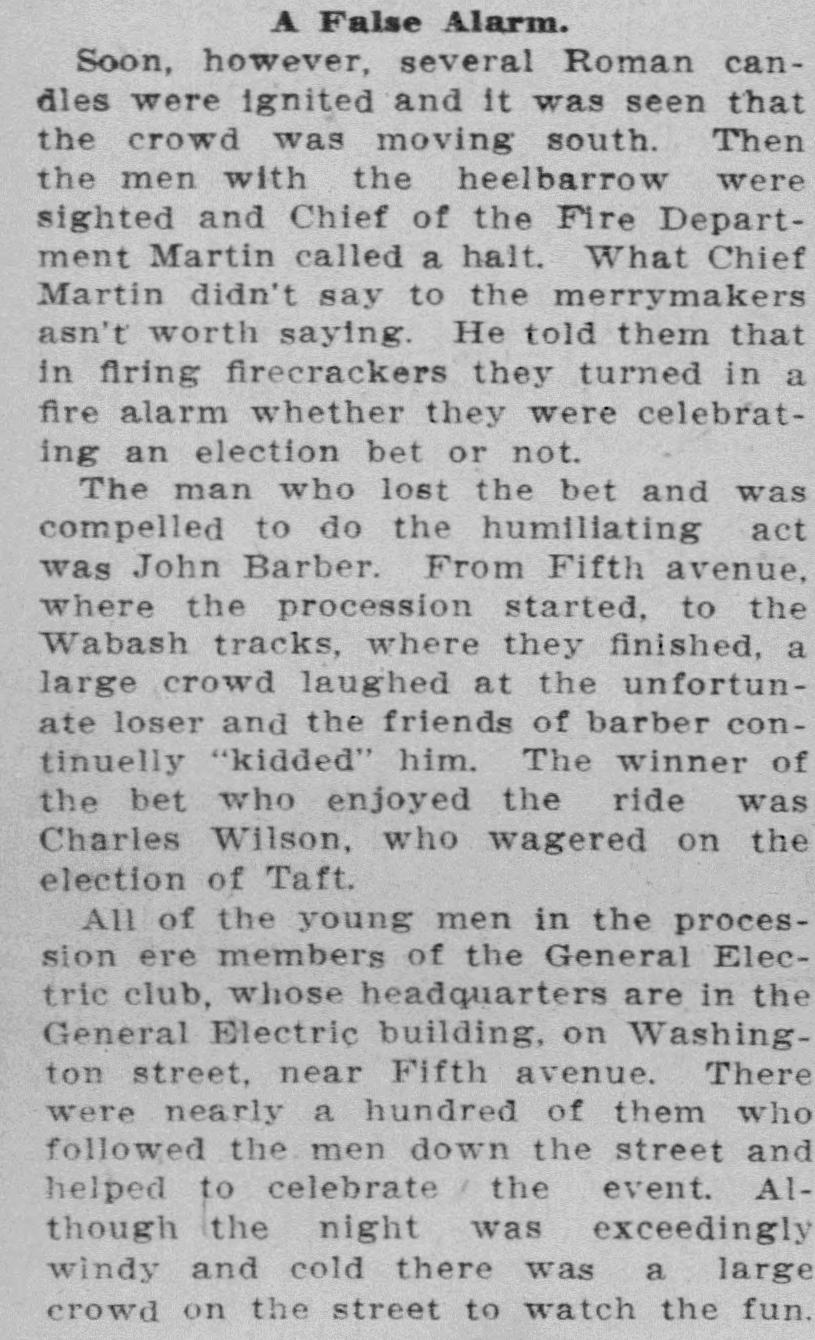
The rest of the story. The Lake County Times, Hammond, Indiana, November 5, 1908, page 8. Library of Congress, Chronicling America. Click the clipping to read it full size.
Gary, Indiana, Hires Its First Fireman
Gary, Indiana, didn’t stay a six-shooter town for long. On November 28, 1908, just over three weeks after the wheelbarrow night, the Lake County Times ran the headline “Gary’s First Fireman Receives Appointment.” William Frazier, who had been helping Chief Martin at the police station, took the job of fireman at Gary’s new fire station, at Thirteenth avenue and Washington street. He was the first regular fireman the town ever hired.
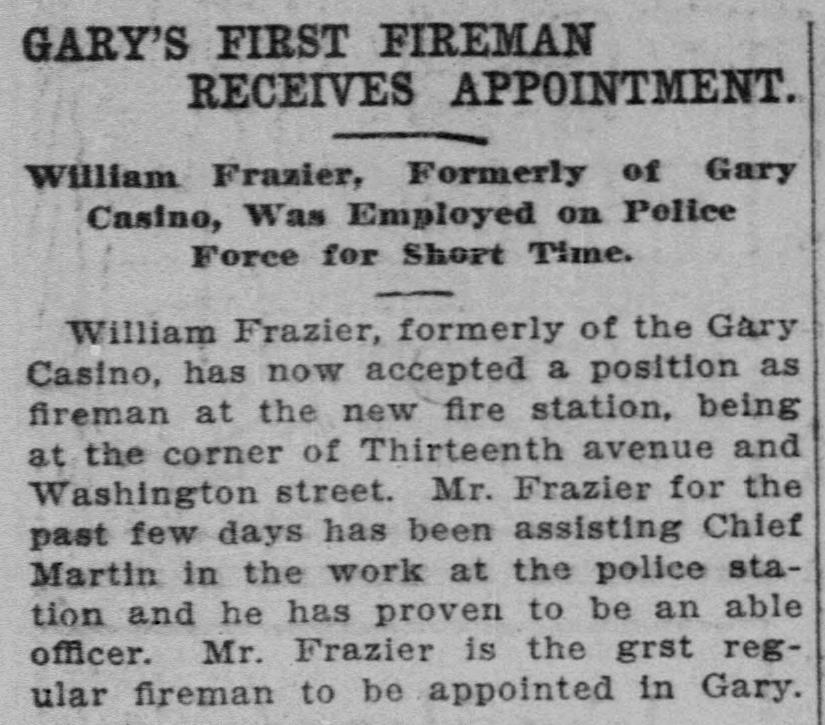
The Lake County Times, Hammond, Indiana, November 28, 1908, page 5. Library of Congress, Chronicling America. Click the clipping to read it full size.
The old alarm came back at least once. Before dawn on June 7, 1909, Officer Mulcahey saw a barn burning on Eighth avenue. He went straight to “the quicker method of giving an alarm,” and the bullets in his trusty “44” were “speeding heavenward.” The Times headline said “Garyites Roused by Gun Shots.” It said Gary had gone back to its “pioneer days,” which, it admitted, were only about a year before.
The new fire chief, whom the paper called Chief Feeley, had just come to town. He was used to fire alarms with “brass gongs.” When the shots woke him, he stuck his head out the window in his nightcap and saw nothing but “the rotund and smiling moon.” He nearly went back to bed, until one of his men, “an old settler,” told him “that shots at night in Gary mean a fire.” In Gary, an old settler could be someone who had lived there all of two years.
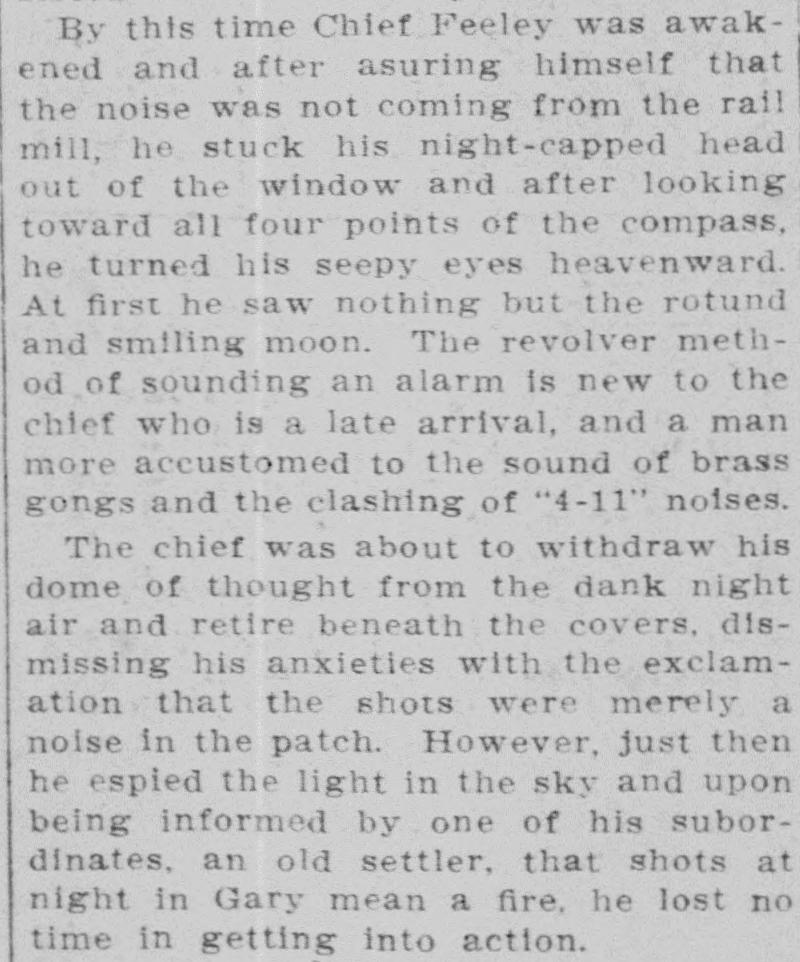
“Garyites Roused by Gun Shots.” The Lake County Times, Hammond, Indiana, June 7, 1909, page 8. Library of Congress, Chronicling America. Click the clipping to read it full size.
The “Best Fire Department in the Country” in Gary, Indiana
By the end of 1910, Gary, Indiana, was a city, and its fire department had 23 paid men. Hose Company No. 1, in City Hall, had an automobile that carried both hose and a chemical tank, plus 1,000 feet of hose. In April 1908 the town had owned “a few feet.” The city’s 1910 report didn’t hold back. In a list of things to brag about, it wrote: “Best fire department in the country.”
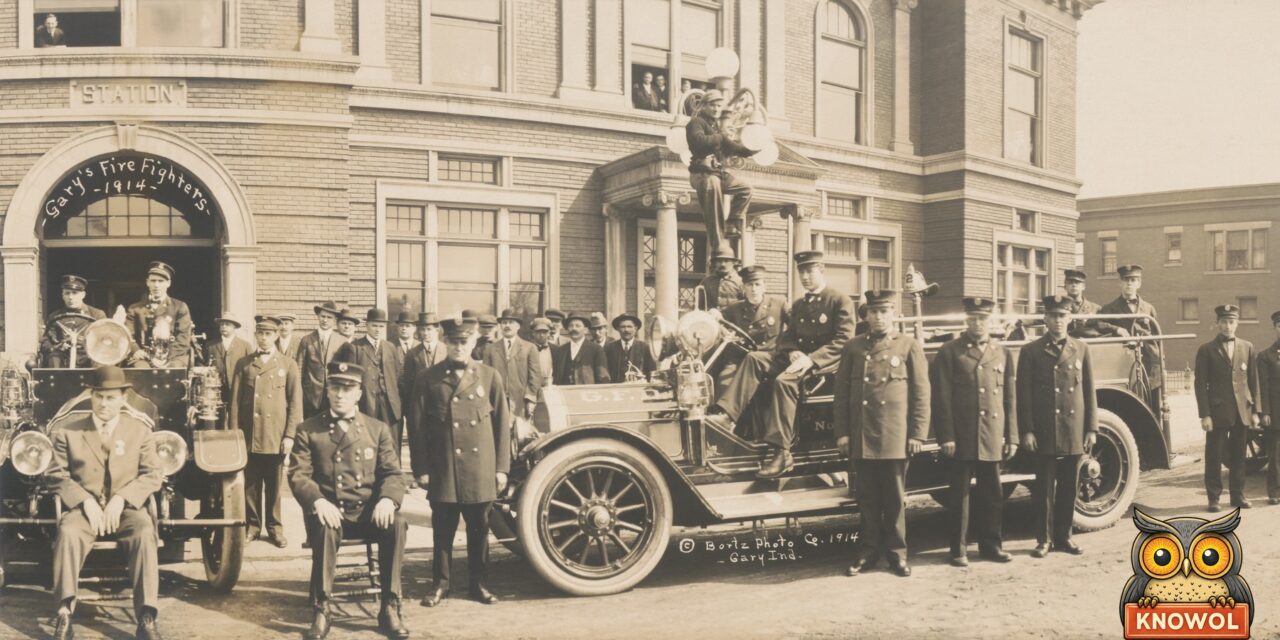
The photo at the top of this page shows “Gary’s Fire Fighters” in 1914, six years after the wheelbarrow night, lined up with their motor fire trucks outside the city’s Central Police Station. Nobody had to fire a six-shooter to call them anymore. But for a little while, Gary was a town so new that it listened for gunshots in the dark, and one lost bet, one wheelbarrow and some firecrackers could send the whole fire department running down Broadway.
Sources
- “Freak Bet Causes False Fire Alarm,” The Lake County Times (Hammond, Indiana), November 5, 1908, page 8. Library of Congress, Chronicling America.
- “Mars Reporter’s Beauty Sleep,” The Lake County Times, October 8, 1908, page 3, reprinting W. H. Blodgett’s Indianapolis News story from Gary, October 7, 1908. Library of Congress, Chronicling America.
- “New Fire Equipment Comes,” The Lake County Times, April 6, 1908, page 6, in the Gary News column. Library of Congress, Chronicling America.
- “Gary’s First Fireman Receives Appointment,” The Lake County Times, November 28, 1908, page 5. Library of Congress, Chronicling America.
- “Garyites Roused by Gun Shots,” The Lake County Times, June 7, 1909, page 8. Library of Congress, Chronicling America.
- “Gary Delegation Busy,” The Richmond Palladium and Sun-Telegram (Richmond, Indiana), November 18, 1908, page 1. Library of Congress, Chronicling America.
- City of Gary, Annual Report of the Heads of Municipal Departments of the City of Gary, Indiana, for the Year Ending December 31, 1910: “Gary at a Glance,” pages 15 and 16, the steel mill and the Gary Land Company, the 1906 and 1908 Broadway photos, and the Report of Gary Fire Department. Lake County Public Library copy, Internet Archive.
- City Directory of Gary, Indiana, 1908-1909, P. L. Fitzgerald and Co.: the General Electric Club boarders, the Brennan block, and Joseph D. Martin, chief of police. Internet Archive.
- Bortz Photo Co., “Gary’s Fire fighters, 1914,” Gary, Indiana (the cover). Library of Congress Prints and Photographs Division, Panoramic Photographs. No known restrictions on publication.
- The newspapers, city report, directory and photographs above were all published or made before 1931 and are in the public domain.