“Knight of Cross Roads, Prepare to charge! Charge, Sir Knight!” Shortly after 10 o’clock on the morning of Monday, October 23, 1905, Sheriff Samuel B. Hardy shouted that command in Boucher’s woodland at Annapolis, Maryland, and the first rider in the Elks’ big tournament galloped off with his lance. That afternoon the Evening Capital’s headline read “Gallant Men Ride To The Call of Chief Marshall Hardy And Ladies Look On.” A few ladies did much more than look on.
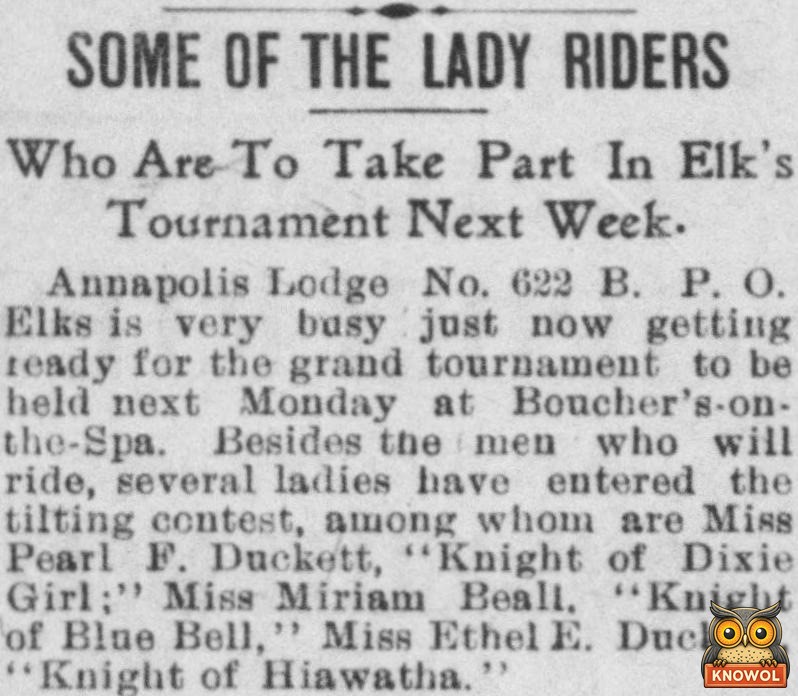
“Some of the Lady Riders Who Are To Take Part In Elk’s Tournament Next Week.” The Evening Capital, Annapolis, Maryland, October 17, 1905, page 1. Library of Congress, Chronicling America. Click the clipping to read it full size.
Charging at rings
A Maryland tournament wasn’t a fight. Each rider, called a knight, took a name like the Knight of Cherry Grove and galloped down a course “marked at its beginning, center and end by beautifully decorated arches, from which hung the rings to be lanced by the knights.” Three runs at three rings made a perfect score of nine. The winner crowned a Queen of Love and Beauty at the ball that night. In 1962, Maryland made jousting its official state sport.
That September, at a tournament in Davidsonville, Maryland’s Secretary of State, Col. Oswald Tilghman, gave the speech that sent the knights off. Winfield Murray, the Knight of Odenton, won both the professional and the amateur class. Tilghman “advised this gallant tilter to crown twins and avoid trouble in the family.”
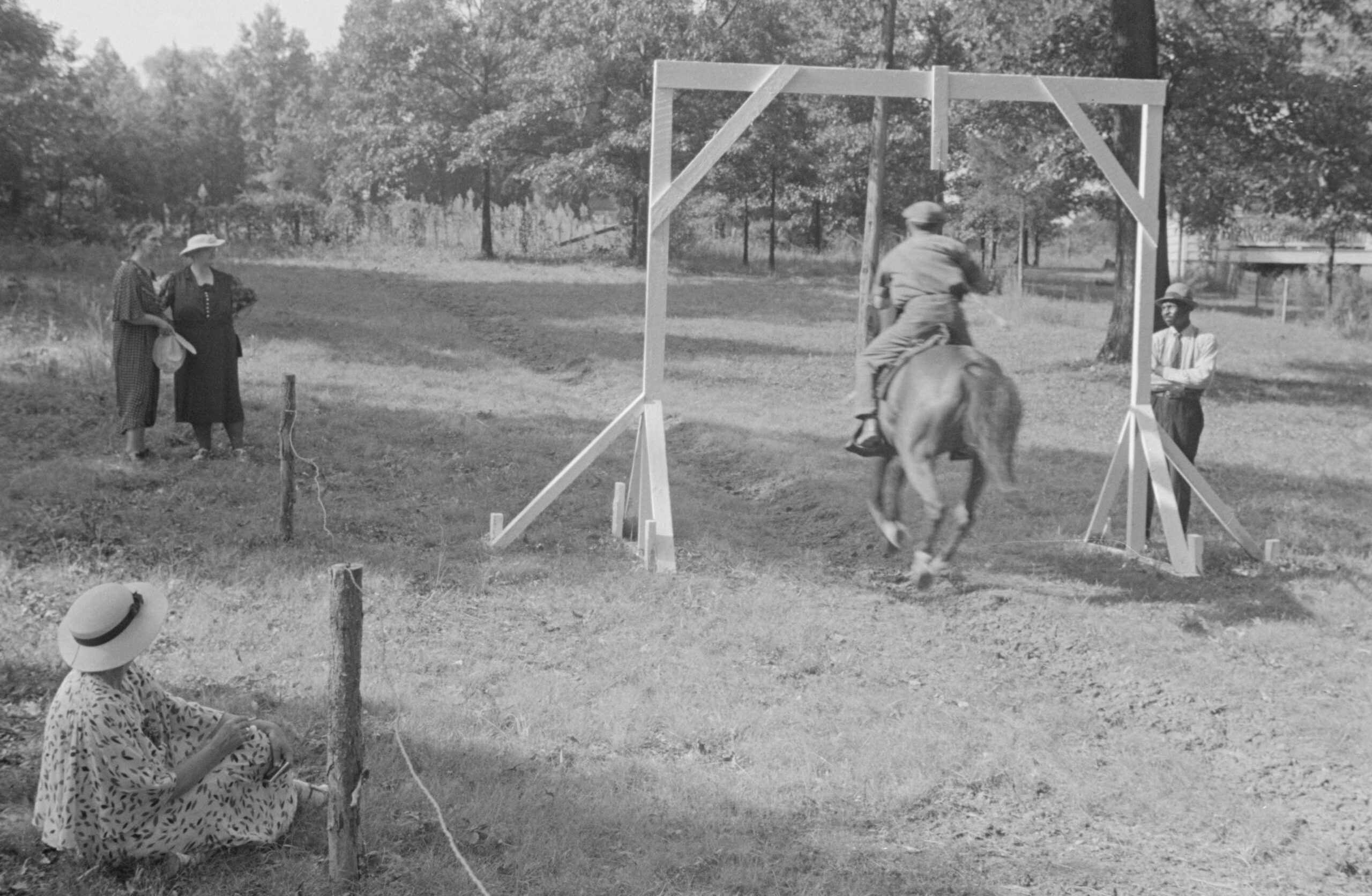
A rider gallops at the ring hanging from an arch at a tournament in Accokeek, Maryland, in the summer of 1937, 32 years after the Annapolis tournament. Photograph by Ben Shahn. Library of Congress, Prints & Photographs Division, Farm Security Administration/Office of War Information Black-and-White Negatives. Click the picture to see it full size.
The ladies of Davidsonville
The Davidsonville tournament, a Modern Woodmen fundraiser for a lodge hall, promised something extra. The Evening Capital said “in the afternoon the ladies will ride,” and the ad billed “Tournament and Lady Riders after Dinner.” The paper’s report of the day listed the men’s winners but never said how the ladies did.
A few weeks later the Annapolis Elks, Lodge No. 622, planned their own tournament at Boucher’s-on-the-Spa. “A number of ladies from Davidsonville have consented to enter the contest,” the paper reported, and the Elks’ ad billed them as a special feature. On October 17 the paper named three: Miss Pearl F. Duckett, “Knight of Dixie Girl”; Miss Miriam Beall, “Knight of Blue Bell”; and Miss Ethel E. Duckett, “Knight of Hiawatha.” The top three professional men would win $15, $10 and $5 in cash. The prizes for the ladies would be “a riding whip, riding bridle and riding hat.”
Three days before the tournament, the paper picked its stars. “The interest centers in the lady riders, many of whom are said to be experts in the saddle.”
Tournament day
On the big morning, county knights rode into Annapolis on the shell road. The arches were hung with bunting in the colors of the Star-Spangled Banner and “the yellow and black of the Maryland flag,” and part of the Naval Academy band played. Charles E. Myers, the Knight of Cherry Grove, rode three times “without missing a single ring.” He was the only rider in his class to make a straight score. The Elks, the paper added, were the fraternity “whose hail is ‘Hello, Bill.'”
The ladies’ class came in the afternoon. The Evening Capital called it “the greatest attraction of the day’s sport,” even though only three women rode in it.
Hiawatha takes the rings
The next day’s paper gave the results. “Miss Ethel E. Duckett, Lady of Hiawatha, was first among the lady riders, with three rings out of the nine.” Miss Mary Stallings, the Lady of Navajo, matched her but “was defeated in the ride-off,” and Pearl Duckett, the Lady of Dixie Girl, took two. A week earlier the paper had called the women knights. Now it called them ladies.
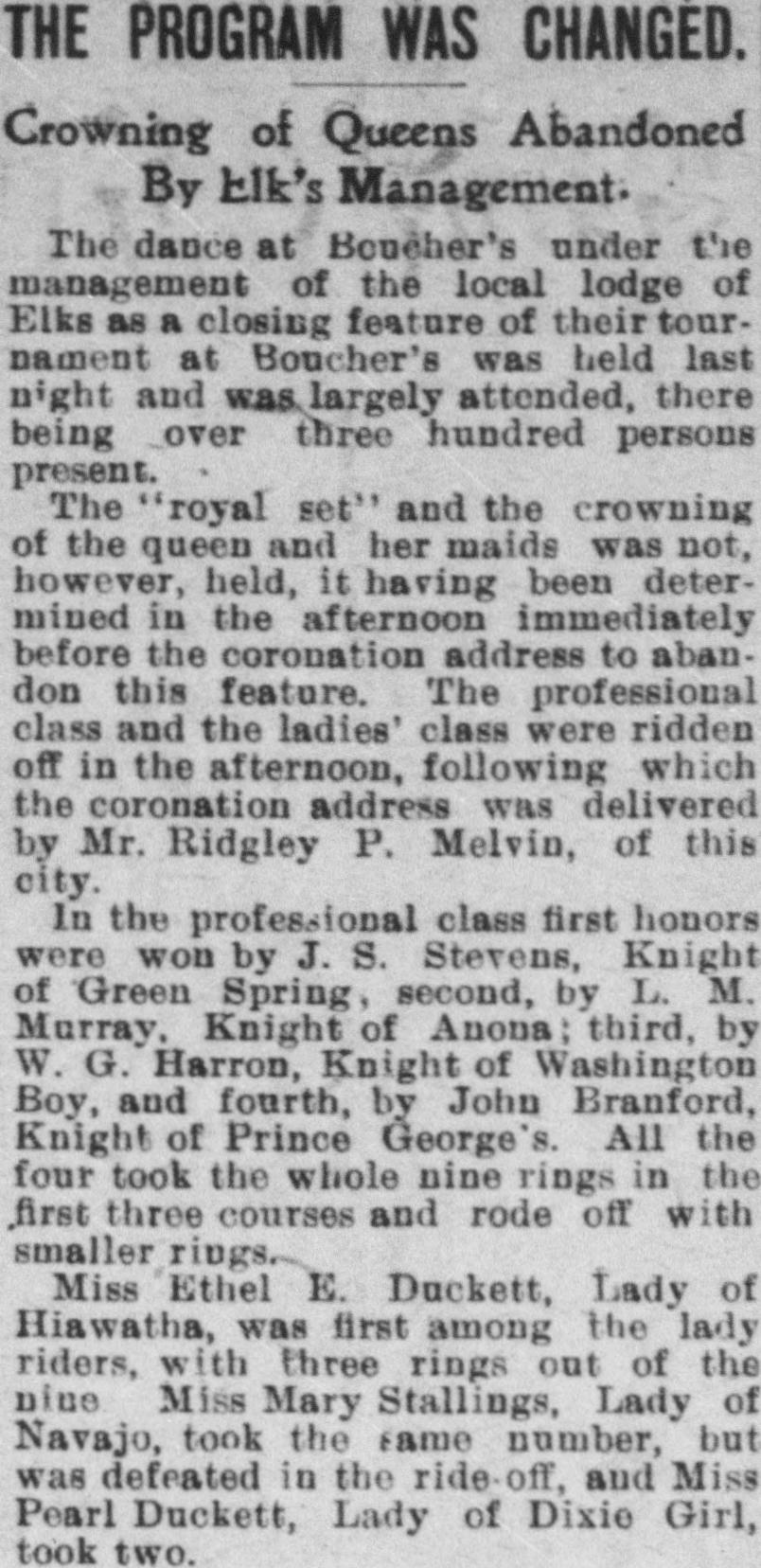
“The Program Was Changed.” The Evening Capital, Annapolis, October 24, 1905, page 4. Library of Congress, Chronicling America. Click the clipping to read it full size.
There was one surprise. The crowning of the queens was dropped, decided that afternoon just before the coronation speech, and the paper never said why. The dance at Boucher’s went on anyway, with more than 300 people there.
A quarter to get in
A tournament was cheap fun. Admission to the Elks’ tournament was 25 cents, with dancing extra. Davidsonville’s tournament also cost a quarter to get in. Its ad promised a big country dinner with “Oysters, Cake and Fancy Tables, Ice Cream and Confectionery,” a baseball game (it ran until dark) and a “Fortune Wheel, Clown and Other Attractions.”
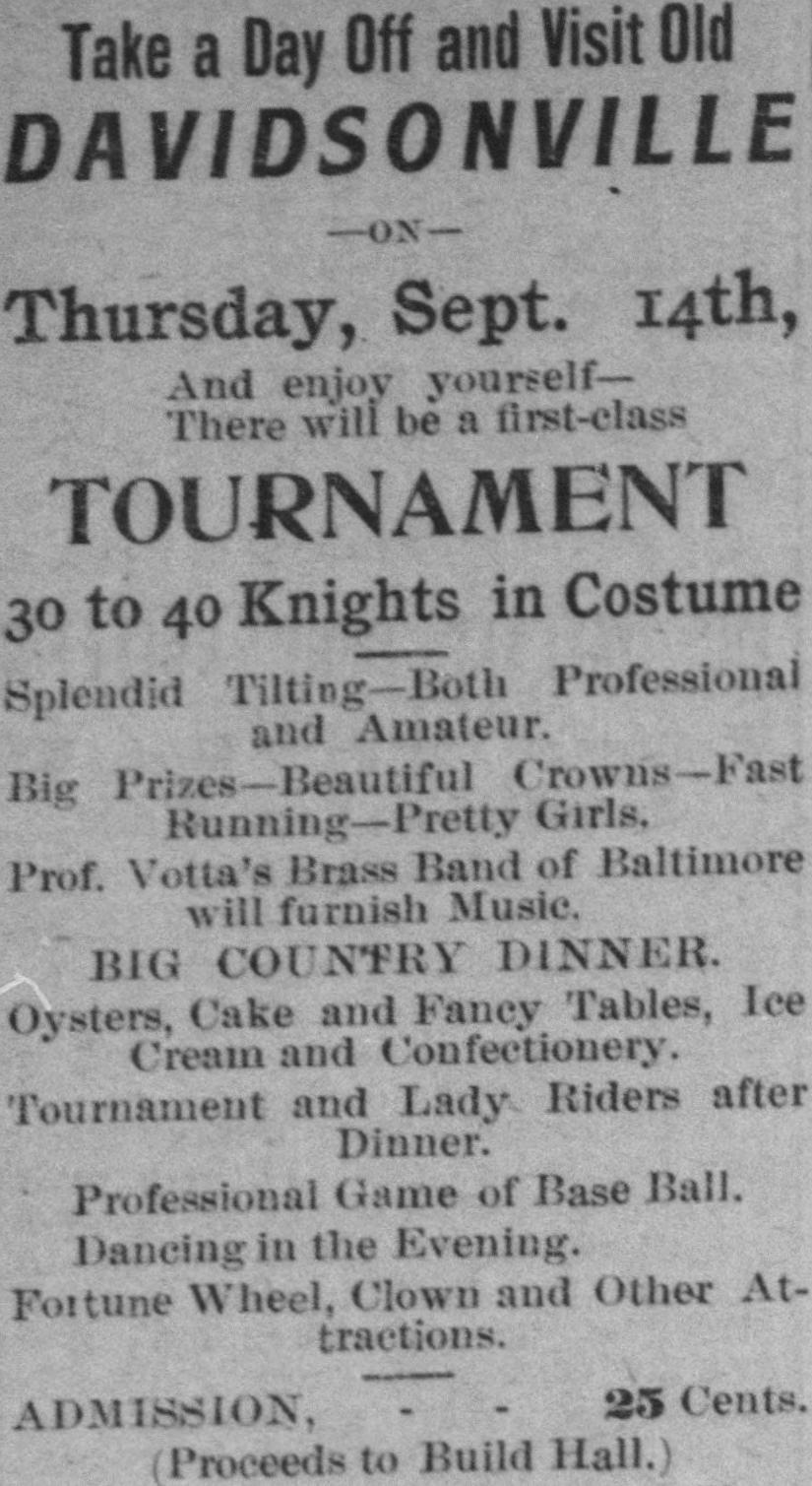
“Take a Day Off and Visit Old Davidsonville.” The Davidsonville tournament advertisement, the Evening Capital, Annapolis, September 7, 1905, page 4. Library of Congress, Chronicling America. Click the clipping to read it full size.
In town, a new Grand Union Tea Company stand at the City Market House sold fresh country eggs for 25 cents a dozen, Elgin creamery butter for 25 cents a pound and sugar for 5½ cents a pound. One of the men who ran the Elks’ tournament, W. A. Hollebaugh, managed the Colonial Theatre, where Biograph moving pictures cost 10, 20 or 30 cents a seat.
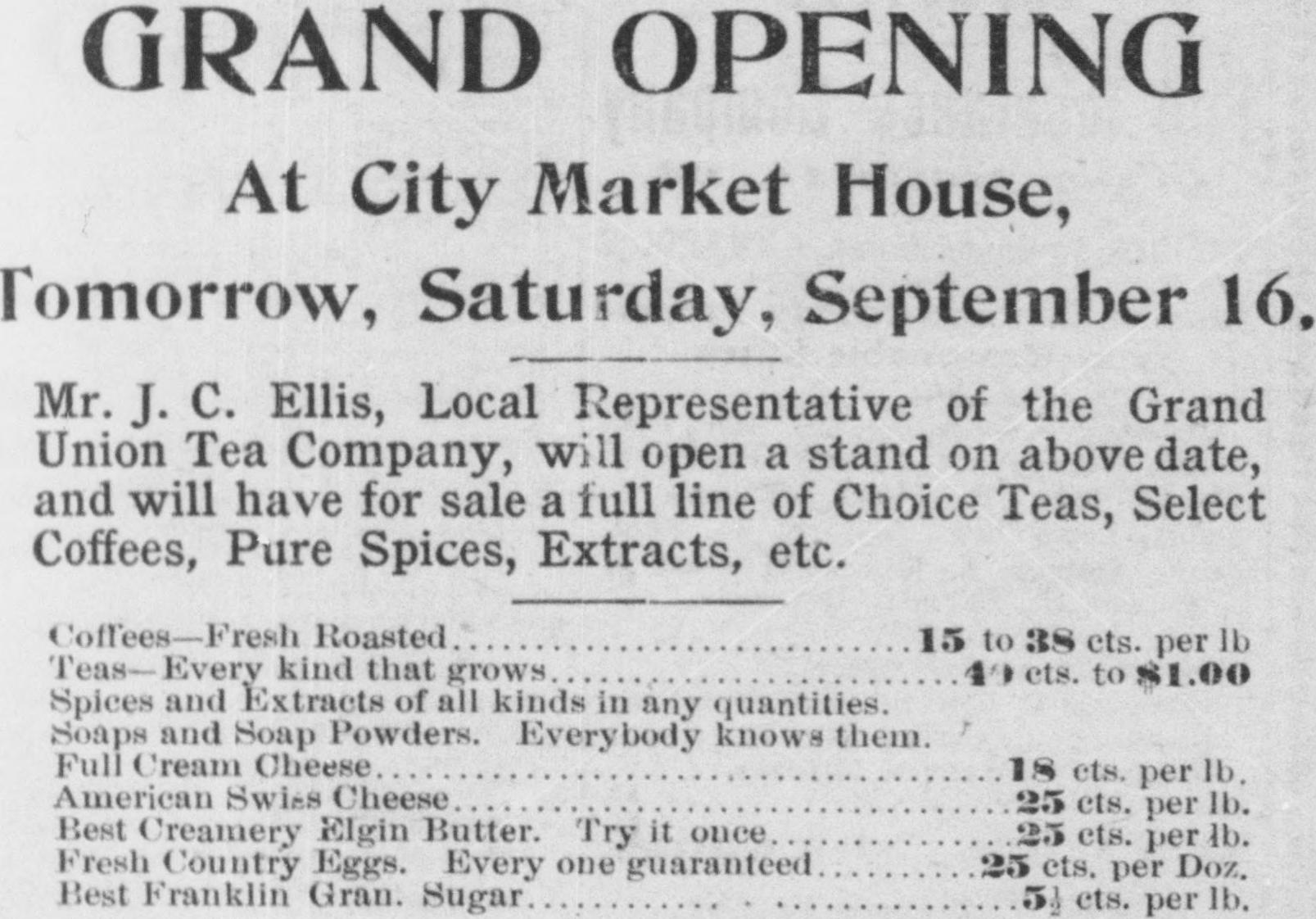
The Grand Union Tea Company’s opening at the City Market House. The Evening Capital, Annapolis, September 15, 1905, page 1. Library of Congress, Chronicling America. Click the picture to see it full size.
Three rings out of nine
The Evening Capital called the Elks’ day “an unusual success for Annapolis.” It never said which prize Ethel Duckett carried home, the whip, the bridle or the hat. But it printed her name first. On one October afternoon in 1905, the top rider in the ladies’ class at Annapolis was Miss Ethel E. Duckett, the Knight of Hiawatha.
Sources
- The Evening Capital (Annapolis, Md.), September 7, 1905, page 1 (“Tournament At Davidsonville”: “in the afternoon the ladies will ride”) and page 4 (“Take a Day Off and Visit Old Davidsonville” advertisement; the same ad ran September 11 and 12).
- The Evening Capital, September 15, 1905, page 1 (“Tournament Was a Success for Woodmen”; Grand Union Tea Company opening at the City Market House).
- The Evening Capital, October 10, 1905, page 4 (“The Elks Tournament”; “A Grand Tournament” advertisement; Colonial Theatre advertisement).
- The Evening Capital, October 17, 1905, page 1 (“Some of the Lady Riders Who Are To Take Part In Elk’s Tournament Next Week”).
- The Evening Capital, October 20, 1905, page 1 (“The Elks Tournament”: “The interest centers in the lady riders”).
- The Evening Capital, October 23, 1905, page 1 (“Big Elks Doing Themselves Proud at Boucher’s”).
- The Evening Capital, October 24, 1905, page 4 (“The Program Was Changed”).
- Newspaper images from the Library of Congress, Chronicling America. Published 1905, public domain.
- Jousting as Maryland’s state sport since 1962: Maryland Manual, Maryland State Archives.
- Photograph: “Accokeek, Maryland. A modern version of an old medieval jousting tournament game: picking off a ring on a lance while riding by on horseback at full speed.” Ben Shahn, summer 1937. Library of Congress, Farm Security Administration/Office of War Information Black-and-White Negatives, public domain.
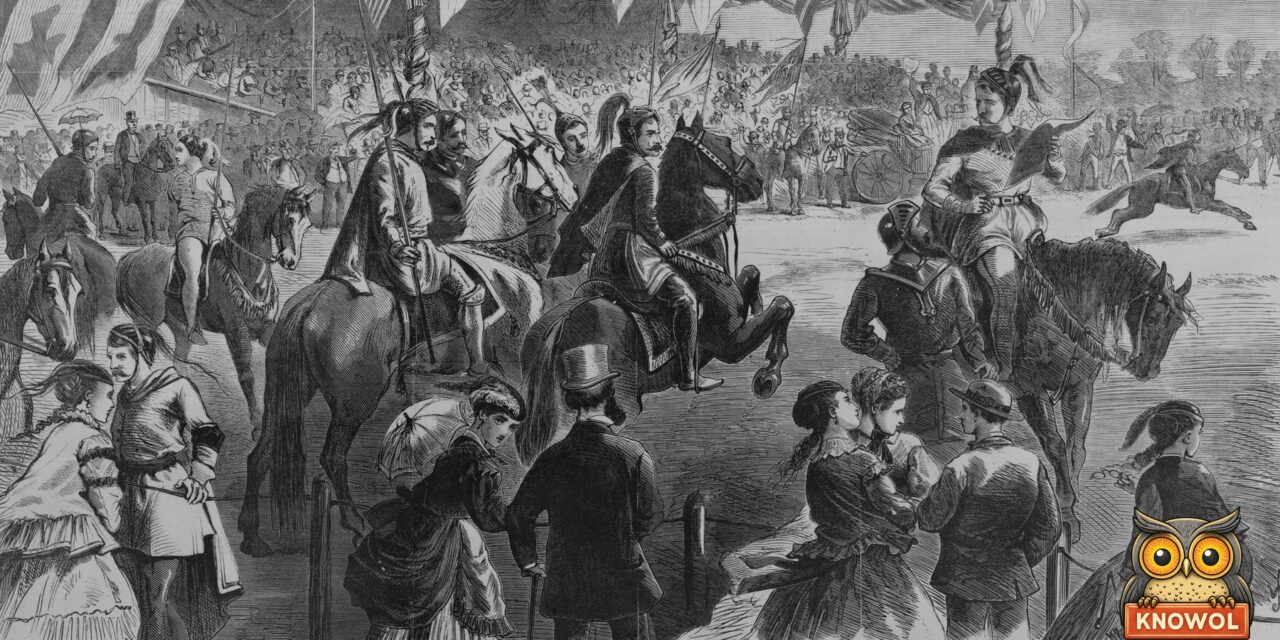
- Cover: “A modern tournament,” drawn by W. S. L. Jewett, wood engraving, Harper’s Weekly, December 4, 1869 (cropped). Library of Congress Prints and Photographs Division, 2002695555. No known restrictions on publication.