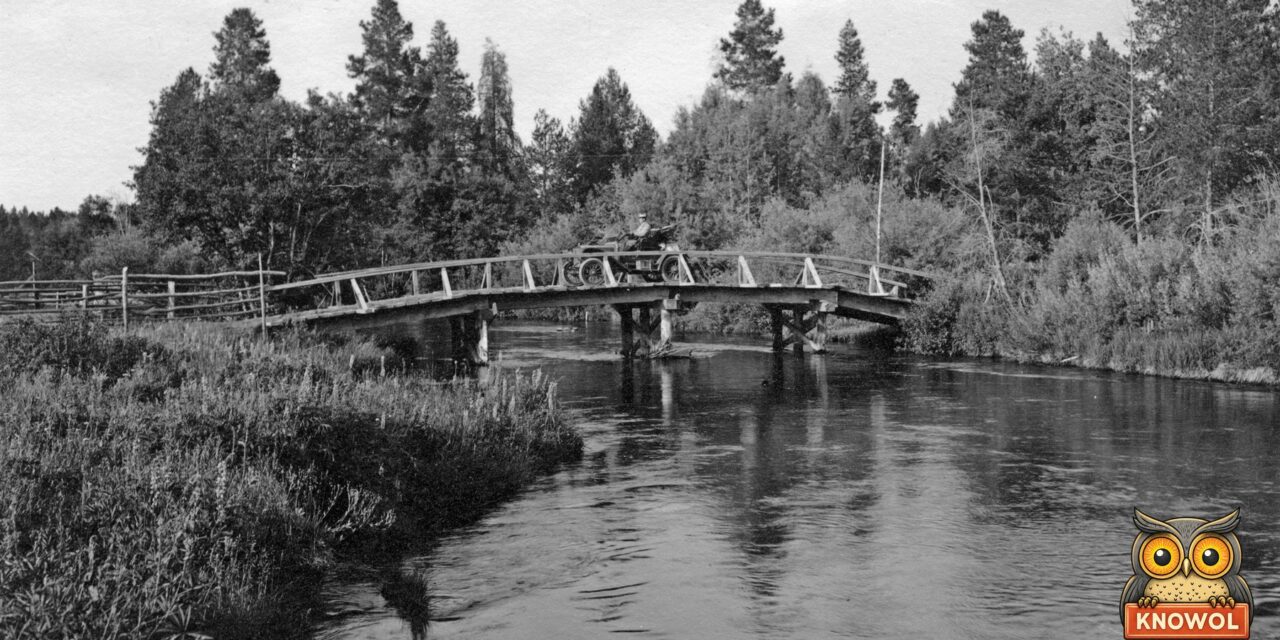
On Sunday morning, April 16, 1911, a cowboy and a cowgirl rode down the main street of Fort Klamath, Oregon, and stopped their horses in front of an office. They never got down. Justice of the Peace C. C. Jackson married them right there, both still sitting on their cow ponies. The East Oregonian called it “one of the most novel weddings ever solemnized in this part of the country.”
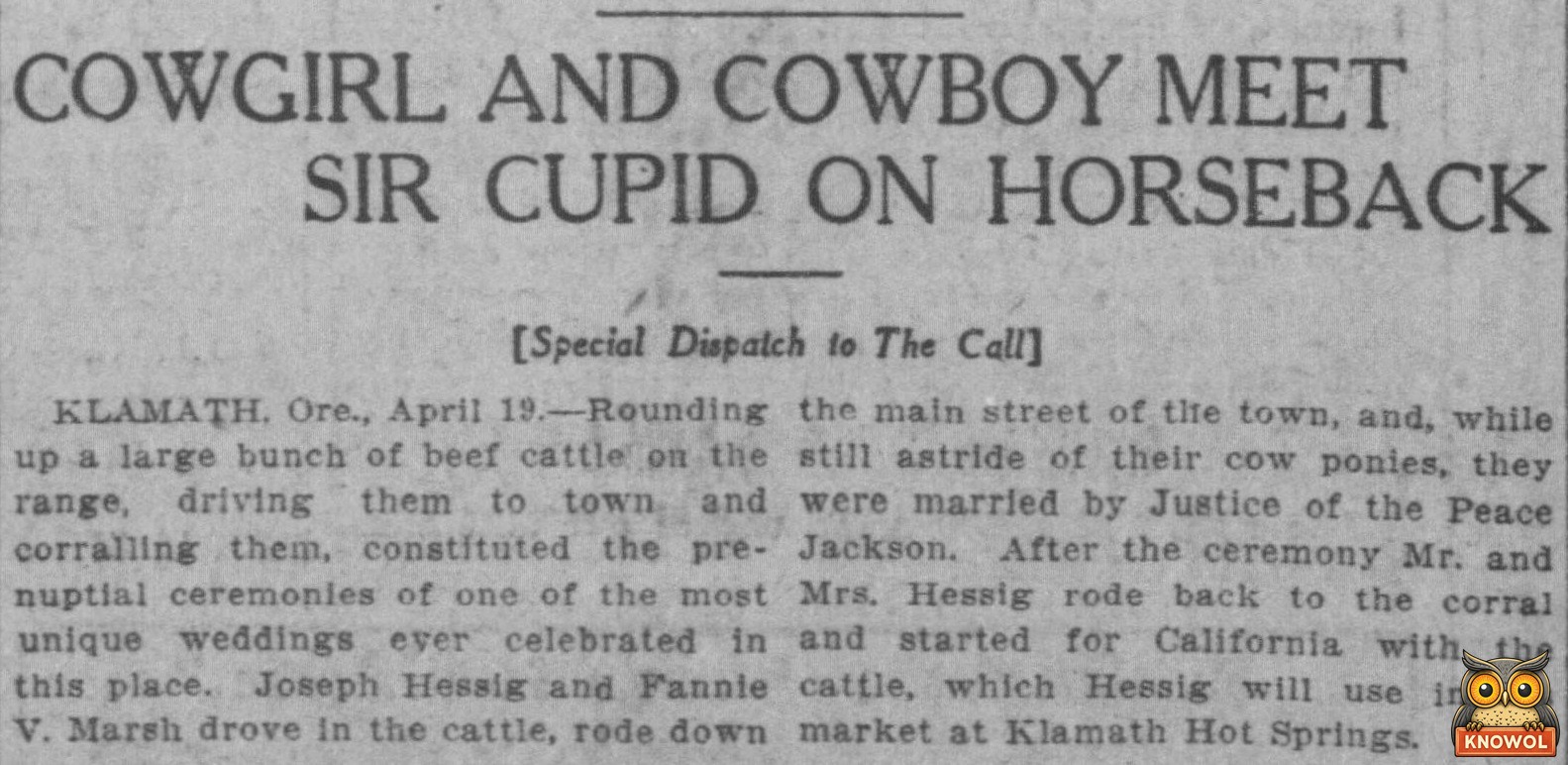
“Cowgirl and Cowboy Meet Sir Cupid on Horseback,” the San Francisco Call, San Francisco, California, April 20, 1911, page 1. Library of Congress, Chronicling America. Click the clipping to read it full size.
Beef cattle first
The groom was Joseph Hessig, and the bride was Fannie V. Marsh. They lived at Klamath Hot Springs, down the Klamath River just across the line in California, where Joseph ran a meat shop. He came up to the Wood River Valley around Fort Klamath often to buy beef cattle. Fannie was “an experienced horsewoman,” and this time she rode along.
On the way they stopped in Klamath Falls and got a permit to marry. On Saturday they gathered up a bunch of beef cattle through the valley and drove them into a corral. Then on Sunday morning they rode up in front of the place of Joseph’s brother, John Hessig, and said their vows from the saddle.
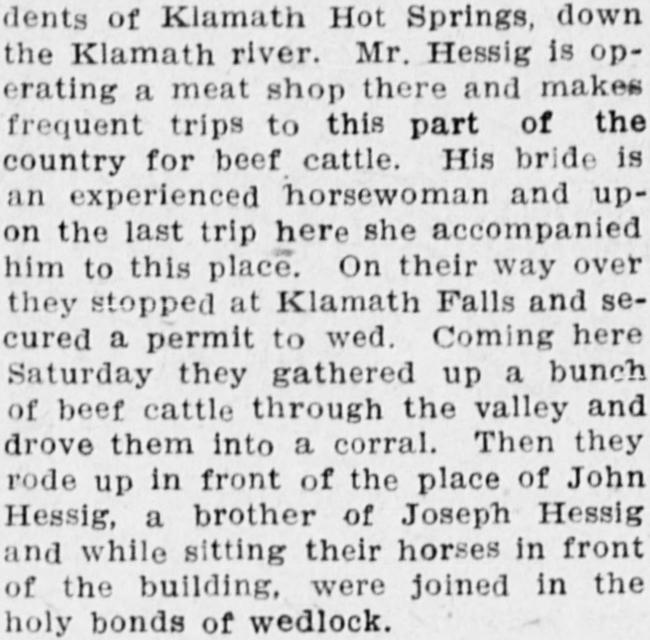
The East Oregonian, Pendleton, Oregon, April 20, 1911, page 9. Library of Congress, Chronicling America. Click the clipping to read it full size.
Straight back to work
None of the papers mention a party. As soon as Justice Jackson finished, the newlyweds “turned their horses’ heads toward the corral.” They drove the cattle out onto the road and started on the long ride home to Klamath Hot Springs, where they planned to live on the Hessig homestead. The San Francisco Call put it simply: they “started for California with the cattle,” which Joseph would sell in his market.
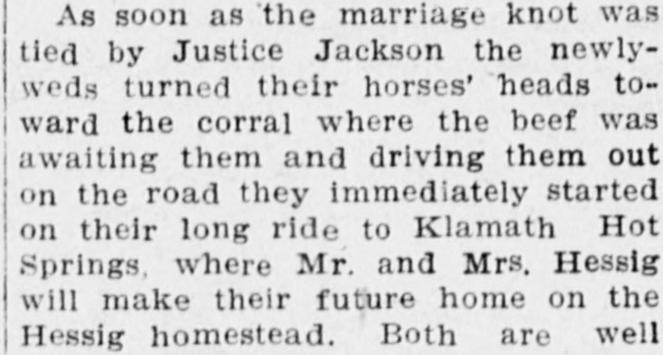
The East Oregonian, April 20, 1911, page 9. Library of Congress, Chronicling America. Click the clipping to read it full size.
The wire got it a little wrong
The United Press sent the story to papers up the coast, and somewhere along the line it grew. The Tacoma Times said the groom was “president of the Klamath Telephone & Telegraph company” and a big stock man, and that the couple were “spending their honeymoon today rounding up cattle” on one of his ranches.
The telephone man in the family was really the brother. John Hessig had been the telephone company’s secretary and general manager since 1904, and he was the one whose office the couple stopped in front of.
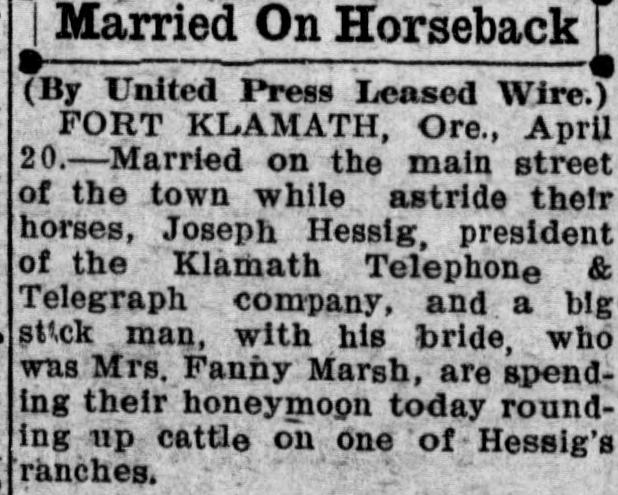
“Married on Horseback,” the Tacoma Times, Tacoma, Washington, April 20, 1911, page 1. Library of Congress, Chronicling America. Click the clipping to read it full size.
Six horses or a Locomobile
The Hessigs went home the old way, at the speed of a herd of cattle. That same spring, travel to Klamath Hot Springs was changing fast. For as long as anyone could remember, a six-horse stage had run every day over the 22 miles from the Southern Pacific station at Ager to the springs, where Shovel Creek runs into the Klamath River. The ride took four and a half hours.
In May 1911, the San Francisco Call reported that a big Locomobile, carrying seven passengers and a chauffeur, had taken the stage’s place and cut the trip to an hour and a half. A fisherman could now get there by midafternoon and “line his creel with trout before the dinner bell.”
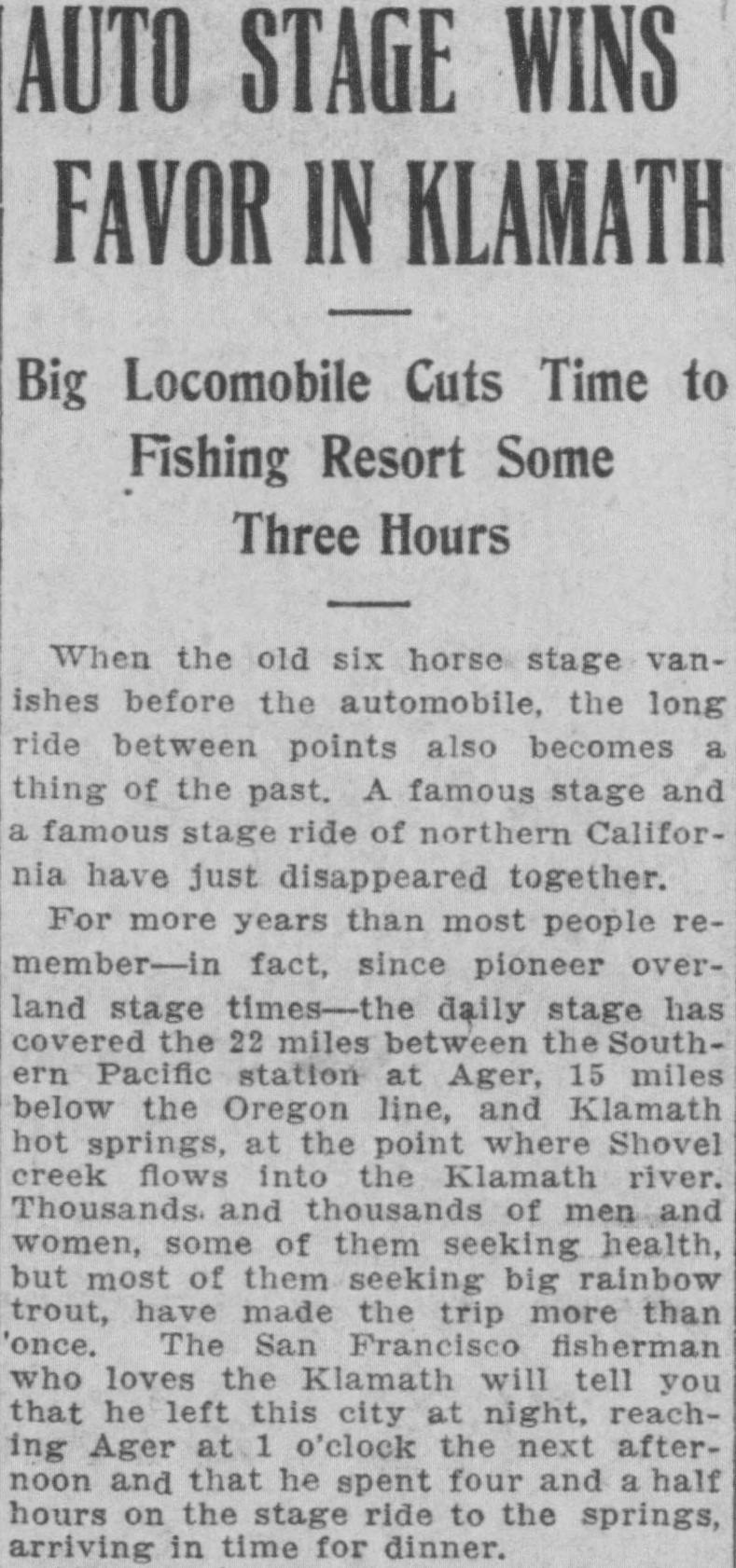
“Auto Stage Wins Favor in Klamath,” the San Francisco Call, May 14, 1911. Library of Congress, Chronicling America. Click the clipping to read it full size.
A new justice for Wood River
The wedding had one more turn in it. By January 1912, Justice Jackson had moved out of Klamath County, and a large number of Fort Klamath people signed a petition for his replacement. The county court appointed John Hessig, the same man whose office had stood behind the horseback wedding. The Evening Herald in Klamath Falls caught him in town that day “gathering a few law points from County Attorney Manning for use in his new office.”
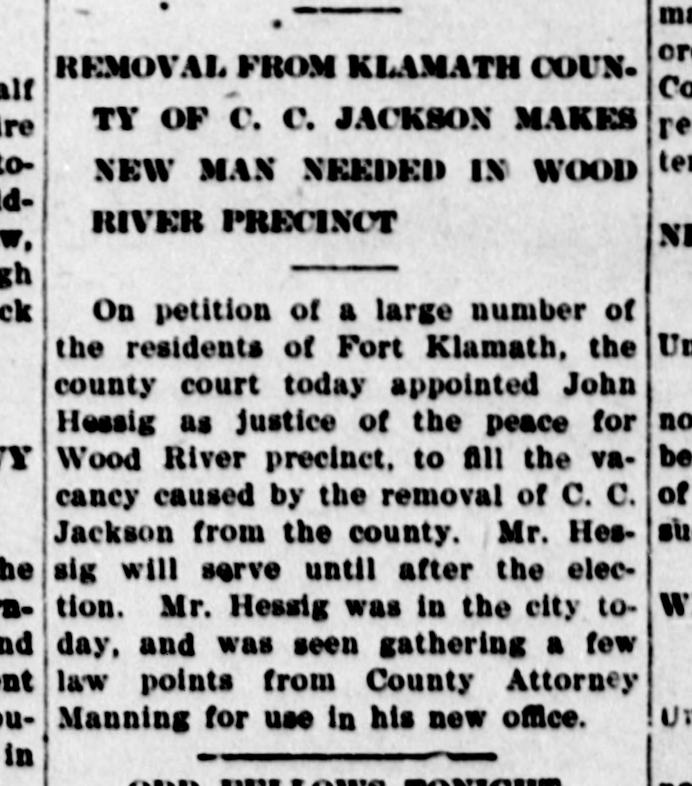
The Evening Herald, Klamath Falls, Oregon, January 12, 1912, page 1. Library of Congress, Chronicling America. Click the clipping to read it full size.
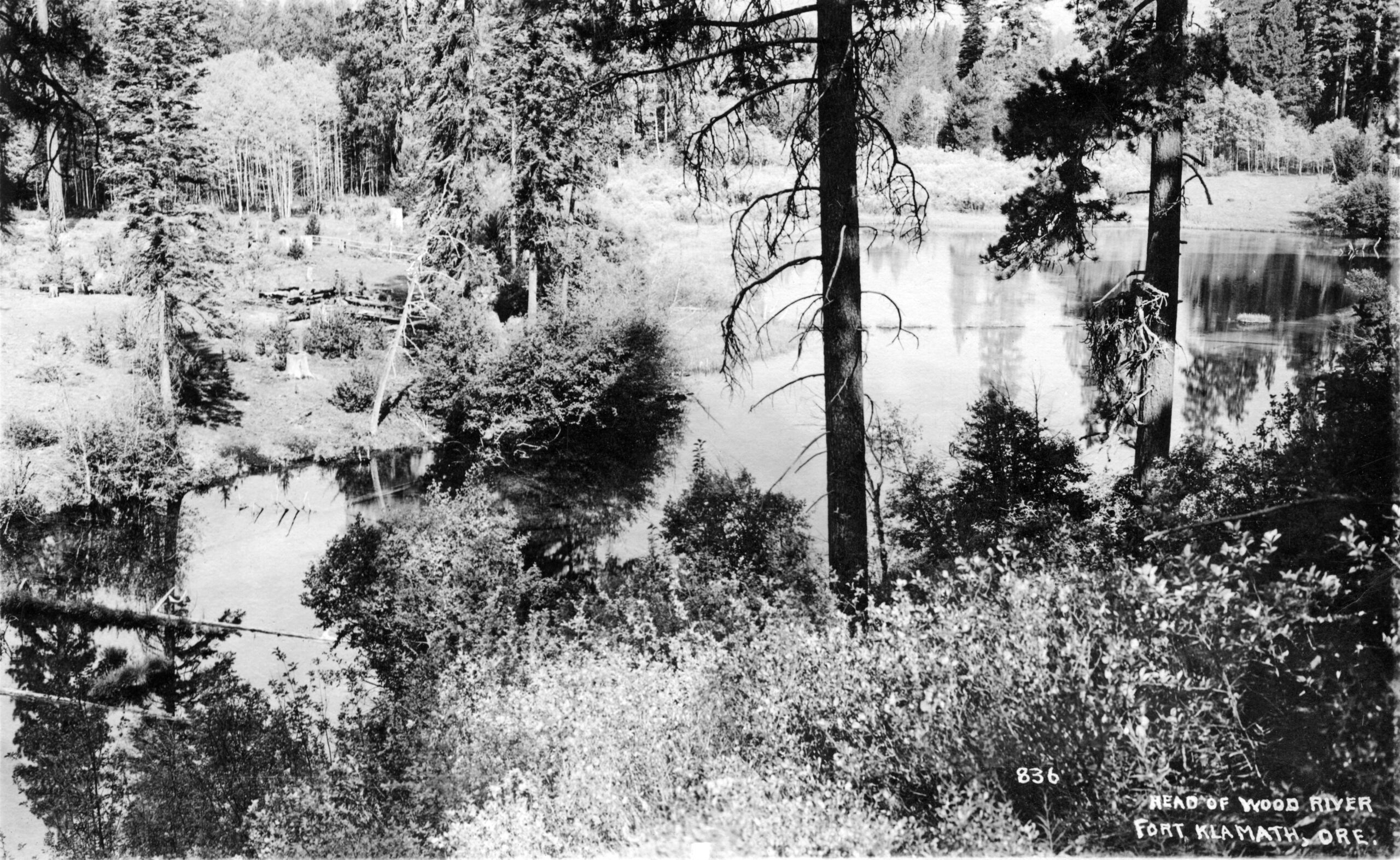
The head of the Wood River at Fort Klamath, Oregon, in the valley where Joseph and Fannie gathered their cattle, on an early real photo postcard. Gerald W. Williams Collection, Oregon State University Special Collections and Archives. Click the picture to see it full size.
Sources
- The East Oregonian (Pendleton, Ore.), April 20, 1911, page 9 (“Couple Are Married on Their Horses”).
- The San Francisco Call (San Francisco, Calif.), April 20, 1911, page 1 (“Cowgirl and Cowboy Meet Sir Cupid on Horseback”) and May 14, 1911, page 36 (“Auto Stage Wins Favor in Klamath”).
- The Tacoma Times (Tacoma, Wash.), April 20, 1911, page 1 (“Married on Horseback”).
- The Evening Herald (Klamath Falls, Ore.), January 12, 1912, page 1 (John Hessig appointed justice of the peace) and March 14, 1913, page 2 (“Back From Yreka”).
- Joseph Gaston, The Centennial History of Oregon, 1811-1912, volume 4 (Chicago, 1912), page 464 (J. H. Hessig).
- All newspaper images: Library of Congress, Chronicling America. No known copyright restrictions.
- Photograph: “Head of Wood River, Fort Klamath, Ore.,” real photo postcard No. 836, Gerald W. Williams Collection, Oregon State University Special Collections and Archives, via Wikimedia Commons. No known copyright restrictions.
- Cover: “Wood River bridge, Fort Klamath, Oregon,” real photo postcard No. 826 (cropped), Gerald W. Williams Collection, Oregon State University Special Collections and Archives, via Wikimedia Commons. No known copyright restrictions.