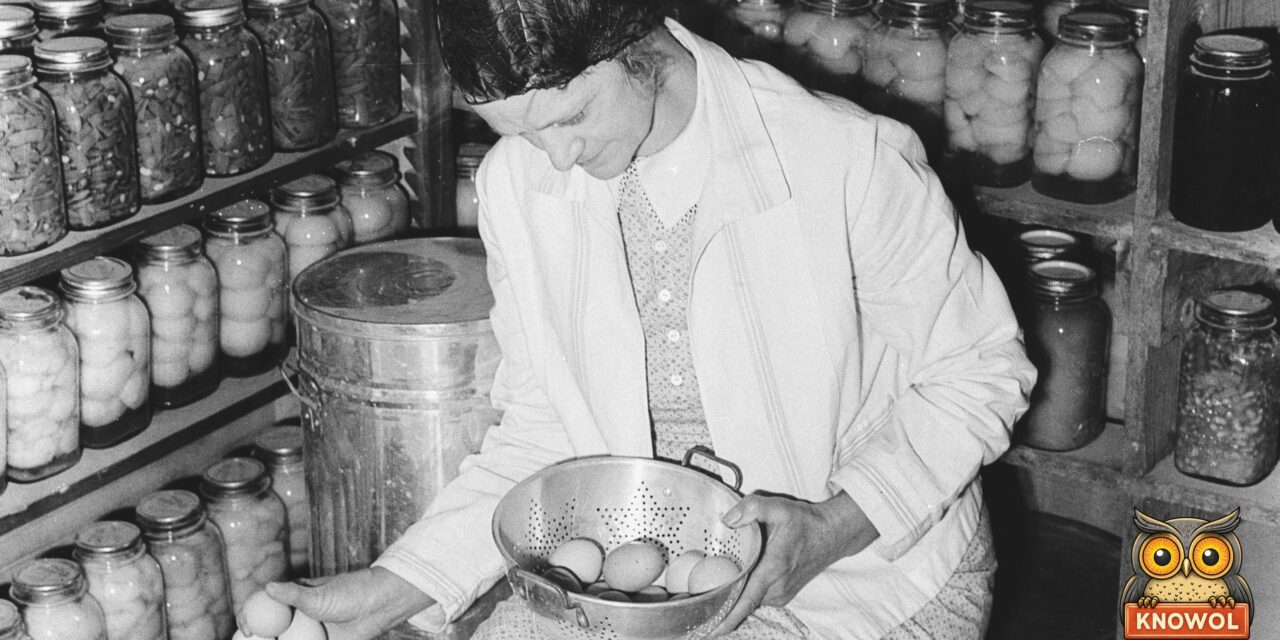
A woman sits in a small storeroom, surrounded by glass jars from the floor to the ceiling. She has a hair net on and a metal colander full of eggs in her lap. With her other hand she holds three more eggs down low, near a wooden crate. It’s 1941, on a farm in Donley County, Texas, in the Panhandle, where the county seat is Clarendon, Texas. The government photographer who took the picture wrote a caption card for it, and the last line of that card is the one that makes you look twice: “Note that Mrs. Gill’s attractive jacket is made from a sugar sack.”
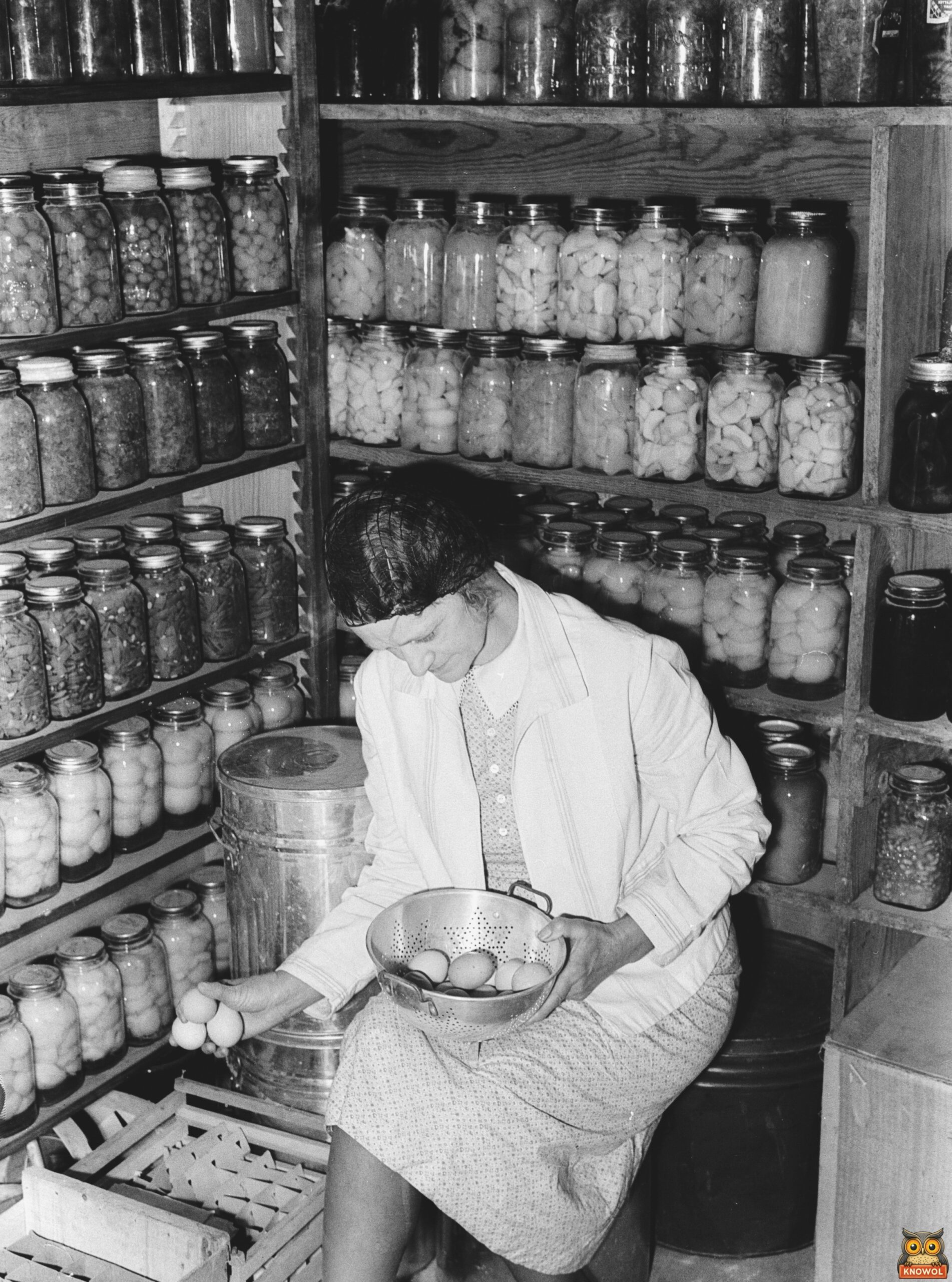
“Mrs. Richard R. Gill, Donley County, Texas, prepares eggs for the market. The large containers are filled with homemade lard for this work grant family. Note that Mrs. Gill’s attractive jacket is made from a sugar sack.” Photo by Wilkinson, 1941. Library of Congress, Prints and Photographs Division, FSA/OWI Collection. No known restrictions. Click the picture to see it full size.
What the Card Says About Mrs. Gill of Donley County, Texas
Here is the whole caption card, word for word: “Mrs. Richard R. Gill, Donley County, Texas, prepares eggs for the market. The large containers are filled with homemade lard for this work grant family. Note that Mrs. Gill’s attractive jacket is made from a sugar sack.”
That’s three sentences, and every one of them points at something in the picture. The eggs in her colander were going to be sold, not eaten. The big metal can beside her, and probably the dark drum behind her too, were full of lard. And the clean white jacket with the thin stripes was a sack that sugar once came in.
The card gives her only as Mrs. Richard R. Gill, the way married women were often named back then. It doesn’t give her first name, and it doesn’t say which town she lived nearest.
The Jars, the Eggs and the Lard in Donley County, Texas
Look around Mrs. Gill in the Donley County storeroom and you can count more than 70 jars without trying. Some hold pale fruit halves. Some hold green beans. Some hold what look like whole small potatoes or onions. That’s a family’s summer garden, put up in glass so it would last through the winter.
The lard was a farm family’s cooking fat. When a family butchered a hog, they cut up the fat and cooked it slowly in a big kettle until it melted. Then they strained it and let it cool into soft white lard, good for frying and for pie crusts for months. Homemade lard means the Gills most likely raised and butchered their own hogs.
And the eggs were money. Down at her feet sits what looks like an egg crate, a wooden box with cardboard dividers inside to keep eggs from knocking together on the way to town. On a lot of farms, eggs from the family’s own hens were sold or traded at the store for things a farm couldn’t grow, like coffee, sugar and cloth. The card says she was getting them ready “for the market.”
What a Work Grant Family Was
The card calls the Gills a “work grant family.” That’s a Farm Security Administration term. The FSA was a government office set up in 1937 to help farm families hit hard by the Great Depression.
Donley County had been hit hard. The Texas State Historical Association’s Handbook of Texas says many of the county’s farmers lost a great deal in the Depression, and a long drought in the early 1930s made it worse. In 1930 the county had 10,262 people and 1,364 farms. By 1940 it was down to 7,487 people and 877 farms. Nearly 500 farms were gone in ten years.
The FSA mostly made loans. But for families in real trouble it also made grants, money that didn’t have to be paid back. A 1941 handbook for FSA workers, called Toward Farm Security, explains the deal: “In those cases where the family can do some useful work in return for a grant, they are requested to do it, even if the work is done on their own farm and toward their own future rehabilitation.” Rehabilitation, in FSA talk, meant getting a family back on its feet. The handbook warns its workers that the grant “is not ‘free’ money.”
So a work grant family got help, and worked for it, often by fixing up its own place. The card doesn’t say what work the Gills did.
The Garden, the Cow, the Sow and the Chicken
The FSA had a plan for families like the Gills, and you can see it on those shelves. The same 1941 handbook puts it in one line: “The rehabilitation of our families depends greatly on the garden, the cow, the sow, and the chicken.”
FSA workers sat down with the husband and wife and figured out how much food the family needed for a year, and how much of it they could grow at home. Then they came back to help, down to when to plant and “how to can them properly.”
The handbook says it worked. Among FSA families, the canned fruit and vegetables rose from an average of 51 quarts per family to 242. The average family’s yearly income went from $480 before they joined to $650 in 1940. The garden filled the jars, the sow filled the lard cans, and the chickens laid the eggs Mrs. Gill was taking to market.
Why a Sugar Sack Made a Good Jacket in Texas
Now, the jacket. In the 1930s and 1940s, sugar, flour and animal feed often came in big sacks made of cotton cloth. Once the sack was empty, the cloth was still good. Farm women washed the sacks, picked out the seams and sewed them into dresses, aprons, shirts, curtains, dish towels and quilts.
The mills noticed. Many began printing their sacks in flowers, checks and bright patterns to win customers. In February 1939, the FSA photographer Russell Lee found a mill’s poster hanging in a migrant camp near Sebastian, Texas, in the Rio Grande Valley of South Texas. It says, “LOOK FOR THE COUPON! IN EVERY BAG OF ROSE BUDS & PERFECTION FLOUR,” from Liberty Mills of San Antonio, Texas. Its drawings show the cloth turned into a blouse, an apron, a quilt, towels and curtains. Two full flour sacks in a busy flowered print sit on the bed under it.
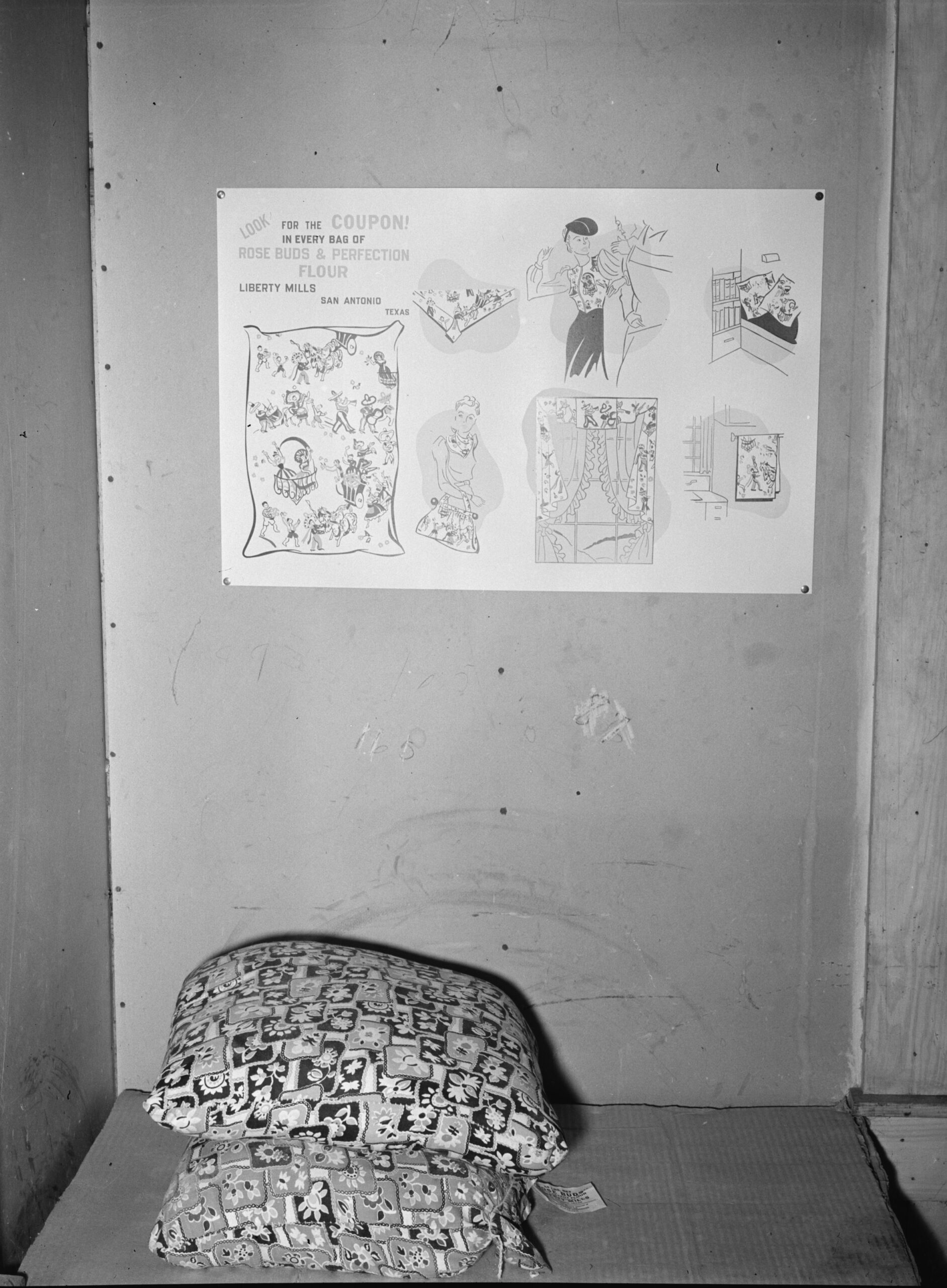
“Flour sacked in new printed fabrics. Chart above indicates various uses of the sacking. Throughout the rural areas and in migrant camps garments made of this sacking are seen. Migrant camp near Sebastian, Texas.” Photo by Russell Lee, February 1939. Library of Congress, FSA/OWI Collection. No known restrictions. Click the picture to see it full size.
Lee’s caption card adds, “Throughout the rural areas and in migrant camps garments made of this sacking are seen.” Two months later, at Sabine Farms near Marshall, Texas, he photographed a young woman holding up two dresses she had sewn from flour sacks, with her card’s words: “Wife of FSA (Farm Security Administration) client holding dresses which she made from flour sacks.”
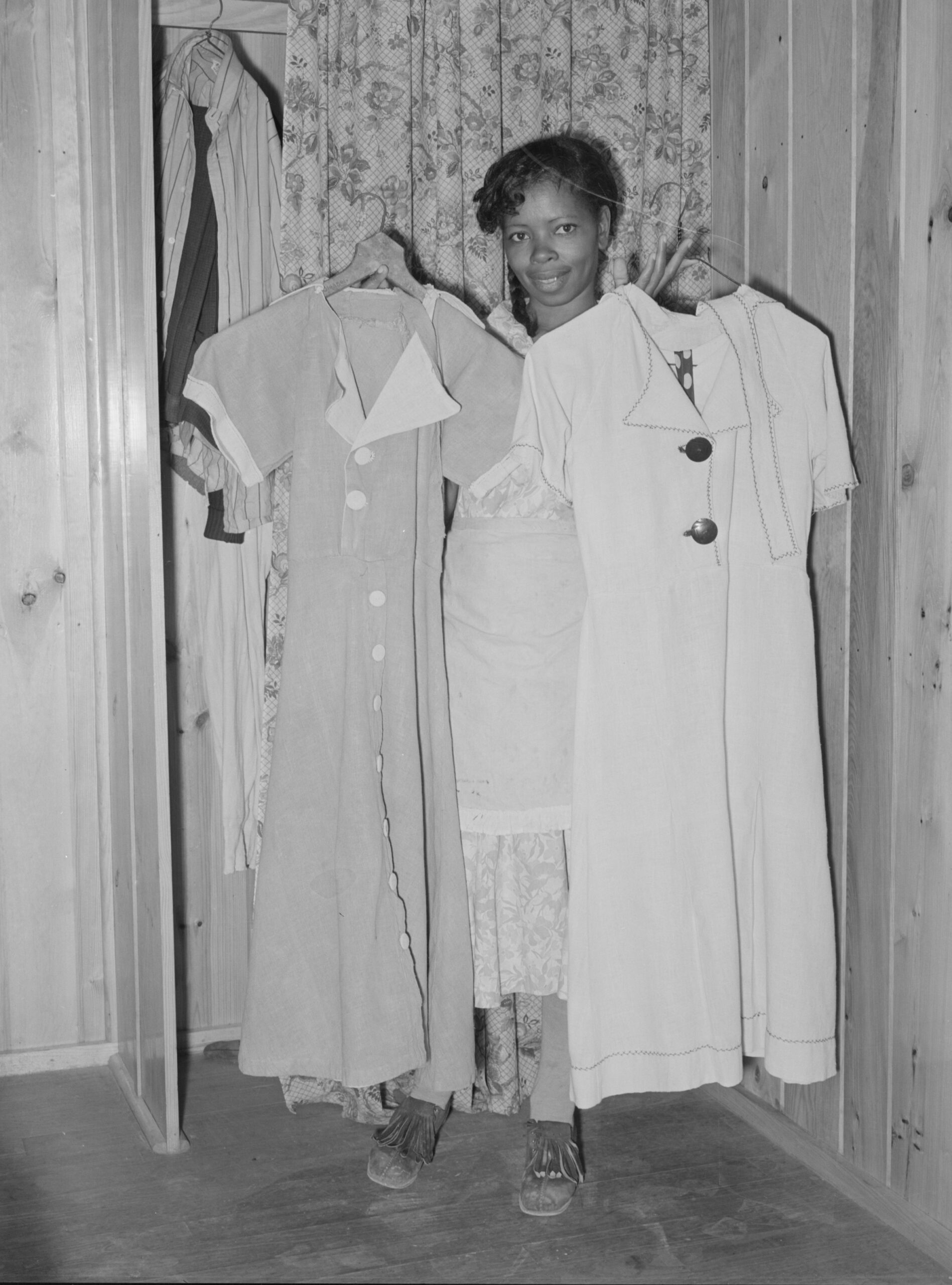
“Wife of FSA (Farm Security Administration) client holding dresses which she made from flour sacks. Sabine Farms, Marshall, Texas.” Photo by Russell Lee, April 1939. Library of Congress, FSA/OWI Collection. No known restrictions. Click the picture to see it full size.
Today the Museum of Texas Tech University in Lubbock keeps a whole collection of printed cotton sacks. It says the printed sacks “aided the creativity of the area’s residents who made them into clothing and quilts.”
Who Took the Picture in Donley County, Texas
The photographer is named on the Library of Congress record only as “Wilkinson.” The record doesn’t give a first name, and we couldn’t find one. The negative’s number puts it in the FSA’s own photo files, and the record says the Office of War Information handed it to the Library of Congress in 1944.
The FSA sent its photographers out across the country to show how Americans lived and worked, and how the agency’s families were doing. A caption like this one was written for readers far away. Wilkinson wanted them to see a farm wife with her own food on every shelf, her own lard in the cans and her own eggs headed to town, and then to notice one more thing. Her jacket had started out as a sugar sack, and it looked good.
The card doesn’t say what became of the Gill farm. But the picture is still at the Library of Congress, free for anyone to see, and the jacket still looks as crisp and white as it did on the day Mrs. Gill sat down with her eggs.
Sources
- Wilkinson, “Mrs. Richard R. Gill, Donley County, Texas, prepares eggs for the market. The large containers are filled with homemade lard for this work grant family. Note that Mrs. Gill’s attractive jacket is made from a sugar sack,” 1941. Caption card title, record and full-size scan: Library of Congress, item 2017765286 (LC-USF34-014165-D). FSA/OWI photographs: no known restrictions.
- Russell Lee, flour sacks and the Liberty Mills poster, migrant camp near Sebastian, Texas, February 1939: item 2017782327. Russell Lee, flour-sack dresses, Sabine Farms, Marshall, Texas, April 1939: item 2017783139. Poster words read off the full-size scan.
- Joseph Gaer for the FSA Personnel Training Committee, Toward Farm Security (U.S. Department of Agriculture, Government Printing Office, 1941), pages 75, 81 and 82: AgEcon Search PDF (the garden, the cow, the sow and the chicken; work in return for a grant; not “free” money; canned food 51 to 242 quarts; income $480 to $650). Quotes read off the page scans.
- Texas State Historical Association, Handbook of Texas, “Donley County”: tshaonline.org (Depression and drought; people and farms in 1930 and 1940; Clarendon the county seat).
- Museum of Texas Tech University, Clothing and Textiles, Feedsacks: depts.ttu.edu.
- The Farm Security Administration: Wikipedia. About the FSA/OWI photographs and their rights: Library of Congress, FSA/OWI Black-and-White Negatives and rights and restrictions.