
A shore town on Long Island Sound, first called Wepawaug, where the planters of 1639 built the New Haven Colony's first mill, oystermen wintered in seaweed huts at Milford Point, and Baldwin's straw shop sent out millions of hats.
Then and now
The same town 144 years apart. Click either map to look closer.
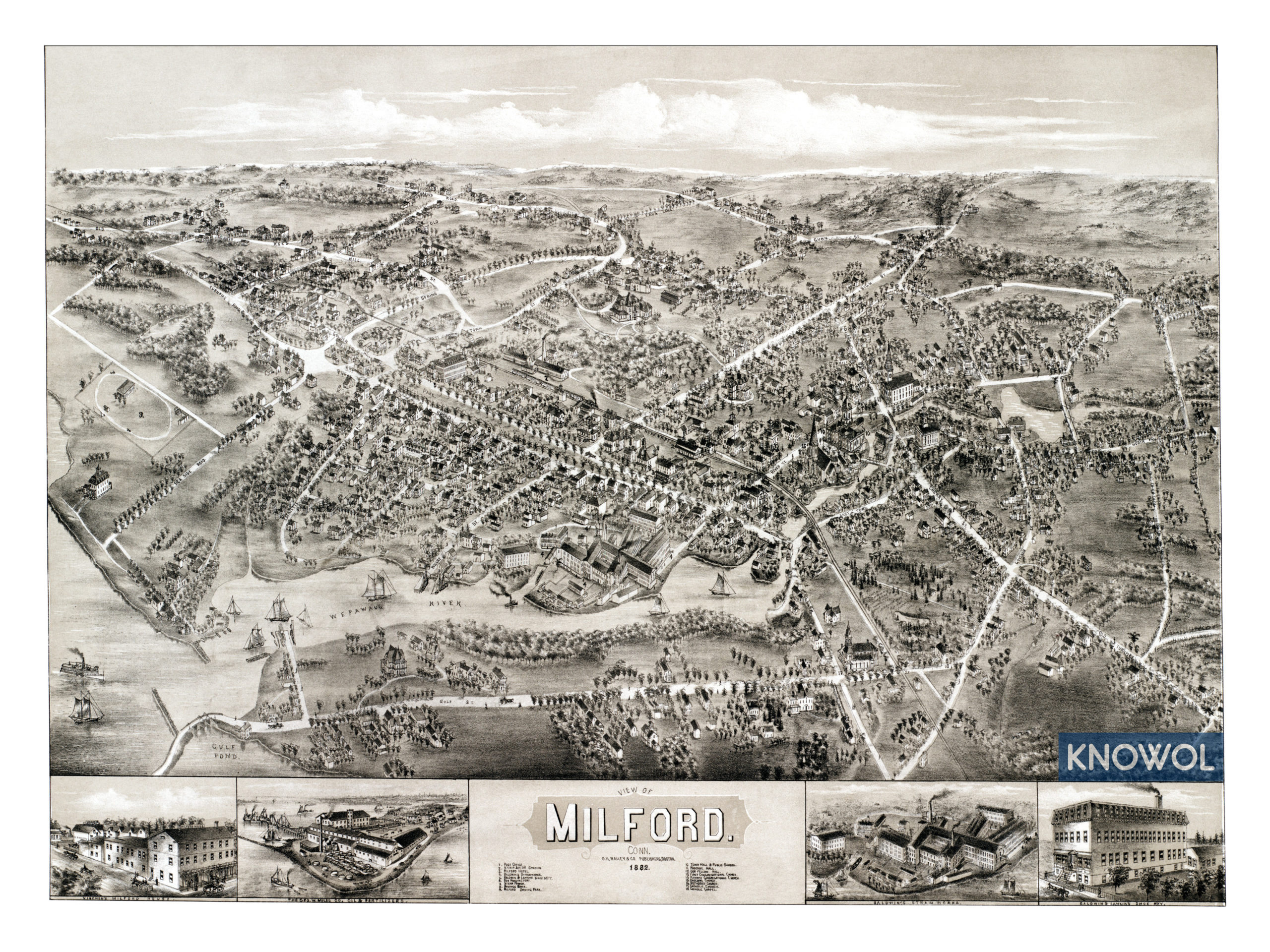
The bird's-eye view
By O.H. Bailey
Milford drawn as if from the sky in 1882, with street names and old landmarks: the Milford Hotel, the post office, Baldwin's Straw Works, a box manufactory, the savings bank, the Milford Driving Park, the Masonic and Odd Fellows halls and the churches.4
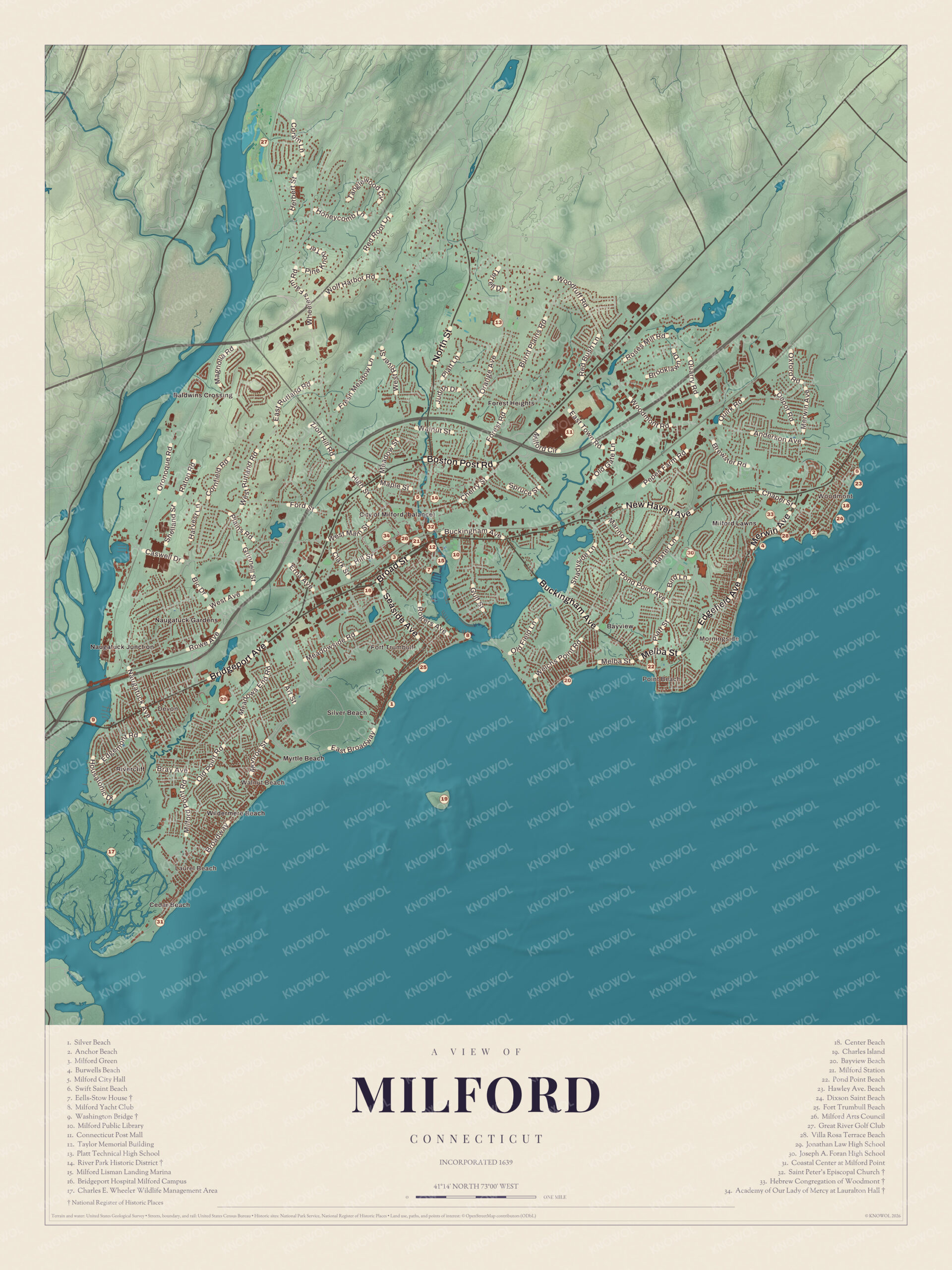
Milford today
By KNOWOL
Shaded land from Cedar Beach and the mouth of the Housatonic to Woodmont, every street, the green, the Wepawaug River and Charles Island, and a guide of 34 numbered landmarks with the National Register sites marked.5
The story of Milford
Oysters, shad and straw hats
Old Milford lived off the water. A history of 1838 says oysters were once so plentiful at Milford Point that a man could load a two-yoke team in a single tide, and farmers laid in a winter's supply each November. The first oyster act came in 1764. Out on the point stood a street of about twenty-five huts covered in seaweed, where sixty or more oystermen spent the winter. In spring the Housatonic ran with shad, and ten or twelve thousand might be taken in a day at one fishing place. Then came hats. About 1850 a straw hat works moved from New York to the head of the harbor. Known as Baldwin's straw shop, it sent out millions of hats, and you can find Baldwin's Straw Works on the 1882 map.6724
Two judges in the cellar
In August 1661 two of the judges who had sentenced King Charles I came quietly to Milford. Major-General Whalley and Major-General Goffe were wanted by the new king, and they spent more than two years hidden in the stone basement of a shop on the Tomkins house lot, across from today's town hall on West River Street. The story goes that the Tomkins daughters spun in the room above and sometimes sang a ballad about the late king's martyrdom, one that named the judges, never knowing who was listening below. A few leading men kept the secret, among them Benjamin Fenn, who arranged to miss the meeting where the colonies agreed to search for the fugitives. Then the judges went on to Hadley.892
The Ponds of Milford
Captain Charles Pond officered one of the first vessels the colony fitted out in the Revolution, and later he kept a store in town. When he was seventy, burglars cleaned it out one night. Pond had noticed a strange crew eyeing his window fastenings the day before, so he sailed for Long Island in his fast sloop Sally, ran down their boat, and found his own best beaver hat sitting on the cabin table. Adam Pond, of the same family, sailed clipper schooners. Coming up the Sound with word that Napoleon had escaped from Elba, he stopped at Milford and told it there first, then landed in New York and ran up Beekman Street hatless shouting the news. As the family's chronicler put it, for once Milford was ahead of New York.210
Through the years
25 moments from 1639 to today.
- 1639Planters tied to the New Haven Colony buy the land from Ansantawae, chief of the local Paugussett.1
- 1640William Fowler builds a grist mill on the Wepawaug, the first mill in the New Haven Colony.11
- 1640On November 24 the freemen vote to name the plantation Milford.11
- 1643Milford joins the New Haven Colony after a summer of arguing over six voters who weren't church members.12
- 1648Thomas Hine frees a Mohawk captive left tied in the salt meadows and helps him get home.13
- 1657Charles Deal is allowed to buy Milford Island for a tobacco plantation. It takes his name.5
- 1661The fugitive judges Whalley and Goffe begin more than two years hidden in a shop basement on West River Street.8
- 1666Robert Treat leads Milford families to the Passaic River in New Jersey, where they found Newark.14
- 1690Bethuel Langstaff builds a 150-ton brig for Alexander Bryan, an early sign of Milford shipbuilding.15
- 1764The town passes its first oyster act, closing the beds from April to September.6
- 1776Milford puts up batteries at Burns' Point and Fort Trumbull and camps soldiers at Burwell's Farms and Milford Point.2
- 1777A flag of truce ship lands 200 sick American prisoners from New York. The town cares for them, but 46 die within a month.16
- 1811A Yale student finds the serpentine marble quarry in the east part of town.17
- 1818The East India ship Isabella, the last vessel built in Milford, is launched.15
- 1822The northern and eastern sections split off as the town of Orange.1
- 1848Milford Station opens on Christmas Day.5
- 1850About this year the straw hat works moves from New York to Milford, beside the harbor head.2
- 1850St. Peter's Episcopal Church goes up in Portland brownstone.18
- 1866Sewing machines come to the straw shop, and it can turn out a thousand dozen hats a day.2
- 1882O.H. Bailey publishes his bird's-eye view of Milford.4
- 1894The Taylor Memorial Library is completed at the east end of the green.19
- 1897The old Milford Hotel on Broad Street burns.2
- 1903The southeastern part of town becomes the Borough of Woodmont.1
- 1959The town, with Woodmont, becomes the City of Milford.1
- 1975The first Milford Oyster Festival is held.1
Places to see
The numbers match the landmark guide printed on the 2026 map.
- 3Milford GreenCity center. The heart of the old town.
- 7Eells-Stow HouseHigh Street. Believed to be Milford's oldest building.Visit their website
- 9Washington BridgeDevon. Route 1 over the Housatonic since 1921.
- 12Taylor Memorial BuildingBroad Street. The 1894 library by Joseph W. Northrop.
- 14River Park Historic DistrictBoth banks of the Wepawaug. The first settlement and riverside parks.
- 19Charles IslandOffshore. Reached by a sandbar at low tide.
- 21Milford StationDowntown. Opened on Christmas Day, 1848.
- 31Coastal Center at Milford PointMilford Point. Audubon nature center in the 1847 hotel.Visit their website
- 32Saint Peter's Episcopal ChurchRiver Street. Brownstone Gothic Revival church of 1850.Visit their website
- 33Hebrew Congregation of WoodmontEdgefield Avenue, Woodmont. Summer synagogue of 1926.Visit their website
On the National Register
All 11 places in Milford on the National Register of Historic Places that still stand today, oldest first, and why each one matters.3
-
River Park Historic District
The civic and residential heart of Milford along both banks of the Wepawaug, taking in part of the first colonial settlement. In the early 1900s the town lined the riverbanks with a string of parks.20
-
Eells-Stow House
Believed to be Milford's oldest surviving building, with a later lean-to that gives it a saltbox shape. Architectural historians long debated the order in which it was built. It's now a museum of the Milford Historical Society.21
-
Buckingham House
One of the city's oldest buildings, on land given to Thomas Buckingham in 1639. Its front has an unusual five bays below and three above, and the carpenter Jehiel Bryan changed it after marrying into the family in 1753.22
-
Milford Point Hotel
George T. Smith built this small seaside hotel for travelers arriving on the new coast railroad. It's one of the oldest surviving shore hotel buildings in the state and now serves as the visitor center of the Coastal Center at Milford Point.23
-
St. Peter's Episcopal Church
A Gothic Revival church of Portland brownstone, a significant work of Frank Wills, with a rectory and parish hall added in the 1890s. It's one of the few 19th-century buildings left in Milford's civic center.18
-
Taylor Memorial Library
A Richardsonian Romanesque library of fieldstone, red sandstone and yellow brick by the Bridgeport architect Joseph W. Northrop. It now houses the Milford Chamber of Commerce.19
-
Academy of Our Lady of Mercy at Lauralton Hall
Founded by the Sisters of Mercy in 1905, it's the oldest Catholic college preparatory school for girls in Connecticut, on a 25-acre campus a block from Milford station.24
-
Washington Bridge
Also called the Devon Bridge, this drawbridge with five 100-foot arches cost $1.5 million in 1921, the state highway department's largest and most expensive project up to then. A ferry crossed here from about 1758.25
-
Hebrew Congregation of Woodmont
A small Colonial Revival synagogue built for Jewish families who summered at the beach. The congregation began in 1920 in Rabbi Yehuda Heschel Levenberg's vacation home, and the building was restored after a fire in 2012.26
-
Laurel Beach Casino
A Colonial Revival meeting hall with a wraparound porch, a stage and a bowling alley. Milford's shore villages once had seven of these casinos, and this is the last one left.27
-
US Post Office-Milford Main
A Classical Revival post office of red brick and limestone designed by James A. Wetmore, part of the cluster of civic buildings around the triangular green.28
In their words
“A more substantial company of emigrants never followed a clergyman into the wild woods of America, than the fathers of Milford.”
The History of Connecticut, 1855, on the first planters29
“In all the wars in which the county has been engaged, Milford has furnished her full quota of brave men.”
The historical, statistical and industrial review of the state of Connecticut, 188330
“He had landed at Milford in passing through the Sound and proclaimed it here first, so for once Milford was ahead of New York.”
The Ponds of Milford, The Connecticut magazine, on Adam Pond and the news of Napoleon's escape10
Nearby towns
Sources
- Milford, Connecticut, Wikipedia
- Milford, by M. Louise Greene, The Connecticut magazine (1899), Internet Archive
- National Register of Historic Places listings in New Haven County, Connecticut, Wikipedia
- Bird's-eye view of Milford, Connecticut from 1882, restored by KNOWOL
- Map of Milford, Connecticut in 2026, KNOWOL (USGS elevation, Census Bureau roads)
- History of the colony of New Haven (1838), on the oysters of Milford Point, Internet Archive
- History of the colony of New Haven (1838), on the shad fishery, Internet Archive
- History of the colony of New Haven (1838), on the regicides in Milford, Internet Archive
- A history of three of the judges of King Charles I (1794), Internet Archive
- The Ponds of Milford, Connecticut, The Connecticut magazine, Internet Archive
- History of the colony of New Haven to its absorption into Connecticut (1881), on Fowler's mill and the naming of Milford, Internet Archive
- Connecticut: a study of a commonwealth-democracy (1887), on Milford's six burgesses, Internet Archive
- History of the colony of New Haven (1838), on Thomas Hine and the Mohawk captive, Internet Archive
- History of the colony of New Haven (1838), on the Milford settlers of Newark, Internet Archive
- History of the colony of New Haven (1838), on Milford shipbuilding, Internet Archive
- History of the colony of New Haven (1838), on the prisoners landed in 1777, Internet Archive
- History of the colony of New Haven (1838), on the Milford marble quarry, Internet Archive
- St. Peter's Episcopal Church (Milford, Connecticut), Wikipedia
- Taylor Memorial Library, Wikipedia
- River Park Historic District, Wikipedia
- Eells-Stow House, Wikipedia
- Buckingham House (Milford, Connecticut), Wikipedia
- Milford Point Hotel, Wikipedia
- Academy of Our Lady of Mercy, Lauralton Hall, Wikipedia
- Washington Bridge (Connecticut), Wikipedia
- Hebrew Congregation of Woodmont, Wikipedia
- Laurel Beach Casino, Wikipedia
- United States Post Office-Milford Main, Wikipedia
- The History of Connecticut, from the first settlement of the colony (1855), Internet Archive
- The historical, statistical and industrial review of the state of Connecticut (1883), Internet Archive