
A small mill village on the Blackstone River at the Rhode Island line, where the island mills turned out wool, scythes and felt, the South Parish meetinghouse of 1769 still keeps its box pews, and a Hall of Fame catcher grew up.
Millville, Massachusetts on the map
Click the map to look closer.
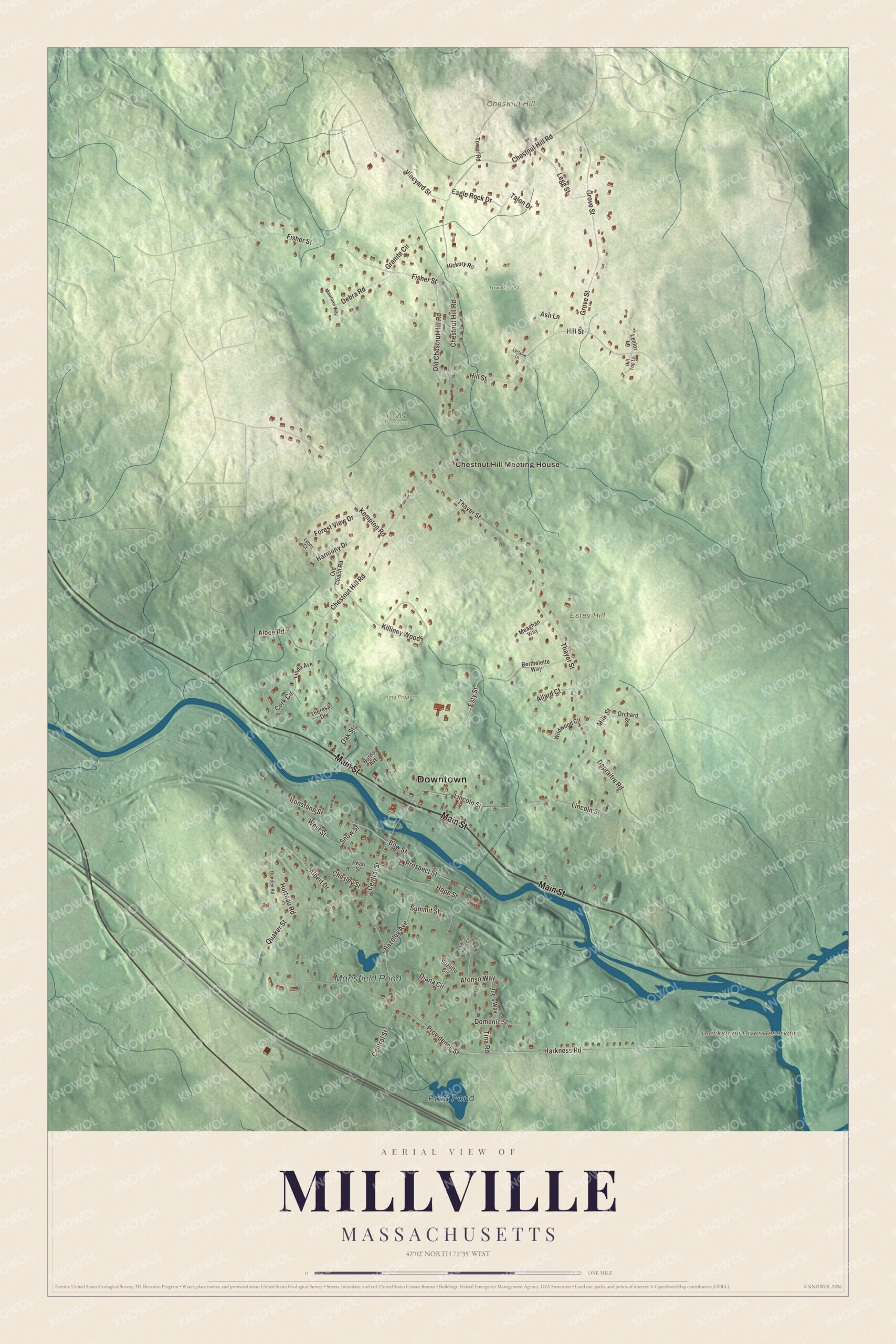
Millville today
By KNOWOL
Shaded hills along the Blackstone River with Main Street, Central Street, Ironstone Street, Thayer Street, Harkness Road and Chestnut Hill Road, Pratt Pond and Mansfield Pond, Chestnut Hill, Estey Hill and the Chestnut Hill Meeting House.5
The history of Millville, Massachusetts
The mills on the island
Millville grew around an island in the Blackstone River. By 1732 Samuel Thompson ran a grist mill there, and he struck a deal with the town of Mendon: he'd keep up the bridge from the island to the south bank if the town kept up the one on the north side. The county history of 1889 says Central Street dates from that bargain. A fulling mill came late in the 1700s, and in 1814 Esek Pitts built a woolen mill the same book calls the first on the Blackstone. Collins Capron's Stone Mill followed in 1825, the Island Mill in 1835, and in 1845 Welcome Farnum bought the whole river privilege. Smiths forged axes and scythes here too, and later the water power went to rubber and felt.267
The minister who fled in the night
Long before the mills, the people on these hills worshiped at Chestnut Hill, the meeting of the South Parish, incorporated in 1766. In 1768 the parish settled Rev. Benjamin Balch as its pastor, and in 1769 it raised the plain wooden meetinghouse that still stands at Chestnut and Thayer streets. Balch's pay was supposed to include firewood and other necessaries, and the loose terms led to arguments. On the night of March 27, 1773, he fled to Dedham. The parish went without a settled minister until Rev. Preserved Smith came in 1805. He stayed seven years, and the 1889 history says his memory is blessed. Inside, the meeting room still holds 26 box pews.83
Seven miles to church
Irish families made Millville their own. James Nugent left County Westmeath in the famine year of 1847, worked in E. S. Hall's factory, saved for a horse and wagon, and built up a junk business and then a livery stable. In those early years he walked seven miles every Sunday to Mass. William J. Bowes, born in Dublin, brought his family to Millville in 1877 and founded the Lawrence Felting Company's plant here, later sold to the United States Rubber Company. And when a Woonsocket father took a job at Banigan's Millville Rubber Shop, his eldest son, Gabby Hartnett, grew up in town. Hartnett caught for the Chicago Cubs from 1922 and was elected to the Hall of Fame in 1955.97105
Millville, Massachusetts through the years
23 moments from 1662 to today.
- 1662European settlement of the area begins, on land the Nipmuc people had long lived on.1
- 1732Samuel Thompson, who runs a grist mill on the island, agrees to keep up the bridge to the south bank, the start of Central Street.2
- 1766The South Parish, which meets at Chestnut Hill, is incorporated.8
- 1769The South Parish builds its meetinghouse on Chestnut Hill.8
- 1773Rev. Benjamin Balch, at odds with the parish over his firewood, flees by night to Dedham.8
- 1805Rev. Preserved Smith becomes the first settled pastor at Chestnut Hill since Balch.8
- 1814Esek Pitts builds what the county history calls the first woolen mill on the Blackstone River.2
- 1825Collins Capron builds the Stone Mill, and work begins on the Blackstone Canal.2
- 1827Millville gets its first post office, with Willard Wilson as postmaster.2
- 1828The Blackstone Canal opens between Worcester and Providence.11
- 1833The Methodist Reformed Church Society builds the village's first church, on Central Street.8
- 1835The Island Mill goes up.2
- 1837A young reform preacher named Fish begins nine years in the Millville pulpit.12
- 1845Welcome Farnum buys the whole river privilege and soon adds a brick mill.2
- 1847James Nugent arrives from famine-struck Ireland and finds work in E. S. Hall's factory.9
- 1848The Blackstone Canal shuts down, outrun by the railroad.11
- 1871The Mansfield Scythe Factory is built off Central Street.6
- 1874Fire destroys the Stone Mill, which is later partly rebuilt.2
- 1877William J. Bowes moves his family to Millville, where he founds the Lawrence Felting Company's plant.7
- 1893Grocer John Conway is appointed Millville's postmaster.13
- 1916Millville becomes a town, divided from Blackstone.1
- 1919The public library is established.1
- 1922Gabby Hartnett, who grew up in Millville, joins the Chicago Cubs.5
Places to see in Millville, Massachusetts
Places worth a visit in Millville today.
- Chestnut Hill Meeting HouseChestnut and Thayer streets. The South Parish meetinghouse of 1769.Visit their website
- Blackstone RiverThrough the village. Flowing from Worcester toward Providence.
- Blackstone Canal lockBlackstone River valley. A well-preserved lock from the 1820s canal.
- Main StreetNorth of the river. The mill village's north-bank street.
- Central StreetSouth of the river. Laid out from the 1732 island bridge.
- Mansfield PondMillville. One of the town's two named ponds.
- Pratt PondMillville. One of the town's two named ponds.
- Chestnut HillAround the meetinghouse. Home of the old South Parish.
- Estey HillMillville. One of the town's named hills.
- Millville public libraryOff Route 122. The town library, established in 1919.Visit their website
Millville on the National Register of Historic Places
All 4 places in Millville on the National Register of Historic Places that still stand today, oldest first, and why each one matters.4
-
Chestnut Hill Meetinghouse
Built for the South Parish, this plain frame meetinghouse still holds 26 box pews. It's one of a small number of surviving 18th-century meetinghouses with the main door on the long side of the building.3
-
Blackstone Canal Historic District
The whole Massachusetts course of the canal that carried boats between Worcester and Providence from 1828 until 1848. Its granite locks were built to the design of Erie Canal engineers, and Millville keeps one of the best preserved.11
-
Central Street Historic District
The south-bank heart of the old mill village, from the remnant mill sites on the island in the Blackstone River up the hillside where Millville's wealthier families built their homes. The former Longfellow School of 1850 at 8 Central Street held the town offices until 2016.14
-
Main Street Historic District
A large part of Millville's 19th-century industrial village, along Main Street, Lincoln Street and Chestnut Hill Road, north of the river from the Central Street district.15
Millville in their words
“in 1814 Esek Pitts built the first woolen-mill ever erected upon the Blackstone River”
History of Worcester County, Massachusetts, 18892
“He remained seven years and his memory is blessed.”
History of Worcester County, Massachusetts, 1889, on Rev. Preserved Smith of Chestnut Hill8
“He was honest and upright and was respected by all classes and conditions of men.”
Historic homes and institutions of Worcester County, 1907, on James Nugent of Millville9
Towns near Millville, Massachusetts
Sources for the history of Millville
- Millville, Massachusetts, Wikipedia
- History of Worcester County, Massachusetts (1889), on the Millville mills, Internet Archive
- Chestnut Hill Meetinghouse, Wikipedia
- National Register of Historic Places listings in Worcester County, Massachusetts, Wikipedia
- Map of Millville, Massachusetts in 2026, KNOWOL
- History of Worcester County, Massachusetts (1889), on Blackstone in the 1880s, Internet Archive
- Encyclopedia of Massachusetts, biographical, genealogical (1916), on William J. Bowes, Internet Archive
- History of Worcester County, Massachusetts (1889), on the Millville churches and Chestnut Hill, Internet Archive
- Historic homes and institutions and genealogical and personal memoirs of Worcester County, Massachusetts (1907), on James Nugent, Internet Archive
- Encyclopedia of Massachusetts, biographical, genealogical (1916), on Robert J. Bowes, Internet Archive
- Blackstone Canal Historic District, Wikipedia
- History of Milford, Massachusetts, part 2 (1882), Internet Archive
- Historic homes and institutions and genealogical and personal memoirs of Worcester County, Massachusetts (1907), on John Conway, Internet Archive
- Central Street Historic District, Wikipedia
- Main Street Historic District, Wikipedia