
The first of John Eliot's praying towns, settled in 1651 by Massachusett people beside the Charles River at South Natick, Natick later grew into a busy shoe town of brogans and baseballs around the crossroads of Central and Main Streets.
Natick then and now
The same town 149 years apart. Click either map to look closer.
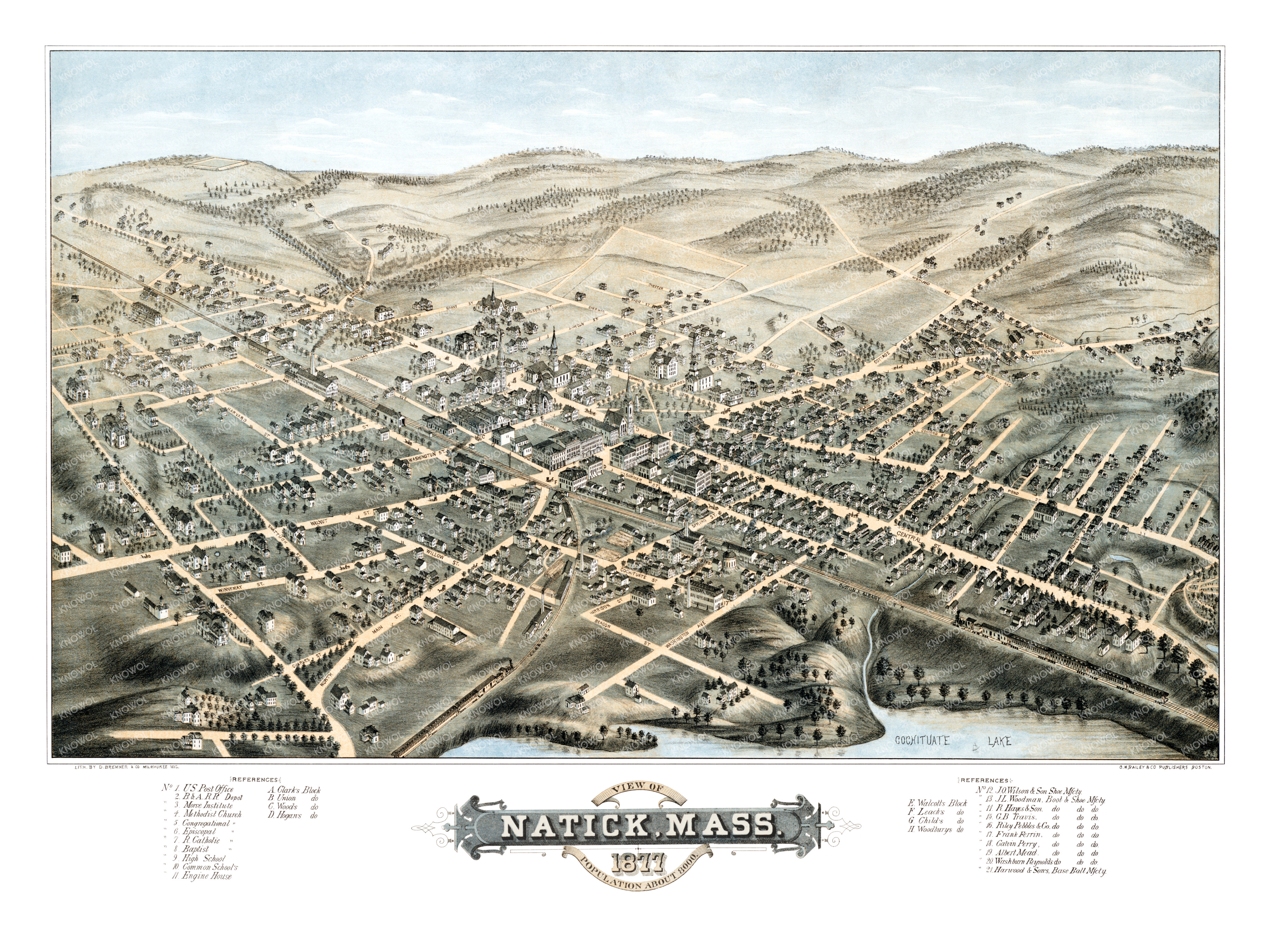
Natick in 1877
By O.H. Bailey
A bird's-eye view of Natick three years after the great fire, with the Boston and Albany Railroad station, the Morse Institute, Clark's Block, Union Block, Hogan's Block, the Harwood & Sons baseball factory and nine shoe and boot makers.5
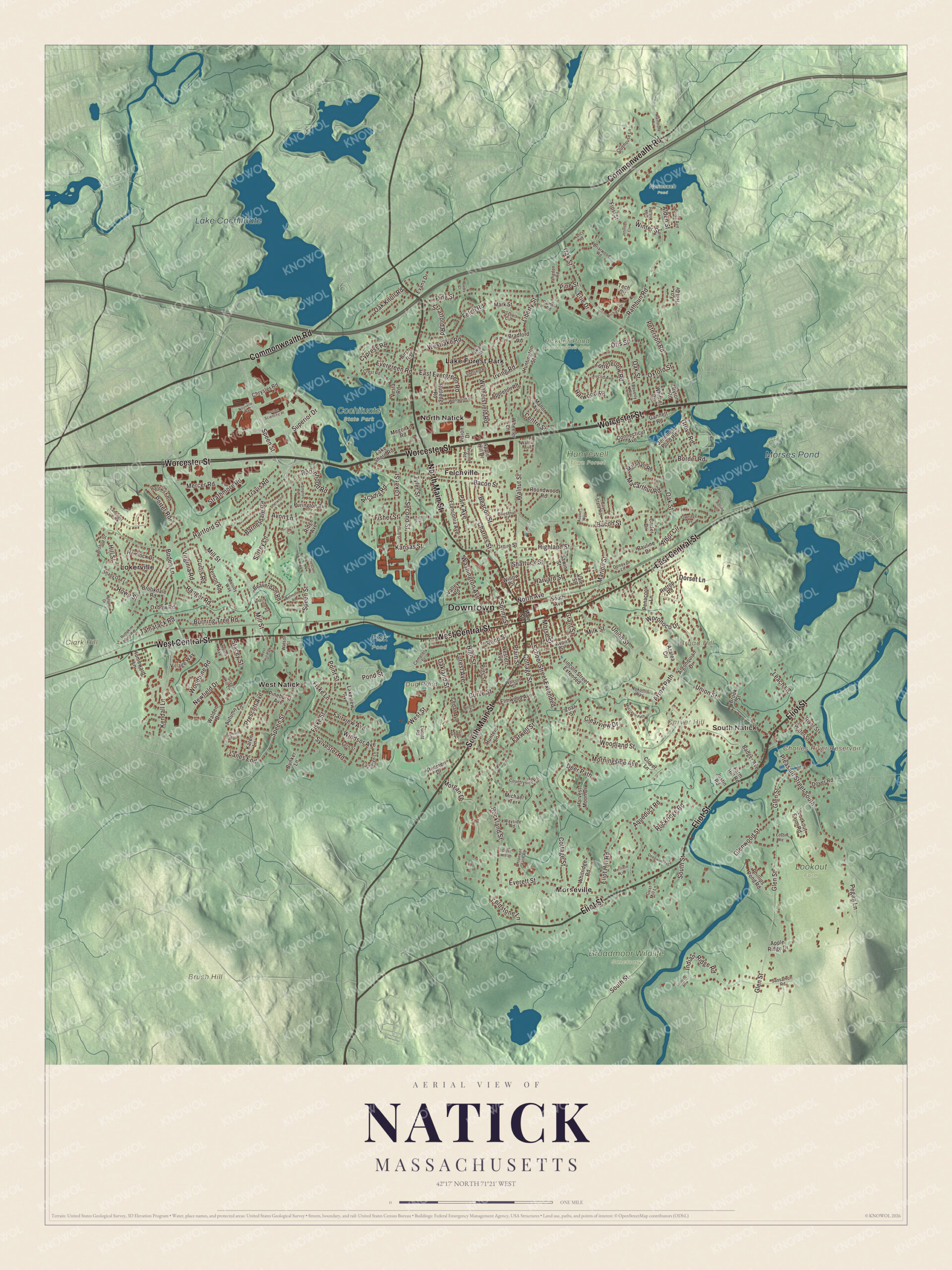
Natick today
By KNOWOL
Natick Center where Central Street meets Main Street, with North Main, South Main, Eliot and Worcester Streets, Dug Pond, Lake Cochituate, Morses Pond, the Charles River Reservoir and Broad, Brush and Carver Hills, out to South Natick and Felchville.6
The history of Natick, Massachusetts
A town built by its own people
Natick was built by the Massachusett people who settled here with John Eliot in 1651. They laid out streets on both sides of the Charles and put up a footbridge eighty feet long, giving their labor though Eliot offered to pay. By 1658 Genesis and Matthew, in Eliot's translation into their own language, were in use here. Judge Sewall wrote in 1683 that Daniel of Natick was the first Native minister ordained, and Thomas Waban kept the town records in his own language. Every village officer was Native until 1733. In 1675, during King Philip's War, the colony sent the people to Deer Island, where many died that winter. Lake Waban, now in Wellesley, still carries the name of Waban, one of their first leaders.7891011112
The morning the church bell rang three times
Natick's business center was built mostly of wood, and people had long predicted a big fire. It came on Tuesday morning, January 13, 1874, starting at Summer and North Main Streets and leaping onto Clark's Block and Walcott's shoe factory. Stores, halls, houses and the Congregational Church went down. The church spire burned last, and just before it fell the bell struck three times. Nearly forty buildings were lost, about a fifth of the taxable property in town, yet no one died. Natick answered by pumping water from Dug Pond, first turned on in August 1875, and by opening the new Central Fire Station on Summer Street. Clark's Block was rebuilt 260 feet long, the largest business block in Natick.313141
Brogans, baseballs and the Natick Cobbler
Shoes made Natick. Asa Felch began making shoes to sell in 1827, in a room of his own house, and the village of Felchville grew up around his trade. Natick's specialty became the brogan, a heavy work shoe, at first made by hand for the Southern market. In December 1833 Henry Wilson walked down from Farmington, New Hampshire, to learn the business. He once tried to make fifty pairs without sleeping and almost did, and as a manufacturer he is said to have made 664,000 pairs before going on to the Senate and the vice presidency. In 1858 Harrison Harwood opened a baseball factory, where the balls were wound in the shop and the covers were sewn on by women at home.1516172181
Natick, Massachusetts through the years
24 moments from 1651 to today.
- 1651John Eliot and Massachusett converts settle Natick on both sides of the Charles River, the first of his praying towns.1
- 1651The settlers build a footbridge eighty feet long over the Charles, giving their labor though Eliot offers to pay.7
- 1658Genesis and Matthew, in Eliot's translation, are already in use at Natick.8
- 1660The Natick church is gathered, the first church among Eliot's praying towns.19
- 1661The New Testament is printed in the Natick dialect of the Massachusett language.6
- 1675During King Philip's War the colony sends Natick's Native people to Deer Island, where many die over the winter.1
- 1683Judge Sewall writes that Daniel of Natick was the first Native minister ordained.9
- 1716The Rev. Daniel Takawambait, pastor at Natick, dies at sixty-four.9
- 1721Oliver Peabody preaches his first sermon at Natick and finds only two English families in town.20
- 1729John Speen's petition for a grist mill on Indian Brook is granted, with Native corn ground toll free for thirty years.21
- 1733John Sawin and Thomas Ellis are the first English town officers elected; until now every village officer has been Native.11
- 1745Natick becomes a parish, and its Native people are placed under guardians.11
- 1753Stephen Badger arrives as missionary; his house still stands on Eliot Street.22
- 1775Seventy-six Natick men march on the Lexington alarm under Captain Joseph Morse.23
- 1781Natick is incorporated as a town.1
- 1797Natick gains Needham Leg and gives up the Welles farm, which later gives Wellesley its name.24
- 1827Asa Felch first makes shoes to sell, and Felchville grows up around his trade.15
- 1828The Eliot Church is built in South Natick on the spot of Eliot's meetinghouse.25
- 1833Henry Wilson walks from Farmington, New Hampshire, to Natick to learn shoemaking.17
- 1858Harrison Harwood starts his baseball factory.18
- 1873The Morse Institute, Mary Ann Morse's gift of a free library, is dedicated on Christmas Day.26
- 1874On January 13 fire destroys nearly forty buildings in the center of town.3
- 1875Water pumped from Dug Pond is first turned on in August.3
- 1891Natick's firemen win the World's Hook and Ladder Championship, and the town becomes the Home of Champions.1
Places to see in Natick, Massachusetts
Places worth a visit in Natick today.
- South NatickOn the Charles River. Where the praying town began.
- Eliot StreetSouth Natick. Some of Natick's oldest homes.
- Natick CenterCentral and Main Streets. Rebuilt in brick after the 1874 fire.
- Morse Institute LibraryEast Central Street. Mary Ann Morse's gift to her town.Visit their website
- The Center for Arts in NatickSummer Street. In the 1875 Central Fire Station.Visit their website
- Pond Street stone markerNear downtown. Native and English Revolutionary soldiers together.
- Dug PondMemorial Beach and Natick High School. Spring-fed pond that watered the town.
- Lake CochituateNorth, toward Wayland and Framingham. Boston's first major water supply.
- H. H. Harwood & Sons factoryNear the railroad. Baseball factory, condominiums since 1988.
- Broad HillEast of the center. Held the town's first water reservoir.
Natick on the National Register of Historic Places
All 10 places in Natick on the National Register of Historic Places that still stand today, oldest first, and why each one matters.4
-
John Eliot Historic District
The heart of South Natick, where John Eliot founded the first praying town in 1651. It holds the Eliot Church of 1828, the Bacon Free Library of 1880, built partly over the old Native burying ground, and the homes of Harriet Beecher Stowe and Horatio Alger.27
-
Stephen Bacon House
The oldest part was built about 1704 by Stephen Bacon, one of Natick's early settlers, and it is one of the town's oldest buildings. The town's first school classes were held here, and a local company of minutemen mustered here in the Revolution.28
-
Robert Jenison House
A five-bay house with a big central chimney, built about 1738 by Robert Jenison and one of the town's oldest buildings. An outbuilding on the property is marked as the place where Henry Wilson learned to make shoes.29
-
Rev. Stephen Badger House
Built in 1753 for Stephen Badger, the last missionary to Natick's Praying Indian community, it is a well-preserved Georgian house. Oliver Bacon, whose gift built South Natick's Bacon Free Library, bought it in 1822.22
-
Natick Center Historic District
The 19th-century civic and business heart of Natick, on land first set aside for the minister. It grew after the meetinghouse of 1799 and the railroad of 1835, and after the fire of 1874 it was rebuilt in brick Gothic and Romanesque blocks.30
-
The Parsonage
National Historic Landmark
Believed to have been built by Oliver Bacon in the 1820s, this was the summer home of Horatio Alger, writer of rags-to-riches stories for boys, whose father was parson of the Eliot Church. Alger moved in for good in 1898. It is a National Historic Landmark.31
-
Henry Wilson Shoe Shop
A ten-footer, the small backyard shop of a New England shoemaker, used by Henry Wilson, the Natick Cobbler who became a senator and the 18th vice president of the United States.32
-
Clark Houses
Two Second Empire houses tied to Edward Clark, a Natick grocer and town treasurer whose father built the Clark Block. Clark built Number 74 in 1870, and Number 76 was home to Mary Clark Whitney, who died in 1915 two weeks before her 100th birthday.33
-
Sudbury Aqueduct Linear District
Built from 1875 to 1878 to carry Sudbury River water 16 miles to the Chestnut Hill Reservoir for Boston. Parts of it in Natick were dug as tunnels, and it is kept today as an emergency backup.34
-
Casey's Diner
A ten-stool lunch car built in 1922 by the Worcester Lunch Car Company, it was moved to Natick by Fred Casey in 1927 and to South Avenue in 1977. It is one of the oldest operating diners in Massachusetts, known for its steamed hot dogs.35
Natick in their words
“A truly New England landscape is presented in Natick, the church and school, the library and factory, the public hall and stores, the green-house and the farm, the flying train and the telegraphic wires.”
History of Middlesex County, Massachusetts, 188036
“Natick brogans have been known all over the country.”
Professional and industrial history of Suffolk County, Massachusetts, 189437
“In most things, especially in trade, it has always seemed to me that Natick got the best end of the bargain.”
The president of the day at Dover's Old Home Day, 1909, introducing a Natick speaker38
Towns near Natick, Massachusetts
Sources for the history of Natick
- Natick, Massachusetts, Wikipedia
- History of Middlesex County, Massachusetts (1890), Natick chapter, on boots and shoes, Internet Archive
- History of Middlesex County, Massachusetts (1880), Natick chapter, on the fire of 1874 and the water works, Internet Archive
- National Register of Historic Places listings in Middlesex County, Massachusetts, Wikipedia
- Beautifully restored map of Natick, Massachusetts from 1877, restored by KNOWOL
- Map of Natick, Massachusetts in 2026, KNOWOL
- History of Middlesex County, Massachusetts (1880), Natick chapter, on the first settlement and its bridge, Internet Archive
- History of Middlesex County, Massachusetts (1880), Natick chapter, on Eliot's Bible, Internet Archive
- History of Middlesex County, Massachusetts (1880), Natick chapter, on Daniel Takawambait, Internet Archive
- Proceedings of the Littleton Historical Society (1895), on Waban and Thomas Waban, Internet Archive
- History of Middlesex County, Massachusetts (1880), Natick chapter, on the first settlers and town officers, Internet Archive
- History of Middlesex County, Massachusetts (1880), Natick chapter, on Waban, Internet Archive
- History of Middlesex County, Massachusetts (1890), Natick chapter, on the great fire, Internet Archive
- History of Middlesex County, Massachusetts (1890), Natick chapter, on Clark's Brick Block, Internet Archive
- History of Middlesex County, Massachusetts (1880), Natick chapter, on the first shoe manufacturers, Internet Archive
- A gazetteer of the state of Massachusetts (1890), on Natick brogans, Internet Archive
- History of Middlesex County, Massachusetts (1880), Natick chapter, on Henry Wilson, Internet Archive
- History of Middlesex County, Massachusetts (1890), Natick chapter, on the Harwood base-ball factory, Internet Archive
- The Puritan as a colonist and reformer (1899), on the Natick church, Internet Archive
- History of Middlesex County, Massachusetts (1890), Natick chapter, on Oliver Peabody, Internet Archive
- Journals of the House of Representatives of Massachusetts (1919 printing, 1729 session), on John Speen's mill, Internet Archive
- Rev. Stephen Badger House, Wikipedia
- History of Middlesex County, Massachusetts (1880), Natick chapter, on the minutemen, Internet Archive
- History of Middlesex County, Massachusetts (1880), Natick chapter, on Needham Leg and the Welles farm, Internet Archive
- History of Middlesex County, Massachusetts (1880), Natick chapter, on Stephen Badger and the churches, Internet Archive
- History of Middlesex County, Massachusetts (1880), Natick chapter, on the Morse Institute, Internet Archive
- John Eliot Historic District, Wikipedia
- Stephen Bacon House, Wikipedia
- Robert Jenison House, Wikipedia
- Natick Center Historic District, Wikipedia
- The Parsonage, Wikipedia
- Henry Wilson Shoe Shop, Wikipedia
- Clark Houses, Wikipedia
- Sudbury Aqueduct Linear District, Wikipedia
- Casey's Diner, Wikipedia
- History of Middlesex County, Massachusetts (1880), Natick chapter, closing words, Internet Archive
- Professional and industrial history of Suffolk County, Massachusetts (1894), on Natick brogans, Internet Archive
- Old home day: proceedings of the 125th anniversary of the incorporation of Dover, Massachusetts, 1909 (1910), Internet Archive