
A high, cold hill town on the Massachusetts line, where a pastor kept the railroad off the village green, the Battell and Eldridge families gave a library, a fountain and a music festival, and Alfredo Taylor built more than thirty summer houses.
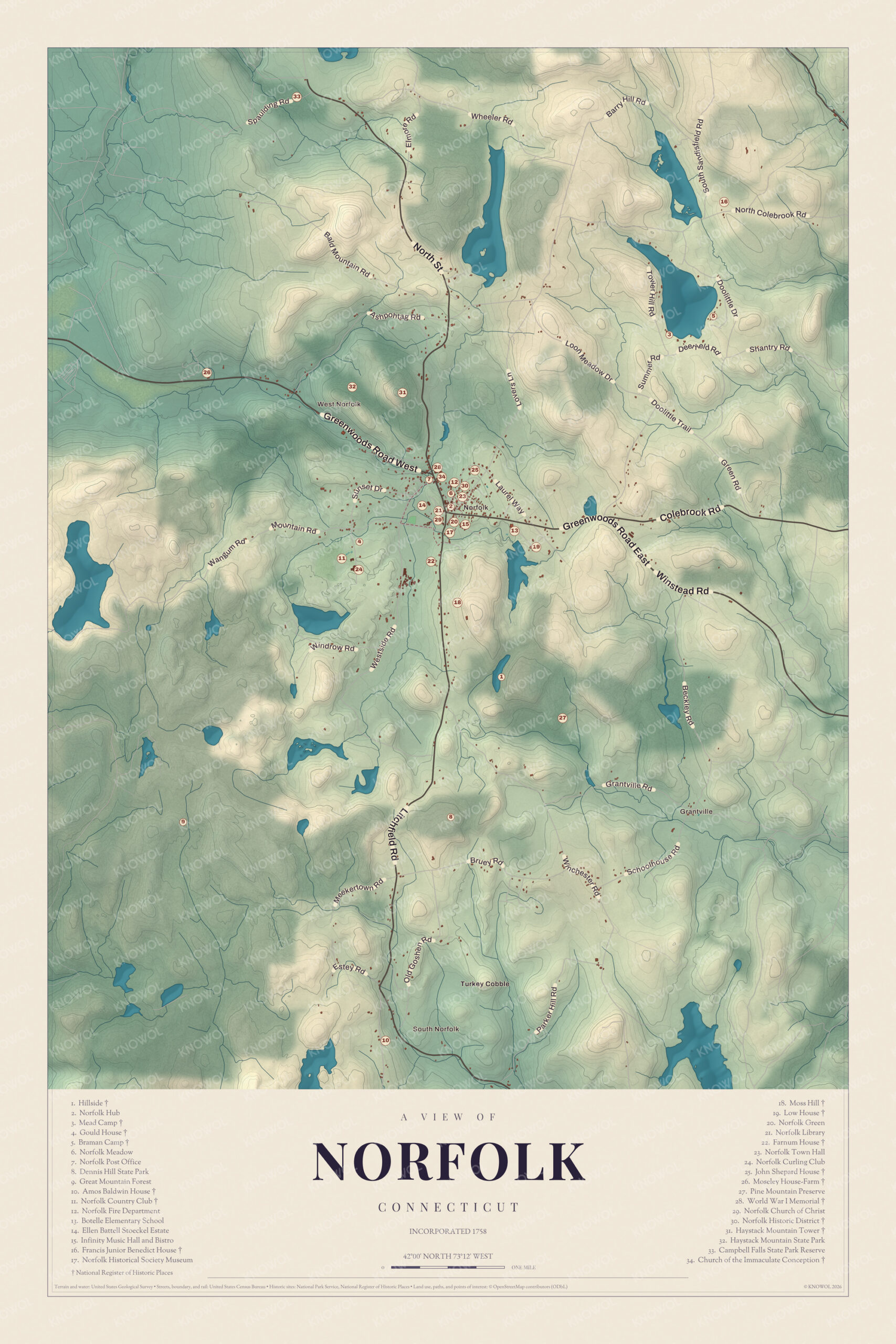
Norfolk on the map
Click the map to look closer.
Norfolk today
By KNOWOL
Shaded hills from Haystack Mountain in the north to Dennis Hill and South Norfolk in the south, every street, the village green, and a guide of 34 numbered landmarks with the National Register sites marked.4
The story of Norfolk
The pastor who saved the green
When a railroad through Norfolk was first talked about in the 1860s, a native living in New York said that when he was a boy even the crows had trouble flying over the Norfolk hills. Egbert T. Butler pushed for it anyway, and the first train ran on December 21, 1871, his 58th birthday. Norfolk's station, at 1,250 feet, was the highest a railroad reached in the state. The surveyors wanted the line to run straight through the village green, and a petition said 204 of the town's 256 voters agreed. The pastor, Rev. Joseph Eldridge, said no. At hearing after hearing in 1870 he spoke up for the little green the town's ancestors had planted, with Robbins Battell and a few others behind him, and he won. The tracks went another way.5627
Snow to the ridge of the barn
Norfolk has always been cold. In the cold summer of 1816, tradition says the only corn in town that ripened grew on a rocky patch where stones warmed by the sun kept off the frost at night. An old story tells of Reuben Munger, whose barnyard filled with snow right up to the ridge of the barn, so he led his yearlings up the crust and fed them hay on the roof. In the blizzard of March 1888 four to six feet of snow fell, drifts measured 18 feet, and the postmistress was snowed into the post office for two days. Sixty-two men turned out to dig out the railroad, and Anna Battell bought them all dinner. In 1943 Norfolk set the state's record low, 37 below zero.8910111
Music, books and a fountain
Much of Norfolk's center was a gift. In 1824 Joseph Battell gave the church society a fund for sacred music, and for years singing schools filled the old conference room on winter evenings. Isabella Eldridge built the Norfolk Library in memory of her parents, and in 1889 Mary Eldridge put up the Stanford White fountain at the south end of the green, with a lion's head pouring water into a granite bowl for horses. Ellen Battell Stoeckel started the town's first singing society and led it herself. It grew into the Litchfield County Choral Union, seven hundred voices strong by 1914, and she and her husband Carl built the Music Shed for its festivals. Sibelius, Grainger and Coleridge-Taylor wrote new works for Norfolk.1213141516
Through the years
25 moments from 1744 to today.
- 1744Cornelius Brown moves his family to Norfolk, the first loaded team to come through the Green Woods.17
- 1754The town is auctioned at Middletown a second time, and families from Danbury and Simsbury settle the north and south ends.17
- 1758Norfolk is incorporated as a town, named for Norfolk in England.1
- 1761Ammi R. Robbins is ordained as the first pastor of the Church of Christ in Norfolk.18
- 1763The first parts of the house now called the Blackberry River Inn go up.19
- 1794Zilpah Polly Grant, later a pioneer of higher education for women, is born near Grantville.20
- 1804Norfolk gets a post office, and one drawer holds all the mail.21
- 1816In the cold summer, tradition says the only corn that ripens grows on a rocky patch of ground.8
- 1821A daily four-horse stage from New Haven to Albany starts running through town.22
- 1824Joseph Battell gives a fund for sacred music that pays for singing schools.12
- 1850About this year the Ryans build a four-story woolen factory and dam Tobey Pond for water.23
- 1861The idle woolen factory burns in a set fire just as the Civil War begins.24
- 1870Rev. Joseph Eldridge fights the railroad's plan to run through the village green, and wins.7
- 1871The first train runs on the Connecticut Western Railroad on December 21.6
- 1884Robbins Battell and his sister Anna found the Robbins School on the old Robbins parsonage site.25
- 1888The March blizzard buries Norfolk in four to six feet of snow, with drifts up to 18 feet.10
- 1889The Norfolk Library, built by Isabella Eldridge in memory of her parents, opens.13
- 1889Mary Eldridge puts up the Stanford White fountain on the green in memory of Joseph Battell.14
- 1898The great ice storm of February 20 to 22 breaks trees all over the region.26
- 1903Moss Hill is built, the first of Alfredo S. G. Taylor's more than thirty works in town.27
- 1908Dr. Frederic S. Dennis has Taylor design a stone bungalow on top of Dennis Hill.28
- 1921Taylor's World War I Memorial, with its copy of the Liberty Bell, is dedicated.29
- 1929Ellen Battell Stoeckel gives the land and the stone tower for Haystack Mountain State Park.30
- 1939Ellen Battell Stoeckel dies, and her estate goes to Yale for the music festival.4
- 1943On February 16 the temperature falls to 37 below zero, Connecticut's record low.1
Places to see
The numbers match the landmark guide printed on the 2026 map.
- 1HillsideLitchfield Road. Taylor house with a 40-foot hall.
- 8Dennis Hill State ParkSouth Norfolk. Dr. Dennis's summit bungalow of 1908.Visit their website
- 10Amos Baldwin HouseGoshen Street East. One of the oldest houses in town.
- 14Ellen Battell Stoeckel EstateWest of the green. Home of the Music Shed.Visit their website
- 15Infinity Music Hall and BistroVillage center. The 1883 Village Hall and opera house.Visit their website
- 20Norfolk GreenVillage center. The triangle the pastor saved.
- 21Norfolk LibraryNorth side of the green. George Keller's library of 1888.Visit their website
- 28World War I MemorialGreenwoods Road West and North Street. Taylor's granite memorial with a bell.
- 31Haystack Mountain TowerHaystack Mountain. Stone tower with views of three states.Visit their website
- 33Campbell Falls State Park ReserveMassachusetts line. The Whiting River falls nearly 100 feet.Visit their website
On the National Register
All 25 places in Norfolk on the National Register of Historic Places that still stand today, oldest first, and why each one matters.3
-
Norfolk Historic District
The village center around the triangular green, with two churches, George Keller's library of 1888 and a memorial fountain by Stanford White. Most of its 90 acres are the old Stoeckel estate, now home to Yale's summer music programs.31
-
Moseley House-Farm
A colonial farmhouse that Alfredo S. G. Taylor remade so fully in the 1920s that little of its first look remains. It became an inn after 1939 and is now the Blackberry River Inn; the listed land reaches one acre into North Canaan.19
-
Amos Baldwin House
One of the oldest buildings in Norfolk, a gambrel-roofed house with its original kitchen fireplace. Amos Baldwin, a farmer and local politician, is its best-known owner, and the private Norfolk School used it from 1940 to 1943.32
-
Francis Benedict Jr. House
Its oldest part went up about 1795, the year Francis Benedict Jr. built a dam and sawmill on Benedict Pond below it, and the main house followed about 1811. It's a well-kept example of the town's early houses.33
-
Moss Hill
Built for his mother-in-law, this stone and stucco Tudor Revival house was the first of Alfredo S. G. Taylor's more than thirty works in Norfolk.27
-
Robbins Stoeckel House
A Taylor house of stucco and shingles with his small square and diamond window panes and a half-round window in the gambrel end. Taylor also designed its 1920s ell.34
-
Norfolk Downs Shelter
A rubblestone pavilion Taylor designed for the Norfolk Downs, a public nine-hole course the Eldridge sisters opened in 1897. Their objection to Sunday golf led others to start the Norfolk Country Club next door.35
-
Hillside
One of Taylor's most spectacular houses, built for Helen Hartley Jenkins, an heir to the Remington Arms fortune, with a main hall 40 feet high and a walk-in fireplace.36
-
Farnum House
One of three stucco houses Taylor built on the west side of Litchfield Road, a Tudor Revival country house with some of its original Taylor furnishings.37
-
Tamarack Lodge Bungalow
The stone bungalow Taylor designed for Dr. Frederic S. Dennis at the top of Dennis Hill, where he hosted Andrew Carnegie, President Taft and Walter Damrosch. Dennis gave the estate to the state in 1935.28
-
Gould House
A Taylor house known for its unusual roof, which sweeps down to the first floor and wraps across the front.38
-
Norfolk Country Club House
Taylor's U-shaped Georgian Revival clubhouse, built from 1915 to 1917, looks over a nine-hole course by A. W. Tillinghast that opened in 1928.39
-
Noble House
The largest and most elaborate of Taylor's Georgian Revival houses in Norfolk, with a two-story columned portico and a chauffeur's house.40
-
Low House
A Georgian Revival house of two joined wings, built by Taylor for the Low family, friends of the Nobles next door.41
-
World War I Memorial
Taylor's granite memorial has three curved legs meeting over a copy of the Liberty Bell. The town asked for local materials, no sculpture, and a design simple enough to be built by relatives of the war dead.29
-
John Shepard House
A rubblestone house in the style of a Swiss chateau, with dark chestnut clapboards and angled wings, one of Taylor's later Norfolk commissions.42
-
Starling Childs Camp
An unusual Taylor cottage on Doolittle Lake, set on a rubble stone base with round-arched openings, one of six camps he designed there.43
-
Braman Camp
A rustic Taylor cottage on Doolittle Lake with rough clapboards and a big rubblestone chimney, its roof coming within five feet of the ground at one corner.44
-
Rectory and Church of the Immaculate Conception
Two 19th century buildings that Taylor remade in 1925, fronting the church with a stucco tower on a rubblestone base. His drawings for the job include a rare surviving design for an altar.45
-
Rockwell House
One of Taylor's most academically correct Norfolk houses, in the Adamesque Federal Revival style, with a dumbwaiter for hauling firewood.46
-
Haystack Mountain Tower
A 50-foot tower of granite quarried on the spot, given with the land for the state park by Ellen Battell Stoeckel in memory of her husband Carl. On a clear day you can see three states and Long Island Sound.30
-
Tom Thumb House
A tiny Taylor cottage of boulder walls up to two and a half feet thick under slate roofs, built for the Childs family, who called it the Teahouse.47
-
Mead Camp
One of Taylor's most substantial summer houses, built for Grace Hartley Jenkins Mead, with a three-story stone tower facing Doolittle Lake.48
-
Sports Building
A fieldstone building with a round turret, built for the Childs family with indoor courts for squash, badminton and fives, and timbers taken from old barns.49
-
Mulville House
Taylor's only brick house in Norfolk, probably chosen because the client was a masonry contractor. It was painted with white paint meant to wear off into the mottled look it has today.50
In their words
“Why, when I was a boy and lived there it was with difficulty that even the crows could fly over the Norfolk hills.”
A native living in New York, on the idea of a railroad, in History of Norfolk, 19005
“Ask your honors, if possible, to spare our little Green. It was laid out and planted by our ancestors, and has become quite beautiful, and forms a pleasant center.”
Rev. Joseph Eldridge before the Railroad Commissioners, 1870, in History of Norfolk, 19007
“Yes, gentle reader, it snowed in Norfolk, and it also blowed, as can still be proven by eye-witnesses, and there were some drifts.”
History of Norfolk, 1900, on the blizzard of 188810
Nearby towns
Sources
- Norfolk, Connecticut, Wikipedia
- History of Norfolk, Litchfield County, Connecticut, 1744-1900 (1900), on the railroad station's height, Internet Archive
- National Register of Historic Places listings in Litchfield County, Connecticut, Wikipedia
- Map of Norfolk, Connecticut in 2026, KNOWOL (USGS elevation, Census Bureau roads)
- History of Norfolk, Litchfield County, Connecticut, 1744-1900 (1900), on a railroad over the Norfolk hills, Internet Archive
- History of Norfolk, Litchfield County, Connecticut, 1744-1900 (1900), on the first train, Internet Archive
- History of Norfolk, Litchfield County, Connecticut, 1744-1900 (1900), on the railroad and the green, Internet Archive
- History of Norfolk, Litchfield County, Connecticut, 1744-1900 (1900), on the cold summer, Internet Archive
- History of Norfolk, Litchfield County, Connecticut, 1744-1900 (1900), on Reuben Munger's barn, Internet Archive
- History of Norfolk, Litchfield County, Connecticut, 1744-1900 (1900), on the blizzard of 1888, Internet Archive
- History of Norfolk, Litchfield County, Connecticut, 1744-1900 (1900), on digging out the railroad, Internet Archive
- History of Norfolk, Litchfield County, Connecticut, 1744-1900 (1900), on singing schools, Internet Archive
- History of Norfolk, Litchfield County, Connecticut, 1744-1900 (1900), on the Norfolk Library, Internet Archive
- History of Norfolk, Litchfield County, Connecticut, 1744-1900 (1900), on the memorial fountain, Internet Archive
- Annual report of the Connecticut Historical Society (1939), on Ellen Battell Stoeckel, Internet Archive
- A history of Connecticut: its people and institutions (1914), on the Litchfield County Choral Union, Internet Archive
- History of Norfolk, Litchfield County, Connecticut, 1744-1900 (1900), on Cornelius Brown, Internet Archive
- History of Norfolk, Litchfield County, Connecticut, 1744-1900 (1900), on the ordination of Mr. Robbins, Internet Archive
- Blackberry River Inn (Moseley House-Farm), Wikipedia
- History of Norfolk, Litchfield County, Connecticut, 1744-1900 (1900), on Zilpah Polly Grant, Internet Archive
- History of Norfolk, Litchfield County, Connecticut, 1744-1900 (1900), on the first post office, Internet Archive
- History of Norfolk, Litchfield County, Connecticut, 1744-1900 (1900), on the Albany stage, Internet Archive
- History of Norfolk, Litchfield County, Connecticut, 1744-1900 (1900), on the Ryan woolen factory, Internet Archive
- History of Norfolk, Litchfield County, Connecticut, 1744-1900 (1900), on the 1861 factory fire, Internet Archive
- History of Norfolk, Litchfield County, Connecticut, 1744-1900 (1900), on the Robbins School, Internet Archive
- History of Norfolk, Litchfield County, Connecticut, 1744-1900 (1900), on the ice storm of 1898, Internet Archive
- Moss Hill, Wikipedia
- Dennis Hill State Park (Tamarack Lodge Bungalow), Wikipedia
- World War I Memorial (Norfolk, Connecticut), Wikipedia
- Haystack Mountain Tower, Wikipedia
- Norfolk Historic District, Wikipedia
- Amos Baldwin House, Wikipedia
- Francis Benedict Jr. House, Wikipedia
- Robbins Stoeckel House, Wikipedia
- Norfolk Downs Shelter, Wikipedia
- Hillside (Norfolk, Connecticut), Wikipedia
- Farnum House, Wikipedia
- Gould House (Norfolk, Connecticut), Wikipedia
- Norfolk Country Club, Wikipedia
- Noble House (Norfolk, Connecticut), Wikipedia
- Low House (Norfolk, Connecticut), Wikipedia
- John Shepard House, Wikipedia
- Starling Childs Camp, Wikipedia
- Braman Camp, Wikipedia
- Rectory and Church of the Immaculate Conception, Wikipedia
- Rockwell House (Norfolk, Connecticut), Wikipedia
- Tom Thumb House (Norfolk, Connecticut), Wikipedia
- Mead Camp, Wikipedia
- Childs Sports Building, Wikipedia
- Mulville House, Wikipedia