
The first settlement of old Andover, where Anne Bradstreet lived near the Old Center, Franklin Academy took in girls from the start, and the mills of Cochichewick Brook made flannel below the Great Pond, now Lake Cochichewick.
North Andover, Massachusetts on the map
Click the map to look closer.
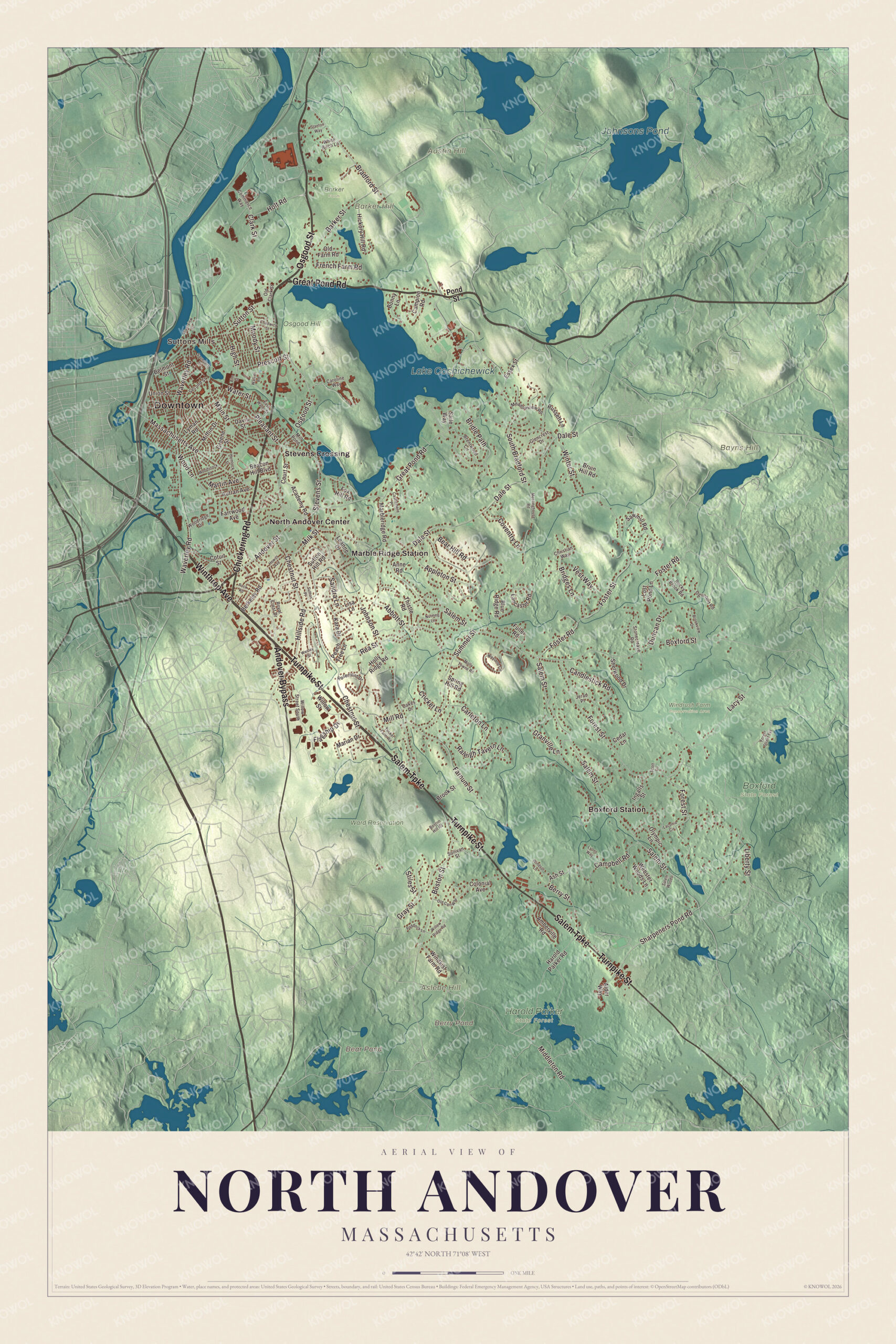
North Andover today
By KNOWOL
Hills shaded from United States Geological Survey elevation data and every street from the Census Bureau, from the Old Center and Osgood Street to Lake Cochichewick, the Ward Reservation, Barker Hill and Aslebe Hill.6
The history of North Andover, Massachusetts
Captain Nat's flannel
Nathaniel Stevens was born in the North Parish in 1786. He shipped before the mast from Salem, sailed to Leghorn, and came home to keep a grocery store near the church. In October 1813 he started making woolen goods on the upper fall of Cochichewick Brook, where Governor Bradstreet is said to have built a grist mill. On Abraham Marland's advice he turned to flannels. One day Abbott Lawrence looked over his goods and told him to shut down his mill and save his money. Stevens answered that he'd keep running as long as he could get water to turn his wheel. He said later he never told Lawrence he'd just reached a profit of five dollars a piece. He started with fifty pounds of wool a day, and by 1849 he was using four to five hundred.37
Girls at Franklin Academy
Franklin Academy opened in the North Parish in 1799 and 1800, and the town's 1880 history says it was the first incorporated school in Massachusetts to admit young ladies, with a place for them from the start. The building had two rooms, one for the preceptor and one for the preceptress. The first preceptress to teach real studies was Elizabeth Palmer. She married the preceptor, Nathaniel Peabody, in 1802, and her daughters grew up to be Elizabeth Peabody, Mrs. Nathaniel Hawthorne and Mrs. Horace Mann. Later the strict master Simeon Putnam ran the school, and once told a boy who dropped his books that in Bonaparte's army he'd have been shot. The academy closed about 1853, and its old building became a stable for the Bradstreet house.89
The house they called Bradstreet's
Simon and Anne Bradstreet were among the first settlers of the town, and in July 1666 their house burned to the ground. For generations afterward, an old house on Osgood Street went by the name of the Bradstreet House. Sarah L. Bailey, who was born in it, called it the home of the first woman poet in America in her 1880 history, and wrote of two venerable elms on its lawn. The Register write-up tells it differently: Parson Thomas Barnard built the house in 1715, after his own house burned. The North Andover Historical Society bought it in 1950 and opens it as the Parson Barnard House. Anne Bradstreet died here in 1672, and many historians believe she lies in the Old Burying Ground nearby.10116
North Andover, Massachusetts through the years
24 moments from 1634 to today.
- 1634The General Court reserves the land about Cochichewick for an inland plantation and promises settlers three years free of taxes.12
- 1643William Hughes of Ipswich sells cattle, a house and a house lot to Richard Barker of Cochichewick.13
- 1646Rev. John Woodbridge buys the Cochichewick Plantation from the sachem Cutshamekin, and it's incorporated as Andover, with its center here.1
- 1650Anne Bradstreet's poems are published in London as The Tenth Muse Lately Sprung Up in America.6
- 1666The Bradstreets' house burns to the ground in July.10
- 1672The oldest dated gravestones in the old burying ground, near the site of the first meetinghouse, carry this year.14
- 1692In the witch trials more than fifty people of the town are accused, and the magistrate Dudley Bradstreet, who refuses to grant more warrants, has to flee.15
- 1709The town is split into North and South parishes. The North Parish is today's North Andover.1
- 1715Parson Thomas Barnard builds the house on Osgood Street now known as the Parson Barnard House.11
- 1775Dr. Thomas Kittredge serves as an army surgeon at the Battle of Bunker Hill.16
- 1784The Kittredge Mansion on Academy Road is built for Dr. Thomas Kittredge.17
- 1799Franklin Academy is founded, by the 1880 town history's account the first incorporated school in Massachusetts to admit girls.8
- 1802James Scholfield buys the lower fall at Sutton's Mills for $120 and starts the first woolen mill in town.3
- 1813Nathaniel Stevens starts his woolen mill on the upper fall of Cochichewick Brook, the site of Governor Bradstreet's grist mill.3
- 1836Barnes, Gilbert and Richardson open a machine shop at Isaac Osgood's old grist mill, the start of Machine Shop Village.4
- 1844An organ comes into the North Parish meetinghouse, and the church's old orchestra of clarinet, bassoon, violin and bass viol falls silent.18
- 1850Ridgewood Cemetery has its first burial on November 9.19
- 1855On April 7 the North Parish is incorporated as the town of North Andover.2
- 1865The Evangelical church leaves the old center for a new church in Machine Shop Village.20
- 1892Moses T. Stevens of North Andover sits in Congress, the first Democrat ever chosen from his district.21
- 1892On August 11 two streetcars packed with people from a band concert run away down a long grade in town, and two passengers die.22
- 1907The Stevens Memorial Library is completed, on land and money given by Moses Tyler Stevens.23
- 1913The old Stevens homestead on Lake Cochichewick opens on July 1 as a vacation home run by a Boston church charity.24
- 1995The town buys Osgood Hill when Boston University plans to sell the Stevens estate for house lots.25
Places to see in North Andover, Massachusetts
Places worth a visit in North Andover today.
- Old CenterOsgood Street and Academy Road. Where the first Andover began.
- Parson Barnard House179 Osgood Street. The 1715 house long called Bradstreet's.Visit their website
- Old Burying GroundAcademy Road and Osgood Street. Gravestones dated as early as 1672.
- North Parish ChurchNorth Andover Green. The parish's Gothic church of 1836.
- Stevens HouseGreat Pond Road. A first-period house from before 1720.
- Lake CochichewickNortheast of the Old Center. The old Great Pond, the town's water.
- Suttons MillsCochichewick Brook. Where the first woolen mill started, 1802.
- Ward ReservationTurnpike Street. 704 acres of hayfields and woods.Visit their website
- Harold Parker State ForestSouthern part of town. State forest of woods and ponds.Visit their website
North Andover on the National Register of Historic Places
All 15 places in North Andover on the National Register of Historic Places that still stand today, oldest first, and why each one matters.5
-
North Andover Center Historic District
The historic center of North Andover, which was also the heart of Andover until the two towns split in 1855. Its 75 properties include the Parson Barnard House and the Kittredge Mansion, which stands on land that held the town's original muster ground.26
-
Carlton-Frie-Tucker House
It is a rare example of a period building that was moved and added onto another which had been damaged by fire. The oldest portion of the house, its east side and center chimney, were probably built c. 1709 by Ebenezer Frie.27
-
Abiel Stevens House
Built in 1710 by Abiel Stevens, one of Andover's early major landowners, this house is unusual for keeping its basic 18th-century form with little change. The rear lean-to and the front porch were added in the late 1700s.28
-
Samuel Frye House
Tradition says it went up between 1711, when an earlier house on the site burned, and 1719, when Samuel Frye gave it to his son. It stayed in the Frye family until 1880 and keeps its old two-room form, though its center chimney was taken out in the Federal period.29
-
Parson Barnard House
Parson Thomas Barnard built this house in 1715 after his earlier house burned, and it is counted among the most important First Period houses in New England. For many years it was believed to be the home of Simon and Anne Bradstreet. The North Andover Historical Society bought it in 1950 and opens it for tours.11
-
House at 922 Dale Street
A First Period house that grew in stages: its oldest part, at the right rear, is thought to date from the first quarter of the 1700s, rooms were added between 1740 and 1780, and a Federal-period remodeling gave it twin chimneys and its present shape.30
-
Capt. Timothy Johnson House
A gambrel-roofed house built about 1720 by Timothy Johnson, a leading Andover resident who led Massachusetts troops in the 1745 Siege of Louisbourg. It keeps a wealth of well-preserved First Period and Georgian detail.31
-
Col. John Osgood House
The original part of the house, its left side, was built c. 1720. A second, similar building (without chimney) was then attached to the right side of the chimney at a later date, demonstrating an unusual method of joining the two structures.32
-
Samuel Osgood House
Built about 1740, it is said to be the birthplace of Samuel Osgood (1747 to 1813), a member of the Continental Congress and the first Postmaster General of the United States. It is also said to be one of the places where Harvard College's library was kept during the Revolution.33
-
Kittredge Mansion
Built in 1784 for Dr. Thomas Kittredge, a doctor who served at the Battle of Bunker Hill, and home to generations of Kittredge doctors. Its design has been attributed to the Salem builder Samuel McIntire, and it was still in the family when it was listed in 1976.17
-
Machine Shop Village District
A mill village on Cochichewick Brook, just east of the town center, that grew up in the mid-1800s around two brick mill complexes. It keeps a stone mill of about 1825, a row of double workers' cottages on Water Street from 1839, mill owners' houses, and the 1865 Trinitarian Congregational Church.34
-
Ridgewood Cemetery
Organized in 1849, with its first burial on November 9, 1850, it was the town's third cemetery and its first in the rural cemetery style, with winding lanes. Its bronze gates, a gift of mill owner George Gilbert, were installed in 1909.19
-
Osgood Hill
Textile manufacturer Moses Tyler Stevens created this estate between 1884 and 1886, with a mansion and outbuildings by architect William C. Richardson. The Stevens heirs gave it to Boston University in 1951, and the town bought it in 1995 when the university planned to sell it for house lots. It is now a conference center.25
-
George Kunhardt Estate
Hardtcourt, a brick mansion overlooking Lake Cochichewick, was built in 1906 for George Kunhardt, owner of a textile mill complex in Lawrence, to a design by his friend Stephen Codman. The Jesuits made it a retreat called Campion Hall in 1937, and the house and carriage house are now part of a condominium development.35
-
Tavern Acres Historic District
A 1920s neighborhood around Memorial Park, laid out for the heirs of Moses Tyler Stevens with a plan by the Olmsted Brothers landscape firm. It includes the Stevens Memorial Library, built on land and money Stevens gave in 1904 and completed in 1907.23
North Andover in their words
“As long as I can get water to turn my wheel, I shall continue to run my mill.”
Captain Nathaniel Stevens to Abbott Lawrence, as his grandson told it to the North Andover Historical Society in 19257
“The long line of the Merrimac a flashing silver stream, the 'Great Pond' a crowning gem.”
George B. Loring, on the view from North Andover's hills, History of Essex County, 188836
“The town of North Andover may claim distinction, for this Academy was the first incorporated institution in Massachusetts to which young ladies were admitted.”
Historical sketches of Andover, 1880, on Franklin Academy8
Towns near North Andover, Massachusetts
Sources for the history of North Andover
- North Andover, Massachusetts, Wikipedia
- Standard history of Essex County, Massachusetts (1878), on the act of 1855, Internet Archive
- A sketch of the early days of the woolen industry in North Andover, Massachusetts, by Nathaniel Stevens (1925), Internet Archive
- History of Essex County, Massachusetts (1888), on the mills of the Cochichewick, Internet Archive
- National Register of Historic Places listings in Essex County, Massachusetts, Wikipedia
- Map of North Andover, Massachusetts in 2026, KNOWOL (USGS elevation, Census Bureau roads)
- A sketch of the early days of the woolen industry in North Andover, Massachusetts (1925), on Captain Stevens and Abbott Lawrence, Internet Archive
- Historical sketches of Andover (comprising the present towns of North Andover and Andover), Massachusetts (1880), on Franklin Academy, Internet Archive
- History of Essex County, Massachusetts (1888), on Franklin Academy and Simeon Putnam, Internet Archive
- Historical sketches of Andover (comprising the present towns of North Andover and Andover), Massachusetts (1880), on the Bradstreet house, Internet Archive
- Parson Barnard House, Wikipedia
- History of Essex County, Massachusetts (1888), George B. Loring's North Andover chapter, on the 1634 order, Internet Archive
- History of Essex County, Massachusetts (1888), on Richard Barker of Cochichewick, Internet Archive
- History of Essex County, Massachusetts (1888), on the old burying ground, Internet Archive
- History of Essex County, Massachusetts (1888), on 1692 in North Andover, Internet Archive
- History of Essex County, Massachusetts (1888), on Dr. Thomas Kittredge, Internet Archive
- Kittredge Mansion, Wikipedia
- History of Essex County, Massachusetts (1888), on the North Parish meetinghouse, Internet Archive
- Ridgewood Cemetery, Wikipedia
- History of Essex County, Massachusetts (1888), on the Evangelical church, Internet Archive
- Massachusetts of today (1892), on Moses Tyler Stevens, Internet Archive
- Annual report of the Board of Railroad Commissioners, Massachusetts (report for 1892), on the North Andover streetcar accident, Internet Archive
- Tavern Acres Historic District, Wikipedia
- Annual report of the Central Board of the Benevolent Fraternity of Churches (report covering 1913), on the Vacation Home at North Andover, Internet Archive
- Osgood Hill, Wikipedia
- North Andover Center Historic District, Wikipedia
- Carlton-Frie-Tucker House, Wikipedia
- Abiel Stevens House, Wikipedia
- Samuel Frye House, Wikipedia
- House at 922 Dale Street, Wikipedia
- Capt. Timothy Johnson House, Wikipedia
- Col. John Osgood House, Wikipedia
- Samuel Osgood House, Wikipedia
- Machine Shop Village District, Wikipedia
- George Kunhardt Estate, Wikipedia
- History of Essex County, Massachusetts (1888), George B. Loring on the North Andover landscape, Internet Archive