
The Meadow City on the Connecticut River, settled at Nonotuck in 1654, where Jonathan Edwards preached on Meeting-house Hill, a silk boom and an abolitionist community made the village of Florence, and Jenny Lind looked out from Round Hill and called it the Paradise of America.
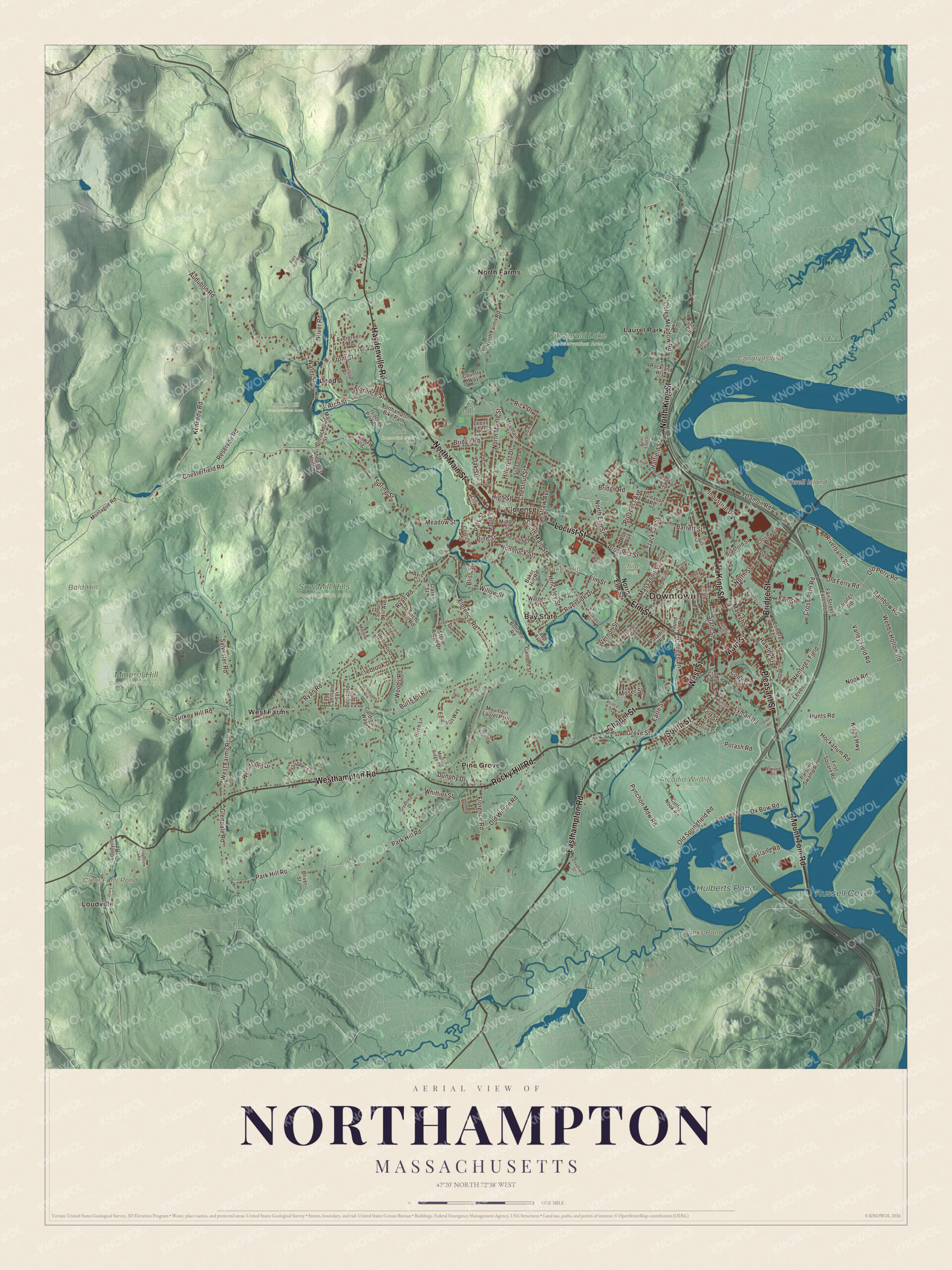
Northampton, Massachusetts on the map
Click the map to look closer.
Northampton today
By KNOWOL
Shaded hills and the Connecticut River valley from Leeds and Florence down to downtown, with Main, Elm, King and West streets, Laurel Park, Danks Pond, Hulberts Pond, Russell Cove, Baker Hill, Bald Hill, Canary Island and Elwell Island printed by name.2
The history of Northampton, Massachusetts
How Florence got its name
For two centuries the plain along the Mill River was just Broughton's Meadow, and in 1812 it had seven houses. Then came the mulberry craze of 1835 to 1845, when Samuel Whitmarsh led the planting of 400 to 500 acres of mulberry trees for silk. A 1904 history says that bubble created Florence. The Northampton Association took over the silk works in 1842, and in summer its Sunday meetings gathered under a giant old pine, where William Lloyd Garrison and Wendell Phillips spoke and Sojourner Truth held crowds with her singing and her quick wit. The place was called the Community, then Bensonville, then Greenville. In the fall of 1852 the villagers met in the South schoolhouse, and Dr. Munde offered the name of Italy's silk city. Florence stuck. His name for the stream, the Arno, never did.647189
The morning the Mill River came down
Leeds began as Rail Hill, settled about 1790 up the Mill River. A sawmill came in 1800, a cotton mill in 1808, and in 1812 Col. James Shepherd built a woolen mill, so for forty years the place was Shepherd's Hollow. When Henry Clay rode through in 1833 the mill hands lined up to greet him, and he was given a roll of their broadcloth. The village later took the name of Leeds, England, and turned to silk. Then on May 16, 1874, the reservoir dam up the river gave way. George Cheney rode for Williamsburg, Collins Graves and Jerome Hillman for Haydenville, and Myron Day drove on through Leeds to warn Florence. Fifty-one people died in Leeds, and of thirty buildings on its main street only three were left. Leeds rebuilt its mills and carried on.101161213
Pudding Lane and the Old Church
Old Northampton grew up around Meeting-house Hill, and an 1841 book passed along the saying that its crooked streets were laid out by the cows, following their paths to pasture. Five meetinghouses have stood on that hill, the first a log house of 1654. For thirty-six years the town had no bell, and meetings were called by drum or trumpet. The streets had no official names until 1826. Before that, Hawley Street was Pudding Lane, Elm Street was New Boston and West Street was Welch End. Out on the river meadows the first settlers' names, Old Rainbow, Bark Wigwam and Hog's Bladder, were still in use in 1904. Jenny Lind sang in the Old Church of 1812, and when it came down in 1876, the town remembered that no other building had been so much loved.14151617181920
Northampton, Massachusetts through the years
25 moments from 1653 to today.
- 1653John Pynchon and his partners buy the Nonotuck land for 100 fathoms of wampum, ten coats, some small things and the plowing of sixteen acres.21
- 1654The first settlers arrive in the spring and raise a log meetinghouse, 26 by 18 feet, on Meeting-house Hill.15
- 1656Northampton is incorporated as a town.2
- 1710The Mill River is turned to run straight to the Connecticut instead of around Fort Hill into Danks's pond.22
- 1734Jonathan Edwards leads a revival here that spreads through the Connecticut River Valley.1
- 1786William Butler starts the Hampshire Gazette. He later makes all its paper by hand at his own mill.23
- 1786On August 29, Daniel Shays and his followers stop the civil court from sitting in Northampton.1
- 1812Col. James Shepherd builds a woolen mill at Rail Hill, and for forty years the place is called Shepherd's Hollow.10
- 1823George Bancroft and Joseph G. Cogswell open the Round Hill School for boys, which once had two hundred pupils.24
- 1825General Lafayette rides in from Pittsfield and is given a royal reception.25
- 1826A town committee gives the streets their present names. Hawley Street had been Pudding Lane.17
- 1833Henry Clay passes through Shepherd's Hollow, where the mill hands line up to greet him and give him a roll of broadcloth.11
- 1840A spring freshet cuts across the neck of the Oxbow and gives the Connecticut River its present channel.3
- 1842The Northampton Association of Education and Industry starts its silk community in what is now Florence.1
- 1851Jenny Lind sings in the Old Church on the night before the Fourth of July.19
- 1852The villagers meet in the South schoolhouse and name their village Florence, after the silk city of Italy.6
- 1867The Clarke School for the Deaf opens, the first permanent oral school for the deaf in the United States.1
- 1874The Mill River flood of May 16 sweeps through Leeds, where fifty-one people die.12
- 1875Smith College is dedicated on July 14, with a first entering class of thirteen.26
- 1876Robbers take $1.6 million from the Northampton National Bank in January and hide the loot in a schoolhouse by the Bridge Street cemetery.127
- 1883Northampton becomes a city.1
- 1892The first game of women's basketball is played at Smith College.1
- 1904The Meadow City celebrates 250 years with three days of festivities, June 5 to 7.28
- 1910Calvin Coolidge becomes mayor, on his way to the governor's office and the White House.1
- 1930Look Park, about 150 acres given by Fannie Burr Look, opens in Florence on the Mill River.2
Places to see in Northampton, Massachusetts
Places worth a visit in Northampton today.
- Academy of MusicMain Street. Theater Edward H. R. Lyman gave the city.Visit their website
- First ChurchMain Street. Jonathan Edwards' home church, with Tiffany glass.Visit their website
- City HallMain Street. The castle-like city hall downtown.
- Smith CollegeElm Street. Women's college; College Hall dates from 1875.Visit their website
- Forbes LibraryWest Street. Home of the Coolidge presidential library.Visit their website
- Clarke School for the DeafRound Hill Road. First permanent oral school for the deaf.Visit their website
- Ross FarmMeadow Street, Florence. Northampton Association farmhouse of the 1840s.
- Look ParkFlorence. Fannie Burr Look's gift, opened 1930.Visit their website
- LeedsMill River, northwest. Mill village rebuilt after the 1874 flood.
- Elwell IslandConnecticut River. A sand bar Levi Elwell grew with willows.
Northampton on the National Register of Historic Places
All 14 places in Northampton on the National Register of Historic Places that still stand today, oldest first, and why each one matters.5
-
Northampton Downtown Historic District
Main Street has been the center of Northampton's civic and business life since the town began. After a fire in 1870 it was rebuilt mostly in brick and stone, and the district takes in the Academy of Music, the First Church and the castle-like City Hall.29
-
Parsons, Shepherd, and Damon Houses Historic District
Three houses of Historic Northampton on land first laid out in 1654: the Nathaniel Parsons House, its core built about 1719, the Federal Shepherd House of 1795, and the house of about 1813 built by Isaac Damon, one of the area's leading Federal-style builders.30
-
The Manse
It stands on Rev. Solomon Stoddard's land, where his 1684 parsonage stood and his grandson Jonathan Edwards briefly lived. Stoddard's son John built the rear ell in 1744, and his grandson Solomon, sheriff of Hampshire County, added the front in 1782.31
-
Fort Hill Historic District
Six houses on South Street built by families of the first settlers, the Clapps, Strongs and Bartletts. The Capt. Roger Clapp House of about 1753 is the oldest, and the Eleazer Strong House of 1797 is one of the city's oldest Federal houses.32
-
Ross Farm
The farmhouse of the Northampton Association of Education and Industry, the abolitionist silk community of the 1840s whose members included Sojourner Truth. Austin Ross, the next owner, kept it a station on the Underground Railroad.7
-
Dorsey-Jones House
Built in 1849 in Florence for Basil Dorsey, who had escaped from slavery in 1836 with abolitionists' help, on land bought from George Benson's silk company. In 1854 it was bought by Mary Jones, wife of the preacher and antislavery activist Thomas H. Jones, who had escaped too.33
-
Pomeroy Terrace Historic District
One of the city's most desirable neighborhoods of the 1800s, east of the railroad, built up mostly between about 1855 and 1870. It reaches across Bridge Street to take in the Bridge Street Cemetery, one of the town's first civic institutions.34
-
Clarke School for the Deaf Historic District
The Round Hill Road campus of the Clarke School for the Deaf, founded in 1867 as the first permanent oral school for the deaf in the United States. Grace Coolidge, later first lady, was among its teachers.35
-
Grove Hill Mansion
Built on the hill above Leeds for Lucius Dimock, director of the Nonotuck Silk Company, it looks much like the company's 1879 mill because the same architect, Eugene C. Gardner, designed both. A 1954 account called its Eastlake staircase, inlaid doors and attic chapel the most spectacular home interior in the area.36
-
Building at 8 to 22 Graves Avenue
A row of eight red brick Queen Anne rowhouses, built about 1887 on the old house lot of Elisha Graves during a boom in the city's growth. Its first tenants were working people, among them a photographer, a milk contractor and a telegraph operator.37
-
Smith Alumnae Gymnasium
In this 1890 gym, one of the first in America built just for women, Senda Berenson Abbott staged the first formal women's basketball game in 1892. Saved from demolition in the 1970s, it now holds the college archives.38
-
Calvin Coolidge House
A plain two-family house that Calvin and Grace Coolidge rented for about 25 years, through his rise from the city council to governor, vice president and president. He never owned it, and in 1930 he moved to The Beeches on Hampton Terrace to get away from the tourists.39
-
Northampton Veterans Administration Hospital Historic District
Opened in Leeds in 1924 to care for veterans with mental illness, it was the first VA hospital in Massachusetts and is a well-kept example of the first generation of VA psychiatric hospitals. Most of its buildings date from 1922 to 1947.40
-
Miss Florence Diner
A Worcester Lunch Car Company diner opened in 1941 by Maurice and Pauline Florence Alexander and enlarged into an L in 1949, with Moderne lettering and a chevron sign in the center of Florence. The same family owned it for more than fifty years.41
Northampton in their words
“This is the Paradise of America.”
Jenny Lind, looking out from Round Hill, as remembered in The Meadow City's quarter-millennial book, 190442
“In that village, if anywhere in this broad land, were developed people of simple living and high thinking”
Western Massachusetts: a history, 1926, on Florence43
“No other building in town was so much admired, none other so much loved.”
Historical localities in Northampton, 1904, on the Old Church of 181220
Towns near Northampton, Massachusetts
Sources for the history of Northampton
- Northampton, Massachusetts, Wikipedia
- Map of Northampton, Massachusetts in 2026, KNOWOL (USGS elevation, Census Bureau roads)
- Historical localities in Northampton (1904), on the Oxbow, Internet Archive
- Historical localities in Northampton (1904), on the mulberry fields of Florence, Internet Archive
- National Register of Historic Places listings in Hampshire County, Massachusetts, Wikipedia
- The history of Florence, Massachusetts (1895), on how Florence took its name, Internet Archive
- Ross Farm, Wikipedia
- The history of Florence, Massachusetts (1895), on the Sunday meetings under the old pine, Internet Archive
- The history of Florence, Massachusetts (1895), on Sojourner Truth, Internet Archive
- Historical localities in Northampton (1904), on Shepherd's Hollow, Internet Archive
- Historical localities in Northampton (1904), on Henry Clay's visit, Internet Archive
- The history of Florence, Massachusetts (1895), on the Mill River flood of 1874, Internet Archive
- Leading manufacturers and merchants of central and western Massachusetts (1887), on Leeds, Internet Archive
- Historical collections, relating to the history and antiquities of every town in Massachusetts (1841), on Northampton, Internet Archive
- Historical localities in Northampton (1904), on Meeting-house Hill, Internet Archive
- Historical localities in Northampton (1904), on the town without a bell, Internet Archive
- Historical localities in Northampton (1904), on the old street names, Internet Archive
- Historical localities in Northampton (1904), on the names of the meadows, Internet Archive
- Historical localities in Northampton (1904), on Jenny Lind's concerts, Internet Archive
- Historical localities in Northampton (1904), on the Old Church, Internet Archive
- Western Massachusetts: a history, 1636-1925 (1926), on the purchase of Nonotuck, Internet Archive
- Historical localities in Northampton (1904), on the old course of the Mill River, Internet Archive
- Historical localities in Northampton (1904), on William Butler's paper mill, Internet Archive
- Historical localities in Northampton (1904), on the Round Hill School, Internet Archive
- Historical localities in Northampton (1904), on Lafayette's visit, Internet Archive
- Historical localities in Northampton (1904), on Smith College, Internet Archive
- Historical localities in Northampton (1904), on the bank robbers' hiding place, Internet Archive
- The Meadow City's quarter-millennial book: the 250th anniversary of the settlement of Northampton, June 5, 6 and 7, 1904, Internet Archive
- Northampton Downtown Historic District, Wikipedia
- Parsons, Shepherd, and Damon Houses Historic District, Wikipedia
- The Manse, Wikipedia
- Fort Hill Historic District, Wikipedia
- Dorsey-Jones House, Wikipedia
- Pomeroy Terrace Historic District, Wikipedia
- Clarke Schools for Hearing and Speech, Wikipedia
- Grove Hill Mansion, Wikipedia
- Building at 8 to 22 Graves Avenue, Wikipedia
- Smith Alumnae Gymnasium, Wikipedia
- Calvin Coolidge House, Wikipedia
- Northampton Veterans Affairs Medical Center, Wikipedia
- Miss Florence Diner, Wikipedia
- The Meadow City's quarter-millennial book (1904), on Jenny Lind at Round Hill, Internet Archive
- Western Massachusetts: a history, 1636-1925 (1926), on the spirit of Florence, Internet Archive