
A farm town that began as Bryan's Farms in the north of Milford, with a white Federal church on a green where boys once chased geese for their quill pens, and where PEZ mints are made today.
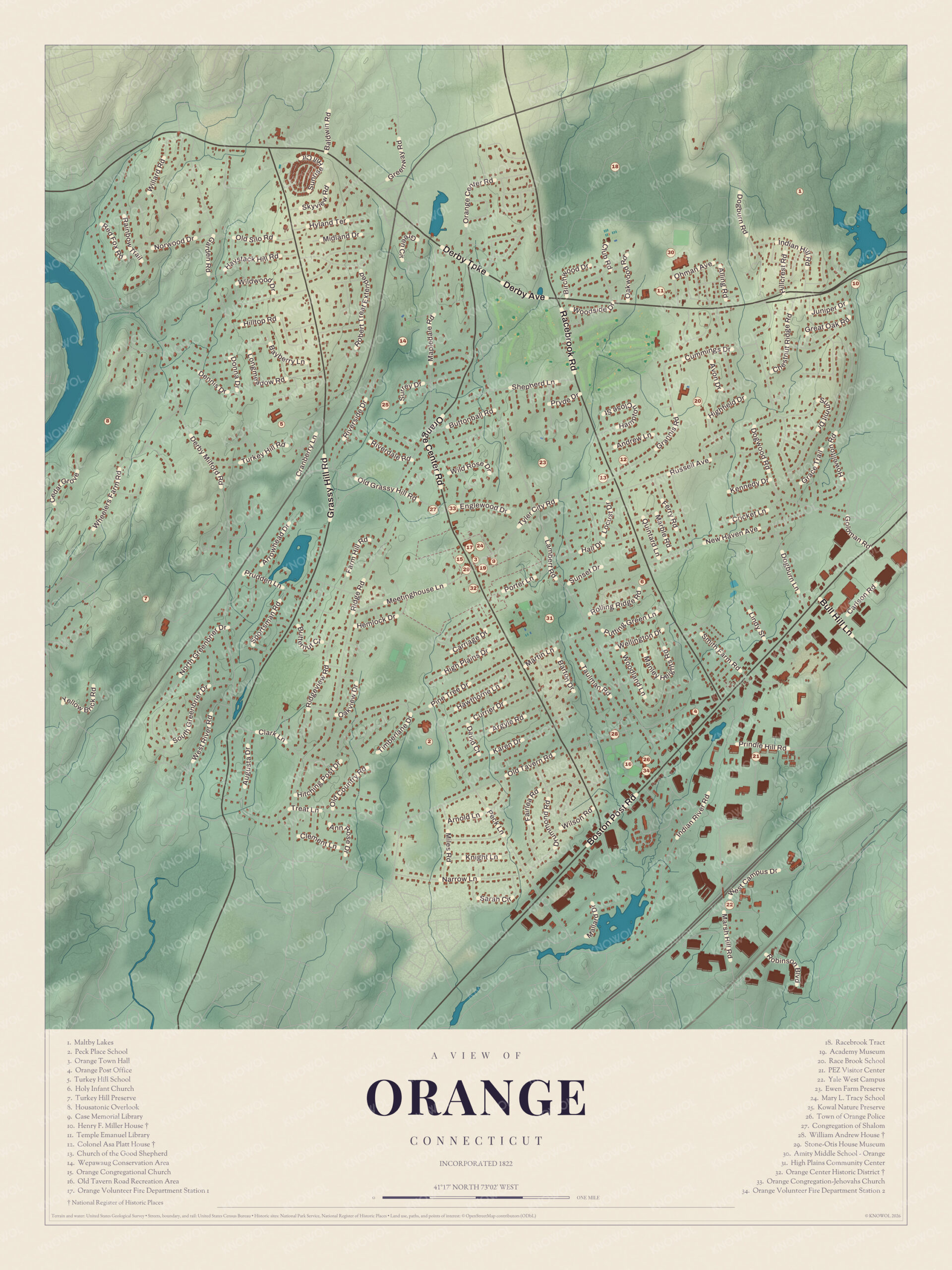
Orange on the map
Click the map to look closer.
Orange today
By KNOWOL
Shaded hills from Georges Cellar Hill to Turkey Hill and the Maltby Lakes, every street from Orange Center Road to the Boston Post Road, and a guide of 34 numbered landmarks with the National Register sites marked.6
The story of Orange
Geese on the green
Orange Center began as Bryan's Farms. The land was surveyed in 1687, and Richard Bryan, Jr., of Milford was the first to settle here for good. By 1750 enough farm families had come that a winter school was set up. For Sunday meeting people went to Milford, until about 1790 they built a meeting house of their own for winter preaching. In 1804 fifty petitioners won their own society, and the church began in 1805 with five members. A man born here in the 1840s remembered the green as a goose pasture, where boys chased the geese for quills to make school pens and climbed the steeple by its lightning rod. Deacon Beach's horse, he said, once heard the Sunday bell while the deacon lay sick, jumped the fences and went to its place in the horse sheds.7389
Tyler City
Two miles east of Orange Center, Tyler City grew up around a stop on the Derby railroad, which came through Orange in 1871. An 1892 county history called it a hamlet of a few buildings. One was the shop of the Peerless Button Hole Attachment Company, incorporated in 1887. A large building put up for a private school later became the county home of refuge, and the station had its own post office. Leonard Schaffnit, who came from Germany, settled here in 1882 to make cigars and became the station agent in 1885. Edward W. Russell opened the Tyler City Creamery in May 1890 and lived on the property where Colonel Platt had kept a hotel for many years. The name lives on in Tyler City Road, where the Colonel Asa Platt House still stands.101112113
The House of Tomorrow
In 1948 and 1949 Henry F. Miller, a student at the Yale School of Architecture, designed and built a house on Derby Avenue as his master's thesis. It was one of the area's first modern houses, with a flat roof, an open plan with movable walls and wide sheets of glass, set on the side of a hill above wetlands. Its windows face south, shaded so the winter sun comes in and the summer sun stays out, and the roof could be flooded in summer to cool the house. The New Haven Register called it "The House of Tomorrow." For a few weeks it was opened to raise money for the New Haven Boys' Club, and about 25,000 people paid a small admission to walk through it. The Millers lived there, and it joined the National Register in 2001.4
Through the years
25 moments from 1639 to today.
- 1639Rev. Peter Prudden buys the land from the Native people for coats, blankets, a kettle, hatchets, hoes, knives and small mirrors.1
- 1687The land around today's Orange Center is surveyed and laid out, though no one settles it until after 1700.7
- 1700sRichard Bryan, Jr., of Milford is the first to settle here for good, and the area becomes Bryan's Farms.7
- 1750So many farm families live here that a winter school is set up.7
- 1790About this year the people of North Milford build a meeting house for winter preaching.3
- 1791A common is set aside at the center; part of it is today's town green.14
- 1800Work begins on a toll road from New Haven to Derby through Orange.1
- 1804Fifty petitioners win their own church society for North Milford.3
- 1805The church is organized on March 13 with five members, and Erastus Scranton becomes its minister.3
- 1810The Congregational church designed by David Hoadley is built on the green.14
- 1811About this year the Colonel Asa Platt House goes up, after Platt bought the land in 1810.13
- 1822North Milford parish and West Haven parish are united as the town of Orange in May.2
- 1823Charles W. Alling starts a mill in Orange for carding wool and dressing cloth.15
- 1847The town sells the Platt house, used for a time as its poor farm, to William Russell.13
- 1871The New Haven and Derby Railroad opens through Orange, with a station in town.1
- 1878The Academy, a schoolhouse with Stick style trim, is built at the center.14
- 1882Leonard Schaffnit settles at Tyler City and starts making cigars.11
- 1887The Peerless Button Hole Attachment Company is incorporated at Tyler City.10
- 1890Edward W. Russell opens the Tyler City Creamery in May.12
- 1898The first Orange Country Fair is held; it runs until 1912 and returns in 1975.1
- 1905The church on the green celebrates its hundredth anniversary, June 30 to July 2.16
- 1921The General Assembly sets off West Haven as its own town, leaving Orange largely rural.1
- 1949Henry F. Miller finishes the House of Tomorrow on Derby Avenue.4
- 1973PEZ builds a factory in Orange.17
- 2000The town buys the William Andrew House, the oldest building in Orange, to make it a museum.18
Places to see
The numbers match the landmark guide printed on the 2026 map.
- 1Maltby LakesOn the West Haven line. Three reservoirs, dams first built 1862.
- 3Orange Town HallOrange Center. Beside the church on the green.
- 10Henry F. Miller House30 Derby Avenue. The House of Tomorrow, 1949.
- 12Colonel Asa Platt HouseTyler City Road. Federal house credited to David Hoadley.
- 15Orange Congregational ChurchThe town green. David Hoadley's church of 1810.
- 19Academy MuseumOrange Center. Schoolhouse of 1878, now a museum.Visit their website
- 21PEZ Visitor CenterSoutheast Orange. Where PEZ mints are still made.
- 28William Andrew HouseOld Tavern Road. The oldest building in Orange.
- 29Stone-Otis House MuseumOrange Center. Federal house of about 1830.Visit their website
- 31High Plains Community CenterSoutheast of the center. Home of the Orange Country Fair.
On the National Register
All 4 places in Orange on the National Register of Historic Places that still stand today, oldest first, and why each one matters.5
-
William Andrew House
The oldest surviving building in Orange, a Georgian colonial house with a finely detailed cornice, feather-edged sheathing and hand-split lath put up without nails. One source dates it to about 1750 for the Bryan family of North Milford, another to about 1775 for William Andrew. The town bought it in 2000, and the historical society runs it as a house museum.18
-
Orange Center Historic District
The old farming town center around the green set aside in 1791. Its centerpiece is David Hoadley's Federal church of 1810, with a Palladian window, a domed belfry and a painted black oval window on the tower, along with the Stone-Otis House of about 1830 and The Academy of 1878.14
-
Col. Asa Platt House
A fine Federal house credited to the New Haven builder David Hoadley for its exceptional woodwork. It was taken by the town for taxes and used for a time as the poor farm, then sold in 1847 to William Russell, whose family kept it into the late 1900s.13
-
Henry F. Miller House
Henry F. Miller designed and built it in 1948 and 1949 as his Yale master's thesis, one of the area's first International Style houses. Called "The House of Tomorrow," it drew about 25,000 paying visitors and helped spread modern architecture in Connecticut.4
In their words
“We who were born here have a rich inheritance, and are the debtors of the goodly men and women whose names today are on our lips.”
A native son at the Orange church's centennial, printed in 19108
“The Green was a goose pasture in those days, and we boys used to chase them about trying to make them shed their quills for pens to be used in school.”
The same speaker, remembering his boyhood on the green8
“although our buildings are too small to accommodate you we trust our hearts are large enough to hold you.”
Welcome to the Orange church's centennial, printed in 191019
Nearby towns
Sources
- Orange, Connecticut, Wikipedia
- History of New Haven County, Connecticut (1892), on how Orange was formed, Internet Archive
- Contributions to the ecclesiastical history of Connecticut (1861), on the church in Orange, Internet Archive
- Henry F. Miller House, Wikipedia
- National Register of Historic Places listings in New Haven County, Connecticut, Wikipedia
- Map of Orange, Connecticut in 2026, KNOWOL (USGS elevation, Census Bureau roads)
- History of New Haven County, Connecticut (1892), on Orange village and Bryan's Farms, Internet Archive
- Church of Christ Congregational in Orange, Connecticut, centennial papers and addresses (1910), on the green, Internet Archive
- Church of Christ Congregational in Orange, Connecticut, centennial papers and addresses (1910), on Deacon Beach, Internet Archive
- History of New Haven County, Connecticut (1892), on the academy and Tyler City, Internet Archive
- History of New Haven County, Connecticut (1892), on Leonard A. Schaffnit, Internet Archive
- History of New Haven County, Connecticut (1892), on Edward W. Russell, Internet Archive
- Col. Asa Platt House, Wikipedia
- Orange Center Historic District, Wikipedia
- History of New Haven County, Connecticut (1892), on the Alling mill, Internet Archive
- Church of Christ Congregational in Orange, Connecticut, centennial papers and addresses (1910), foreword, Internet Archive
- Pez, Wikipedia
- William Andrew House, Wikipedia
- Church of Christ Congregational in Orange, Connecticut, centennial papers and addresses (1910), the welcome, Internet Archive