
A hill town above the Housatonic whose voters marched on Derby to win their own town in 1798, where Quaker Farms keeps its 1812 church and the old Oxford Turnpike, now Route 67, still runs through the center.
Oxford on the map
Click the map to look closer.
Oxford today
By KNOWOL
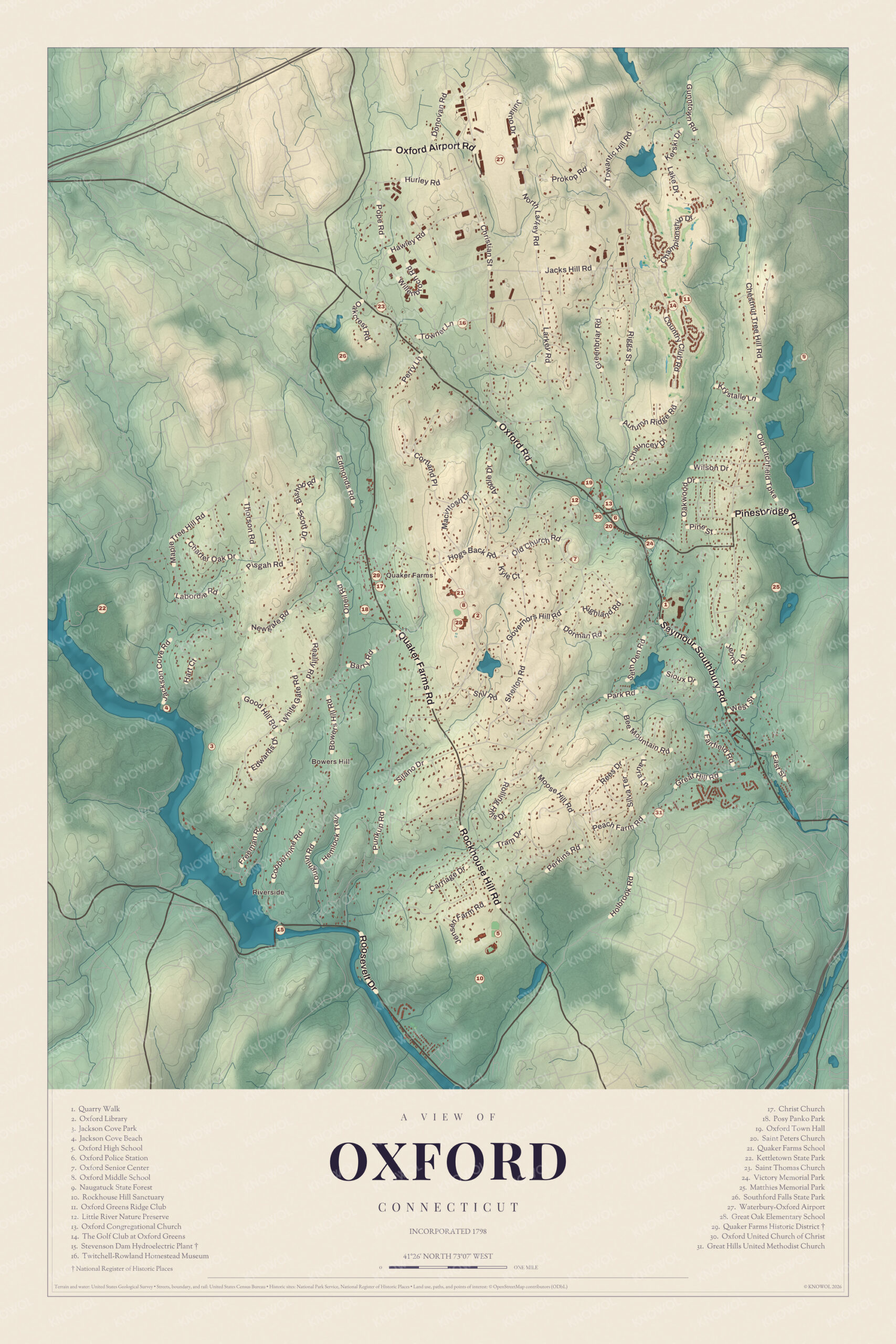
Shaded hills from Bowers Hill down to the Housatonic and north to Southford Falls, every street, with Quaker Farms, Riverside, Pinesbridge and Bowers Hill printed by name, and a guide of 31 numbered landmarks with the National Register sites marked.4
The story of Oxford
The morning Oxford marched on Derby
Until 1798 Oxford was a parish of Derby, and year after year its people asked to become a town of their own. An 1880 history tells how they finally forced the issue. Derby's town meeting was warned for nine in the morning, but by custom it never opened before one in the afternoon. So the Oxford voters gathered on their main street, formed a procession and marched to the Derby town house, bringing their minister along to say the opening prayer. They opened the meeting at nine sharp. By the time Derby riders had rounded up enough voters, Oxford had chosen the town clerk and voted to hold half of all town meetings in Oxford. Oxford became a town that October, and its first town meeting, held in deep snow, was fully attended.5671
The farmer who gave Yale a telescope
Sheldon Clark was born in Oxford in 1785 and raised by his grandfather, who thought a college education was a waste of money. Sheldon read every book he could find, and after his grandfather died in 1811 he spent a winter studying at Yale. Then he went home to farm. By hard work and thrift he grew his $20,000 inheritance to $25,000, and in 1823 he gave Yale $5,000 to grow into a professorship, which put this plain hill-town farmer at the head of the college's benefactors. In 1829 he gave a telescope with a ten-foot focal length, made to his order. He also left the town money for a bridge at Pines Bridge. He died in 1840 after a fall from his hay mow.8910
Who was the Quaker?
The village of Quaker Farms is older than the town around it. The old town records call it Quaker's Farm, and the name was in use by 1683, but no one has ever learned who the Quaker was or where he went. Abraham Wooster, father of General David Wooster, bought land here in 1722 and kept a mansion house and a farm with a sawmill. John Griffin, the first English child born here, came along in 1725 and lived to fight at Quebec under Wolfe. Later David Tomlinson sold goods from a room in his house, built a trade that reached for miles, and sent ships to foreign ports until French privateers took one. Christ Church went up in 1812, and it still anchors the village.1112131415
Through the years
25 moments from 1678 to today.
- 1678The first of more than a dozen Indian deeds for the land of the original Oxford is given; the last comes in 1710.16
- 1683The name Quaker's Farm is already in use, though no one ever learns who the Quaker was.11
- 1722Abraham Wooster, father of General David Wooster, buys land at Quaker's Farm and runs a farm with a sawmill.11
- 1725John Griffin, the first English child born at Quaker's Farm, is born; he lives to fight at Quebec under Wolfe.13
- 1741Oxford becomes a separate parish of Derby.17
- 1745Rev. Jonathan Lyman is ordained Oxford's first minister.18
- 1747Mills are standing at the Wooster mill site on the Little River.19
- 1764Rev. Richard Mansfield gathers the Episcopal parish of St. Peter's.20
- 1770St. Peter's first church is finished on Governor's Hill.21
- 1795The Oxford Turnpike is chartered, the second in the state, and the Congregational meetinghouse is raised.22
- 1795Daniel and Job Candee build the hotel later called the Oxford House, home of the first post office.22
- 1798Oxford becomes a town in October and holds its first town meeting that November in deep snow.7
- 1812Christ Church is built at Quaker Farms.15
- 1823Oxford farmer Sheldon Clark gives Yale $5,000 to grow into a professorship.9
- 1826Eureka Chapter of Royal Arch Masons is founded in Oxford; it moves to Waterbury in 1847.23
- 1829Sheldon Clark gives Yale a telescope with a ten-foot focal length, made to his order.8
- 1834St. Peter's builds its present church on the south side of the green.20
- 1836Oxford has three satinet factories and a large hat manufactory run by Hunt and Crosby.24
- 1850Seymour is formed, taking part of Oxford; Beacon Falls takes more in 1871.25
- 1861At least seventy-five Oxford men enlist in the Union army.26
- 1876Oxford holds a centennial celebration on the Fourth of July, with a town history read by Judge N. J. Wilcoxson.27
- 1919The Stevenson Dam starts making electricity, and the river behind it becomes Lake Zoar.28
- 1965The Wooster mill stops running when its last miller, Joe Montriski, dies.19
- 1969Waterbury-Oxford Airport opens on old farmland.4
- 2024On August 18, 16.31 inches of rain fall in Oxford, the most ever recorded in the state.1
Places to see
The numbers match the landmark guide printed on the 2026 map.
- 2Oxford LibrarySouthwest of the center. Founded 1883, moved here in 2018.Visit their website
- 13Oxford Congregational ChurchOxford Center. The parish church since the 1740s.
- 15Stevenson Dam Hydroelectric PlantHousatonic River, Route 34. First high dam on the river.
- 16Twitchell-Rowland Homestead MuseumNorth of town. Award-winning Oxford Historical Society preservation.Visit their website
- 17Christ Church470 Quaker Farms Road. Federal and Gothic church of 1812.
- 19Oxford Town HallOxford Center. Town offices in the center.
- 20Saint Peters ChurchOxford Center. Episcopal parish gathered in 1764.
- 26Southford Falls State ParkNorth of town. Waterfalls, fire tower and covered bridge.Visit their website
- 27Waterbury-Oxford AirportNorth of the center. Opened in 1969 on farmland.
- 29Quaker Farms Historic DistrictQuaker Farms Road. The old village, houses from the 1720s.
On the National Register
All 3 places in Oxford on the National Register of Historic Places that still stand today, oldest first, and why each one matters.3
-
Quaker Farms Historic District
A small rural village on the old road between Derby and Woodbury, anchored by Christ Church, an 1812 wood-frame church in the Federal and Gothic styles with a well-preserved early interior. Around it stand eleven houses from the middle 1700s to the middle 1800s, the oldest from the 1720s, and one built about 1800 as a carriage factory.15
-
Wooster Sawmill and Gristmill Site
From at least 1747 until 1965 this site on the Little River sawed lumber, ground grain and pressed cider, one of the longest known histories of any water-powered mill complex in the country. Captain John Wooster bought it about 1750, and Joe Montriski, who built the present mill in the 1920s, ran it until his death. It's now a private home.19
-
Stevenson Dam Hydroelectric Plant
The first high dam on the Housatonic, built by about 800 men who lived at a work camp called Camp Crisfield. The bridge built into the dam carries Route 34, and the water it held back became Lake Zoar, covering a place called Pleasant Vale that had been part of Oxford. The powerhouse stands on the Monroe side.28
In their words
“He is said to have been marshal of the day in that grand Oxford descent upon old Derby, leading the procession to complete triumph, being assisted by the parson.”
The history of the old town of Derby, 1880, on the march that won Oxford its town6
“This new instance of liberality excited additional interest in the hardworking Oxford farmer, whose example had now placed him at the head of the benefactors of this ancient literary institution.”
History of Seymour, Connecticut, 1879, on Sheldon Clark and Yale8
“In 1861, at the breaking out of the civil war, Oxford's sons proved themselves true to the old flag and the support of the authority of the nation.”
The history of the old town of Derby, 188026
Nearby towns
Sources
- Oxford, Connecticut, Wikipedia
- History of New Haven County, Connecticut (1892), on the Oxford Turnpike, Internet Archive
- National Register of Historic Places listings in New Haven County, Connecticut, Wikipedia
- Map of Oxford, Connecticut in 2026, KNOWOL (USGS elevation, Census Bureau roads)
- The history of the old town of Derby, Connecticut, 1642-1880 (1880), on Oxford's march to Derby, Internet Archive
- The history of the old town of Derby, Connecticut, 1642-1880 (1880), on the end of the march, Internet Archive
- The history of the old town of Derby, Connecticut, 1642-1880 (1880), on Oxford's first town meeting, Internet Archive
- History of Seymour, Connecticut (1879), on Sheldon Clark, Internet Archive
- A selection from the miscellaneous historical papers of fifty years (1918), on the benefactors of Yale, Internet Archive
- History of New Haven County, Connecticut (1892), on Sheldon Clark, Internet Archive
- The history of the old town of Derby, Connecticut, 1642-1880 (1880), on Quaker's Farm, Internet Archive
- The Connecticut magazine (1908), on Abraham Wooster, Internet Archive
- The history of the old town of Derby, Connecticut, 1642-1880 (1880), on the first births at Quaker's Farm, Internet Archive
- The history of the old town of Derby, Connecticut, 1642-1880 (1880), on David Tomlinson, Internet Archive
- Quaker Farms Historic District, Wikipedia
- History of New Haven County, Connecticut (1892), on the first settlers and Riggs Street, Internet Archive
- History of New Haven County, Connecticut (1892), on the Oxford parish, Internet Archive
- History of Seymour, Connecticut (1879), on the Oxford parish church, Internet Archive
- Wooster Sawmill and Gristmill Site, Wikipedia
- History of New Haven County, Connecticut (1892), on St. Peter's Church, Internet Archive
- Sketches of church life in colonial Connecticut (1902), on St. Peter's, Oxford, Internet Archive
- The history of the old town of Derby, Connecticut, 1642-1880 (1880), on the meetinghouse, turnpike and hotel of 1795, Internet Archive
- The town and city of Waterbury, Connecticut (1896), on Eureka Chapter, Internet Archive
- The history of the old town of Derby, Connecticut, 1642-1880 (1880), on Oxford in 1836, Internet Archive
- History of New Haven County, Connecticut (1892), on the town of Oxford, Internet Archive
- The history of the old town of Derby, Connecticut, 1642-1880 (1880), on Oxford in the Civil War, Internet Archive
- The history of the old town of Derby, Connecticut, 1642-1880 (1880), on the Oxford deeds and settlers, Internet Archive
- Stevenson Dam Hydroelectric Plant, Wikipedia