
Farmington's old Great Plain, a town that grew up around the canal boats at Bristol Basin, named itself by vote in 1831 and went on to make hames, carriages, clock hands and knit goods.
Then and now
The same town 148 years apart. Click either map to look closer.
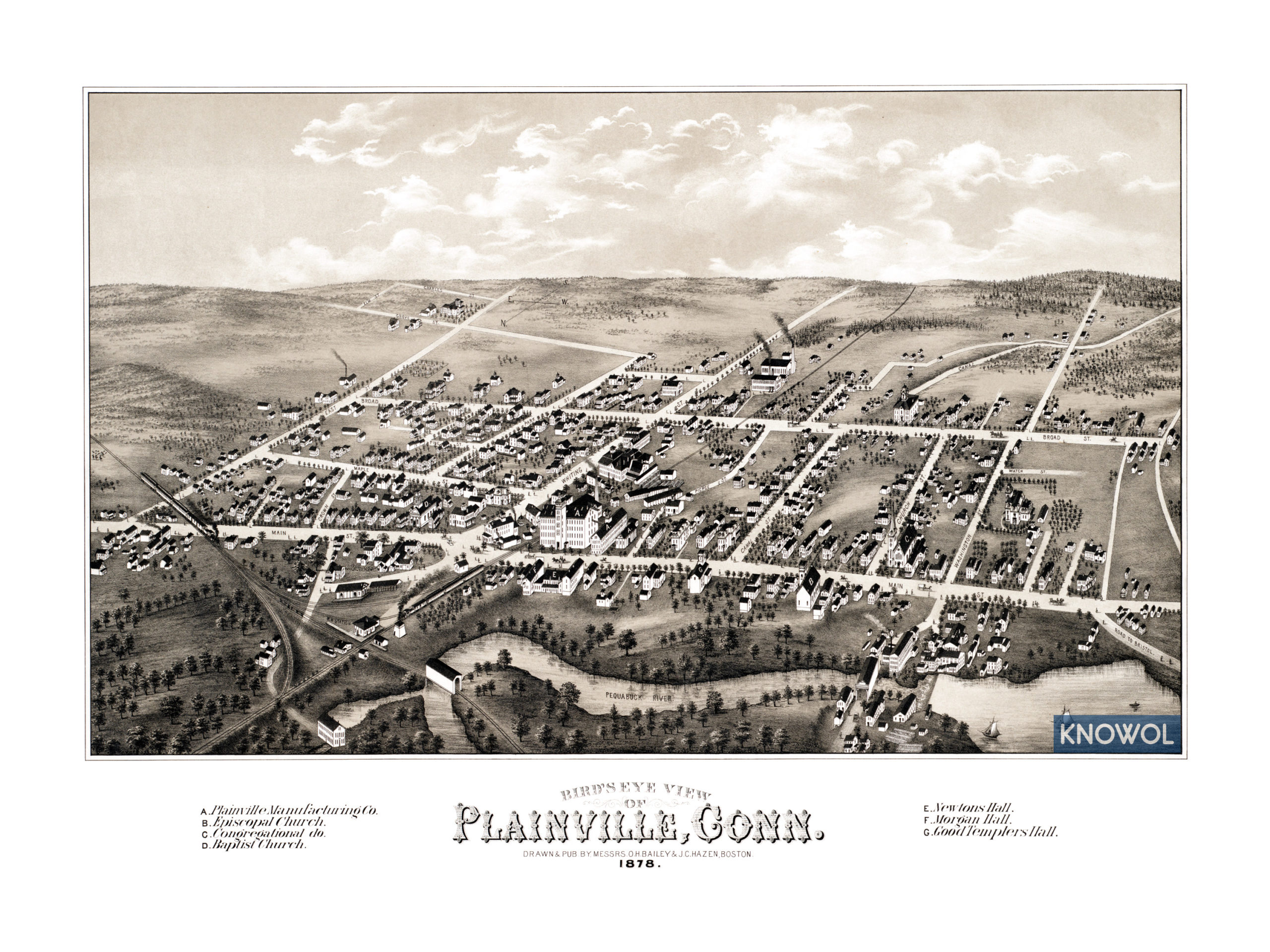
The bird's-eye view
By O.H. Bailey and J.C. Hazen
Plainville drawn as if from the sky, with its street names and old landmarks: the Plainville Manufacturing Company, Newton's Hall, Morgan Hall, Good Templars Hall, the Hartford, Providence and Fishkill Railroad, and the Episcopal, Congregational and Baptist churches.5
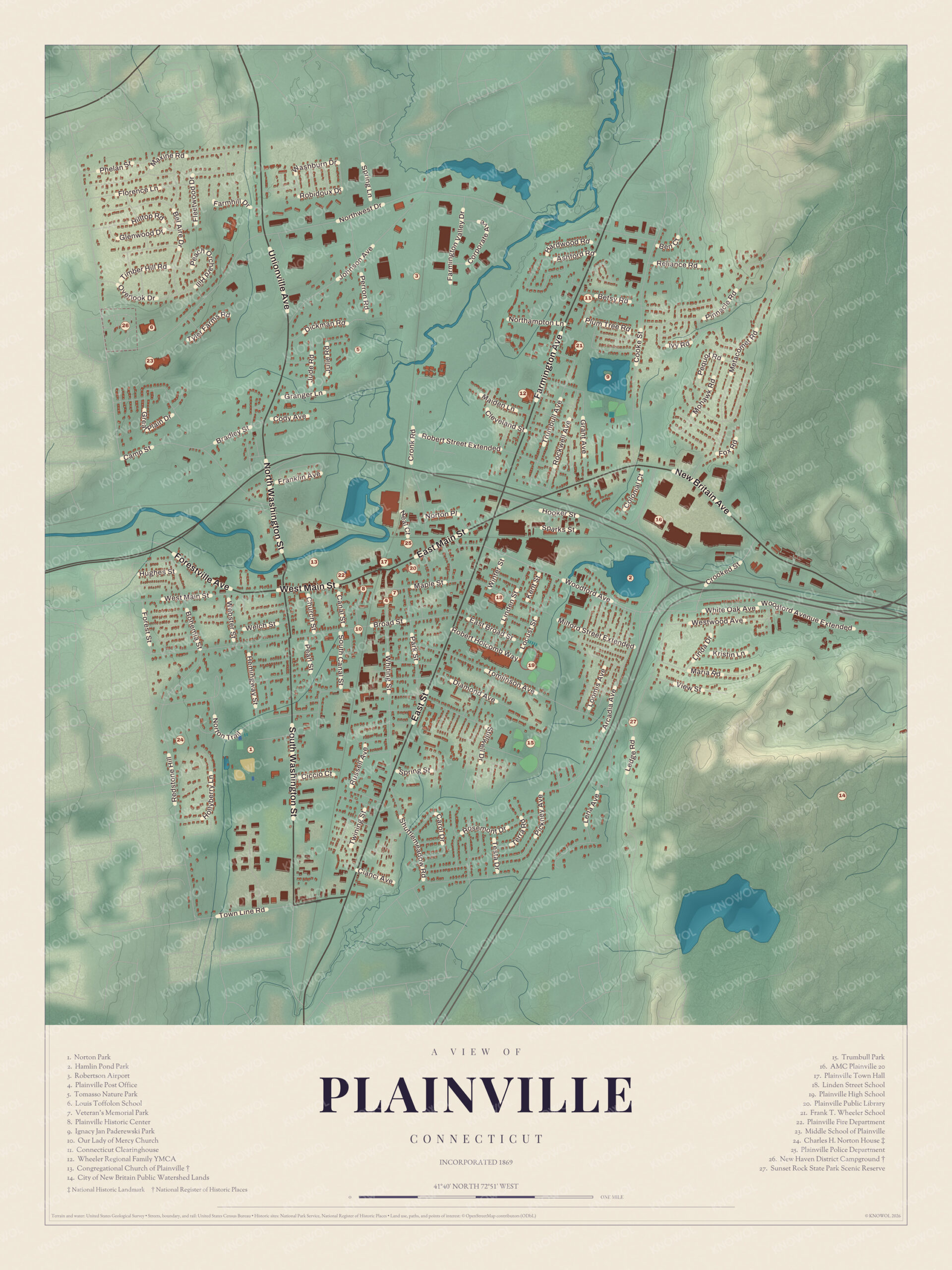
Plainville today
By KNOWOL
Shaded hills from the valley downtown up to Bradley Mountain and Pinnacle Rock, every street, and a guide of 27 numbered landmarks with the National Historic Landmark and the National Register sites marked.6
The story of Plainville
How the Great Plain got its name
Long before it was a town, this flat stretch in the south of Farmington was known as Red Stone Hill, and then as the Great Plain. In 1797 the Baptists of Southington were already voting on how often their preacher should go over to the great plain. The name we use came out of a canal hotel. E. H. Whiting built a basin, a warehouse, a store and a hotel beside the new canal, the first post office opened in his hotel, and in 1831 the people voted to call the place Plainville. The mail sat on a board under a lattice of tape, so anyone could see at a glance whether a letter had come. That lasted until 1860. A scholar writing in 1918 noticed something else: among Connecticut's town names, Plainville was the one that mixed two languages.728
Boats on Bristol Basin
The Farmington Canal made Plainville. When boats first came through, one old lady said, "Who'd a-thought of a boat going across the great plain!" In 1829 E. H. Whiting bought thirteen acres along the canal at Bristol Basin for less than twelve dollars an acre, and about 1835 H. M. Welch built a big store on the west side of the basin. Canal boats brought his goods in, heavy teams hauled them out across the countryside, and farmers brought in their produce to ship. A county history of 1886 calls that trade the beginning of the town. The canal leaked and froze, though, and the railroad took its place. The first passenger train reached Plainville on January 8, 1848, and a washout near Simsbury emptied the canal for good, leaving its boats high and dry.92106
Hames, carriages and clock hands
Plainville's shops made the small, useful things of the 1800s. Hiram Hills dammed the Pequabuck River to run his shop and turned out wooden hames for horse collars, along with shingles, sash and blinds, and in 1869 he went to the legislature as the new town's first representative. Jared Goodrich made clocks here in the 1840s, tried his luck in California in 1849, and in 1853 started the knitting business that became the Plainville Manufacturing Company. Plainville carriages sold widely in the South until the Civil War cut off the trade. Clark and Cowles made clock hands and rivets, and another shop sawed ivory and horn for knife handles. Charles H. Norton, born here in 1851, grew up to design the precision grinding machines the automobile industry needed.1112131415
Through the years
25 moments from 1650 to today.
- 1650Europeans first settle here, around this year.1
- 1660sThe land becomes part of the town of Farmington.1
- 1790About this year the first schoolhouse on the Great Plain is built.16
- 1797Southington's Baptists vote on how often their preacher should go to the great plain.7
- 1829E. H. Whiting buys thirteen acres along the canal at Bristol Basin for less than twelve dollars an acre.2
- 1831At the first post office, in Whiting's hotel, the people vote to adopt the name Plainville.2
- 1839Plainville's first Congregational society is organized, apart from Farmington's church.17
- 1840A man who grew up here later recalled standing on the canal's tow-path bridge as a boy and watching a boat bring the Amistad Africans, more than fifty people, four of them women, to Bristol Basin, where wagons carried them on toward their court case in Hartford.18
- 1841After the Supreme Court sets the Amistad Africans free, a Plainville boy rides the canal boat with them to New Haven and long remembers their leader, Cinque.19
- 1841Jared Goodrich and William Hills start making clocks in Plainville.13
- 1848The first passenger train arrives in Plainville on January 8, and the canal is soon left empty.10
- 1850The Congregational church on West Main Street is built to Henry Austin's design.20
- 1852About this year the Hartford, Providence and Fishkill Railroad opens east and west through Plainville.10
- 1853Jared Goodrich founds the knit goods business that becomes the Plainville Manufacturing Company.13
- 1860A brick Episcopal church is consecrated, months after the first prayer book service in August 1859.21
- 1865The Methodist camp meeting ground, now the New Haven District Campground, opens.22
- 1869Plainville separates from Farmington and becomes a town.1
- 1869Hiram Hills, maker of wooden hames, goes to the legislature as the new town's first representative.12
- 1878O.H. Bailey and J.C. Hazen publish their bird's-eye view of Plainville.5
- 1881The Catholic church, a Methodist church and a Swedish Methodist church are all built.17
- 1884In January two of Plainville's carriage works burn.14
- 1911Robertson Field opens north of the center.3
- 1922Charles H. Norton builds Sharpenhoe, his brick house on Redstone Hill.15
- 1925John H. Trumbull of Plainville becomes governor, soon known as the Flying Governor.23
- 1957The campground loses its religious tie, and its cottages become summer homes.22
Places to see
The numbers match the landmark guide printed on the 2026 map.
- 1Norton ParkSouthwest of town. Home of the Hot Air Balloon Festival.
- 3Robertson AirportNorth of the center. The town's own airfield, opened 1911.
- 8Plainville Historic CenterDowntown. Local history near Town Hall.
- 10Our Lady of Mercy ChurchSouth of downtown. Catholic parish organized in the 1880s.
- 13Congregational Church of PlainvilleWest Main and Church Streets. Henry Austin's church of 1850.Visit their website
- 17Plainville Town HallDowntown. Side by side with the library.
- 20Plainville Public LibraryDowntown. Next door to Town Hall.Visit their website
- 24Charles H. Norton HouseRedstone Hill. Inventor's home, a National Historic Landmark.
- 26New Haven District CampgroundNorthwest of town. 89 cottages around a preaching circle.
- 27Sunset Rock State Park Scenic ReserveBradley Mountain. Cliff-top views over Crescent Lake.
On the National Register
All 3 places in Plainville on the National Register of Historic Places that still stand today, oldest first, and why each one matters.4
-
Congregational Church of Plainville
Designed by the New Haven architect Henry Austin for a congregation formally organized in 1839. Its mix of round-arched Romanesque and pointed Gothic windows shows a tension in church design of the time, and its square tower carries clocks in diamond-shaped frames.20
-
New Haven District Campground
Opened in 1865 as a Methodist camp meeting ground, it has 89 small cottages, many with gingerbread trim, set in a circle around the central preaching area. At its height it had its own railroad station. It lost its religious tie in 1957, and the cottages are summer homes.22
-
Charles H. Norton House
National Historic Landmark
Charles H. Norton, born in Plainville in 1851, designed the heavy-duty precision grinding machines that mattered to the young automobile industry. He called this brick Georgian Revival house Sharpenhoe and lived here from 1922 until his death in 1942.15
In their words
“Who'd a-thought of a boat going across the great plain!”
An old lady at the coming of the canal, in The Connecticut quarterly, 18959
“In those days Bristol Basin was a busy centre.”
The memorial history of Hartford County, 188610
“The position yielded honor rather than profit.”
The memorial history of Hartford County, 1886, on Plainville's first postmaster2
Nearby towns
Sources
- Plainville, Connecticut, Wikipedia
- The Memorial History of Hartford County, Connecticut, 1633-1884 (1886), on Whiting and the first post office, Internet Archive
- Robertson Field (Connecticut), Wikipedia
- National Register of Historic Places listings in Hartford County, Connecticut, Wikipedia
- Bird's-eye view of Plainville, Connecticut from 1878, restored by KNOWOL
- Map of Plainville, Connecticut in 2026, KNOWOL (USGS elevation, Census Bureau roads)
- Ecclesiastical and other sketches of Southington, Conn. (1875), Internet Archive
- A Selection from the Miscellaneous Historical Papers of Fifty Years (1918), on Connecticut town names, Internet Archive
- The Connecticut quarterly (1895), on the Farmington Canal, Internet Archive
- The Memorial History of Hartford County, Connecticut, 1633-1884 (1886), on Bristol Basin and the railroad, Internet Archive
- Encyclopedia of Connecticut biography, genealogical-memorial (1917), on Hiram Hills' shop and dam, Internet Archive
- Commemorative biographical record of Hartford County, Connecticut (1901), on Hiram Hills, Internet Archive
- Commemorative biographical record of Hartford County, Connecticut (1901), on Jared Goodrich, Internet Archive
- The Memorial History of Hartford County, Connecticut, 1633-1884 (1886), on Plainville's carriage works and shops, Internet Archive
- Charles H. Norton House, Wikipedia
- The memorial history of Hartford County, Connecticut, 1633-1884 (1886), on Plainville's schools, Internet Archive
- The Memorial History of Hartford County, Connecticut, 1633-1884 (1886), on Plainville's churches, Internet Archive
- The Connecticut Magazine (1907), a Plainville memory of the Amistad captives on the Farmington Canal
- A narrative and documentary history of St. John's Church, Waterbury (1907), on Theodore I. Driggs of Plainville
- Congregational Church of Plainville, Wikipedia
- The history of the Episcopal Church in Connecticut (1883), Internet Archive
- New Haven District Campground, Wikipedia
- John H. Trumbull, Wikipedia