
The largest town in Massachusetts, on the shore where the Wampanoag village of Patuxet stood, where the Mayflower's passengers came ashore in 1620, and where the Plymouth Cordage Company once ran the longest ropewalk in the world.
Then and now
The same town 116 years apart. Click either map to look closer.
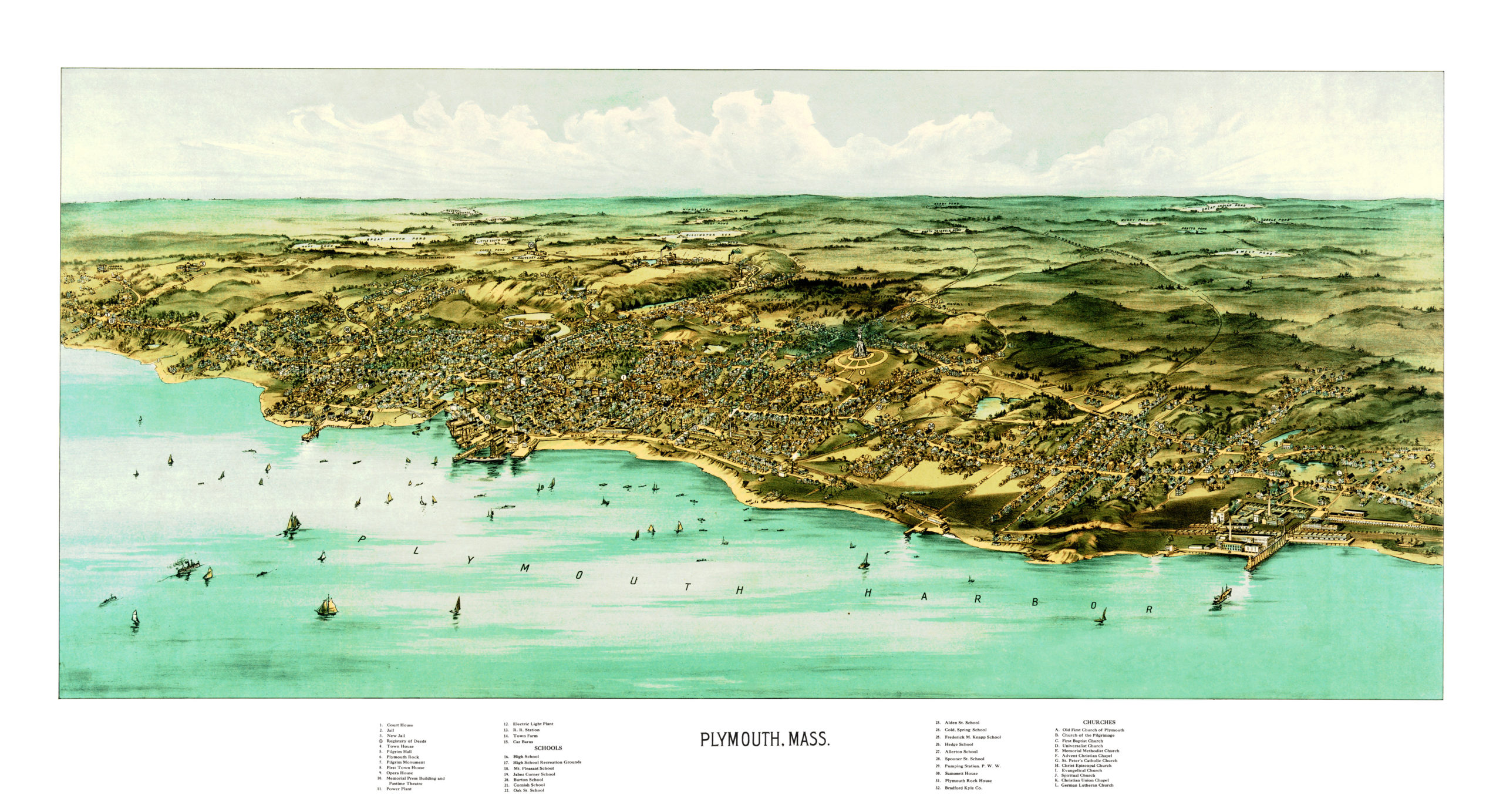
Plymouth in 1910
By George H. Walker
Plymouth as it looked in 1910, with Pilgrim Hall, Plymouth Rock, the First Town House, the Pilgrim Monument, Plymouth Harbor, the Old First Church and the Plymouth Rock House.5
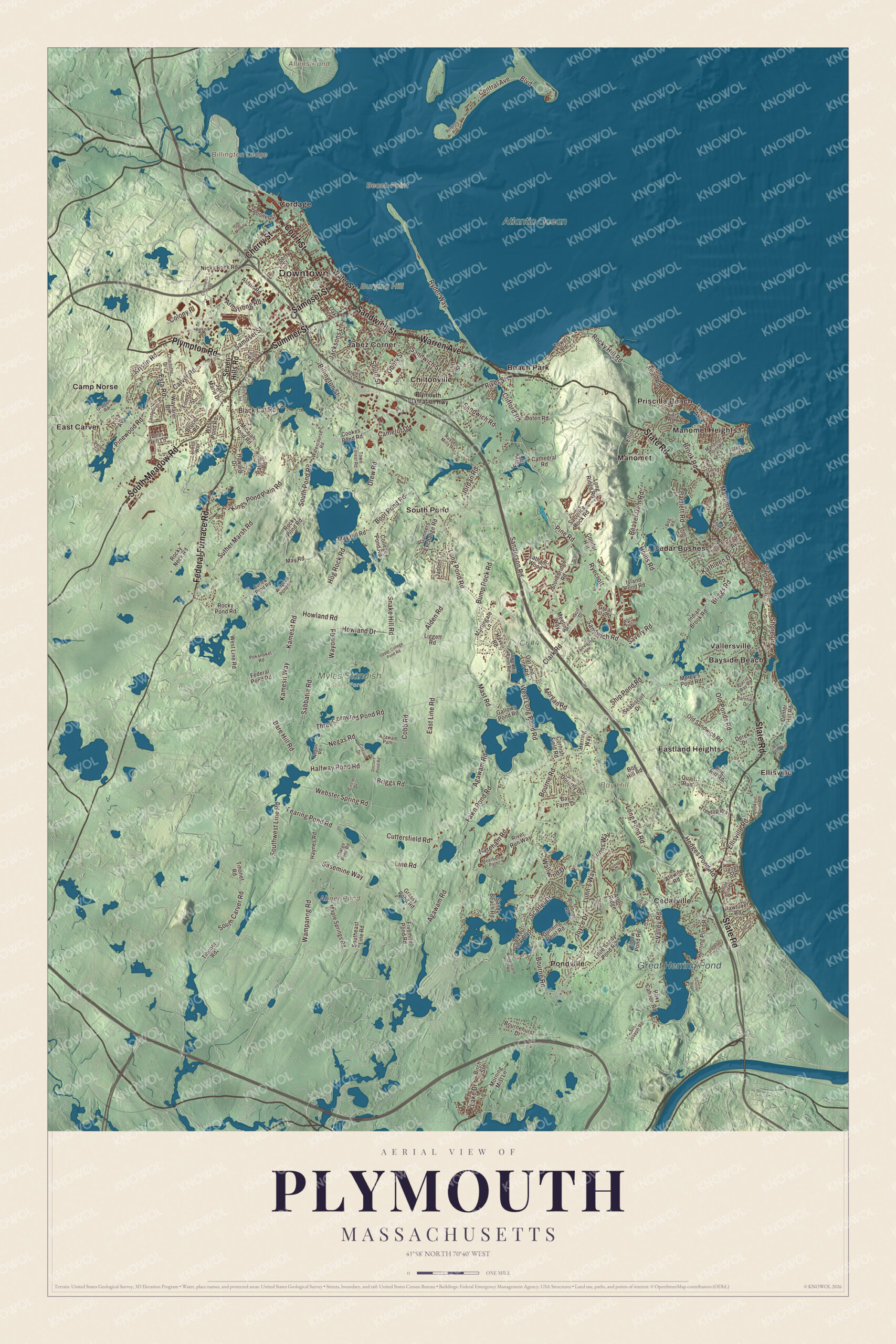
Plymouth today
By KNOWOL
Shaded relief from Bayside Beach and Beach Point on Cape Cod Bay back to Great Herring Pond, Abner Pond and Allens Pond in the woods, with Court Street, Summer Street, Sandwich Street, Samoset Street, Warren Avenue, State Road and Burying Hill.2
The story of Plymouth
The rock that kept moving
No record from the time says where the Pilgrims first stepped ashore. In 1741 Thomas Faunce, 94 years old and the last ruling elder of the first church, heard that a wharf was to be built over a boulder at the water's edge, and he came into town to point it out as the landing place the first settlers had always named to him. In 1774 the town tried to haul the rock up to Town Square, and it split in two. On July 4, 1834, the top half was carried to Pilgrim Hall in a procession led by the town's schoolchildren, with a little model of the Mayflower on a flower-trimmed car drawn by six boys. The halves were joined on the shore again in 1880, and since 1921 the rock has rested under a granite portico.16782
Spirit Rocks and Herring Pond
Before it was Plymouth, this shore was Patuxet, a Wampanoag village, and by 1620 disease had killed every Patuxet but one, Tisquantum. By the colonists' own accounts, the help of the Wampanoag sachem Massasoit kept them from starving, and Native families stayed in the town long after. A description of Plymouth printed in 1815 counted about a hundred Native people living within its bounds, with a small meetinghouse near Herring Pond, their main settlement in the town, and several thousand acres of land. The same writer described Sacrifice Rocks, two and a half miles past Cornish's Tavern on the Sandwich road, where Native travelers still laid branches as they passed in silence, and he gave their name as Manittoo Asseinah, Spirit Rocks. Since 1970, Native people have gathered on Cole's Hill every Thanksgiving Day for the National Day of Mourning.29
Rope from North Plymouth
The Plymouth Cordage Company was incorporated in 1824, and by 1832 its ropewalk near the Kingston line stood three stories high, laid its rope by water power, and could keep eighty hands busy making five hundred tons of cordage a year. On March 28, 1859, the company hired a fifteen-year-old office boy, Gideon F. Holmes, who swept the office, ran errands and helped haul rope to the scales. Fifty years later he held the company's highest executive post, and Plymouth Cordage set a holiday and fed nearly two thousand people in his honor. By 1925 its long wooden ropewalk ran from the Kingston line to the main mills, ocean steamships brought its raw materials from Mexico and the Philippines to its own piers, and more than three thousand people worked there. It closed in 1964.1011122
Through the years
25 moments from 1614 to today.
- 1614Captain John Smith explores the coast and gives the area the name Plymouth.1
- 1620The Mayflower's passengers come ashore at Patuxet on December 21.2
- 1621One of the Billingtons climbs a tall tree and spots the pond now called Billington Sea.3
- 1621The Wampanoag sachem Massasoit and the colonists make a peace treaty on March 22.2
- 1621Edward Winslow marries the widowed Susanna White, the first wedding in Plymouth.13
- 1621After the harvest, the colonists gather with Massasoit and ninety Wampanoag men in the celebration now called the First Thanksgiving.2
- 1640About this year Richard Sparrow builds the Summer Street house that's now the oldest in town.2
- 1691Plymouth Colony is merged into the Province of Massachusetts Bay, and Plymouth is no longer a capital.1
- 1741Thomas Faunce, 94 years old, points out Plymouth Rock as the landing place.2
- 1769Seven townsmen form the Old Colony Club, partly to keep clear of the company at the taverns, and start the yearly celebration of the landing.14
- 1774Townspeople try to haul Plymouth Rock up to Town Square, and it splits in two.7
- 1792Land at Parting Ways is granted for a settlement of free Black families founded by four Revolutionary War veterans.2
- 1815About a hundred Native people live within Plymouth, with a meetinghouse near Herring Pond.9
- 1824The Plymouth Cordage Company is incorporated.10
- 1824Pilgrim Hall opens on Court Street in a granite building by Alexander Parris.15
- 1834On July 4 the top half of Plymouth Rock is paraded to Pilgrim Hall.8
- 1835Ralph Waldo Emerson marries Lydia Jackson in the old Winslow house.16
- 1880The two halves of the rock are joined again on the shore, and the date 1620 is carved into it.7
- 1889The National Monument to the Forefathers is dedicated on August 1.17
- 1898The great storm of November 27 carries houses and hillocks off Plymouth Beach.18
- 1921Plymouth Rock goes back to the waterfront under a granite portico by McKim, Mead and White.2
- 1947Plimoth Plantation, now Plimoth Patuxet, opens.2
- 1957Mayflower II, built in Brixham, England, sails across the Atlantic.2
- 1964The Plymouth Cordage Company closes.2
- 1970Frank "Wamsutta" James speaks on Cole's Hill on Thanksgiving Day, and the National Day of Mourning has been held there every year since.2
Places to see
Places worth a visit in Plymouth today.
- Plymouth RockPilgrim Memorial State Park, Water Street. Under its granite portico since 1921.
- Cole's HillCarver Street, above the rock. Massasoit's statue and the first burial ground.
- Mayflower IIState Pier. Sailed over from Brixham, England, in 1957.Visit their website
- Pilgrim Hall MuseumCourt Street. Opened in 1824 in Alexander Parris's building.Visit their website
- Burying HillAbove Town Square. The Pilgrims' fort site and old graves.
- Richard Sparrow HouseSummer Street. Oldest surviving house, built around 1640.Visit their website
- Jabez Howland HouseSandwich Street. House museum begun in 1667.Visit their website
- Plimoth PatuxetChiltonville. Living history museum opened in 1947.Visit their website
- Cordage Commerce CenterNorth Plymouth. The old Plymouth Cordage factory.
- Parting WaysRoute 80, near the Kingston line. Free Black settlement on land granted 1792.
On the National Register
All 25 places in Plymouth on the National Register of Historic Places that still stand today, oldest first, and why each one matters.4
-
Cole's Hill
National Historic Landmark
The first burial ground used by the Mayflower passengers, in the winter of 1620 to 1621, across the street from Plymouth Rock. Cyrus Dallin's statue of the Wampanoag sachem Massasoit stands on the hill.19
-
Plymouth Rock
The boulder traditionally named as the Pilgrims' landing place, first pointed out by Thomas Faunce in 1741. It split in two in 1774, its halves were joined again in 1880, and it now lies under a granite portico on the shore.7
-
Town Brook Historic and Archeological District
The valley of the brook the Pilgrims settled beside, with mill ponds, dams, herring runs and old mill sites spanning more than three centuries. The Richard Sparrow House stands in it, and Brewster Gardens was laid out near the brook's mouth in the 1920s.20
-
Old Burial Hill
The burial place of several Pilgrims, on the hill where they built their first fort in 1621 and 1622. It holds more than 2,000 marked graves dating from 1680 to 1957.21
-
Plymouth Village Historic District
Part of the area of earliest settlement, taking in Leyden Street and streets laid out as early as 1633, close to Plymouth Rock and Pilgrim Hall.22
-
Richard Sparrow House
Richard Sparrow, an English surveyor who arrived in 1636, built the house around 1640 on his 16-acre grant. It's the oldest surviving house in Plymouth and is now a house museum.23
-
Jabez Howland House
Jacob Mitchell built the oldest part in 1667, and it was bought by Jabez Howland, son of Mayflower passengers John Howland and Elizabeth Tilley. A private home until 1915, it's now a house museum.24
-
Sgt. William Harlow Family Homestead
The oldest part of this gambrel-roofed Cape is believed to have been built by Sergeant William Harlow before he built the nearby Harlow Old Fort House, which would make it one of Plymouth's oldest surviving buildings.25
-
Harlow Old Fort House
Tradition says Sergeant William Harlow built it in 1677 with timbers from the Pilgrims' fort on Burial Hill, though a 1996 survey dated it to 1700 or later. The Plymouth Antiquarian Society restored it and opened it to the public in 1921.26
-
Clifford, Warren House
A gambrel-roofed Cape built about 1695 on land granted to Richard Warren in 1627, believed to be the third house on the property. Its best-known resident was James Warren, an opponent of British rule and a major general in the Continental Army.27
-
Old County Courthouse
Built in 1749, the two-story wood-frame building is believed to be the oldest wooden courthouse in the United States; it stands on the site of the first courthouse built by Plymouth Colony settlers, and may incorporate elements of a 1670 building. The site was originally the site of Edward Winslow's first house in Plymouth.28
-
Plymouth Light Station
Gurnet Light stands on Gurnet Point at the entrance to Plymouth Bay, reached by land only through Duxbury. A light was first built here in 1768, the present tower is called the oldest wooden lighthouse in the United States, and it was moved about 140 feet in 1998 because of beach erosion.29
-
Parting Ways Archeological District
The site of a settlement of free Black families founded on 94 acres granted in 1792 to four Revolutionary War veterans, Cato Howe, Prince Goodwin, Plato Turner and Quamony Quash. Archaeologists led by James Deetz excavated its cemetery and house sites in the 1970s.30
-
Bartlett, Russell, Hedge House
Built about 1803 for Joseph Bartlett, a ship's captain, this three-story brick Federal house later became an inn run by his son William. William's son John grew up here and went on to publish Bartlett's Familiar Quotations.31
-
Plymouth Antiquarian House
Built in 1809 for sea captain William Hammatt and home to the Hedge family from 1830 to 1919. The Plymouth Antiquarian Society moved it from Court Street to Water Street in 1919 and opens it as the Hedge House.32
-
Pilgrim Hall
Opened in 1824 and run by the Pilgrim Society, it's the oldest public museum in the United States in continuous operation. Alexander Parris designed its granite building, and its collections include a 1651 portrait of Edward Winslow, the only known portrait of a Pilgrim made in his lifetime.15
-
Bethel African Methodist Episcopal Church and Parsonage
The congregation, founded in 1866, is one of a small number of African Methodist Episcopal (AME) congregations in eastern Massachusetts, and is an enduring component of the small African-American community in Plymouth. Its church, built about 1840 as a commercial building and consecrated in 1870, was listed on the National Register of Historic Places in 2007.33
-
Bradford, Union Street Historic District
A waterfront neighborhood across Town Brook from downtown, built up in the mid-1800s for workers in maritime and other trades. Alden Harlow built many of its small story-and-a-half cottages as a speculation in the 1840s.34
-
Hillside
A Gothic Revival house of 1845 where Benjamin Watson started the Old Colony Gardens, one of the nation's first garden nurseries. Ralph Waldo Emerson stayed the night here before marrying Plymouth's Lydia Jackson.35
-
Duxbury Pier Light
Nicknamed Bug Light, it was built in 1871 in Plymouth Harbor, on the north side of the main channel, to mark the dangerous shoal off Saquish Head.36
-
National Monument to the Forefathers
Formerly called the Pilgrim Monument, it honors the Mayflower Pilgrims. Its cornerstone was laid in 1859 and it was dedicated on August 1, 1889, and at 81 feet it's thought to be the world's largest solid granite monument.17
-
First Parish Church of Plymouth
The congregation was founded in 1620 by the Pilgrims in Plymouth. The current building was constructed in 1899.37
-
Plymouth Post Office Building
The building was designed by Oscar Wenderoth and built in 1914-15 by the Hanold-O'Brien Company for the federal government. The two story brick Colonial Revival building, in addition to housing the main post office branch for the town, also housed other federal government offices on the upper floor.38
-
Pinewoods Camp
A dance and music camp on 31 acres of woods between Long Pond and Round Pond, called the oldest continuously run folk dance camp in the country. Helen Osborne Storrow founded it in 1919 as a Girl Scout leadership school, and it became a dance camp in 1933.39
-
Mayflower II
A reproduction of the Mayflower built at the Upham Shipyard in Brixham, England, in 1955 and 1956 with Plimoth Plantation, now Plimoth Patuxet. It sailed from Plymouth, England, on April 20, 1957, and is berthed at the State Pier.40
In their words
“He who has not longed to pick a mayflower in Plymouth on Mayday is not a New Englander.”
Old Plymouth trails, 192041
“The most famous boulder in the world is Plymouth Rock, a bit of stone as geographically erratic and as influentially enduring as the Pilgrim Fathers themselves.”
Massachusetts: a typical American commonwealth, 189342
“Nestling at his feet, between the hill and the sea, are the thickly clustering roofs of the old town.”
Handbook of Old Burial Hill, 1902, on the view from Burial Hill43
Nearby towns
Sources
- Plymouth, Massachusetts, Wikipedia
- Map of Plymouth, Massachusetts in 2026, KNOWOL (USGS elevation, Census Bureau roads)
- The Pilgrims in their three homes: England, Holland, America (1900), on Billington Sea, Internet Archive
- National Register of Historic Places listings in Plymouth County, Massachusetts, Wikipedia
- Vintage map of Plymouth Massachusetts from 1910, restored by KNOWOL
- Guide to Plymouth, and recollections of the Pilgrims (1846), on Elder Faunce and the rock, Internet Archive
- Plymouth Rock, Wikipedia
- Memoirs of American governors (1846), on Plymouth Rock, Internet Archive
- Notes on Plymouth, Mass., Collections of the Massachusetts Historical Society, second series, vol. 3 (1815), Internet Archive
- History of the town of Plymouth (1832), on the Plymouth Cordage Company, Internet Archive
- Golden anniversary celebration by the Plymouth Cordage Company in honor of Gideon Francis Holmes (1909), Internet Archive
- Plymouth, Land of the Pilgrims' Pride (1925), on the Plymouth Cordage Company, Internet Archive
- Massachusetts Historical Society Proceedings, vol. 52 (1918), on Edward Winslow, Internet Archive
- History of the town of Plymouth (1832), on the Old Colony Club, Internet Archive
- Pilgrim Hall, Wikipedia
- The Massachusetts magazine (1908), on the Winslow house, Internet Archive
- National Monument to the Forefathers, Wikipedia
- Historic Duxbury in Plymouth County, Massachusetts (1920), on Plymouth Beach, Internet Archive
- Cole's Hill, Wikipedia
- Town Brook Historic and Archeological District, Wikipedia
- Old Burial Hill, Wikipedia
- Plymouth Village Historic District, Wikipedia
- Richard Sparrow House, Wikipedia
- Jabez Howland House, Wikipedia
- Sgt. William Harlow Family Homestead, Wikipedia
- Harlow Old Fort House, Wikipedia
- Clifford, Warren House, Wikipedia
- Old County Courthouse, Wikipedia
- Plymouth Light Station, Wikipedia
- Parting Ways Archeological District, Wikipedia
- Bartlett, Russell, Hedge House, Wikipedia
- Plymouth Antiquarian House, Wikipedia
- Bethel African Methodist Episcopal Church and Parsonage, Wikipedia
- Bradford, Union Street Historic District, Wikipedia
- Hillside, Wikipedia
- Duxbury Pier Light, Wikipedia
- First Parish Church of Plymouth, Wikipedia
- Plymouth Post Office Building, Wikipedia
- Pinewoods Camp, Wikipedia
- Mayflower II, Wikipedia
- Old Plymouth trails (1920), Internet Archive
- Massachusetts: a typical American commonwealth (1893), Internet Archive
- Handbook of Old Burial Hill, Plymouth, Massachusetts (1902), Internet Archive