
A Naugatuck Valley mill town, once Chusetown and then Humphreysville, where General David Humphreys raised a woolen factory at the falls and the river went on to turn out broadcloth, paper, augers, copper and brass.
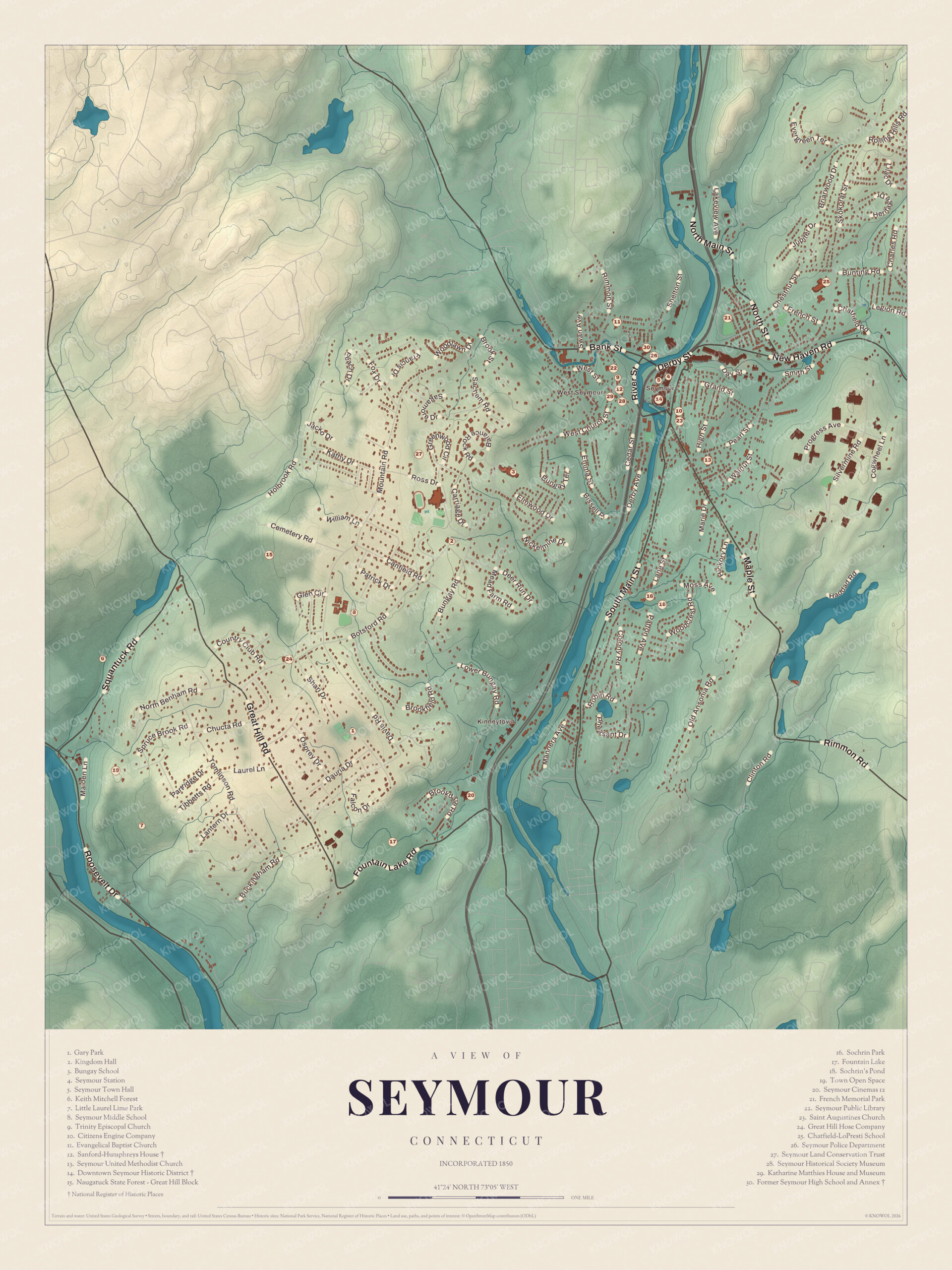
Seymour on the map
Click the map to look closer.
Seymour today
By KNOWOL
Shaded hills from Great Hill on the west side down to the Naugatuck River, every street, Seymour and Kinneytown printed by name, and a guide of 30 numbered landmarks with the National Register sites marked.5
The story of Seymour
The general's sheep and the president's suit
When David Humphreys came home from Spain he sent ahead a flock of one hundred merino sheep, and in 1803 he bought the mills at the falls of the Naugatuck. His woolen factory went up soon after. Seventy-three of his apprentice boys came from the New York almshouse. He gave them evening and Sunday schools, put them in uniform as a militia company and drilled them himself, and his wife made them an embroidered silk flag. The cloth was good enough that in November 1808 President Jefferson sent for some, writing that homespun was the spirit of the times. President Madison wore Humphreysville broadcloth at his inauguration in 1809. When Yale's Timothy Dwight came by in 1811, he called the scenery delightfully romantic.2678
Paper, augers and a ledge in the river
Walter French came from Mansfield about 1810 and made screw augers by hand, and a 1900 magazine says the first auger sold in the New York market was made here. Money was so scarce in those years that paper and augers passed as cash. In 1832 the village paper mill ran night and day making newsprint for the New Haven Palladium, and in 1837 a mill here made the first paper from straw in Connecticut. In 1844 Raymond French rowed the river at Kinneytown, spotted a ledge, stepped out of the boat into about three feet of water and walked across it. He built a dam there. Upstream, the Rimmon dam was finished in 1867, with an overflow about 300 feet long.910111213
Four names for one town
A Seymour minister counted four names for the place in 1876. The first, Naukotunk, was said to mean one great tree. The second was Chusetown, for the sachem Joseph Mauwehu, called Chuse, whose wigwam stood among white oaks on the flat by the river. The third was Humphreysville, for the general and his mill. In 1850, when the village broke away from Derby, the bill was printed with the name Richmond. Judge Munson suggested Seymour instead, and Rev. Sylvester Smith agreed. It was short, he said, and an eminent name in Connecticut. Not everyone was sold. In 1856 the town voted on changing its name to Humphrey, and Seymour won, 117 to 81.141511617
Through the years
24 moments from 1678 to today.
- 1678Col. Ebenezer Johnson buys three parcels of land from the Indians, bounded on the northwest by Rock Rimmon.18
- 1728About this year Benajah and Sarah Johnson move into what Seymour's historian calls the first house in Seymour.19
- 1782Ashbel Loveland is appointed to build a bridge over the Naugatuck below the falls.20
- 1789Twenty-six people join a new Congregational society in this part of Derby.21
- 1797Dr. Samuel Sanford, the first resident doctor, gets leave to inoculate for smallpox and runs a hospital just north of Castle Rock.22
- 1803David Humphreys buys the mills and dam at the falls of the Naugatuck.6
- 1806The frame of Humphreys' woolen factory is raised in June.23
- 1808President Jefferson orders cloth from Colonel Humphreys' mill for a suit of American make.7
- 1809President Madison wears a suit of Humphreysville broadcloth at his inauguration.2
- 1810The Humphreysville Manufacturing Company is incorporated.24
- 1811Yale's president, Timothy Dwight, visits and praises the cloth, the machinery and the scenery.8
- 1832The paper mill starts running night and day, making paper for the New Haven Palladium.11
- 1836Humphreysville becomes a borough within Derby.1
- 1837A mill here makes the first paper from straw in Connecticut.10
- 1844Raymond French starts a dam on a rock ledge in the river at Kinneytown.12
- 1849The first locomotive reaches Humphreysville on May 10.25
- 1850The town is incorporated as Seymour, after a bill first printed with the name Richmond.16
- 1853A November flood carries away half the railroad bridge.26
- 1856Voters turn down renaming the town Humphrey, 117 to 81.17
- 1867The gates of the new Rimmon dam are closed, backing up Rimmon Pond.13
- 1884The Citizens Engine Company is organized when the town buys a steam fire engine.1
- 1886The town's first public high school opens on Bank Street with 456 students.27
- 1892The Seymour Free Public Library is established.28
- 1983Downtown Seymour is listed on the National Register as a historic district.29
Places to see
The numbers match the landmark guide printed on the 2026 map.
- 4Seymour StationDowntown. Metro-North trains down the valley.
- 5Seymour Town HallDowntown. Inside the historic district.
- 10Citizens Engine CompanyDeForest Street. Fire company organized in 1884.
- 12Sanford-Humphreys House61-63 West Street. The doctor's and the general's house.
- 14Downtown Seymour Historic DistrictDowntown. 21 acres in a river bend.
- 15Naugatuck State ForestGreat Hill. The forest's newest block.Visit their website
- 21French Memorial ParkNortheast of downtown. A short walk from downtown.
- 24Great Hill Hose CompanyGreat Hill. Organized in 1947 for the west side.
- 29Katharine Matthies House and MuseumWest of downtown. Home of the historical society's exhibits.Visit their website
- 30Former Seymour High School and AnnexBank Street. The town's first high school, 1886.
On the National Register
All 3 places in Seymour on the National Register of Historic Places that still stand today, oldest first, and why each one matters.4
-
Sanford-Humphreys House
Dr. Samuel Sanford, the area's first physician, owned it first, and part of the rear wing is credited to him. General David Humphreys bought it in 1803 and built the main house, and his nephew John lived here while running the woolen mill.6
-
Downtown Seymour Historic District
The mill and business center that grew at the falls after the railroad came in the late 1840s, with copper and brass among its leading trades. Its oldest building is believed to be the Trestle Tavern of about 1850, and the old Waterman Pen buildings fill the south end.29
-
Seymour High School and Annex
The town's first public high school, begun in 1884 on two acres bought for $3,000. It opened in 1886 with 456 students in nine rooms and later served as Center School.27
In their words
“It is short, our Governor and the Speaker of the House have that name, and it is an eminent name in Connecticut, and we will have it the name of our town.”
Rev. Sylvester Smith in 1850, as told in History of Seymour, 187916
“The scenery at this spot is delightfully romantic. The Fall is a fine object.”
Timothy Dwight, president of Yale, on Humphreysville in 1811, quoted in History of Seymour, 18798
“The beauty and grandeur of our drives among the hills are not surpassed by any town in New England.”
Frank G. Bassett, The Connecticut Magazine, 190030
Nearby towns
Sources
- Seymour, Connecticut, Wikipedia
- Connecticut, a study of a commonwealth-democracy (1903), Internet Archive
- The Connecticut Magazine (1900), The Town of Seymour, Internet Archive
- National Register of Historic Places listings in New Haven County, Connecticut, Wikipedia
- Map of Seymour, Connecticut in 2026, KNOWOL (USGS elevation, Census Bureau roads)
- Sanford-Humphreys House, Wikipedia
- Chapter sketches, Connecticut Daughters of the American Revolution; patron saints (1901), Internet Archive
- History of Seymour, Connecticut (1879), on President Dwight's visit, Internet Archive
- The Connecticut Magazine (1900), The Town of Seymour, on augers, Internet Archive
- History of Seymour, Connecticut (1879), on straw paper, Internet Archive
- History of Seymour, Connecticut (1879), on the first paper mill, Internet Archive
- History of Seymour, Connecticut (1879), on the Kinneytown dam, Internet Archive
- History of Seymour, Connecticut (1879), on the Rimmon dam, Internet Archive
- History of Seymour, Connecticut (1879), on the town's four names, Internet Archive
- History of Seymour, Connecticut (1879), on Chuse's wigwam, Internet Archive
- History of Seymour, Connecticut (1879), on naming the town, Internet Archive
- History of Seymour, Connecticut (1879), on the vote to rename the town, Internet Archive
- The history of the old town of Derby, Connecticut, 1642-1880 (1880), on Rock Rimmon, Internet Archive
- History of Seymour, Connecticut (1879), on the first house, Internet Archive
- History of Seymour, Connecticut (1879), on the bridge below the falls, Internet Archive
- History of Seymour, Connecticut (1879), on the first churches, Internet Archive
- History of New Haven County, Connecticut (1892), on Seymour's doctors, Internet Archive
- History of Seymour, Connecticut (1879), on Humphreys' woolen factory, Internet Archive
- An introduction to the history of Connecticut as a manufacturing state (1915), Internet Archive
- History of Seymour, Connecticut (1879), on the first locomotive, Internet Archive
- History of Seymour, Connecticut (1879), on the flood of 1853, Internet Archive
- Seymour High School (Connecticut), Wikipedia
- History of Waterbury and the Naugatuck Valley, Connecticut (1918), on Seymour's schools and library, Internet Archive
- Downtown Seymour Historic District, Wikipedia
- The Connecticut Magazine (1900), The Town of Seymour, closing, Internet Archive