
A hilltop town on the divide between Boston and Providence, once called Stoughtonham, where Lake Massapoag gave up iron for Revolutionary cannon and shade for summer visitors, and where the soldier Deborah Sampson spent the rest of her life.
Sharon then and now
The same town 195 years apart. Click either map to look closer.
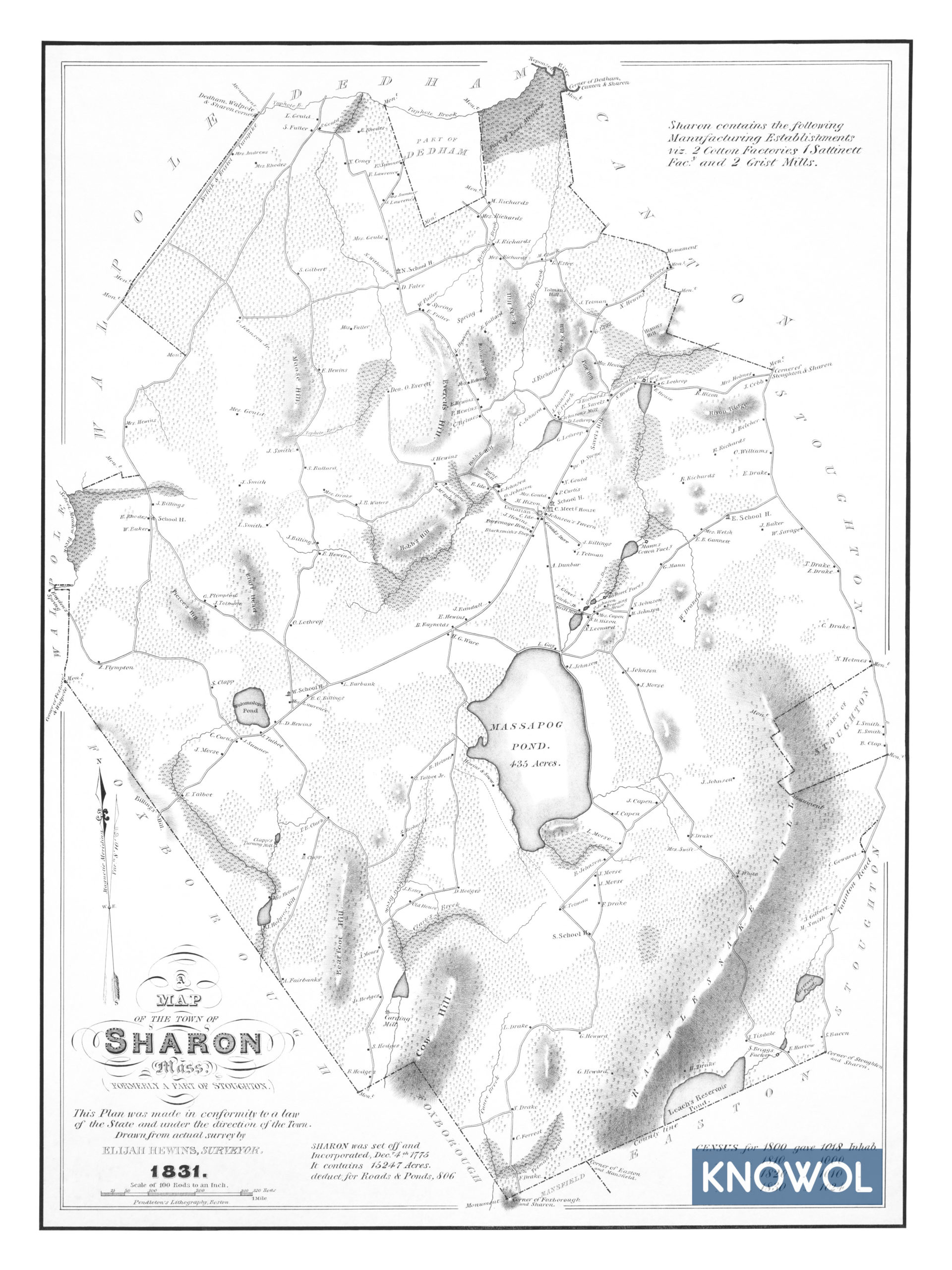
The 1831 town plan
By Elijah Hewins, surveyor
Made under the direction of the town from a survey by Elijah Hewins, a lifelong Sharon man, it shows Rattlesnake Hill, Cow Hill, Wolomolopog and Massapog ponds, Clapp's Turning Mill, Leach's Reservoir Pond, Johnson's Boarding House, the Sharon Cot Factory and a paint mill. A note on the map gives the town 15,247 acres, with census counts from 1800 to 1830.5
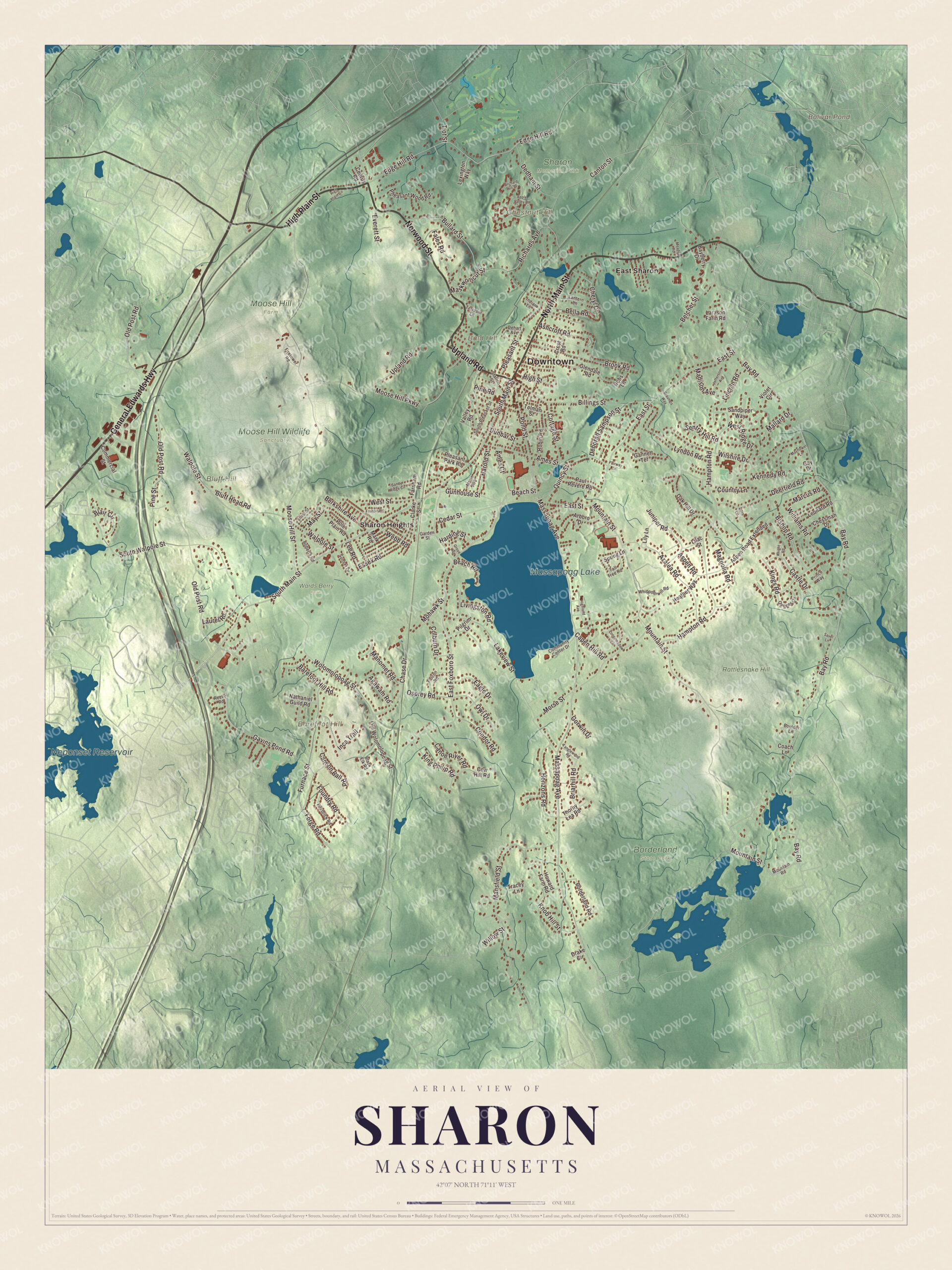
Sharon today
By KNOWOL
Massapoag Lake at the middle of town, with North Main Street, Norwood Street, High Plain Street, Upland Road, Mountain Street and General Edwards Highway, and Bolivar Pond, the Neponset Reservoir, Bald Hill, Barefoot Hill and Bluff Hill printed on the map.2
The history of Sharon, Massachusetts
The night Charlestown burned
In February 1775 the district of Stoughtonham voted to raise twenty-eight minute-men, and on April 19 two companies marched toward Boston. On June 17 the women left at home heard heavy guns from the direction of Boston all day. They climbed Sharon Hill, the high ground near the schoolhouse, and saw Charlestown burning on the horizon, twenty miles away. That night they gathered in the schoolhouse with their minister, Rev. Philip Curtis, for what the 1884 county history calls the first watch-meeting ever held in Sharon. The next spring the town voted to ask that its name be changed to Washington, which never happened, and on May 20, 1776 it pledged lives and fortunes to support independence.67
Massapoag, the great water
The 1884 county history says Massapoag meant great water. Alewives and shad once ran up the brook into the pond so thick that a horse driven through it would kill them with its hooves, until mill dams ended the runs. William Tolman, clearing a farm south of the pond, dug out a hornbeam log for a boat. Edmund Quincy Jr. noticed iron ore lying on the beach, and Col. Richard Gridley drew the pond down to dig it. The guns cast from that ore were tested at the pond in 1775. Later came summer houses on the bluffs, the Massapoag House hotel, Burkhardt's Grove with its own railroad station, and the big ice-houses of the Boston Ice Company.89101112
Deborah Sampson of East Street
Deborah Sampson served about 17 months in the Continental Army as Robert Shirtliff before her secret came out. In 1785 she married Benjamin Gannett, a Sharon farmer, and they made their home on East Street, about a mile from the village. In March 1802 she stood on the stage of the Federal Street Theatre in Boston and told her story, then took the talk to other towns, which the 1905 reprint of her address calls the work of a pioneer. Paul Revere visited the farm in 1804 and wrote to her congressman, and a year later she was put on the pension list. She lies in Rock Ridge Cemetery, and her grandson, George Washington Gay, left money for a soldiers' monument nearby that carries her name.2131415
Sharon, Massachusetts through the years
25 moments from 1717 to today.
- 1717Capt. Billings dies at his tavern on the Bristol and Boston post road, the earliest house known in town.16
- 1740This part of Stoughton becomes its second precinct, and people begin building a meeting house on Pole Plain.17
- 1742Rev. Philip Curtis is ordained. He'll serve the parish for 55 years.18
- 1765The precinct becomes the district of Stoughtonham.1
- 1775On June 17, women of the town watch Charlestown burn from Sharon Hill and hold the first watch-meeting in Sharon.6
- 1775The first guns cast from Massapoag's iron ore are tested at the pond.11
- 1776The town votes to ask that its name be changed to Washington. The request isn't granted.7
- 1776On May 20, voters pledge their lives and fortunes to support independence if Congress declares it.7
- 1778The southwest part of the town is set off as Foxborough.7
- 1783Stoughtonham takes the name Sharon.1
- 1785Deborah Sampson marries Benjamin Gannett, a Sharon farmer.2
- 1802Deborah Sampson Gannett takes the stage of the Federal Street Theatre in Boston to tell her story, then tours other towns.13
- 1811Sharon's first cotton factory is built, beside a new dam near Samuel Hewins's house.19
- 1816A winter epidemic kills 18 of its first 24 patients in ten days, and Dr. James Mann is called in.20
- 1826Sharon natives living in and near Boston start a fund for the town's schools.19
- 1831Elijah Hewins surveys the town for its official plan.5
- 1835The Boston and Providence Railroad opens, with a station in Sharon.1
- 1838On a Sunday morning in November the Christian Society's church catches fire from its stove and burns.21
- 1866Massachusetts militia squadrons drill for three days on the plain near Sharon Heights, reviewed by Gen. Benjamin F. Butler.22
- 1884The new town hall, set on a foundation of Sharon granite, is dedicated on February 21.23
- 1891The Sharon Sanatorium opens in the pines to treat tuberculosis in its early stages.24
- 1902Eugene Tappan and his friends bring Old Home Week to Sharon.25
- 1916Moose Hill Wildlife Sanctuary is founded, Mass Audubon's oldest property.2
- 1955Henry P. Kendall founds the Kendall Whaling Museum in Sharon.1
- 1983The state names Deborah Sampson the official State Heroine of the Commonwealth.1
Places to see in Sharon, Massachusetts
Places worth a visit in Sharon today.
- Sharon Historic DistrictNorth Main Street. The old center, with two churches.
- Sharon Public LibraryNorth Main Street. Deborah Sampson's statue stands out front.Visit their website
- Unitarian and Congregational churchesNorth Main Street. Both ring bells made by Revere.
- Rock Ridge CemeteryEast Street. Deborah Sampson's grave.
- Cobb's TavernBay Road, East Sharon. Colonial tavern of about 1740.
- Massapoag LakeSouth of the center. Town beach on the old icehouse site.
- Moose Hill Wildlife SanctuaryWest side of town. Mass Audubon's oldest sanctuary, from 1916.Visit their website
- Stoughtonham Furnace SiteNear the Foxborough line. Where Revolutionary cannon were cast.
Sharon on the National Register of Historic Places
All 6 places in Sharon on the National Register of Historic Places that still stand today, oldest first, and why each one matters.4
-
Cobb's Tavern
A colonial tavern on the old Bay Road in East Sharon, with brick end walls and a central chimney. It served as a tavern for most of the 1800s and housed the East Sharon Post Office between 1817 and 1895. It's now a private home.26
-
Sharon Historic District
The one block of North Main Street that keeps the old look of Sharon Center, which grew up around the precinct's first meeting house of 1740. It holds the 1842 Greek Revival Unitarian Church, the 1839 First Congregational Church, the 1805 Morse House, the first brick building in town, and the library built in 1914 with Andrew Carnegie's help.27
-
Stoughtonham Furnace Site
The site of a colonial iron foundry near Gavin's Pond on the Foxborough line, first set up in the 1760s. Artillery colonel Richard Gridley and his partners took it over, and it made cannons and ammunition for the Continental Army throughout the Revolution.28
-
Stoneholm
A granite house of about 1848 built for Horace Augustus Lothrop, with Second Empire and Italianate details cut from stone of the local Moyles Quarry near Borderland. It has a mansard roof with a rooftop deck and cupola.29
-
Borderland Historic District
The estate of the botanist Oakes Ames and the artist Blanche Ames Ames, who bought land on the Sharon and Easton line in 1906 and built a stone mansion in 1910, largely at Blanche's direction. It became a state park in 1971 and has more than 20 miles of trails.30
-
Charles R. Wilber School
A brick Colonial and Classical Revival school facing the town hall, built in 1921 and 1922 as an elementary school and enlarged in 1928 and 1929 to become Sharon's high school, which it stayed until 1957. It was turned into homes in 2009.31
Sharon in their words
“The town is remarkable for the charm of its scenery, the excellence of its atmosphere and the longevity of its inhabitants.”
A gazetteer of the state of Massachusetts, 18903
“Her tombstone, in the quiet cemetery of Sharon, covers the remains of the bravest woman of the Revolution.”
History of Norfolk County, 1884, on Deborah Sampson Gannett32
“They will find somebody's latch string hanging outside for them to pull and enter.”
Sharon Historical Society scrap-book, 1908, on Old Home Week33
Towns near Sharon, Massachusetts
Sources for the history of Sharon
- Sharon, Massachusetts, Wikipedia
- Map of Sharon, Massachusetts in 2026, KNOWOL
- A gazetteer of the state of Massachusetts (1890), on Sharon, Internet Archive
- National Register of Historic Places listings in Norfolk County, Massachusetts, Wikipedia
- Historic map of Sharon, Massachusetts from 1831, restored by KNOWOL
- History of Norfolk County, Massachusetts (1884), on June 17, 1775, Internet Archive
- Publications of the Sharon Historical Society (1904), Jeremiah Gould's annals of 1830 on the votes of 1776 to 1778, Internet Archive
- History of Norfolk County, Massachusetts (1884), on Lake Massapoag, Internet Archive
- Publications of the Sharon Historical Society (1904), Jeremiah Gould's annals of 1830 on the alewives, Internet Archive
- History of Norfolk County, Massachusetts (1884), on the Tolman brothers, Internet Archive
- History of Norfolk County, Massachusetts (1884), on Massapoag iron and Gridley's guns, Internet Archive
- Publications of the Sharon Historical Society (1906), Frederic Endicott on Massapoag Pond, Internet Archive
- An address delivered in 1802 in various towns in Massachusetts, Rhode Island and New York (1905), on her lecture tour, Internet Archive
- An address delivered in 1802 in various towns in Massachusetts, Rhode Island and New York (1905), on her home and grave, Internet Archive
- History of Plymouth, Norfolk and Barnstable counties, Massachusetts (1928), on Deborah Sampson Gannett, Internet Archive
- History of Norfolk County, Massachusetts (1884), on the Billings tavern, Internet Archive
- Publications of the Sharon Historical Society (1904), Jeremiah Gould's annals of 1830 on the precinct, Internet Archive
- History of Norfolk County, Massachusetts (1884), on Rev. Philip Curtis, Internet Archive
- Publications of the Sharon Historical Society (1904), Jeremiah Gould's annals of 1830 on schools and mills, Internet Archive
- Medical sketches of the campaigns of 1812, 13, 14 (1816), on the Sharon epidemic, Internet Archive
- History of Norfolk County, Massachusetts (1884), on the Christian Society, Internet Archive
- History of Norfolk County, Massachusetts (1884), on the militia muster of 1866, Internet Archive
- History of Norfolk County, Massachusetts (1884), on the town hall, Internet Archive
- Annual report of the Sharon Sanatorium (1925), Internet Archive
- Publications of the Sharon Historical Society (1910), on Eugene Tappan, Internet Archive
- Cobb's Tavern, Wikipedia
- Sharon Historic District, Wikipedia
- Stoughtonham Furnace Site, Wikipedia
- Stoneholm, Wikipedia
- Borderland Historic District, Wikipedia
- Charles R. Wilber School, Wikipedia
- History of Norfolk County, Massachusetts (1884), on Deborah Sampson, Internet Archive
- Scrap-book: Sharon Historical Society, Sharon, Massachusetts (1908), Internet Archive