
A city on Long Island Sound, bought along the Rippowam in 1640 for coats, hoes and wampum, that grew from a quiet Puritan village into the Lock City of the Yale works and then into a skyline of company towers.
Stamford then and now
The same town 151 years apart. Click either map to look closer.
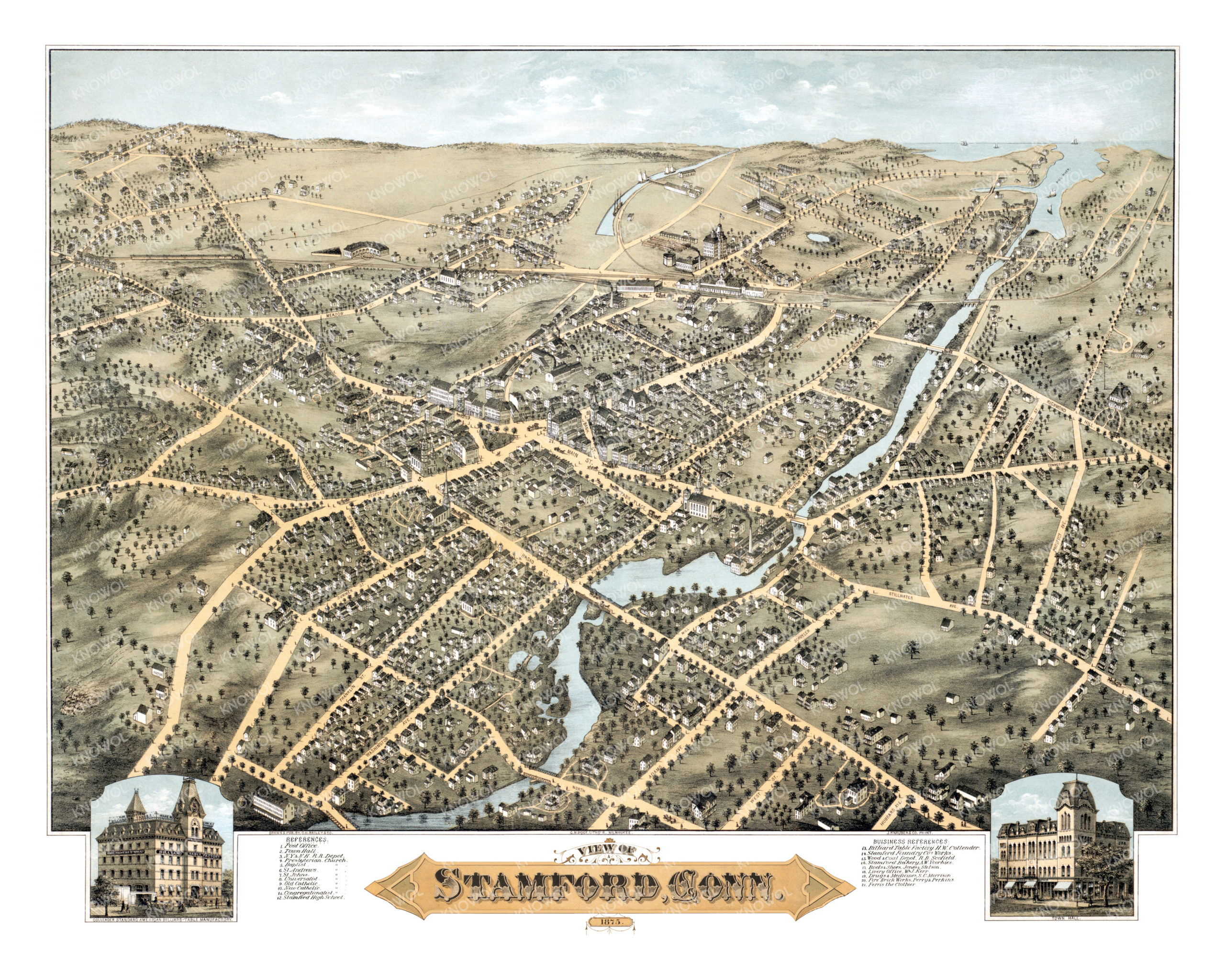
The bird's-eye view of 1875
By O.H. Bailey
Stamford drawn as if from the sky, with its street names and landmarks such as Collender's Billiard Table Factory, the Stamford Foundry Works, Scofield's Wood and Coal Depot, the Stamford Bakery and Ferris the Clothier.5
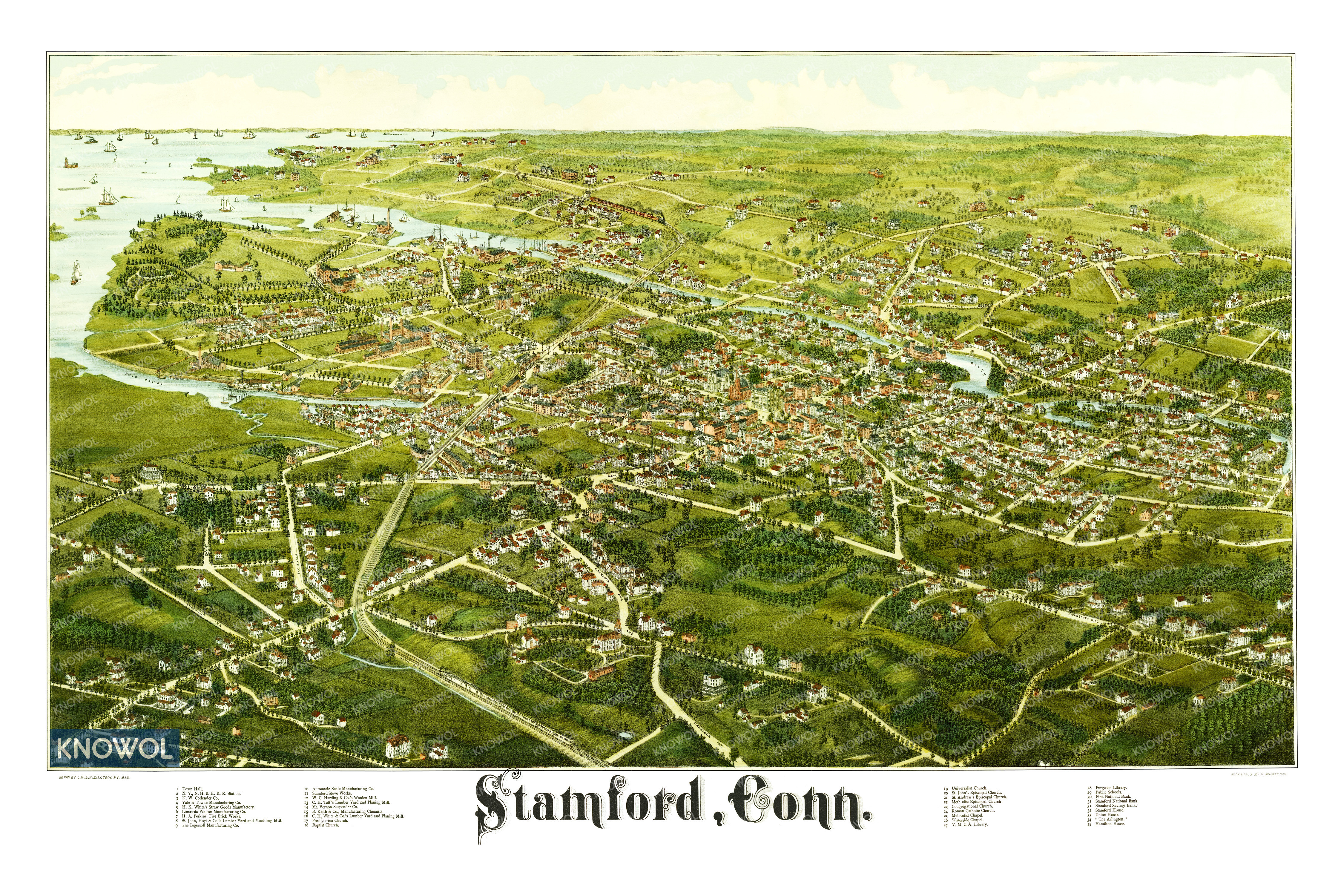
The bird's-eye view of 1883
By Lucien R. Burleigh
Stamford eight years later, hand drawn with its homes and buildings, including the New York, New Haven and Hartford Railroad station, H.A. Perkins' Fire Brick Works, the Automatic Scale Manufacturing Co., the Stamford Stove Works and The Arlington.6
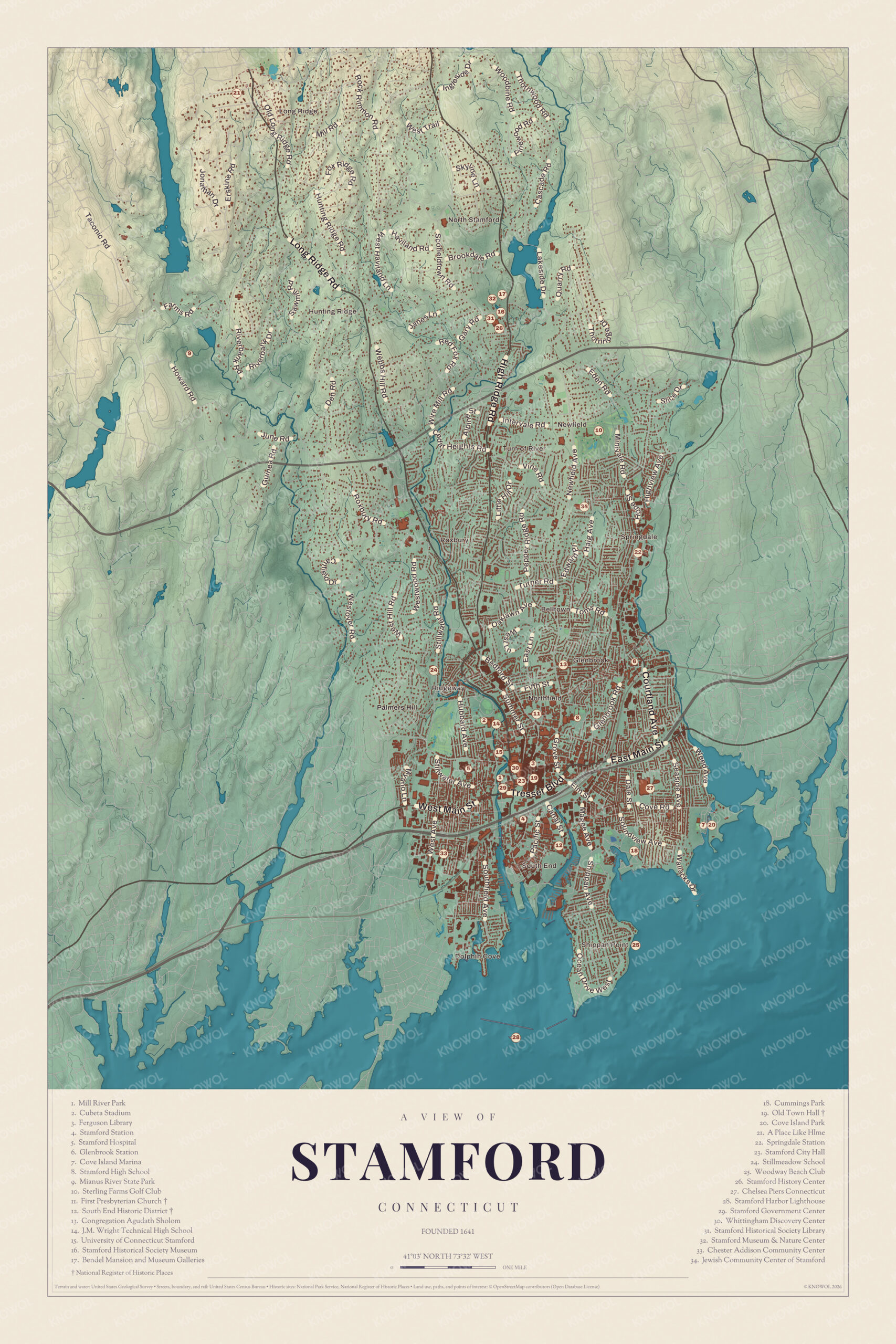
Stamford today
By KNOWOL
Shaded land from the hills of North Stamford down to Stamford Harbor and Westcott Cove, every street with its name, and a guide of 34 numbered landmarks with the National Register sites marked.2
The history of Stamford, Connecticut
Billiard tables and fine locks
In 1868 the Yale Lock Manufacturing Company moved to Stamford from Shelburne Falls, Massachusetts, carrying on the business Linus Yale Jr. had started in Philadelphia. It began here with about thirty workers. By 1880 it had two hundred and fifty, making more than three hundred sizes and styles of locks, along with bank locks and post office fittings, and its locks gave Stamford the nickname Lock City. Nearby stood the H. W. Collender billiard table works, five stories high on four acres, with two ornamental towers. Scientific American said it looked more like a modern university than a factory, and the county history of 1881 called it the leading billiard factory in the country, if not the world. You can find it on the 1875 bird's-eye view.3725
Waking up to the city
An 1881 county history said that around 1829 Stamford was as much a Puritan village as any in Massachusetts, even with New York so close. Getting to the city meant a stage to Saw-Pitts, now Port Chester, and then a crude steamer run by one Cornelius Vanderbilt. That year William Henry Holly started the town's first newspaper, the Advocate. The railroad came in December 1848, and the Advocate wrote that animals went careering round the fields in terror while people ran for the depot. In 1852 local men bought the William W. Frazier, the first Stamford-owned steamer to run regularly to New York. Their later boat, the Shippan, burned at the Stamford wharf in May 1870.891011
From Rippowam to Stamford
In 1640 Captain Nathaniel Turner bargained with the sagamores Ponus and Wascussee for the land along the Rippowam, promising 12 coats, 12 hoes, 12 hatchets, 12 glasses, 12 knives and 4 fathoms of white wampum. Families from Wethersfield came in 1641, and in 1642 the place was renamed Stamford. Nobody has traced an early family to Stamford in England, but an 1892 writer thought the hills and valleys of the two towns looked remarkably alike. When the first minister left, Francis Bell and George Slauson walked to Boston and came home on foot with Rev. John Bishop, his Bible under his arm. For about a century a drum called people to meeting, until Rev. Noah Welles started a subscription for a bell in 1748.122131415
Stamford, Connecticut through the years
25 moments from 1640 to today.
- 1640Captain Nathaniel Turner bargains for the land along the Rippowam, promising coats, hoes, hatchets, knives and white wampum.12
- 1641Rev. Richard Denton and 29 families from Wethersfield settle at Rippowam.2
- 1642The settlement is renamed Stamford, after the town in Lincolnshire, England.2
- 1655Stamford's bounds are set sixteen miles north from the shore, and two trees are marked with the letters S T.16
- 1664Greenwich comes under Connecticut with Stamford. Until now Stamford's officers have served Greenwich too.17
- 1699Samuel Hoyt, a blacksmith, begins the house that's now the oldest in Stamford.18
- 1748Rev. Noah Welles starts a subscription for a bell to replace the drum that called people to meeting.15
- 1775Stamford patriots burn tea in front of Webb's Tavern on Main Street, to fife and drum.19
- 1781General David Waterbury oversees the building of Fort Stamford, which holds up to 800 soldiers.20
- 1820Darien becomes its own town, after New Canaan in 1801.1
- 1824General Lafayette is welcomed on the steps of the Davenport homestead on Main Street.21
- 1829William Henry Holly starts the Advocate, Stamford's first newspaper.8
- 1848The first locomotive arrives in December, scattering the animals in the fields.10
- 1852The William W. Frazier becomes the first Stamford-owned steamer to run regularly to New York.11
- 1858The old meetinghouse on the village green holds its last service. It later becomes a livery stable.22
- 1868The Yale Lock Manufacturing Company moves to Stamford with about thirty workers.3
- 1870The steamer Shippan burns at the Stamford wharf in May.11
- 1875O.H. Bailey publishes his bird's-eye view of Stamford.5
- 1880After a push by the Stamford Herald, Congress grants seven thousand dollars for a lighthouse off the harbor.23
- 1882The cast iron Stamford Harbor Ledge Light goes up on Chatham Rock.24
- 1883Lucien R. Burleigh draws his bird's-eye view of Stamford.6
- 1893Stamford becomes a city.1
- 1906The Beaux-Arts Old Town Hall opens, replacing a town hall lost to fire.25
- 1946On January 3, about 10,000 people turn out for a day of action backing the Yale and Towne strikers.1
- 1958The First Presbyterian Church, the Fish Church, is dedicated on Bedford Street.26
Places to see in Stamford, Connecticut
The numbers match the landmark guide printed on the 2026 map.
- 1Mill River ParkDowntown. Cherry trees along the restored river.Visit their website
- 4Stamford StationSouth of downtown. Second busiest Metro-North station.
- 9Mianus River State ParkNorthwest corner. 527 acres shared with Greenwich.
- 11First Presbyterian ChurchBedford Street. The Fish Church, dedicated 1958.Visit their website
- 12South End Historic DistrictThe South End. The old Yale and Towne neighborhood.
- 18Cummings ParkThe shore. 79 acres named for Homer Cummings.
- 19Old Town HallMain and Atlantic Streets. Beaux-Arts town hall of 1906.
- 20Cove Island ParkEast shore. Beaches, salt marsh and 287 bird kinds.
- 28Stamford Harbor LighthouseChatham Rock. Cast iron tower of 1882.
- 32Stamford Museum & Nature CenterNorth Stamford. Working farm and Bendel mansion.Visit their website
Stamford on the National Register of Historic Places
21 of the 35 places in Stamford on the National Register of Historic Places that still stand today, oldest first, and why each one matters. See the full list of National Register places in Stamford.4
-
Hoyt-Barnum House
The oldest house in Stamford, begun by the blacksmith Samuel Hoyt before his marriage. In 2016 it was taken apart, moved five miles from Bedford Street and restored next to the Stamford History Center, where it's open for tours.18
-
John Knap House
A center-chimney house built by Capt. John Knap and believed to be the second oldest house in Stamford.27
-
Benjamin Hait House
The oldest house in the High Ridge section, a rare New England farmhouse in a now suburban area. It stayed in the Hoyt family until 1960 and stands on what was once the busy road to New York State.28
-
Deacon John Davenport House
A saltbox built by Deacon John Davenport, a descendant of one of the founders of New Haven, on the family's tract that gave Davenport Ridge its name. It stayed in the family until 1972.29
-
Fort Stamford Site
The remains of a Revolutionary War earthwork built under General David Waterbury, which held as many as 800 soldiers. Three of its four bastions can still be traced in a city park with the Goodbody Garden.20
-
Cove Island Houses
A single house, begun by the miller John Holly about 1791 and enlarged for his big family. It's all that's left of the mills at the Cove, which later burned, and it now holds the park's offices.30
-
Long Ridge Village Historic District
A rural village in northern Stamford, built up mostly from 1850 to 1920, that was a local center of shoemaking until the railroads passed it by. It has 34 historic houses and two churches.31
-
St. Andrew's Protestant Episcopal Church
A Gothic church by Henry Hudson Holly, consecrated in 1861. It was the first free church in the diocese, where people didn't have to rent their pews.32
-
South End Historic District
177 acres and 449 buildings, most from the 1870s to the 1930s, in the neighborhood shaped by the Yale and Towne lock works. It takes in an early naturalistic cemetery and the iron Pulaski Street Bridge.33
-
Stamford Harbor Lighthouse
A cast iron sparkplug lighthouse made in Boston and set on Chatham Rock, about 3,600 feet from shore. Keepers and their families lived inside until it was sold to a private owner in 1955.24
-
Main Street Bridge
A two-span wrought iron lenticular truss by the Berlin Iron Bridge Company. When it was listed it was the only such bridge on a major road in the state; today it carries people on foot.34
-
St. John's Protestant Episcopal Church
An English Gothic Revival stone church by William Potter, the third building of a parish founded in 1742, with a rose window and a parish house by Richard M. Upjohn.35
-
Turn-of-River Bridge
A 53-foot lenticular pony truss of wrought and cast iron by the Berlin Iron Bridge Company, one of only about twenty lenticular truss bridges left in the state. It's open to people on foot.36
-
Old Town Hall
A Beaux-Arts town hall with a limestone front and a clock tower, designed in 1905 by Edgar Josselyn and Nathan Mellen after the old one burned. It stood empty for years and was restored by 2010.25
-
Marion Castle, Terre Bonne
A French chateau-style house by Hunt and Hunt for Frank Marion, a movie pioneer whose Kalem Company made one-reelers for the nickelodeons.37
-
Suburban Club
The clubhouse of a social club that ten young men dreamed up on the steps of the Stamford Savings Bank in 1890. It had billiard rooms and bowling in the basement, and closed in 1935.38
-
US Post Office-Stamford Main
An Italianate post office of buff masonry, terra cotta and red tile, one of the last federal post offices designed in its own style. A 2012 lawsuit stopped its sale to a developer, and the National Trust counted it among ten historic places saved in 2013.39
-
First Presbyterian Church
National Historic Landmark
Wallace K. Harrison's Fish Church, shaped like a fish in plan and profile, with stained glass of more than 20,000 faceted pieces and a 260-foot carillon tower. It's a National Historic Landmark.26
-
Graham House
Eliot Noyes designed this house for the art dealer Robert Graham, with two parallel stone walls forming a paved inner street and rooms that seem to float out over the land.40
-
Downtown Stamford Historic District
The largest group of pre-1930s commercial buildings left downtown, enlarged in 1985 to take in old warehouses, laundries and stables and in 2002 to add the Avon Theatre of 1939.41
-
Merritt Parkway
One of the oldest scenic parkways in the country, famous for overpasses that were each decorated differently so no two looked alike. It runs across northern Stamford.42
Stamford in their words
“With the throbbing and busy city, Stamford itself began to wake from its Rip Van Winkle slumber.”
History of Fairfield County, Connecticut, 1881, on the town around 18298
“From the hills surrounding Stamford a view of unsurpassing beauty is afforded.”
The Connecticut Magazine, 190043
“The leading billiard-manufactory in the United States, if not in the world.”
History of Fairfield County, Connecticut, 1881, on the Collender factory7
Towns near Stamford, Connecticut
Sources for the history of Stamford
- Stamford, Connecticut, Wikipedia
- Map of Stamford, Connecticut in 2026, KNOWOL (USGS elevation, Census Bureau roads)
- History of Fairfield County, Connecticut (1881), on the Yale Lock Manufacturing Company, Internet Archive
- National Register of Historic Places listings in Stamford, Connecticut, Wikipedia
- Bird's-eye view of Stamford, Connecticut from 1875, restored by KNOWOL
- Bird's-eye view of Stamford, Connecticut from 1883, restored by KNOWOL
- History of Fairfield County, Connecticut (1881), on the H. W. Collender Company, Internet Archive
- History of Fairfield County, Connecticut (1881), on the Stamford Advocate, Internet Archive
- History of Fairfield County, Connecticut (1881), on travel to New York, Internet Archive
- History of Fairfield County, Connecticut (1881), on the first train, Internet Archive
- Encyclopedia of Connecticut biography (1917), on Captain David Waterbury's steamers, Internet Archive
- The Connecticut Magazine (1900), Stamford, 1641-1900, on Captain Turner's bargain, Internet Archive
- Stephen Clason of Stamford, Connecticut, in 1654 and some of his descendants (1892), Internet Archive
- A catalogue of the names of the early Puritan settlers of the colony of Connecticut (1852), on Rev. John Bishop, Internet Archive
- The Connecticut Magazine (1900), Stamford, 1641-1900, on the meeting drum, Internet Archive
- History of Stamford, Connecticut (1868), on the bounds of 1655, Internet Archive
- History of Stamford, Connecticut (1868), on Greenwich under Stamford, Internet Archive
- Hoyt-Barnum House, Wikipedia
- The Connecticut Magazine (1900), Stamford, 1641-1900, on Webb's Tavern, Internet Archive
- Fort Stamford Site, Wikipedia
- The Connecticut Magazine (1900), Stamford, 1641-1900, on Lafayette's visit, Internet Archive
- The Connecticut Magazine (1900), Stamford, 1641-1900, on the old meetinghouse, Internet Archive
- History of Fairfield County, Connecticut (1881), on the Stamford Herald and the lighthouse, Internet Archive
- Stamford Harbor Ledge Light, Wikipedia
- Old Town Hall (Stamford, Connecticut), Wikipedia
- Fish Church (First Presbyterian Church of Stamford), Wikipedia
- John Knap House, Wikipedia
- Benjamin Hait House, Wikipedia
- Deacon John Davenport House, Wikipedia
- Cove Island Houses, Wikipedia
- Long Ridge Village Historic District, Wikipedia
- St. Andrew's Episcopal Church (Stamford, Connecticut), Wikipedia
- South End of Stamford, Wikipedia
- Main Street Bridge (Stamford, Connecticut), Wikipedia
- St. John's Protestant Episcopal Church (Stamford, Connecticut), Wikipedia
- Turn-of-River Bridge, Wikipedia
- Marion Castle, Wikipedia
- Suburban Club, Wikipedia
- United States Post Office, Stamford Main, Wikipedia
- Graham House (Stamford, Connecticut), Wikipedia
- Downtown Stamford, Wikipedia
- Merritt Parkway, Wikipedia
- The Connecticut Magazine (1900), Stamford, 1641-1900, on the view from the hills, Internet Archive