
A hill town on the quiet Quinebaug, first called New Medfield, where John Winthrop Jr. was granted the black lead hill at Tantiusques in 1644 and the Fiskdale cotton mills and Snell auger works later kept the valley at work.
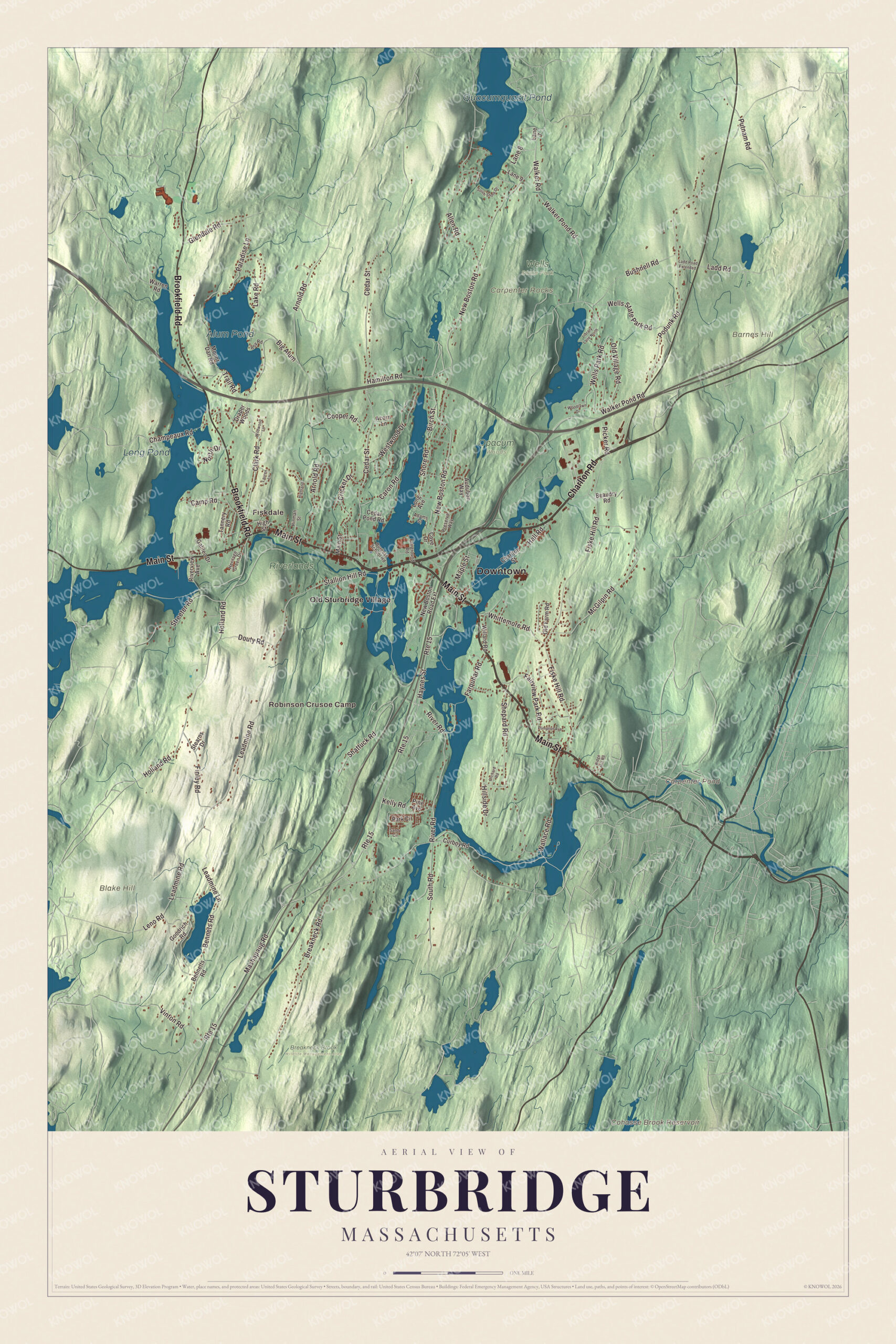
Sturbridge, Massachusetts on the map
Click the map to look closer.
Sturbridge today
By KNOWOL
Sturbridge in 2026, from Downtown and Fiskdale out along Main Street, Breakneck Road and New Boston Road toward Old Sturbridge Village, with Carpenter Pond, Alum Pond, Quacumquasit Pond, Barnes Hill and Carpenter Rocks named on it.6
The history of Sturbridge, Massachusetts
The sound of an axe
Henry and Daniel Fiske, two of the first settlers, pitched their tent near the top of the hill that still carries their name. For a while they didn't know which way their nearest neighbor lived. Then, one clear afternoon, they heard an axe far off to the south and went looking. The other man had heard theirs and was coming the same way. They met on opposite banks of the Quinnebaug, felled two trees into the stream for a bridge, and met on it to trade greetings. He was James Denison, a proprietor living in a cave not far from Westville, until, the old story goes, a wolf with a prior claim wanted it back. Joseph Smith was the first settler to stay through a winter here, probably 1730 to 1731.78
Black lead at Tantiusques
Tantiusques had a mine before Sturbridge had a town. In 1644 the printer Stephen Daye, prospecting for John Winthrop Jr., got the sachem Webucksham's grant of ten miles around the hills where the black lead was, and the General Court granted Winthrop the hill. Black lead is graphite. Winthrop owned it thirty-two years, and there's no evidence he ever saw it. In the late 1730s his grandson called its lead the best known in the world and told his steward, in secret, that it held a fifth part silver. In 1902 the mine's president said he'd never found any. Frederick Tudor of Boston, later rich in the ice business, bought the mine in 1828 and 1829 to supply his crucible works. On October 13, 1830, rock fell in the open cut and killed two workmen.91011
A vote at one hundred and four
Sturbridge took the Revolution seriously. On June 27, 1776, the town voted by a great majority to back independence with their lives and fortunes, and Rev. Joseph S. Clark later counted 239 Sturbridge men who served. Ebenezer Crafts, who kept a tavern in town, led a troop of horse. Among the soldiers was John Phillips. On November 8, 1864, he came into the town hall at one hundred and four years, four months and nine days old. Offered a ticket from each party, he said in a voice the whole hall could hear, "I wish to vote for Abraham Lincoln." Then he asked the Civil War soldiers there to stand in a row so he could meet each one, and the veterans of two wars shook hands.41213
Sturbridge, Massachusetts through the years
25 moments from 1644 to today.
- 1644Prospecting for John Winthrop Jr., the printer Stephen Daye gets the sachem's grant of ten miles around the black lead hills, and the General Court grants Winthrop the hill.9
- 1729On September 3 the General Court grants a new township to petitioners, most of them from Medfield.8
- 1730Joseph Smith becomes the first settler to stay through a winter, probably 1730 to 1731.8
- 1733John Comins Jr. of Oxford builds the first meeting-house, on the plan of one at Grafton.14
- 1736Joshua Morse goes to a proprietors' meeting called to stop bridges being built over the Quinebaug.15
- 1736A church of fourteen men is gathered on September 29, and Caleb Rice is ordained its first minister.14
- 1738Sturbridge is incorporated on June 24, named for Stourbridge in England.2
- 1738On September 18 the young men of the new town hold their first town meeting in the unpainted meeting-house.14
- 1747A Baptist church of fifteen members is formed; members who refuse the minister tax are later jailed at Worcester.16
- 1776On June 27 the town votes by a great majority to back independence with their lives and fortunes.4
- 1780About this year Samuel Hobbs, a Boston Tea Party man, comes to town and starts a tannery.17
- 1784The Baptists build their first meeting-house on Fiske Hill.18
- 1791Ebenezer Crafts moves to Vermont and founds Craftsbury with families from Sturbridge.12
- 1812The Sturbridge Manufacturing Company's mill at Westville starts running in the fall, the first cotton factory in the old town.19
- 1816Southbridge is set off in February, taking a little less than a third of Sturbridge's voters.20
- 1829The Fiske brothers' first brick cotton mill, five stories high, starts running at Fiskdale in May.21
- 1830On October 13 a rockfall in the lead mine's open cut kills two workmen.11
- 1833The center meeting-house gets its Revere bell.22
- 1838On July 4 Rev. Joseph S. Clark, the town's first historian, gives the centennial address.23
- 1853The Snell brothers build stone mills at Wight Village and bring their auger and bit business from Ware.24
- 1854The Worcester South Agricultural Society is incorporated, grown from a farm show held on the Common in 1843.25
- 1864Deacon John Phillips, a Revolutionary soldier aged 104, votes for Abraham Lincoln on November 8.13
- 1908Lightning burns the old meeting-house on the Common early on August 5.26
- 1910The new church is dedicated on May 11, with the old Revere bell recast and ringing again.26
- 1955On August 18 the floods of Hurricane Diane break dams in the towns around and flood the village.1
Places to see in Sturbridge, Massachusetts
Places worth a visit in Sturbridge today.
- Old Sturbridge VillageU.S. Route 20. Living museum of 1790s to 1830s life.Visit their website
- DowntownSturbridge Common. Common, town hall, library and churches.
- FiskdaleNorthwest part of town. Mill village named for the Fiskes.
- Main StreetThrough the town center. Spine of the Common historic district.
- New Boston RoadToward the Brookfields. Follows an old Indian path.
- Breakneck RoadSouth part of town. Into the rocky Breakneck ridges.
- Mashapaug RoadToward Connecticut. Locals call parts of it Old Route 15.
- Alum PondNorth of Fiskdale. A camping ground by the 1880s.
Sturbridge on the National Register of Historic Places
All 3 places in Sturbridge on the National Register of Historic Places that still stand today, oldest first, and why each one matters.5
-
Tantiusques Reservation
A 57-acre reservation of The Trustees of Reservations around the graphite mine John Winthrop the Younger bought from the Nipmuc in 1644. Trenches, tailings and a mine shaft of 1902 can still be seen, along with the Crowd Site, home of mine worker Robert Crowd from 1842 to about 1860.27
-
Sturbridge Common Historic District
The historic center of town, about 138 acres along Main Street around the common laid out when the town was set up in 1738. It takes in the 1838 Greek Revival Town Hall, the 1896 Joshua Hyde Library, the 1922 Federated Church and the Publick House, a tavern of about 1772.28
-
Oliver Wight House
A Georgian house built in the 1780s for the cabinetmaker Oliver Wight and later run as a tavern by Ebenezer Howard. The walls of its front hall carry a mural by the folk artist Rufus Porter, and Old Sturbridge Village later ran it as a motor lodge.29
Sturbridge in their words
“To those who have their home here it is the very centre of the world.”
Levi B. Chase, on the central valley of Sturbridge, History of Worcester County, 188930
“Sturbridge village lies in a basin among the hills, and so embowered in foliage during the summer that only glimpses of its roofs and steeples can be seen from outside points.”
A gazetteer of the state of Massachusetts, 18902
“I wish to vote for Abraham Lincoln.”
Deacon John Phillips, aged 104, at the town hall on November 8, 1864, as told in the History of Worcester County, 188913
Towns near Sturbridge, Massachusetts
Sources for the history of Sturbridge
- Sturbridge, Massachusetts, Wikipedia
- A gazetteer of the state of Massachusetts (1890), on Sturbridge, Internet Archive
- History of Worcester County, Massachusetts (1889), Sturbridge chapter: Tantousque and the lead mine, Internet Archive
- History of Worcester County, Massachusetts (1889), Sturbridge chapter: the Revolution, Internet Archive
- National Register of Historic Places listings in Worcester County, Massachusetts, Wikipedia
- Map of Sturbridge, Massachusetts in 2026, KNOWOL
- A gazetteer of the state of Massachusetts (1890), quoting Clark's Historical Sketch of Sturbridge (1838) on the Fiskes and James Denison, Internet Archive
- History of Worcester County, Massachusetts (1889), Sturbridge chapter by Levi B. Chase: the grant and first settlers, Internet Archive
- The tale of Tantiusques: an early mining venture in Massachusetts, by George H. Haynes (1902), on the 1644 grants, Internet Archive
- The tale of Tantiusques (1902), on the Winthrops and the hope of silver, Internet Archive
- The tale of Tantiusques (1902), on Frederick Tudor and the later mine, Internet Archive
- The Massachusetts magazine (1908 series), on Col. Ebenezer Crafts of Sturbridge, Internet Archive
- History of Worcester County, Massachusetts (1889), Sturbridge chapter: Deacon John Phillips at the 1864 election, Internet Archive
- History of Worcester County, Massachusetts (1889), Sturbridge chapter: the first meeting-house and town meeting, Internet Archive
- History of Worcester County, Massachusetts (1889), Sturbridge chapter: the proprietors and the bridges, Internet Archive
- Collections of the Worcester Society of Antiquity (1881), on the Baptist Church of Sturbridge, Internet Archive
- History of Worcester County, Massachusetts (1889), Sturbridge chapter: Samuel Hobbs's tannery, Internet Archive
- Gazetteer of the state of Massachusetts (1874), on Sturbridge, Internet Archive
- History of Worcester County, Massachusetts (1889), Sturbridge chapter: the Westville cotton factory, Internet Archive
- History of Worcester County, Massachusetts (1879), Sturbridge chapter, Internet Archive
- History of Worcester County, Massachusetts (1889), Sturbridge chapter: Fiskdale and the Fiskdale Mills, Internet Archive
- Historical sketch of the First Congregational church, Sturbridge, Massachusetts (1910), on the town bell, Internet Archive
- Historical sketch of the First Congregational church, Sturbridge, Massachusetts (1910), on Rev. Joseph S. Clark, Internet Archive
- History of Worcester County, Massachusetts (1889), Sturbridge chapter: the Snell Manufacturing Company, Internet Archive
- History of Worcester County, Massachusetts (1889), Sturbridge chapter: the agricultural societies, Internet Archive
- Historical sketch of the First Congregational church, Sturbridge, Massachusetts (1910), on the fire of 1908 and the new church, Internet Archive
- Tantiusques Reservation, Wikipedia
- Sturbridge Common Historic District, Wikipedia
- Oliver Wight House, Wikipedia
- History of Worcester County, Massachusetts (1889), Sturbridge chapter: the central valley, Internet Archive