
Plymouth Hollow on the Naugatuck River, renamed in 1875 for the clockmaker Seth Thomas, whose one small shop of 1813 grew into a clock works of 1,200 hands and a Main Street of brick and towers.
Thomaston on the map
Click the map to look closer.
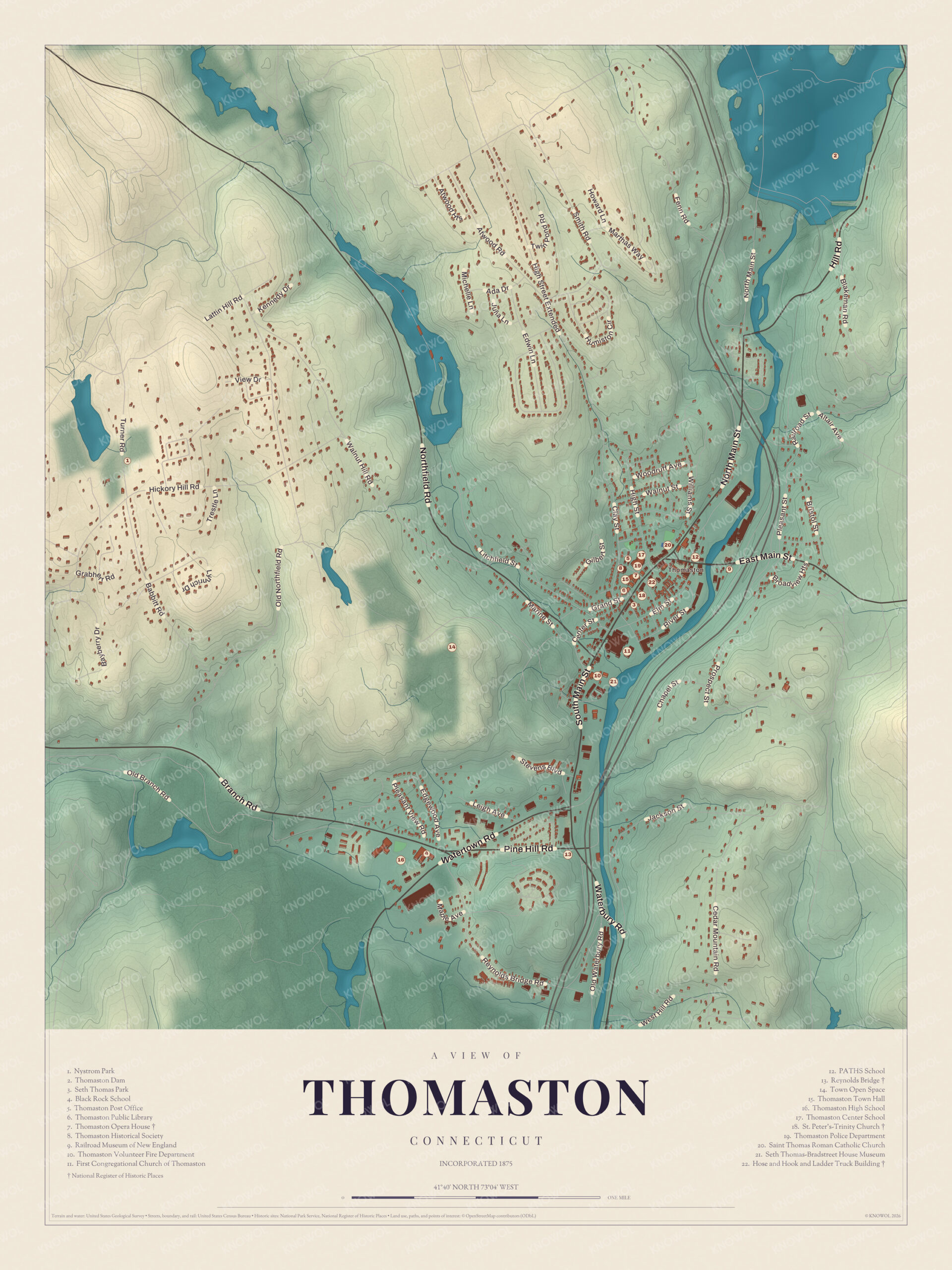
Thomaston today
By KNOWOL
Shaded hills from the high ground around town down to the Naugatuck River and its brooks, every street with its name, Reynolds Bridge, and a guide of 22 numbered landmarks with the National Register sites marked.5
The story of Thomaston
Clocks by six-horse team
In 1813 Seth Thomas bought a small shop in Plymouth Hollow from Heman Clark, who had built it four years before, and started making clocks with about twenty hands. In those days the workers were paid once a year. Lumber and materials came up by horse team from New Haven and Hartford, and the finished clocks went back the same way. A teamster who started with Thomas in 1834 remembered making three trips a week to New Haven, most of the time behind six horses. Thomas added a cotton mill near the covered bridge that year, and a brass mill by the depot about 1852. By 1895 the clock works employed about 1,200 people in good times. A Wolcott historian grumbled that it all might have been his town's.36
The river and its bridges
Thomaston grew where the Naugatuck runs through a narrow valley, and the river has always had its say. A covered bridge went up in the village in 1836, built under selectman Edward Blakeslee. In 1875 a cloudburst swept away railroad bridges and heavy masonry between Thomaston and Waterbury. On another day a sudden shower undermined the railroad bridge at Pine Brook, just above the village, and nine of sixteen workmen riding a car back up the line were drowned. In 1928 the state built Reynolds Bridge, a three-arch concrete span, to carry Waterbury Road over the river and the tracks. After the flood of 1955, the Army Corps of Engineers dammed each of the town's streams, and building Thomaston Dam meant moving about eight miles of track.78915
Three buildings on Main Street
Thomaston became a town of its own on July 6, 1875, and within ten years it had a proud civic center on Main Street. In 1882 it built a brick firehouse, the Hose and Hook and Ladder Truck Building, of brick from the Seth Thomas family brickyard, to a design by Robert Wakeman Hill of Waterbury. Hill also designed the Opera House next door, built in 1883 to 1885 on land given by Aaron Thomas, Seth's son, with a clock tower rising five stages. On the firehouse's other side stands Trinity Church, by Richard M. Upjohn. Its parish got its start with Sunday evening services and an old meeting house the Methodists had left, bought for $1,500. Today the firehouse is an art gallery, and the Opera House is still town hall and theater.210111213
Through the years
25 moments from 1688 to today.
- 1688The meadow just above where the Thomaston bridge would stand is Abraham Andrew's meadow.14
- 1728About this year Henry Cook, remembered as the soldier in the wilderness, settles here.1
- 1740St. Peter's Episcopal parish is organized, and its first church goes up in what is now Thomaston.15
- 1746Barnabas Ford dies. His house, beside a roadside spring, had been named the center of the new parish.16
- 1803Eli Terry sets up a clock factory.1
- 1809Heman Clark builds a small shop in Plymouth Hollow.3
- 1813Seth Thomas buys Clark's shop and starts making clocks with about twenty hands.3
- 1834Thomas builds a cotton factory near the covered bridge.3
- 1836The covered bridge in the village is built under selectman Edward Blakeslee.7
- 1837The Congregational church in Plymouth Hollow is founded in December.15
- 1852About this year Thomas builds a brass mill near the depot.3
- 1853The Seth Thomas Clock Company is organized.3
- 1859Seth Thomas dies.3
- 1874The Thomaston Savings Bank is organized.17
- 1875On July 6 Thomaston begins its life as a town, separated from Plymouth.2
- 1875A cloudburst carries away railroad bridges and masonry between Thomaston and Waterbury.8
- 1879The Eagle Rock church is organized for the factory village at Reynolds Bridge.18
- 1882The brick firehouse on Main Street is built.10
- 1883Work begins on the Opera House, finished in 1885 on land given by Aaron Thomas.11
- 1898The state lists the town's industries as clocks and watches, brass, cutlery, enameled goods, clock bells and bicycle cyclometers.19
- 1928Reynolds Bridge, a three-arch concrete span, is built over the Naugatuck.9
- 1955A great flood ravages the town, and flood control dams follow on its rivers.1
- 1959About eight miles of railroad track are moved over two years to make way for Thomaston Dam.5
- 1972The Thomaston Opera House is listed on the National Register.11
- 1979The old firehouse on Main Street serves its last year as a firehouse.10
Places to see
The numbers match the landmark guide printed on the 2026 map.
- 2Thomaston DamNortheast of town. Flood control dam built after 1955.
- 3Seth Thomas ParkDowntown. Named for the town's clockmaker.
- 6Thomaston Public LibraryMain Street. Just beyond Trinity Church.Visit their website
- 7Thomaston Opera House153 Main Street. Theater and town hall since 1885.Visit their website
- 9Railroad Museum of New EnglandEast of downtown. Runs the Naugatuck Railroad's trains.Visit their website
- 11First Congregational Church of ThomastonSouth of Main Street. The church founded in 1837.
- 13Reynolds BridgeWaterbury Road. Three concrete arches from 1928.
- 18St. Peter's-Trinity Church160 Main Street. Richard M. Upjohn's Stick style church.
- 21Seth Thomas-Bradstreet House MuseumSouth of Main Street. Home of the clockmaker's family.
- 22Hose and Hook and Ladder Truck BuildingMain Street. The brick firehouse of 1882.
On the National Register
All 4 places in Thomaston on the National Register of Historic Places that still stand today, oldest first, and why each one matters.4
-
Trinity Church
A Gothic and Stick style church by Richard M. Upjohn, the architect of the State Capitol, larger and more elaborate than four similar churches he had designed before. Its parish is now joined with St. Peter's of Plymouth.12
-
Hose and Hook and Ladder Truck Building
A brick firehouse with a Venetian-style tower, designed by Robert Wakeman Hill of Waterbury and built of brick from the Seth Thomas family brickyard. It housed volunteer fire companies until 1979 and is now an art gallery.10
-
Thomaston Opera House
A Romanesque brick building with a five-stage clock tower, built on land given by Aaron Thomas, son of Seth Thomas. It has been a stage and movie house since it opened, and after a restoration it holds the town offices downstairs and the Landmark Community Theatre upstairs.11
-
Reynolds Bridge
An open-spandrel concrete bridge of three arches, the main one 169 feet across, carrying Waterbury Road over the river, the railroad and an old trolley route. It was the longest such bridge the State Highway Department had designed up to that time.9
In their words
“The quiet little hamlet of less than a score of buildings has grown to one of the loveliest manufacturing towns in Connecticut”
History of Waterbury and the Naugatuck Valley, 19182
“Thomaston now numbers two thousand inhabitants, and is an enterprising, thriving village. Such has Wolcott lost, and such has Plymouth gained, and such are the results of the energy of one man.”
History of the town of Wolcott, 1874, on Seth Thomas6
“He died in 1859, having left as a monument to his memory these three large and flourishing institutions, themselves emphatic witnesses to his indomitable will and untiring energy”
History of the town of Plymouth, Connecticut, 1895, on Seth Thomas3
Nearby towns
Sources
- Thomaston, Connecticut, Wikipedia
- History of Waterbury and the Naugatuck Valley, Connecticut (1918), on Thomaston, Internet Archive
- History of the town of Plymouth, Connecticut (1895), on Seth Thomas in Plymouth Hollow, Internet Archive
- National Register of Historic Places listings in Litchfield County, Connecticut, Wikipedia
- Map of Thomaston, Connecticut in 2026, KNOWOL (USGS elevation, Census Bureau roads)
- History of the town of Wolcott (Connecticut) from 1731 to 1874 (1874), Internet Archive
- History of the town of Plymouth, Connecticut (1895), on the covered bridge, Internet Archive
- The history of the old town of Derby, Connecticut, 1642-1880 (1880), on the Naugatuck Railroad, Internet Archive
- Reynolds Bridge, Wikipedia
- Hose and Hook and Ladder Truck Building, Wikipedia
- Thomaston Opera House, Wikipedia
- Trinity Church (Thomaston, Connecticut), Wikipedia
- Journal of the annual convention of the Episcopal Church in the Diocese of Connecticut, on Trinity Chapel, Thomaston, Internet Archive
- The town and city of Waterbury, Connecticut, vol. 2 (1896), on the meadows at Thomaston, Internet Archive
- History of the town of Plymouth, Connecticut (1895), on St. Peter's and the Congregational church, Internet Archive
- History of the town of Plymouth, Connecticut (1895), on Barnabas Ford's house, Internet Archive
- Representative citizens of Connecticut, biographical memorial (1916), on the Thomaston Savings Bank, Internet Archive
- The churches of Mattatuck (1892), on the Eagle Rock church, Internet Archive
- Register and manual of the state of Connecticut (1898), Internet Archive