
A hill town on the Waterbury line, once the Westbury parish of Waterbury, where Heminway spooled silk thread, Wheeler and Wilson built their first sewing machines, and the mill village of Oakville grew up along Steel's brook.
Watertown on the map
Click the map to look closer.
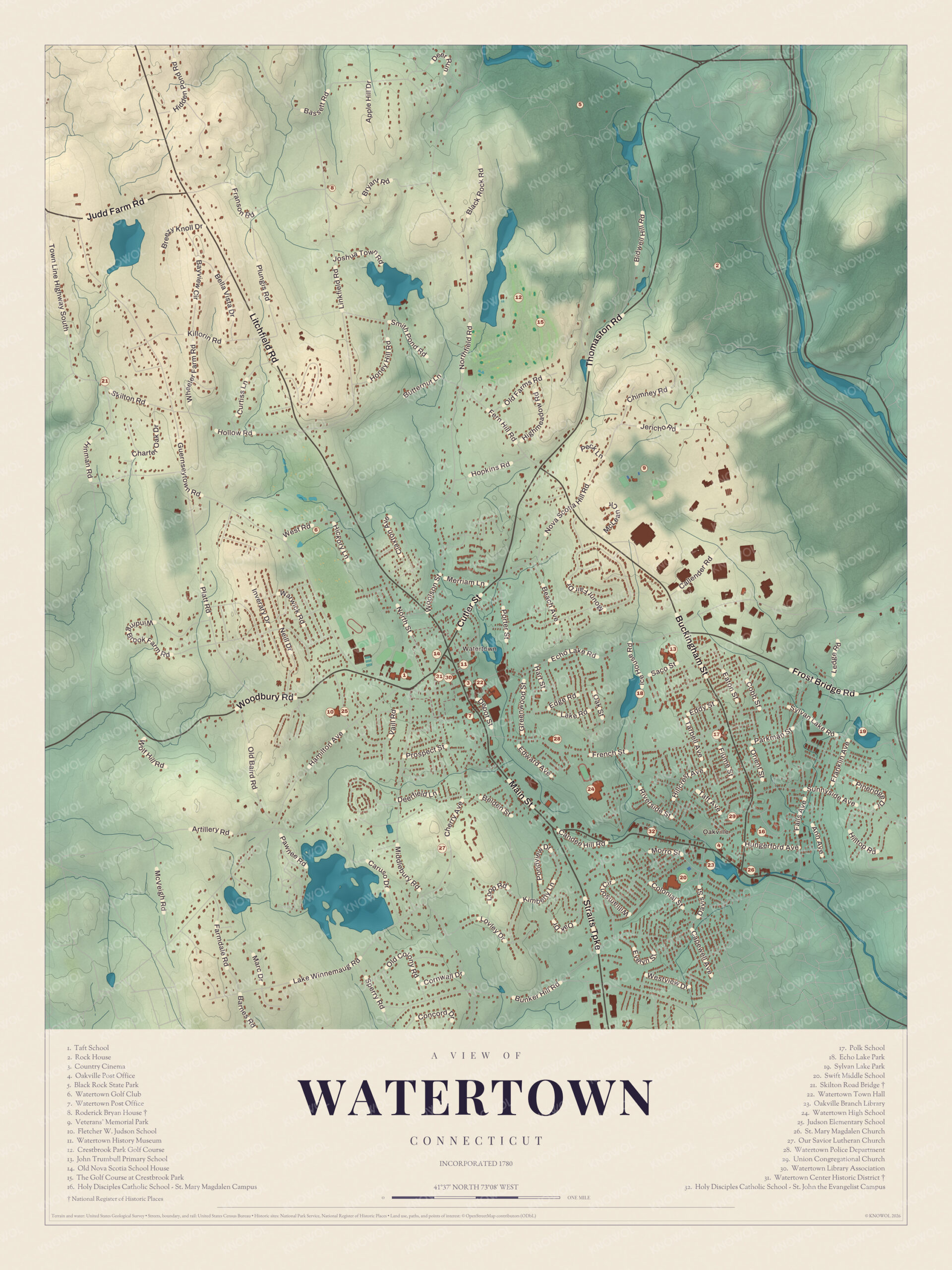
Watertown today
By KNOWOL
Shaded hills from Black Rock in the north down to Oakville in the southeast, every street from the green to Town Line Highway South, and a guide of 32 numbered landmarks with the National Register sites marked.6
The story of Watertown
Silk spools and sewing machines
Watertown's center never had much water power, but it still changed how America sewed. General Heminway came here at 21, clerked in a store, and later began making sewing silk in a building where Nathaniel Wheeler had once made wagons. A 1918 history says he was the first in the country to wind silk on spools, twelve yards to a spool, even though New York merchants warned it would stretch the thread. Wheeler, born in Watertown in 1820, had joined Warren & Woodruff, who made buckles and slides for hat bands. On a trip to New York he saw Allen B. Wilson's new sewing machine and signed on to build five hundred of them here, with Wilson moving to town to oversee the work. The company outgrew Watertown and moved to Bridgeport in 1856.74389
A lonely house at Oakville
Oakville began with one lonely house. Before 1715 young Thomas Welton built it on the north side of Steel's brook, where the Woster and Scott's mountain roads forked, with an unbridged river between him and any help from town. He died in 1717, probably the first death in Oakville. By 1729 the brothers James and Daniel Williams had built the first mill there. Above it rose Scott's mountain, named for land granted to Jonathan and David Scott in 1690, which people were calling Nova Scotia hill by 1896. In 1852 the Oakville Company was formed on the Waterbury line around Chauncey O. Crosby's machine for sticking pins on paper, and the village grew up around its mills.101112
From Westbury to Watertown
For most of the 1700s this was Westbury, the west parish of Waterbury. The first house went up south of Richard's mountain in 1701, and in 1738 the First Ecclesiastical Society of Westbury was formed. In 1780 the General Assembly made it a town called Watertown. The act came with bills to pay: the new town owed Waterbury twelve pounds in wheat, at four shillings a bushel, toward roads, and half the cost of the great bridge over the Naugatuck for ten years. The first Watertown was bigger than today's. Its northern parish, Northbury, sent one of the town's two representatives, and in 1795 the land east of the Naugatuck became Plymouth. Watertown kept the name and all the record books.13621415
Through the years
23 moments from 1684 to today.
- 1684Thomas Judd and other proprietors buy the land as part of Mattatuck, later Waterbury.1
- 1701The first house in what's now Watertown goes up south of Richard's mountain.13
- 1715Before this year young Thomas Welton builds a lonely house at what's now Oakville.10
- 1729James and Daniel Williams build the first mill at Oakville.10
- 1729The Garnsey family settles the area now called Guernseytown.1
- 1735The oldest house still standing in Watertown is built on Main Street.1
- 1738The First Ecclesiastical Society of Westbury is formed, with 338 people.6
- 1750The poet John Trumbull is born here.1
- 1772The town green is laid out, with the meetinghouse at its edge.16
- 1780Westbury is set off from Waterbury and made the town of Watertown.2
- 1795The land east of the Naugatuck becomes Plymouth, and Watertown keeps the name and the records.15
- 1822Bishop & Heminway is formed, the start of the Heminway silk business.4
- 1839The Greek Revival First Congregational Church is built above the green.16
- 1850Wheeler, Wilson & Co. forms to build Allen B. Wilson's sewing machines in Watertown.9
- 1852The Oakville Company is formed around a machine for sticking pins on paper.12
- 1856The Wheeler & Wilson company moves to Bridgeport.9
- 1863Lt. J. A. Woodward and Watertown's men of the 23rd Connecticut are captured in Louisiana.17
- 1865The town votes to build the stone arch bridge on Skilton Road.18
- 1870The first train runs on the new railroad from Waterbury to Watertown.19
- 1883The granite library is built near the green.16
- 1893Horace Dutton Taft moves his school to Watertown, into the old Warren House.6
- 1894The brick town hall is built.16
- 1926A citizens' group gives 254 acres that begin Black Rock State Park.20
Places to see
The numbers match the landmark guide printed on the 2026 map.
- 1Taft SchoolWest of the green. Here since 1893, in grades 9 to 12.Visit their website
- 5Black Rock State ParkThe north. 444 acres beside Mattatuck State Forest.Visit their website
- 8Roderick Bryan HouseLinkfield and Bryan Roads. Cape farmhouse of about 1820.
- 11Watertown History MuseumMunson Memorial Park. Beside the old schoolhouse.Visit their website
- 14Old Nova Scotia School HouseMunson Memorial Park. Greek Revival schoolhouse of 1853.
- 21Skilton Road BridgeOver the Nonewaug River. Single stone arch, voted in 1865.
- 22Watertown Town HallDeforest Street. Brick town hall of 1894.
- 26St. Mary Magdalen ChurchOakville. Parish church in the village.
- 30Watertown Library AssociationNear the center. The town's library.Visit their website
- 31Watertown Center Historic DistrictAround the green. More than 100 historic buildings.
On the National Register
All 3 places in Watertown on the National Register of Historic Places that still stand today, oldest first, and why each one matters.5
-
Watertown Center Historic District
The old village around the green laid out in 1772, with houses and public buildings of unusual quality from the 1700s into the 1900s. It takes in the 1839 Congregational Church, the 1883 granite library, the 1894 town hall and the 1898 Methodist church.16
-
Roderick Bryan House
A well-kept Cape farmhouse built by Roderick Bryan on land his father bought in 1807. Bryan farmed here and apparently ran a small tavern in the back of the house, and much of the original woodwork survives inside.21
-
Skilton Road Bridge
A dry-laid stone arch the town voted to build in 1865, when Skilton Road was the main way to Bethlehem. Stone was likely chosen because it lasts longer and could stand up to floods from a mill dam just upstream.18
In their words
“Mr. Heminway was the first in this country to spool silk. The first were made to hold twelve yards each.”
History of Waterbury and the Naugatuck Valley, 19184
“Mr. Wheeler quickly recognized the merits of the invention, and at once entered into a contract to build five hundred of the machines at his factory in Watertown”
Representative men of Connecticut, 1894, on Nathaniel Wheeler3
“Having lost his boots one day while asleep, he was six months without shoes or stockings, afterward obtaining a pair of the former by whittling out a fancy pipe”
Historical sketch of Watertown, 1871, on Lt. J. A. Woodward in a Texas prison17
Nearby towns
Sources
- Watertown, Connecticut, Wikipedia
- The public records of the State of Connecticut (1894), on the 1780 act making Watertown a town, Internet Archive
- Representative men of Connecticut, 1861-1894 (1894), on Nathaniel Wheeler, Internet Archive
- History of Waterbury and the Naugatuck Valley, Connecticut (1918), on the Heminway silk company, Internet Archive
- National Register of Historic Places listings in Litchfield County, Connecticut, Wikipedia
- Map of Watertown, Connecticut in 2026, KNOWOL (USGS elevation, Census Bureau roads)
- History of the town of Plymouth, Connecticut (1895), on Watertown's mills, Internet Archive
- Representative men of Connecticut, 1861-1894 (1894), on Warren & Woodruff, Internet Archive
- The Connecticut magazine (1905), on the Wheeler & Wilson company, Internet Archive
- The town and city of Waterbury, Connecticut (1896), on the first house and mill at Oakville, Internet Archive
- The town and city of Waterbury, Connecticut (1896), on Scott's mountain (item labeled Waterford), Internet Archive
- The Connecticut magazine (1899), on the Oakville Company, Internet Archive
- The town and city of Waterbury, Connecticut (1896), on Cranberry brook and the first house in Watertown, Internet Archive
- History of the town of Plymouth, Connecticut (1895), on Northbury's representatives, Internet Archive
- The public records of the State of Connecticut (1894), on the 1795 division of Watertown and Plymouth, Internet Archive
- Watertown Center Historic District, Wikipedia
- Third series of the historical sketch of Watertown, Connecticut (1871), Internet Archive
- Skilton Road Bridge, Wikipedia
- The town and city of Waterbury, Connecticut (1896), on the Watertown railroad, Internet Archive
- Black Rock State Park, Wikipedia
- Roderick Bryan House, Wikipedia