
Hartford's old West Division, the farm parish where Noah Webster was born, which asked for its own church in 1710 and its own town until 1854, and grew from potteries, dairies and ice ponds into the suburb around the Center.
Then and now
The same town 157 years apart. Click either map to look closer.
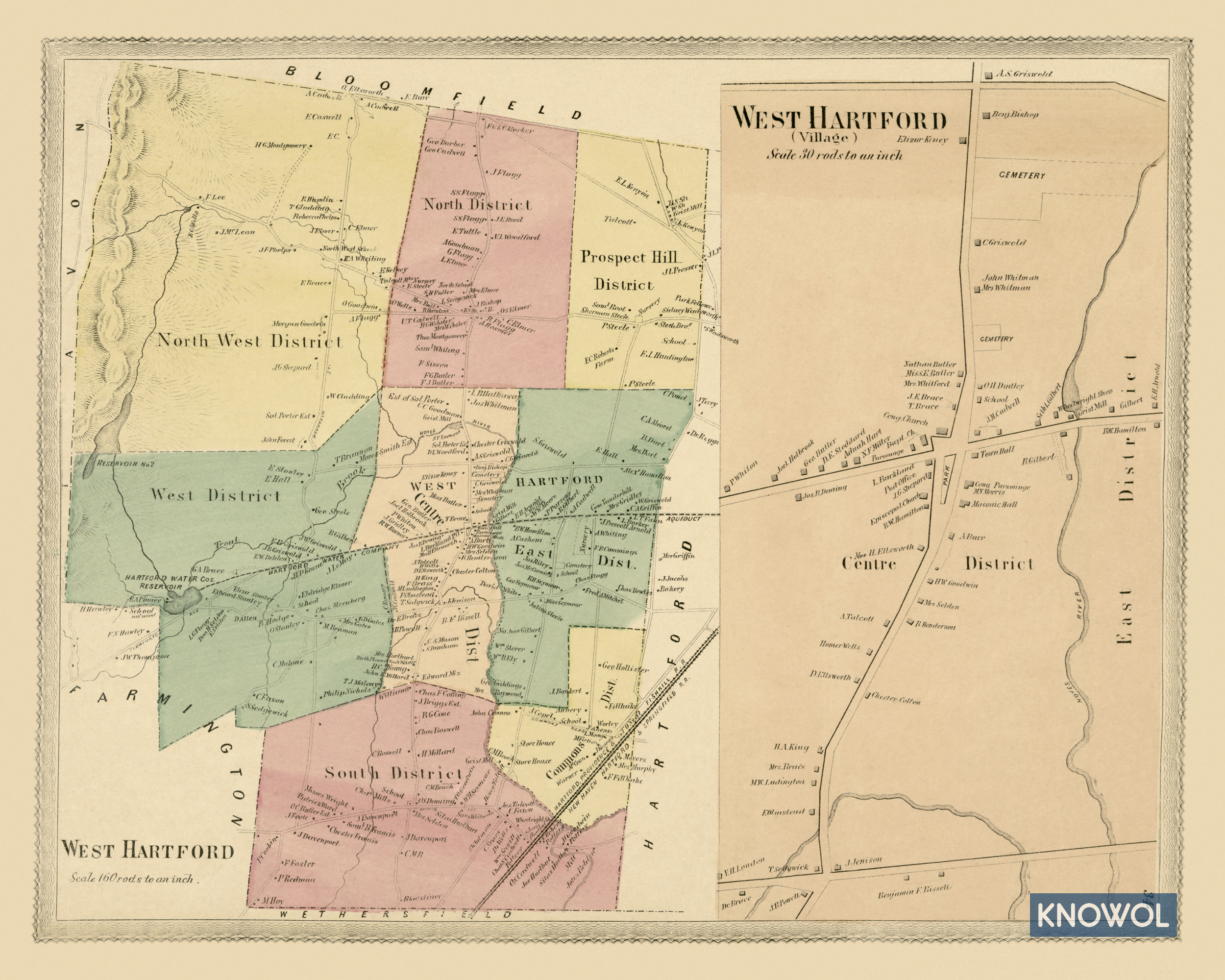
The landowners map
By Baker & Tilden
West Hartford fifteen years after it became a town, divided into nine school districts from North West to Joint, with every plot labeled with its owner's name. The Hartford water reservoir, the aqueduct, Farmington Avenue, the railroad, the Town Hall, Masonic Hall and the Congregational and Episcopal churches are all drawn.5
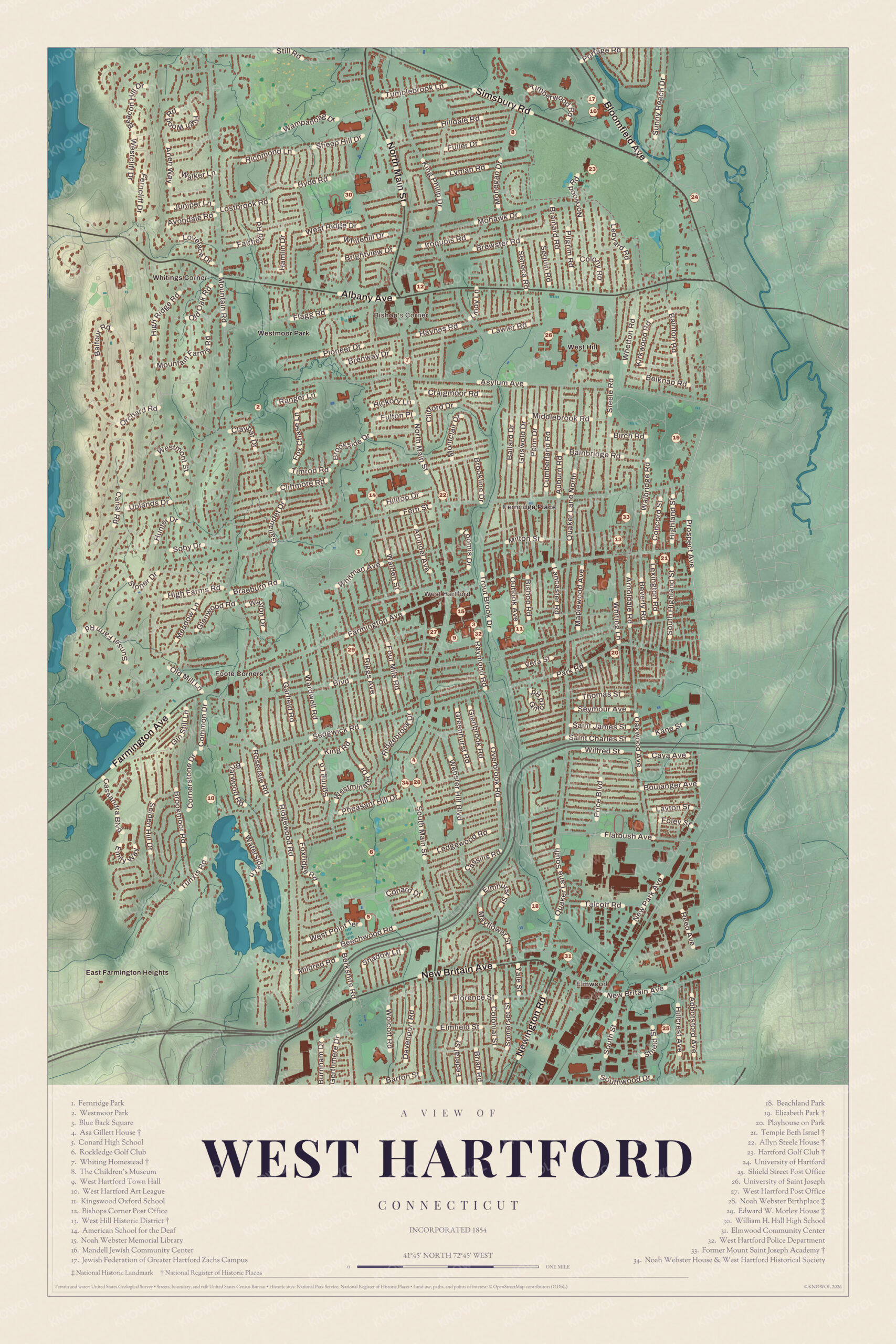
West Hartford today
By KNOWOL
Shaded land from the hills of East Farmington Heights down to Elmwood, every street from Bishops Corner to the Center, and a guide of 34 numbered landmarks with the National Historic Landmarks and National Register sites marked.6
The story of West Hartford
A good part of God's time
In 1710 the farmers of Hartford's West Division asked the General Assembly for a minister of their own. The distance to Hartford was such, they wrote, that a good part of God's time was spent travelling backwards and forwards, over bad roads and a river that was sometimes impassable. Hartford objected, but the legislature made them a society in 1711, and the church gathered with twenty-nine members in 1713. The society ran the schools too, and in 1736 it voted that each family send half a cord of wood for every child, or the child could be kept from the fire. Nathan Perkins later preached here for sixty-six years. Paid partly in wood, he once looked over a load of scraggly treetops and only praised the farmer's steers.7829
The boy from South Main Street
Noah Webster was born in 1758 in the farmhouse that still stands at 227 South Main Street, and he learned from the parish minister, Nathan Perkins. In 1777, with Burgoyne's army invading, a West Hartford company marched out under Deacon Webster, Noah's father, with all three of his sons in the ranks. They came home safe from the victory. His father had mortgaged the farm to send him to Yale, and when Noah graduated in 1778 he gave him an eight-dollar Continental bill, worth about four dollars in silver, and sent him out to make his own way. Webster taught school and read law. His spelling book came out in 1783, and his dictionary of 1828 sold millions of copies.101112
Elmwood's elms and kilns
Elmwood takes its name from a street arched with elms that were already a hundred years old in 1886. Ebenezer Faxon started a pottery on today's New Britain Avenue in 1770, and Seth Goodwin began his about 1798. In the 1870s three young Goodwins took a little shop to carry on what their ancestors had begun, and by 1886 Goodwin Brothers ran a steam-turned potter's wheel and two big kilns, with seventy-five hands on nearly an acre of floor. Most of their decorated ware sold in the South and West. Nearby, Charles M. Beach kept one of the first Jersey herds in the country. When the railroad came through, factories followed, and in the 1910s the New Departure ball bearing plant at Elmwood employed about six hundred hands.13114
Through the years
25 moments from 1672 to today.
- 1672Hartford's proprietors order a division to the west, the 72 Long Lots between today's Quaker Lane and Mountain Road.1
- 1674The lots are laid out across the West Division. The narrowest is a whip-lash three rods wide and a mile and a half long.15
- 1679Stephen Hosmer is sent out to build a sawmill north of today's Center.1
- 1710West Division farmers petition for a minister of their own, tired of the long trip to Hartford's meetinghouses.7
- 1713The church is gathered with twenty-nine members, and Benjamin Colton is ordained its first pastor.2
- 1719John Janes sells the parish the land for its first burying ground on North Main Street.16
- 1736The society votes that families send half a cord of firewood to school for each child.8
- 1758Noah Webster is born in the farmhouse on South Main Street.10
- 1770Ebenezer Faxon starts a pottery on today's New Britain Avenue, in what becomes Elmwood.1
- 1777A West Hartford company marches against Burgoyne under Deacon Webster, with his three sons, Noah among them.12
- 1778Continental soldiers camp for a week in October near today's Reservoir No. 6.17
- 1797The parish votes unanimously to seek separation as its own town.18
- 1833Nathan Perkins, at 83, calls himself the oldest officiating minister in the state.19
- 1843St. James's Parish is organized, the first church here besides the Congregational one and the short-lived Friends.18
- 1854The General Assembly votes on May 3 to make West Hartford a town.1
- 1854One school district votes a well, a year-round school with a woman teacher at thirty dollars a month, and free schooling paid by tax.20
- 1864Hartford voters choose to bring water by gravity from Trout Brook in West Hartford, 1,510 to 508.21
- 1867On January 2 the water is let on from West Hartford and the city's pumps are stopped.21
- 1878The Sisters of Mercy buy a 33-acre farm on Quaker Lane for a boarding school for boys.22
- 1882The Congregational society dedicates its new church of Monson granite on June 7.23
- 1889Trolley lines reach out from Hartford, and the farm town starts to become a suburb.1
- 1906The chemist Edward W. Morley moves into his new house on Westland Avenue.24
- 1907The town stores ten to twelve thousand tons of ice a year for outside markets and raises flowers under glass.25
- 1936Congregation Beth Israel moves into its new temple on Farmington Avenue.26
- 2007Blue Back Square opens in the Center, named for Noah Webster's speller.1
Places to see
The numbers match the landmark guide printed on the 2026 map.
- 3Blue Back SquareWest Hartford Center. Named for Webster's Blue-backed Speller.
- 4Asa Gillett House202 South Main Street. A merchant's house of 1760.
- 7Whiting HomesteadNorth Main Street at Lawler Street. Original paneling from about 1790.
- 9West Hartford Town HallWest Hartford Center. At the heart of the Center.
- 13West Hill Historic DistrictFarmington Avenue. 1920s houses on the Vanderbilt estate.
- 19Elizabeth ParkOn the Hartford line. Gardens and greenhouses on Charles Pond's land.Visit their website
- 21Temple Beth Israel701 Farmington Avenue. Byzantine-style synagogue with an 80-foot dome.
- 22Allyn Steele HouseNorth Main Street at Fern Street. Built about 1775.
- 28Noah Webster Birthplace227 South Main Street. Webster's boyhood farmhouse, built 1747.Visit their website
- 29Edward W. Morley House26 Westland Avenue. The chemist's home, a National Historic Landmark.
On the National Register
20 of the 32 places in West Hartford on the National Register of Historic Places that still stand today, oldest first, and why each one matters. See the full list of National Register places in West Hartford.4
-
Old Center Burying Yard
The town's first cemetery, begun on land bought from John Janes in 1719, and its only burying ground until 1790. Noah Webster's parents, Noah Sr. and Mercy, are buried here among about 155 marked graves.16
-
Sarah Whitman Hooker House
Believed to be the oldest standing house in town, built by John Seymour in one of the first parts of the West Parish to be settled. During the Revolution the Hookers kept two captured Loyalists, Andrew and Philip Skene, here. The town owns it today.27
-
Timothy Goodman House
A saltbox whose roof framing suggests a date of about 1720, with early paneled fireplace walls and original doors and hardware. Timothy Goodman bought the land in 1751 from Noah Webster's grandfather.28
-
Noah Webster Birthplace
National Historic Landmark
Noah Webster was born here in 1758, and his father mortgaged the farm to send him to Yale. A tree-ring study in 2024 dated the house to 1747. A museum since 1966, it keeps early copies of his speller and dictionary and a desk and two clocks he owned.10
-
Stanley-Woodruff-Allen House
One of the first farmhouses in what became West Hartford, built by Samuel Stanley for his son. The town bought it in 1943, and the West Hartford Art League now uses it as a gallery called the Saltbox.29
-
Asa Gillett House
Built for a merchant whose grandfather, Joseph Gillett, settled here in 1694 and helped petition for the West Division's own church. It stands a short way north of the Noah Webster House.30
-
Whitman House
Built by John Whitman Jr., a landowner who signed petitions to separate West Hartford from Hartford. Later the dairy farmer Frederick Duffy, who brought milking machines and silos to the area, lived here.31
-
Allyn Steele House
Built by the son of one of West Hartford's early proprietors, with its winding front stair and paneled parlor. It was the center of a farm until about 1925.32
-
Revolutionary War Campsite
Continental soldiers camped here from October 15 to 21, 1778, sent by Washington to guard Connecticut against raids. Stone-lined fireplaces remain. Long said to be a French camp, it was not.17
-
Whiting Homestead
Built by Gurdon Saltonstall Whiting, a descendant of Governor John Haynes's son, on land first divided in 1679. It keeps unusually complete original wall paneling and stayed in the family until 1920.33
-
Prospect Avenue Historic District
About 240 houses of 1880 to 1930 on the old Goodwin family land along the town line, including the Connecticut Governor's Residence of 1908.34
-
Elizabeth Park
Charles M. Pond left his estate to Hartford on condition it be named for his late wife, Elizabeth. Its rose garden of 1904 is the oldest municipal rose garden in the country, and most of the 102 acres now lie in West Hartford.35
-
Charles E. Beach House
The best preserved of the town's Shingle style houses, built in 1900 and 1901 on the Beach family's Vine Hill dairy farm. The family later gave part of the land for Beachland Park.36
-
Edward W. Morley House
National Historic Landmark
Home of the chemist Edward Morley from 1906 until 1923, who kept a laboratory in the garage. He is remembered for the Michelson-Morley experiment and for weighing hydrogen and oxygen.24
-
Mount St. Joseph Academy
A hilltop brick and limestone school by John J. Dwyer where the Sisters of Mercy taught girls until 1978. It became assisted living in 1996.37
-
Hartford Golf Club Historic District
The club of 1896 and its Donald Ross course, with the Colonial and Tudor Revival neighborhood that grew beside it from 1915 to 1936.38
-
Noah Webster Memorial Library
A brick Colonial Revival library raised by the local Daughters of the American Revolution and finished by the town. It held the town library from 1917 to 1937.39
-
West Hill Historic District
Twenty-five houses of the 1920s on the old estate of Cornelius J. Vanderbilt, built under strict rules on setbacks, cost and architects. The estate's brownstone wall still runs along two sides.40
-
The Spanish House
The town's only Spanish Colonial Revival house, designed by Lester Scheide with Grace Spear Lincoln, who had lived in Spain. Its tiles and fountains came from Spain.41
-
Temple Beth Israel
A domed synagogue in the Byzantine Revival and Art Deco styles by Charles R. Greco, finished in 1936. Its congregation, founded in 1843, is one of the two oldest Jewish congregations in Connecticut.26
In their words
“The parish of West Hartford, for the fertility of its soil, the pleasantness of its situation, the sobriety, industry, good order, and religious deportment of its inhabitants, is not, so far as I know, excelled in the State.”
Timothy Dwight, Yale's president, as quoted in The Memorial History of Hartford County, 188642
“The product of which West Hartford is most proud is her men and women.”
The Memorial History of Hartford County, 188611
“The distance is such that a good part of God's time is spent travelling backwards and forwards.”
The West Division's petition for its own minister, 17107
Nearby towns
Sources
- West Hartford, Connecticut, Wikipedia
- The memorial history of Hartford County, Connecticut, 1633-1884, vol. 2 (1886), on the church and Nathan Perkins, Internet Archive
- The memorial history of Hartford County, Connecticut, 1633-1884, vol. 2 (1886), on the Civil War, Internet Archive
- National Register of Historic Places listings in West Hartford, Connecticut, Wikipedia
- Landowners map of West Hartford, Connecticut from 1869, restored by KNOWOL
- Map of West Hartford, Connecticut in 2026, KNOWOL (USGS elevation, Census Bureau roads)
- The memorial history of Hartford County, Connecticut, 1633-1884, vol. 2 (1886), on the petition of 1710, Internet Archive
- The memorial history of Hartford County, Connecticut, 1633-1884, vol. 2 (1886), on the schools, Internet Archive
- The memorial history of Hartford County, Connecticut, 1633-1884, vol. 2 (1886), on Dr. Perkins' wood, Internet Archive
- Noah Webster House, Wikipedia
- The memorial history of Hartford County, Connecticut, 1633-1884, vol. 2 (1886), on the town's people, Internet Archive
- History and genealogy of the Gov. John Webster family of Connecticut (1915), Internet Archive
- The memorial history of Hartford County, Connecticut, 1633-1884, vol. 2 (1886), on Elmwood and the Goodwin pottery, Internet Archive
- Encyclopedia of Connecticut biography (1923), on the New Departure plant at Elmwood, Internet Archive
- The memorial history of Hartford County, Connecticut, 1633-1884, vol. 2 (1886), on the West Division lots, Internet Archive
- Old Center Burying Yard, Wikipedia
- Revolutionary War Campsite, Wikipedia
- The memorial history of Hartford County, Connecticut, 1633-1884, vol. 2 (1886), on the churches and the new town, Internet Archive
- Connecticut historical collections (1837), Internet Archive
- The Connecticut Common School Journal and Annals of Education (January 1855), Internet Archive
- The memorial history of Hartford County, Connecticut, 1633-1884 (1886), on Hartford's water from West Hartford, Internet Archive
- The memorial history of Hartford County, Connecticut, 1633-1884 (1886), on the Sisters of Mercy, Internet Archive
- The memorial history of Hartford County, Connecticut, 1633-1884, vol. 2 (1886), on the granite church, Internet Archive
- Edward W. Morley House, Wikipedia
- Register and manual, State of Connecticut (1907), Internet Archive
- Congregation Beth Israel (West Hartford, Connecticut), Wikipedia
- Sarah Whitman Hooker House, Wikipedia
- Timothy Goodman House, Wikipedia
- Stanley-Woodruff-Allen House, Wikipedia
- Asa Gillett House, Wikipedia
- Whitman House (West Hartford, Connecticut), Wikipedia
- Allyn Steele House, Wikipedia
- Whiting Homestead, Wikipedia
- Prospect Avenue Historic District, Wikipedia
- Elizabeth Park (Connecticut), Wikipedia
- Charles E. Beach House, Wikipedia
- Mount St. Joseph Academy (West Hartford, Connecticut), Wikipedia
- Hartford Golf Club Historic District, Wikipedia
- Noah Webster Memorial Library (1917 building), Wikipedia
- West Hill Historic District (West Hartford, Connecticut), Wikipedia
- The Spanish House (West Hartford, Connecticut), Wikipedia
- The memorial history of Hartford County, Connecticut, 1633-1884 (1886), on President Dwight's words, Internet Archive