
Once called Waterfield and then Black Horse Village, Winchester grew up around Edward Converse's 1640 mill site on the Aberjona River, became a railroad village called South Woburn, and in 1850 set out as a town of its own between Wedge Pond, the Mystic Lakes and the Fells.
Winchester then and now
The same town 140 years apart. Click either map to look closer.
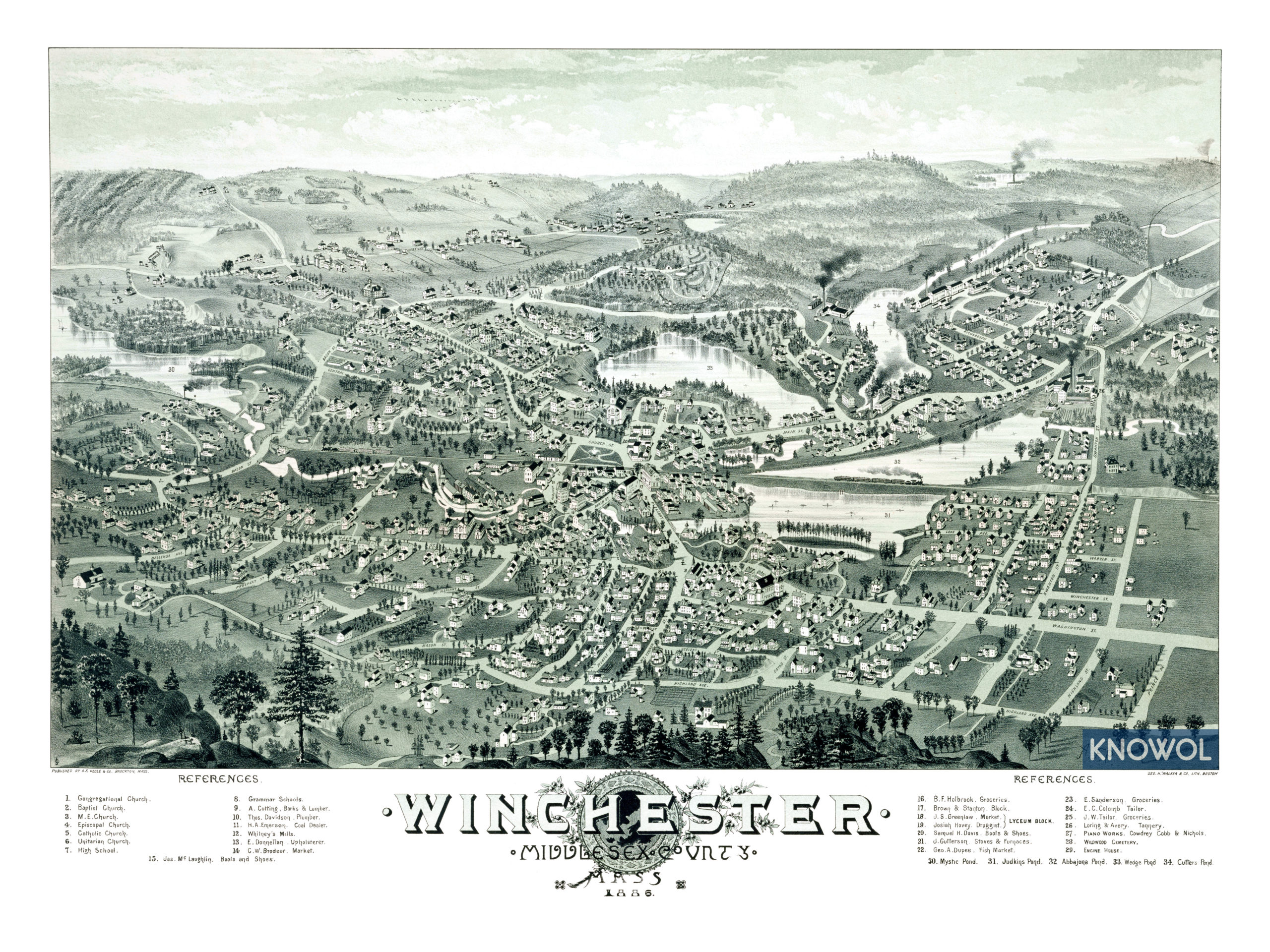
The bird's-eye view
By A.F. Poole and George Walker
Winchester in 1886 as a bird's-eye view, with its street names and old landmarks: Wedge Pond, Whitney's Mills, the Lyceum Block, Dupee Fish Market, Wildwood Cemetery, Mystic Pond, Gutterson Stoves & Furnaces and the Cowdrey Cobb & Nichols Piano Works.5
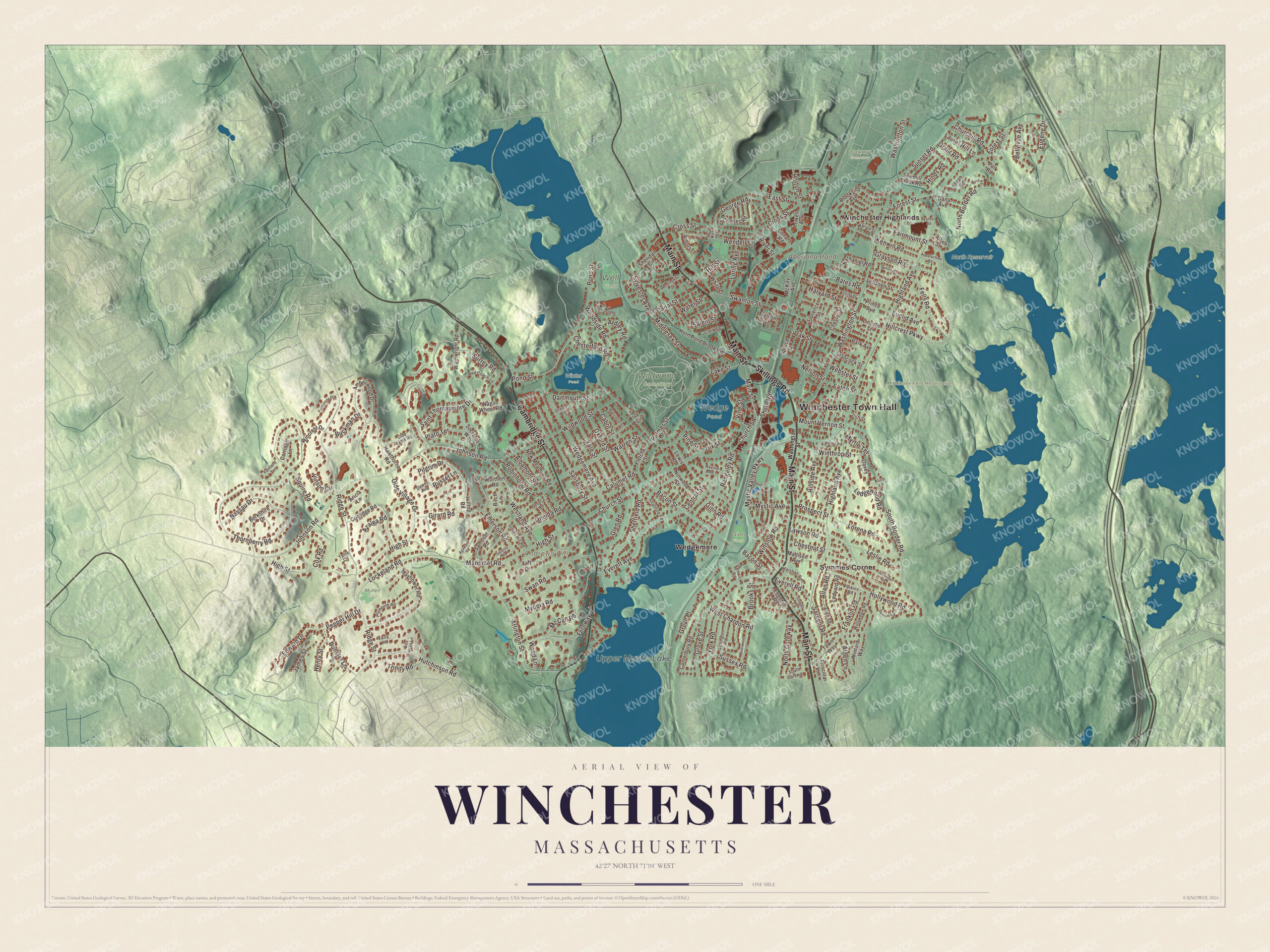
Winchester today
By KNOWOL
Every street from Symmes Corner to Winchester Highlands, around Town Hall and the center, with Aberjona Pond, the Upper Mystic Lake, North Reservoir, the Middlesex Fells Reservation and Andrews Hill printed on the art.6
The history of Winchester, Massachusetts
Black Horse Village
Long before it was Winchester, the scattered houses along the old Great Road took their name from an inn. The Black Horse Tavern went up, tradition says, in 1724. Noah Wyman bought it in 1761 and asked the General Court for a license to keep it, and by 1775 it stood on the upper stage route from Boston to Portsmouth. In 1814 the same road through here was grandly called the road to Montreal and Quebec. An 1880 history remembers the tavern yard full of coaches and teams at night, with the drivers filling its rooms. In 1825 the Grammers opened an English and West India goods store nearby, and the father of the family raised a liberty pole where Main and Washington Streets meet.789
Life at the Woburn Gates
When the Boston and Lowell Railroad opened in 1835, nobody had planned a stop here, so a little shoemaker's shop about ten by fifteen feet served as the station. Where the tracks crossed Main Street, heavy gates were swung open and shut by whoever stood nearby, and the spot was known as the Woburn Gates. People traveled miles just to see the steam monster. Samuel S. Richardson, a Woburn shoe manufacturer, bought the old Converse mill site and started building a village. A friend wrote that he once missed his steamboat at Memphis and still beat it to the next landing. Nearby the Cutters sawed mahogany, and in the new mill Amos Whittemore set up one of the first machines for pegging shoes.1011
Not a dollar for lobby or a supper
In December 1849 the people of South Woburn met to plan a town of their own and weighed six names: Appleton, Avon, Channing, Waterville, Winchester and Winthrop. They chose Winchester because Colonel William P. Winchester had offered to help. Medford and West Cambridge sent protests, but the legislative committee looked over the ground once, from a summer-house on a hill off Main Street, and was satisfied. Not a dollar went to lobbying, the founders said, or even to a supper, and the visiting committee got a very plain meal. The act passed on April 30, 1850. The Colonel sent $3,000 and died that August. His gift first paid for a new town cemetery, and later for the town hall's clock and bell.212
Winchester, Massachusetts through the years
25 moments from 1638 to today.
- 1638Charlestown lays out farm lots in a tract called Waterfield, most of today's Winchester.13
- 1640Edward Converse builds the first house here, near the mill he runs on the river.3
- 1715Between now and 1721 a Brooks family house goes up at Symmes Corner. Governor John Brooks is later born in it.7
- 1724The Black Horse Tavern is built, as tradition has it.7
- 1761Noah Wyman buys the Black Horse and asks the General Court for an innholder's license.8
- 1775The tavern stands on the upper stage route from Boston to Portsmouth, New Hampshire.8
- 1775From Indian Hill, eleven-year-old Martha Cutter watches Charlestown burn on the day of Bunker Hill.13
- 1800About this year Philemon Wright leaves his farm on the western hills. A 1908 history says he went on to found Ottawa.7
- 1803The Middlesex Canal is finished through Waterfield.1
- 1814The road past the Black Horse is grandly called the road to Montreal and Quebec.8
- 1824Robert Bacon starts making hat bodies by the river at what becomes Baconville.14
- 1828Stephen Swan raises a 40 by 60 foot barn and feeds 45 men and 11 boys.15
- 1830The Cutters start sawing mahogany at Cutter Village.11
- 1835The Boston and Lowell Railroad opens, and a little shoemaker's shop serves as the station.10
- 1850Winchester is incorporated on April 30.1
- 1850Colonel William P. Winchester sends the new town $3,000 in May and dies on August 6.12
- 1855An anonymous $500 arrives to buy a town clock. The giver turns out to be Ebenezer Smith.16
- 1859Winchester is the smallest town in the state keeping a high school.17
- 1860Wedge Pond is renamed Echo Lake in September, but the new name doesn't stick.18
- 1870The town buys a chemical fire engine. Its 1880 history says Winchester was almost the first to use one.19
- 1874Water from the new reservoir east of town first runs into the mains on September 20.20
- 1882Diggers on the South Meadow Reservoir find old beaver dams six or seven feet down.21
- 1886In a February freshet the Lake Street bridge floats off its foundation.21
- 1886A.F. Poole and George Walker draw their bird's-eye view of Winchester.5
- 1890On July 4 the town celebrates the 250th anniversary of Edward Converse's first house.21
Places to see in Winchester, Massachusetts
Places worth a visit in Winchester today.
- Winchester Town HallMount Vernon Street. Brick town hall of 1887 with clock tower.
- Symmes CornerMain Street, south of the center. Where Governor John Brooks was born.
- Main StreetNorth to south through town. The old Great Road, Woburn to Medford.
- Cambridge StreetWest side. Plain Street of the first farms.
- Palmer StreetNear Wedge Pond. Wildwood Cemetery, laid out in 1851.
- WedgemereWest of the center. Large houses built from 1890 to 1920.
- Winchester HighlandsNortheast side. Hill neighborhood with its own depot.
- Upper Mystic LakeSouthern border. Sailing water of the Winchester Boat Club.
- North ReservoirMiddlesex Fells, east side. Town water since 1874.
- Middlesex Fells ReservationEast side. Wooded hills around the town reservoirs.Visit their website
Winchester on the National Register of Historic Places
20 of the 68 places in Winchester on the National Register of Historic Places that still stand today, oldest first, and why each one matters. See the full list of National Register places in Winchester.4
-
Johnson-Thompson House
Thought to be the oldest building in Winchester, this Georgian house of about 1750 was probably built by William Johnson when the land was part of Woburn. Timothy Thompson, who married Caroline Johnson, inherited it in 1858, and his descendants still owned it in 1989.22
-
Edward Gardner House
A saltbox of about 1764, one of the oldest buildings in Winchester, on land first granted to Increase Nowell. It's tied to the Gardner family, early settlers of the area.23
-
Middlesex Canal Historic and Archaeological District
The 27-mile barge canal, built from 1793 to 1803 and run until 1851, linked the Merrimack River with Boston and was one of the first projects of its kind in the country. The 2009 listing takes in its whole route, including parts since built over.24
-
Capt. Josiah Locke House
Josiah Locke, a captain in the Woburn militia, built this Federal house in 1803 among his family's farms, and it keeps very early wallpaper. It was later the home of skating champions Maribel Vinson Owen and her daughter Laurence Owen.25
-
Deacon John Symmes House
A fine local Federal house of about 1807, tied to the Symmes family, among Winchester's earliest settlers.26
-
Marshall Symmes House
A rare local brick-end Federal house of about 1817, tied to the Symmes family, among Winchester's earliest settlers.27
-
Philemon Wright/Asa Locke Farm
Philemon Wright, later an explorer of Canada, sold this hill farm in 1800 to the family of Josiah Locke, who farmed it into the 20th century; Asa Locke probably built the Greek Revival farmhouse about 1828. The town bought the farm in 2007, and it's now a working farm of the Wright-Locke Land Trust.28
-
Robert Bacon House
Built about 1830 to a design by the Boston architect John Kutts for Robert Bacon, who had made felt hats with Aberjona River water power since 1824. The house looked toward his mill village, long known as Baconville, and its original drawings and contractor bills survive.29
-
Edward A. Brackett House
Sculptor Edward Augustus Brackett built Winchester's only octagon house in the early 1850s, following plans made popular by Orson Squire Fowler, and added a fifth octagon about 1900.30
-
Wildwood Cemetery
Founded in 1851 with part of Colonel William P. Winchester's $3,000 gift, it holds members of the Symmes, Locke, Richardson and Johnson families, along with publisher Edwin Ginn and mill owner Harrison Parker.31
-
St. Mary's Catholic Church
Built in 1876 on the site of the town's first Catholic chapel of 1874, at the center of a growing Irish-American neighborhood, and clad in brick in 1897 under the church architect Patrick W. Ford.32
-
Winchester Town Hall
Built in 1887 to a design by Rand and Taylor, with a tall clock tower, and funded in part by a bequest from William Parsons Winchester, for whom the town is named.33
-
Wedgemere Historic District
The largest single 19th-century residential development in Winchester, west of the center, with large Queen Anne, Shingle, Colonial Revival and Tudor Revival houses built between about 1890 and 1920.34
-
Winchester Savings Bank
The bank, opened in 1871, built this Richardsonian Romanesque home on Mount Vernon Street in 1892, with a round-arched entry on marble columns and a turret with a conical roof. Its main office moved to Main Street in 1979.35
-
Sanborn House
Oren Sanborn, son of a founder of the Chase & Sanborn coffee company, built this Beaux-Arts country house, which he called Aigremont, in 1906 and 1907 for $250,000. Nuns later lived here beside their Marycliff Academy, and the town bought it in 1969.36
-
Winchester Center Historic District
The commercial and civic heart of Winchester, which grew up around a grist mill and bridge on the Aberjona River after the railroad came in 1835. It includes the 1887 Town Hall, the 1879 Brown and Stanton Block and the Winchester Savings Bank building.37
-
Everett Avenue-Sheffield Road Historic District
One of Winchester's finest turn-of-the-century neighborhoods, with winding roads above the Upper Mystic Lake and houses built mostly from 1890 to 1916. Edward Everett had an estate here in the 1850s, and Everett Avenue is named for him.38
-
Samuel W. McCall House
The home of Samuel W. McCall of Winchester, a ten-term congressman and three-time governor of Massachusetts.1
-
Middlesex Fells Reservation Parkways
The roads inside and around the Middlesex Fells Reservation, a state park created in 1894 that takes in parts of Malden, Medford, Melrose, Stoneham and Winchester. The border roads follow Charles Eliot's idea that they should mark the park's edge and give its neighbors pleasing views.39
-
Mystic Valley Parkway, Metropolitan Park System of Greater Boston MPS
Designed in 1894 and 1895 by the Olmsted Brothers, with Charles Eliot taking a lead role, the parkway runs from the Fells down the Aberjona River valley and along the east side of the Mystic Lakes, following the path of the old Middlesex Canal.40
Winchester in their words
“The territory which it embraces was so compact and well defined, so singularly picturesque and beautiful, that it seemed to have been marked out and set apart for individual corporate existence by the hand of Nature herself.”
History of Middlesex County, 1880, on the new town of 185041
“Thus was the town of Winchester started clear of debt. Her motto was, 'Economy and prompt payment.'”
History of Middlesex County, 1890, on the town's first year2
“It is this public spirit which has made the good town of Winchester what she is to-day.”
William R. Cutter, History of Middlesex County, 189042
Towns near Winchester, Massachusetts
Sources for the history of Winchester
- Winchester, Massachusetts, Wikipedia
- History of Middlesex County, Massachusetts (1890), on the incorporation of Winchester, Internet Archive
- History of Middlesex County, Massachusetts (1890), on Edward Converse's first house, Internet Archive
- National Register of Historic Places listings in Winchester, Massachusetts, Wikipedia
- Historic old map of Winchester, MA from 1886, restored by KNOWOL
- Map of Winchester, Massachusetts in 2026, KNOWOL
- Historic homes and places and genealogical and personal memoirs relating to the families of Middlesex County, Massachusetts (1908), on Winchester's old houses, Internet Archive
- History of Middlesex County, Massachusetts (1890), on the Black Horse Tavern, Internet Archive
- History of Middlesex County, Massachusetts (1880), on the village before 1850, Internet Archive
- History of Middlesex County, Massachusetts (1890), on the village of South Woburn, Internet Archive
- History of Middlesex County, Massachusetts (1890), on Henry Cutter and the mahogany business, Internet Archive
- History of Middlesex County, Massachusetts (1880), on the incorporation of Winchester, Internet Archive
- History of Middlesex County, Massachusetts (1890), on Waterfield and Indian Hill, Internet Archive
- History of the town of Medford, Middlesex County, Massachusetts (1886), on Baconville, Internet Archive
- History of Middlesex County, Massachusetts (1890), on John Swan's diary, Internet Archive
- History of Middlesex County, Massachusetts (1880), on the town clock, Internet Archive
- History of Middlesex County, Massachusetts (1890), on Winchester's schools, Internet Archive
- History of Middlesex County, Massachusetts (1880), on Wedge Pond, Internet Archive
- History of Middlesex County, Massachusetts (1880), on the fire department, Internet Archive
- History of Middlesex County, Massachusetts (1880), on the water works, Internet Archive
- History of Middlesex County, Massachusetts (1890), on Winchester from 1870 to 1890, Internet Archive
- Johnson-Thompson House, Wikipedia
- Edward Gardner House, Wikipedia
- Middlesex Canal Historic and Archaeological District, Wikipedia
- Capt. Josiah Locke House, Wikipedia
- Deacon John Symmes House, Wikipedia
- Marshall Symmes House, Wikipedia
- Philemon Wright/Asa Locke Farm, Wikipedia
- Robert Bacon House, Wikipedia
- Edward A. Brackett House, Wikipedia
- Wildwood Cemetery, Wikipedia
- St. Mary's Catholic Church, Wikipedia
- Winchester Town Hall, Wikipedia
- Wedgemere Historic District, Wikipedia
- Winchester Savings Bank, Wikipedia
- Sanborn House, Wikipedia
- Winchester Center Historic District, Wikipedia
- Everett Avenue-Sheffield Road Historic District, Wikipedia
- Middlesex Fells Reservation Parkways, Wikipedia
- Mystic Valley Parkway, Metropolitan Park System of Greater Boston MPS, Wikipedia
- History of Middlesex County, Massachusetts (1880), on the new town, Internet Archive
- History of Middlesex County, Massachusetts (1890), on Winchester's water works, Internet Archive