
A hill town first called Bantam, where the country's first independent law school taught on South Street, the king's lead statue was melted into bullets, and the falls below Bantam Lake once turned six mill dams.
Litchfield on the map
Click the map to look closer.
Litchfield today
By KNOWOL
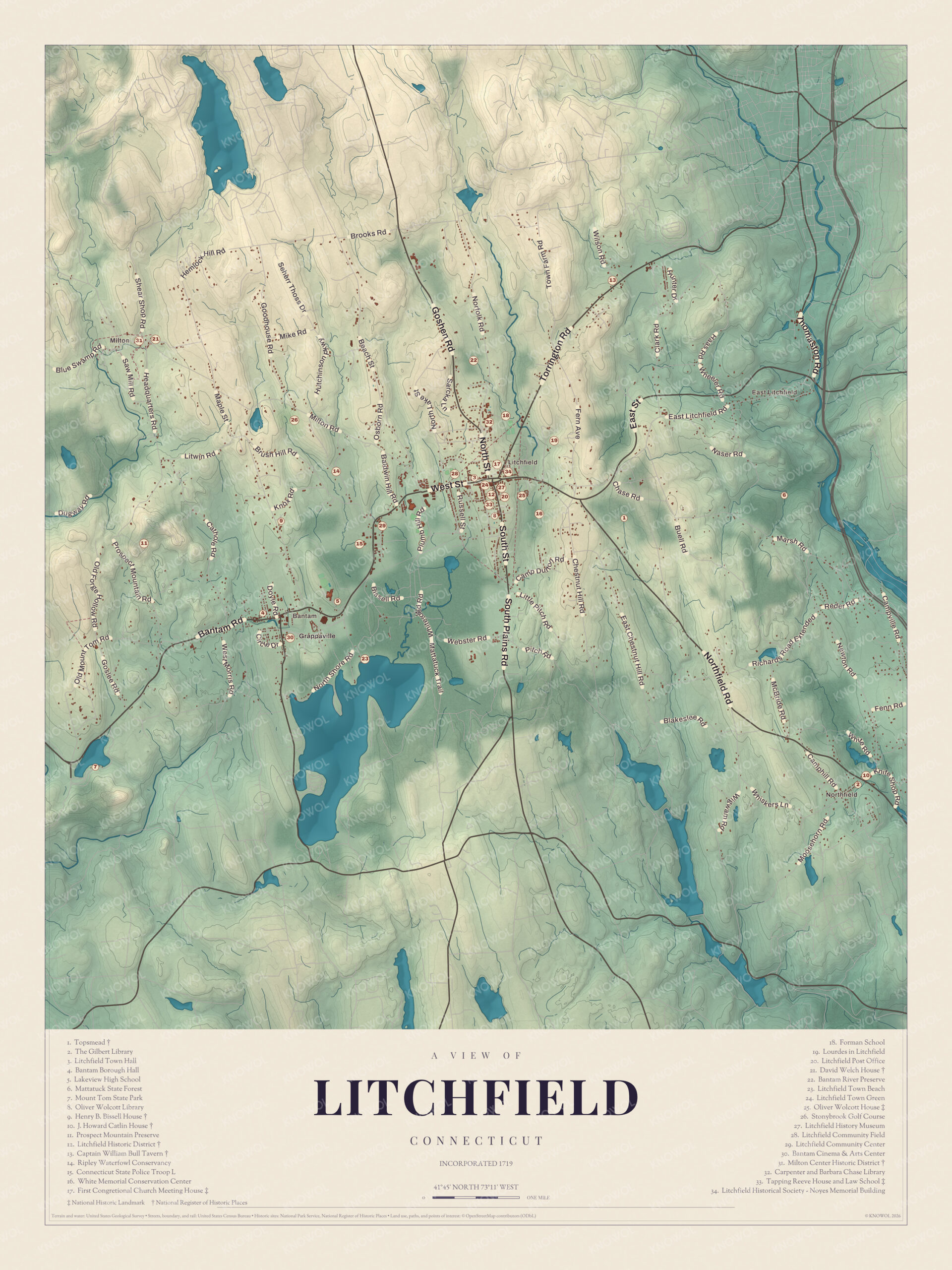
Shaded hills from Milton in the northwest across the borough to Northfield and East Litchfield, every street from West Street to East Street No 2, Bantam and Bantam Lake, and a guide of 34 numbered landmarks with the National Historic Landmarks and National Register sites marked.5
The story of Litchfield
The falls at Bantam
Bantam Lake's outlet doesn't leave quietly. As it nears Bantam village it tumbles nearly a hundred feet in three quarters of a mile, and the 1920 town history counts six dams along that stretch at one time, each turning a different industry. Nobody agrees where the name Bantam came from. An 1859 letter pointed out that Bantam in Java had a king who wrote to Queen Elizabeth in 1602, while the 1920 history decided we'll never know. Horace Bushnell, the great Hartford preacher, was born near the lake in 1802. In the 1900s the Bantam Ball Bearing Company was the big employer, and W. S. Rogers got the village made a borough in 1915, then bought the Borough Hall and gave it to the borough.3678
Prisoners and a dram for Washington
During the Revolution Litchfield sat at the crossing of many post roads, and the Continental Army kept two depots of stores and a workshop here. It was also a safe place to keep important Loyalists. William Franklin, Benjamin Franklin's son and the royal governor of New Jersey, was held in 1776 in the house Elisha Sheldon had built the year before. David Matthews, the Loyalist mayor of New York, was held here too, and he brought the first pleasure carriage to town. George Washington stayed at Oliver Wolcott's house in 1780. One story says that as he rode through town a local man ran out with a square bottle of rum and asked him to take a dram, and the general put it to his lips.9110111213
Geese, fire hooks and wet umbrellas
By 1818 the houses around the green stood as close together as in a city, the villagers told the legislature, and they asked for a charter. They got one as the Corporation of the Village of Litchfield, with power to buy fire engines, fire hooks and ladders, and to keep cattle, sheep and geese from running loose in the streets. In 1836 the village had more than 80 houses, two printing offices and a bank. Litchfield had once been the fourth largest town in the state, but industry moved to the valleys and the hill town became a summer resort. Then came the fire of 1886. With no fire department and only the neighbors' wells, people fought it under wet umbrellas. The loss was about $60,000, and another fire followed in 1888.14151617
Through the years
25 moments from 1719 to today.
- 1719The settlement first called Bantam is incorporated as Litchfield, named for Lichfield in England.1
- 1720The green is laid out as a common pasture.18
- 1724Fearing raids, some settlers flee, and the Assembly orders them back or their land is forfeit.19
- 1735John Davies arrives from England, the first Church of England man in town.20
- 1749St. Michael's first church goes up about a mile west of the center, on land leased for one peppercorn a year.21
- 1751Litchfield becomes the seat of the new Litchfield County.1
- 1753Oliver Wolcott builds his house on South Street.12
- 1756John Marsh Jr. builds a house in Milton for his daughter Irene and David Welch.22
- 1760The second meetinghouse, where Lyman Beecher will preach, is begun on the green.23
- 1776The lead statue of King George III is melted into bullets in Oliver Wolcott's house.1
- 1776William Franklin, royal governor of New Jersey, is held in Elisha Sheldon's house.10
- 1780George Washington stays at the Wolcott house.12
- 1784Tapping Reeve builds a one-room law school beside his house.2
- 1792Sarah Pierce opens the Litchfield Female Academy.1
- 1794The General Assembly makes Northfield a parish; Milton follows in 1795.24
- 1802Horace Bushnell is born near Bantam Lake.7
- 1818The village is chartered as the Corporation of the Village of Litchfield.14
- 1829The Greek Revival meetinghouse on the green is finished.5
- 1834Boys find a carved granite bust in the bank of the Bantam River.25
- 1850Henry B. Bissell builds his house of granite from the family quarry.26
- 1858J. Howard and Franklin Catlin buy the Northfield factory for their knife company.27
- 1862The Nineteenth Connecticut camps on South Chestnut Hill at Camp Dutton.28
- 1886Fire sweeps the wooden buildings on South and West Streets.17
- 1915Bantam is incorporated as a borough.8
- 1923Frederick Fuessenich moves the Captain William Bull Tavern about two miles to save it.29
Places to see
The numbers match the landmark guide printed on the 2026 map.
- 1TopsmeadEast Litchfield. Edith Morton Chase's hilltop estate.Visit their website
- 7Mount Tom State ParkFar southwest. Stone lookout tower finished in 1921.Visit their website
- 9Henry B. Bissell HouseMaple Street. Granite Greek Revival house of 1850.
- 12Litchfield Historic DistrictThe borough. National Historic Landmark district since 1968.
- 16White Memorial Conservation CenterNear Bantam Lake. Nature museum in the old White home.Visit their website
- 17First Congregational Church Meeting HouseOn the green. Greek Revival meetinghouse finished in 1829.Visit their website
- 21David Welch HouseMilton. Built in 1756 for Irene and David Welch.
- 24Litchfield Town GreenBorough center. Laid out in 1720 as common pasture.
- 25Oliver Wolcott HouseSouth Street. Built in 1753 by a Declaration signer.
- 33Tapping Reeve House and Law SchoolSouth Street. America's first independent law school.Visit their website
On the National Register
All 11 places in Litchfield on the National Register of Historic Places that still stand today, oldest first, and why each one matters.4
-
Litchfield Historic District
National Historic Landmark
A National Historic Landmark district, named as a well-preserved example of a late 18th century New England village. It takes in the green, laid out in 1720, the 1829 meetinghouse, the Tapping Reeve law school on South Street and Sheldon Tavern on North Street.18
-
Milton Center Historic District
The old center of Milton, first called West Farms and settled around 1740, where mills ran on the branches of the Shepaug River. It runs from the cemetery to a little triangular green with Trinity Church, and includes the 1791 Congregational church, the Milton Academy and a district school.30
-
Oliver Wolcott House
National Historic Landmark
Built by Oliver Wolcott, a signer of the Declaration of Independence and later governor, it is the oldest house in the borough. George Washington stayed here in 1780 and Lafayette visited. It is a National Historic Landmark and a private home.12
-
David Welch House
John Marsh Jr. built it for his daughter Irene and her husband David Welch, who ran iron foundries and a store from the added wing. Local lore says Irene named the village Milton for its mills. It stayed in the Welch family until 1860.22
-
Tapping Reeve House and Law School
National Historic Landmark
Tapping Reeve built his house in 1773 and the one-room school beside it in 1784. The first independent law school in America taught more than 1,100 students, among them Aaron Burr and John C. Calhoun, before it closed in 1833. The historical society runs it as a museum.2
-
Capt. William Bull Tavern
A gambrel-roofed Colonial house owned in the 1790s by Captain William Bull. When it stood boarded up and about to be taken apart, Frederick Fuessenich bought it and in 1923 moved it about two miles to his farm, across from an old turnpike tollhouse. It is now part of the Tollgate Hill Inn.29
-
Trinity Church
Oliver Dickinson began this Milton church in 1802, modeled on the second Trinity Church in Manhattan, and finished it in 1826. Its mix of Gothic and Classical styles is rare in rural Connecticut, and its organ, built in 1823, may be the oldest in New England.31
-
Henry B. Bissell House
One of the town's finest stone Greek Revival houses, built of granite from the Bissell family's own quarry, with lighter stones picked out for the corners and window trim. It stayed in the family until 1985.26
-
Northfield Knife Company Site
The ruins of the Northfield Knife Company, one of the nation's leading knife makers, which J. Howard and Franklin Catlin started at an 1854 mill dam in 1858. The site is now in Humaston Brook State Park, beside Knife Shop Pond.27
-
Rye House
A Tudor Revival country estate in Bantam designed by Wilson Eyre for Isabella Douglass Curtis, who named it for her earlier home in Rye, New York. Eyre showed it off as a model country house.32
-
Topsmead
Edith Morton Chase, daughter of the founder of the Chase Brass and Copper Company, built this half-timbered Tudor Revival summer house on a hilltop her father bought in 1916. She left it and more than 500 acres to the state in 1972, and it is now Topsmead State Forest.33
In their words
“The remains of this first pastor of our first church lie in Milton, a parish of the famous town of Litchfield; famous not so much for its rocks and its pure air, as for its [men].”
History of Seymour, Connecticut, 187934
“Almost below you is the lovely village of Litchfield, a jewel, clean and white, in the setting of leafy green.”
The Connecticut quarterly, 1896, on the view from Prospect Hill35
“She was very lonely, having no society except that of Presbyterians and wolves.”
The wife of John Davies, who came from England in 1735, writing home, as told in Sketches of church life in colonial Connecticut, 190220
Nearby towns
Sources
- Litchfield, Connecticut, Wikipedia
- Litchfield Law School, Wikipedia
- The history of the town of Litchfield, Connecticut, 1720-1920 (1920), on the Bantam falls, Internet Archive
- National Register of Historic Places listings in Litchfield County, Connecticut, Wikipedia
- Map of Litchfield, Connecticut in 2026, KNOWOL (USGS elevation, Census Bureau roads)
- Sketches and chronicles of the town of Litchfield, Connecticut (1859), on the name Bantam, Internet Archive
- Connecticut as a colony and as a state (1904), Internet Archive
- The history of the town of Litchfield, Connecticut, 1720-1920 (1920), on the borough of Bantam, Internet Archive
- Old paths and legends of the New England border (1907), on Litchfield in the Revolution, Internet Archive
- Chapter sketches, Connecticut Daughters of the American Revolution (1901), Internet Archive
- Old paths and legends of the New England border (1907), on the Loyalist prisoners, Internet Archive
- Oliver Wolcott House, Wikipedia
- Year-book of the Connecticut Society of the Sons of the American Revolution (1896), Internet Archive
- Sketches and chronicles of the town of Litchfield, Connecticut (1859), on the village charter of 1818, Internet Archive
- Connecticut Historical Collections, John Warner Barber (1836), Internet Archive
- The Litchfield book of days (1899), Internet Archive
- The history of the town of Litchfield, Connecticut, 1720-1920 (1920), on the fires of 1886 and 1888, Internet Archive
- Litchfield Historic District, Wikipedia
- The history of the old town of Derby, Connecticut, 1642-1880 (1880), Internet Archive
- Sketches of church life in colonial Connecticut (1902), Internet Archive
- Historical address on St. Michael's parish, Litchfield, Connecticut (1919), Internet Archive
- David Welch House, Wikipedia
- The Connecticut quarterly (1895), on the green and its meetinghouses, Internet Archive
- History of the town of Litchfield, Connecticut (1845), Internet Archive
- Sketches and chronicles of the town of Litchfield, Connecticut (1859), on the carved stone bust, Internet Archive
- Henry B. Bissell House, Wikipedia
- Humaston Brook State Park (Northfield Knife Company Site), Wikipedia
- Military and civil history of Connecticut during the war of 1861-65 (1868), Internet Archive
- Captain William Bull Tavern, Wikipedia
- Milton Center Historic District, Wikipedia
- Trinity Church (Milton, Connecticut), Wikipedia
- Rye House (Litchfield, Connecticut), Wikipedia
- Topsmead State Forest, Wikipedia
- History of Seymour, Connecticut, with biographies and genealogies (1879), Internet Archive
- The Connecticut quarterly (1896), on the views from Chestnut Hill and Prospect Hill, Internet Archive