
A harbor city at the mouth of the Norwalk River, settled in 1649 and burned by the British in 1779, that grew on oysters, hats and steamboats and still keeps its green, its lighthouses and the old landing called Old Well.
Norwalk, Connecticut on the map
Click the map to look closer.
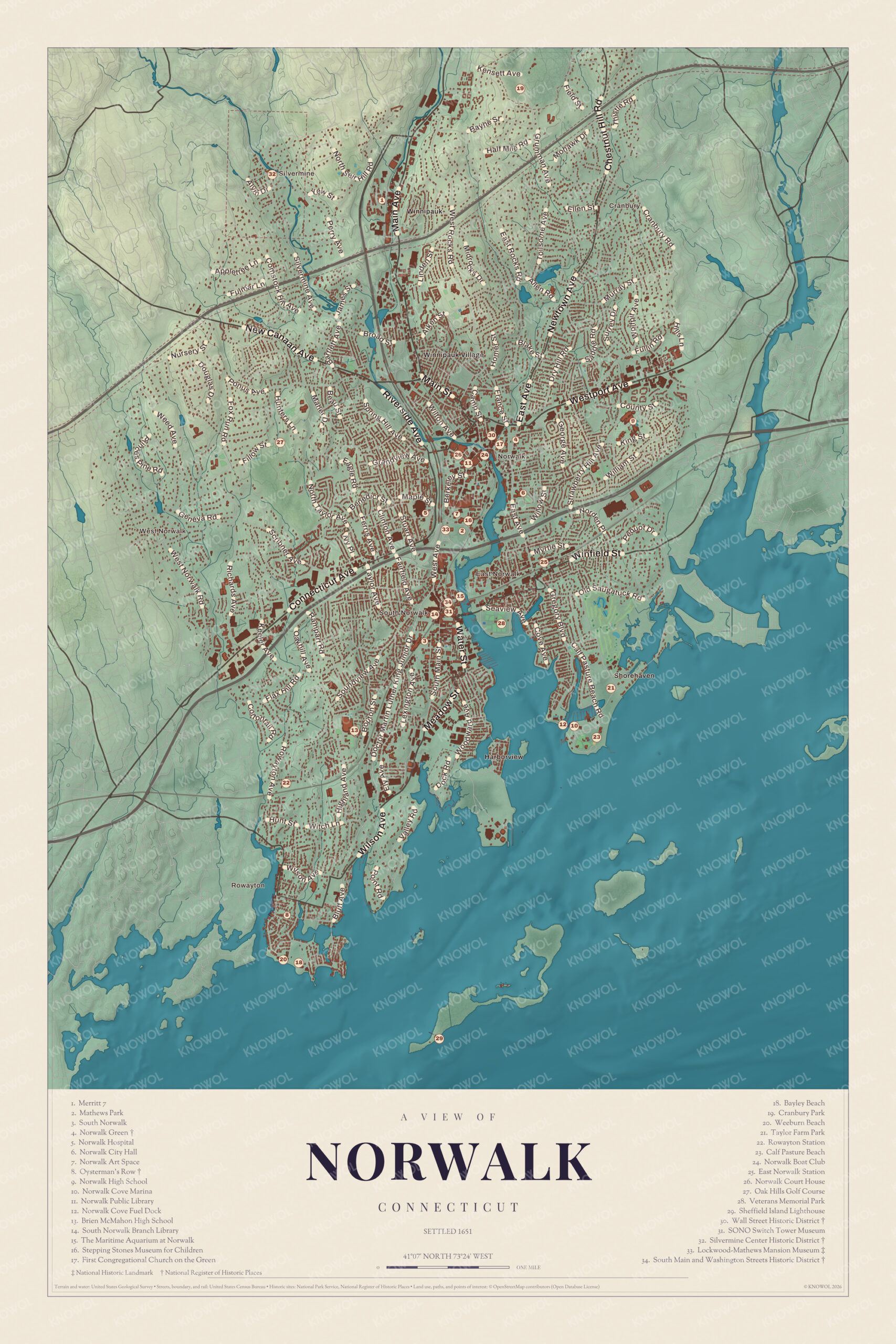
Norwalk today
By KNOWOL
Shaded land from the high ground at Silvermine down to Norwalk Harbor and the islands of the Sound, every street, South Norwalk, Rowayton and East Norwalk, and a guide of 34 numbered landmarks with the National Historic Landmark and the National Register sites marked.2
The history of Norwalk, Connecticut
The day Tryon came
On the night of July 10, 1779, General Tryon's fleet anchored off Norwalk. His troops slept at Cow Pasture, while a regiment of Tories crossed in flat boats to Old Well. Norwalk's men and a few regulars fought them at Flax Hill, Pudding Lane and France Street, with six cannon that Thaddeus Betts had hauled from Salisbury. Then the town burned: 135 dwellings, 89 barns, 25 shops, 5 vessels and 4 mills. A story went around that Tryon watched from a rocking chair. One housekeeper walked straight up to him on Grumman's Hill and saved the Belden house. In 1904 the Daughters of the American Revolution put a tablet on the hill on East Avenue where he watched.567389
Oysters, hats and the Old Well
Norwalk guarded its oysters early. In 1721 the town voted that nobody but its own people could rake them in the harbors and coves. By 1825 there were eleven hat factories in Norwalk, and in 1836 the village of Old Well alone had six or seven hat factories, three potteries and a daily steamboat to New York. One company even turned hatters' felt into carpet, 200 yards a day, without spinning or weaving. When the owners later tried to break the hatters' union, they found every hatter in South Norwalk was secretly a Knight of Labor. Around 1900 Andrew Radel ran thirty oyster boats out of South Norwalk and was called the largest oyster bed owner in the country.101112131415
The ferry, the steamboats and the open draw
Norwalk has always looked to the water for its way to New York. In 1764 Simeon Raymond got leave to run a ferry from the Old Well across the Sound to Huntington, sixteen miles, for one shilling and sixpence. In 1824 the steamboat John Marshall began running to New York for a dollar, and three years later Cornelius Vanderbilt's Nimrod knocked the fare down to a shilling. The railroad brought sorrow too. On May 6, 1853, an express ran through the open draw into the Norwalk River, and many of the dead were doctors heading home from a convention. Old Well kept growing anyway, and in 1870 it became the city of South Norwalk.16171819
Norwalk, Connecticut through the years
25 moments from 1640 to today.
- 1640Roger Ludlow buys the land east of the Norwalk River from Chief Mahackemo.1
- 1649Richard Olmsted and Nathaniel Ely come from Hartford as the first settlers.2
- 1651Norwalk is incorporated as a town.1
- 1652The First Congregational Church is organized.20
- 1669Henry Whitney agrees to keep the town's grist mill at the falls, taking a sixteenth of the grain as his toll.21
- 1721The town votes that only its own people may rake oysters in Norwalk's harbors and coves.10
- 1764Simeon Raymond is licensed to run a ferry from the Old Well across the Sound to Huntington.16
- 1767Clockmaking, watchmaking, nail cutting, paper and pottery get started here over the next few years.22
- 1779Tryon's troops burn Norwalk on July 11, destroying 135 dwellings and 89 barns.3
- 1824The John Marshall becomes the first steamboat between Norwalk and New York.17
- 1825Norwalk has eleven hat factories.11
- 1828The lighthouse on Sheffield Island is finished, with Gershom Smith as keeper.23
- 1834The Patent Carpet Company starts making carpet from hatters' felt, with no spinning or weaving.13
- 1836The borough of Norwalk is created.1
- 1853An express train plunges through the open draw into the Norwalk River on May 6.18
- 1864LeGrand Lockwood begins building his mansion at Elm Park.24
- 1870Old Well becomes the city of South Norwalk, with Dudley P. Ely as its first mayor.19
- 1896The New Haven Railroad builds the swing bridge over the Norwalk River.25
- 1903The Andrew Radel Oyster Company is organized, with headquarters in South Norwalk.15
- 1904The Daughters of the American Revolution mark the hill where Tryon watched the town burn.8
- 1910The cities of Norwalk and South Norwalk are combined.1
- 1922Silvermine artists found the Silvermine Guild.2
- 1929Work starts on Edward Gallaher's limestone house, now the heart of Cranbury Park.26
- 1952Norwalk's Little League team wins the Little League World Series.1
- 1988The Maritime Center, now the Maritime Aquarium, opens in an old iron works.2
Places to see in Norwalk, Connecticut
The numbers match the landmark guide printed on the 2026 map.
- 4Norwalk GreenCentral Norwalk. A common until 1851.
- 8Oysterman's RowRowayton. Houses built by oystermen.
- 15Maritime Aquarium at NorwalkSoNo. In an 1860s iron works.Visit their website
- 19Cranbury ParkNorth Norwalk. Norwalk's largest park, the Gallaher estate.
- 23Calf Pasture BeachEast Norwalk. Colonial grazing land, city park since 1924.
- 29Sheffield Island LighthouseNorwalk Islands. Stone light of 1868, relit 2011.Visit their website
- 31SONO Switch Tower MuseumSoNo. Railroad switch tower of 1896.
- 32Silvermine Center Historic DistrictSilvermine. Mill village turned art colony.
- 33Lockwood-Mathews Mansion MuseumWest Avenue. LeGrand Lockwood's 62-room house of 1868.Visit their website
- 34South Main and Washington Streets Historic DistrictSoNo. Old Well's brick commercial blocks.
Norwalk on the National Register of Historic Places
20 of the 26 places in Norwalk on the National Register of Historic Places that still stand today, oldest first, and why each one matters. See the full list of National Register places in Norwalk.4
-
Enos Kellogg House
A well-preserved late 18th-century saltbox with a big central chimney, built soon after Enos Kellogg bought the land in 1784. His descendants kept it until 1917.27
-
Five Mile River Landing Historic District
The old shipping center of Rowayton on the Five Mile River, with 19th-century houses, the site of a shipyard in Pinkney Park and the Rowayton Hotel, opened about 1848 for summer visitors from New York.28
-
Silvermine Center Historic District
The heart of Silvermine, where the river once turned 12 or 13 mills and where an art colony grew in the early 1900s. The Silvermine Guild Arts Center and the Silvermine Tavern are nearby.29
-
Oysterman's Row
Houses built by Rowayton's oyster families in the late 1800s, when the village had 35 oyster firms running 28 vessels and the waterfront across the street was given over to the oyster trade.30
-
Wall Street Historic District
The commercial and civic center of Central Norwalk, with 42 buildings, most on the south side of Wall Street, among them a Gothic Revival church of 1860.31
-
Lockwood-Mathews Mansion
National Historic Landmark
LeGrand Lockwood's 62-room Second Empire country house, designed by Detlef Lienau and called one of the earliest and finest of its kind in the country. Saved from demolition in the 1960s, it's now a museum.24
-
Norwalk Island Lighthouse (Sheffield Island Light)
The stone keeper's house with a 44-foot light tower in its gable replaced the first light of 1828. It went dark in 1902 and was bought by the Norwalk Seaport Association in 1986.23
-
Whistleville Historic District
A neighborhood of workers' houses, shops and churches that grew from 1874 as Hungarian and Italian immigrants came to South Norwalk to work in the mills. It counts 276 contributing properties.32
-
South Main and Washington Streets Historic District
The close-packed commercial heart of old South Norwalk, with Romanesque Revival, Second Empire and Italianate blocks around the 1895 railroad bridge. Residents got it listed in 1977 when the buildings faced replacement.33
-
Norwalk Green Historic District
The green, a common until 1851, with St. Paul's Episcopal Church and the First Congregational Church facing it, 54 historic buildings, Mill Hill Historic Park and the World War I memorial.34
-
Norwalk River Railroad Bridge
A swing bridge of 1896 with a 202-foot turning span, built at the spot where a train fell through the open draw in 1853. It's one of just two swing bridges of its kind on the Northeast Corridor.25
-
Perry Avenue Bridge
A one-lane stone arch bridge so often painted and photographed by Silvermine's artists that it has come to stand for the whole neighborhood. The flood of 1955 ran right over it.35
-
Greens Ledge Lighthouse
A cast-iron sparkplug light built to guard the approach to Norwalk Harbor, still a working aid to navigation. In 1933 rock dug out for Radio City Music Hall was piled around its base.36
-
Beth Israel Synagogue
Built for an Orthodox congregation organized in 1865, it's the only known synagogue in Connecticut with Moorish onion domes and the only wood-frame synagogue known in the state. A Baptist church has worshipped here since 1972.37
-
Peck Ledge Lighthouse
A 54-foot cast-iron sparkplug light about two miles off Calf Pasture Beach, with three stories of living space for its keepers. It was automated in 1933 and still flashes green.38
-
Rock Ledge
James A. Farrell, later president of U.S. Steel, built a Tudor Revival house here and rebuilt it in granite after it burned. Its stables became the Rowayton Community Center and library.39
-
Norwalk City Hall (former)
A city hall of 1912 in South Norwalk that later housed the Norwalk Historical Society Museum after City Hall moved to 125 East Avenue.40
-
Gallaher Estate
The 227-acre country estate of automobile pioneer Edward Beach Gallaher, with a Tudor Revival house of Indiana limestone. It's now Cranbury Park, Norwalk's largest park.26
-
US Post Office-South Norwalk Main
A limestone-faced post office in the stripped classical style of the 1930s, with lobby murals by Kindred McLeary painted for the Treasury's art program.41
-
Village Creek
A shoreline neighborhood founded in 1949 that set out to welcome families of different races at a time when deed covenants often kept them apart.42
Norwalk in their words
“We call it the battle of Norwalk, for such it really was.”
History of Fairfield County, 1881, on the British raid of 17796
“Norwalk contains two considerable and flourishing villages, Norwalk borough, and the village of Old Well.”
John Warner Barber, Connecticut Historical Collections, 183612
“Who knows but I may yet have a place in this town where I may lay my head?”
Jesse Lee, the Methodist preacher turned away in Norwalk, as quoted in History of Fairfield County, 188143
Towns near Norwalk, Connecticut
Sources for the history of Norwalk
- Norwalk, Connecticut, Wikipedia
- Map of Norwalk, Connecticut in 2026, KNOWOL (USGS elevation, Census Bureau roads)
- Connecticut as a colony and as a state; or, One of the original thirteen (1904), Internet Archive
- National Register of Historic Places listings in Fairfield County, Connecticut, Wikipedia
- History of Fairfield County, Connecticut (1881), on the British landing at Cow Pasture and Old Well, Internet Archive
- History of Fairfield County, Connecticut (1881), on the battle of Norwalk, Internet Archive
- History of Fairfield County, Connecticut (1881), on the defense of the town, Internet Archive
- The refugees of 1776 from Long Island to Connecticut (1913), Internet Archive
- Chapter sketches, Connecticut Daughters of the American Revolution; patron saints (1901), Internet Archive
- History of Fairfield County, Connecticut (1881), on the oyster vote of 1721, Internet Archive
- History of Connecticut in monographic form (1925), on hat making, Internet Archive
- Connecticut Historical Collections, John Warner Barber (1836), Internet Archive
- Connecticut historical collections, John Warner Barber (1837), on the Patent Carpet Company, Internet Archive
- Annual report of the Bureau of Labor Statistics of the State of Connecticut, on the hatters' unions, Internet Archive
- Encyclopedia of Connecticut biography (1917), on Andrew Radel, Internet Archive
- The public records of the colony of Connecticut (1850), on the Old Well ferry of 1764, Internet Archive
- History of Fairfield County, Connecticut (1881), on Norwalk steamboats, Internet Archive
- History of New Haven County, Connecticut (1892), on the Norwalk disaster, Internet Archive
- Illustrated popular biography of Connecticut (1891), on Dudley P. Ely, Internet Archive
- History of Fairfield County, Connecticut (1881), on the First Congregational Church, Internet Archive
- The Whitney family of Connecticut, and its affiliations (1878), Internet Archive
- The development of religious liberty in Connecticut (1905), Internet Archive
- Sheffield Island Light, Wikipedia
- Lockwood-Mathews Mansion, Wikipedia
- Norwalk River Railroad Bridge, Wikipedia
- Cranbury Park (Norwalk, Connecticut), Wikipedia
- Enos Kellogg House, Wikipedia
- Five Mile River Landing Historic District, Wikipedia
- Silvermine, Connecticut, Wikipedia
- Oysterman's Row, National Register nomination, National Park Service
- Wall Street Historic District (Norwalk, Connecticut), Wikipedia
- Greater than the sum of their parts: understanding historic districts, Preservation Connecticut (Whistleville)
- South Main and Washington Streets Historic District, Wikipedia
- Norwalk Green Historic District, Wikipedia
- Perry Avenue Bridge, Wikipedia
- Greens Ledge Light, Wikipedia
- Beth Israel Synagogue (Norwalk, Connecticut), Wikipedia
- Peck Ledge Light, Wikipedia
- Rock Ledge (Norwalk, Connecticut), Wikipedia
- Former Norwalk City Hall, Wikipedia
- United States Post Office-South Norwalk Main, Wikipedia
- Village Creek (Norwalk, Connecticut), Wikipedia
- History of Fairfield County, Connecticut (1881), on Jesse Lee and Norwalk Methodism, Internet Archive